Parts of a Volcano: A Labeled Diagram and What Each Part Does

Students lose marks on this topic in a predictable way: they can name the cone and the crater, and then the diagram asks for the parts they cannot see — the chamber, the conduit, the dike, the sill — and the answer stops. A volcano is a system, not a silhouette. Half of its working parts are underground, hidden inside the mountain, and those are usually the parts that explain everything the visible half does.
This guide walks through the whole system in the order a labeled diagram does: from the bottom up. Underground parts first, then surface parts, then what actually comes out during an eruption. Every part gets the same treatment — what it is, and what it does — because a label without a job description is just vocabulary, and vocabulary without understanding is what gets forgotten by the next exam.
The Parts at a Glance
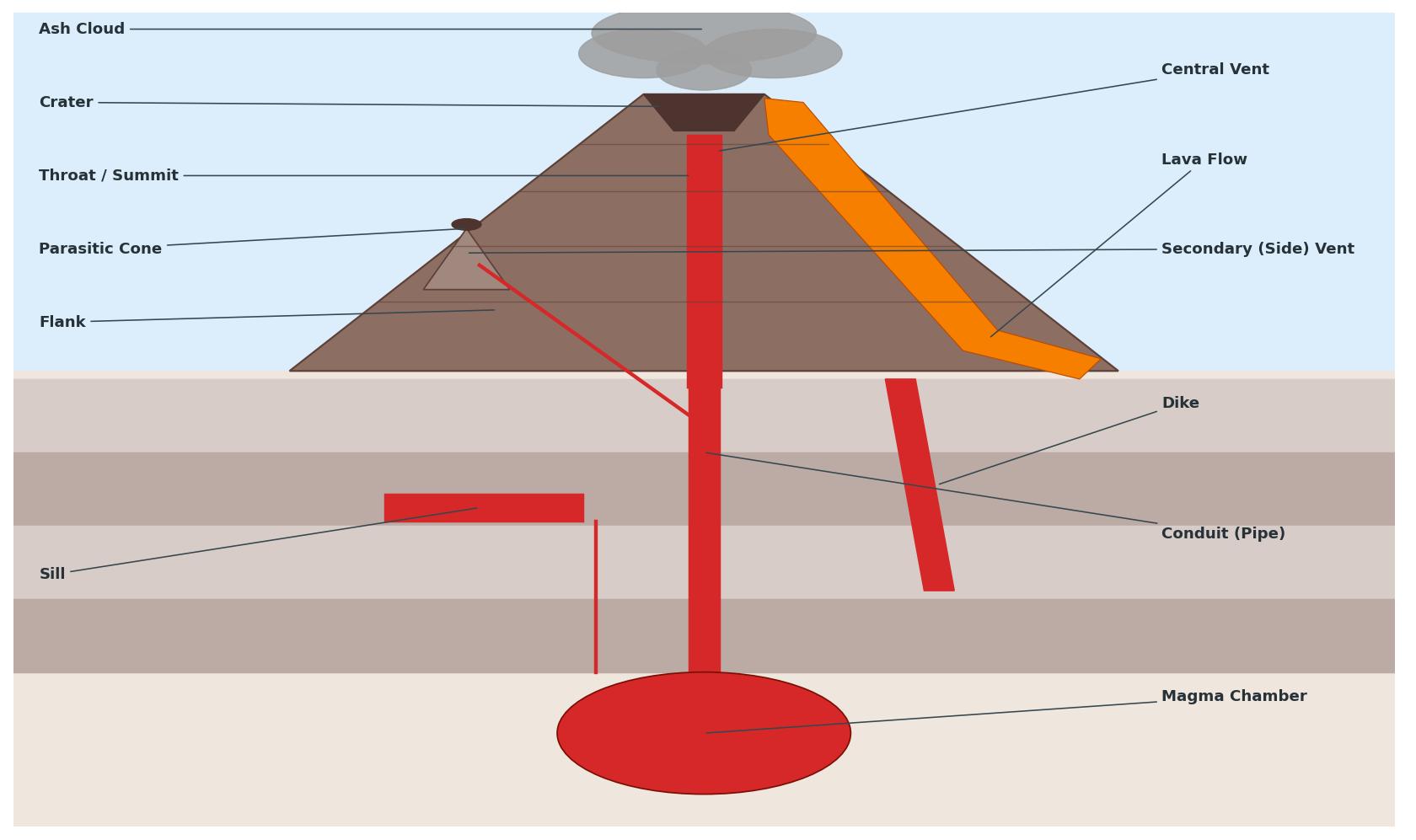
Read the diagram as a journey. Molten rock collects in the magma chamber, deep underground. It travels up the conduit, escapes through a vent, and spreads or piles up at the surface — as lava flows down the flank, as fragments around the crater, sometimes as a small parasitic cone on the volcano’s side. The underground parts move and store the magma; the surface parts are where it comes out and where the mountain gets built. Keep that one sentence in mind and every label below has a place to hang.
Underground Parts
Magma Chamber
The magma chamber sits deep in the Earth and is the large repository of molten rock beneath the volcano — the storage tank of the whole system. Everything a volcano erupts was held here first. The formation story — where magma comes from in the first place — is a separate article; the chamber is where that magma waits, gathered in one body large enough to feed eruptions at the surface above it. It is described in the textbooks simply as a large repository — the mountain you see at the surface is fed by a body of molten rock beneath it that you cannot see at all.
Conduit (Pipe)
The conduit is the narrow pipe through which magma moves upward from the chamber toward the surface — the main channel of the plumbing network inside the volcano. When a volcano erupts, this is the route the magma takes: out of the chamber, up the conduit, and through the vent. In a composite volcano, the essential feature is exactly this conduit system, connecting a reservoir deep in the Earth’s crust to the surface. Think of the chamber as storage and the conduit as the delivery route; an eruption is what happens when the delivery reaches the top.
Dike (Dyke)
A dike forms when magma intrudes into a weakness — a crack or fissure — in the surrounding rock and solidifies there. Because it cuts across the rock it passes through, a dike is usually vertical or angled relative to the existing layers: geologists call such cross-cutting features discordant intrusions. Inside a living volcano, dikes do quiet structural work — lava that solidifies within fissures on the flanks forms dikes that act like ribs, greatly strengthening the cone. Long after a volcano erodes away, its dikes may remain standing as walls of hard rock, marking where magma once forced its way through.
Sill
A sill is the dike’s horizontal counterpart. Where a dike cuts across layers, a sill runs parallel to them: it is a concordant intrusion, formed when magma exploits a weakness between layers of rock, shoulders them apart, and squeezes in between. In the anatomy of a volcano, sills appear as sheets of magma that spread sideways between the volcano’s own layers instead of continuing upward — fed, in the standard diagram, by a small feeder tube branching off the main system. Dike or sill, the deciding question is always the same: did the magma cut across the layering, or slip along it?
Surface Parts
Central Vent
The vents are the openings at the Earth’s surface through which magma and gases escape, and the central vent is the main opening, at the top of the volcano. This is the primary exit of the conduit system — the opening most eruptions use, sitting at the summit, usually inside the crater. When students point at a volcano and say “it erupts from there,” the central vent is what they mean.
Secondary / Side Vent
A volcano can also have many smaller side vents, openings on its flanks rather than at its summit. Side vents matter because they change where an eruption happens: magma escaping through a side vent produces a flank eruption, building the mountain outward instead of upward, and sending lava down a slope that the summit crater never touches. One plumbing system, several possible exits — which is why a volcano can be quiet at the top and active on its side at the same time.
Crater
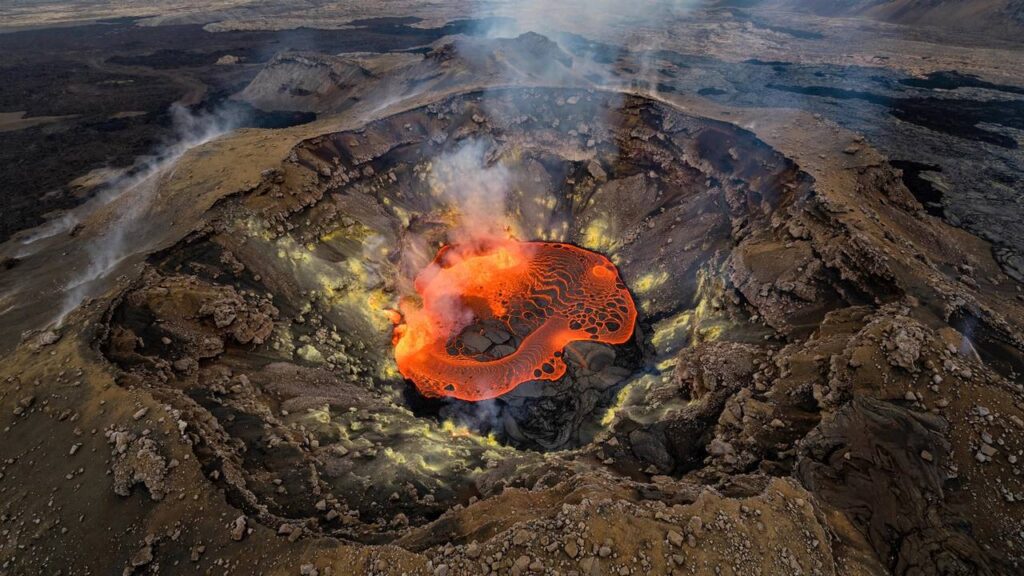
A crater is the bowl-shaped depression surrounding the vent at the top of a volcano. It is built up over time as the volcano deposits erupted material around the vent — the rim is quite literally a ring of the volcano’s own debris, and SLCC’s feature list names that rim separately for good reason: the crater (the bowl) and its rim (the edge) are the two halves of the summit opening students are asked to label. Craters are relatively small features, with diameters on the scale of tens to hundreds of meters.
Flank
The flank is the side — the slope — of the volcano, between the summit and the base. It sounds too plain to be a technical term, but the flank is where much of the action is: lava flows travel down it, side vents open on it, layers of lava and tephra accumulate across it, and parasitic cones sit on it. When a hazard report says an eruption is on a volcano’s flank, it means the slope, not the summit — a distinction that decides which valleys the lava can reach.
Parasitic (Secondary) Cone
A parasitic cone is a small volcano located on the flank of a larger volcano — a mini-edifice with its own vent, fed by the main volcano’s system, growing on its parent mountain’s side. Shastina, on Mount Shasta, is the textbook example. The definition has one sharp edge worth learning: Kilauea sits on the flank of Mauna Loa but is not considered a parasitic cone, because it has its own separate magma chamber. A parasitic cone shares its parent’s plumbing; a neighbor with its own chamber is simply another volcano.
Lava Flow
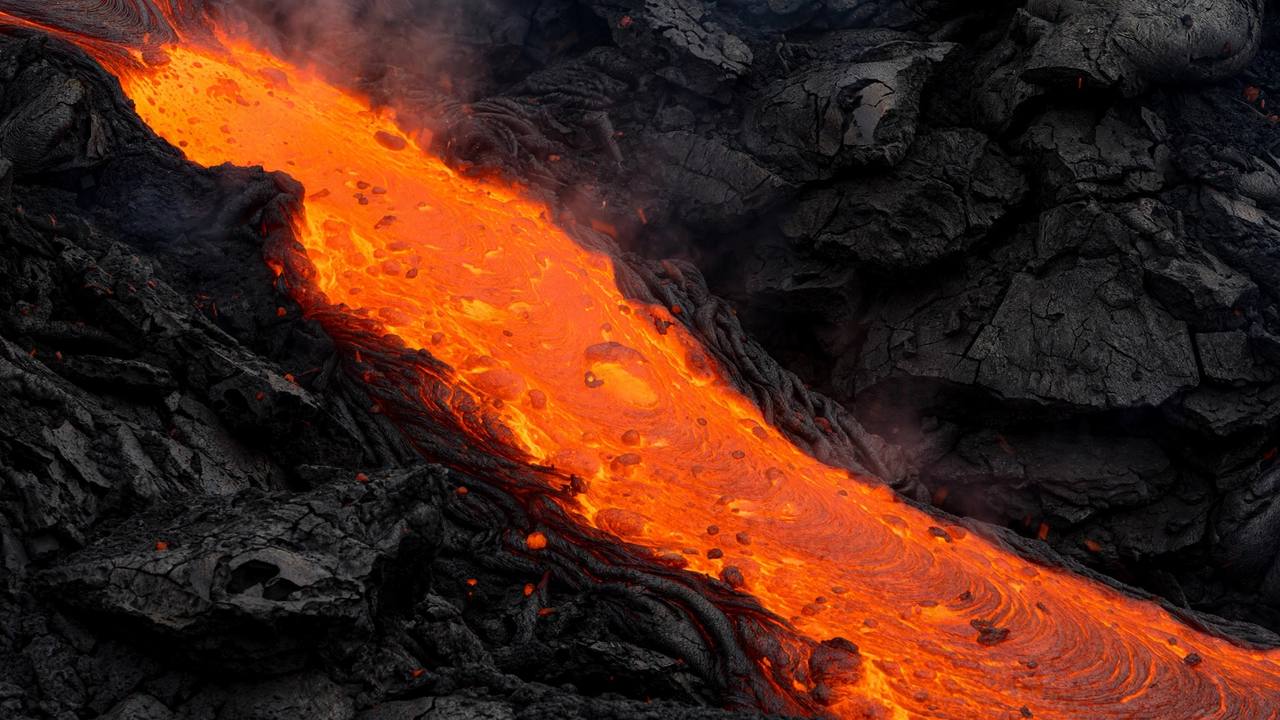
A lava flow is erupted magma — lava — moving across the surface, and after it solidifies, the layer it leaves behind. In the standard anatomy diagram, lava flows appear twice for a reason: as streams erupting from the vent and flowing down the sides of the volcano, and as accumulated layers within the cone, interleaved with layers of tephra from previous eruptions. With continued eruptions, this is how volcanic material accumulates around the vent to form the volcanic mountain itself — flow upon flow, layer upon layer.
Throat / Summit
The summit is the top of the volcano, where the crater sits. The throat is the uppermost stretch of the passage below it — the top end of the conduit system, narrowing toward the central vent. Textbooks give this short section its own label because it is the bottleneck of the whole system: everything the chamber sends up must pass through it. Keep the pair straight: the summit is the place, the throat is the passage just beneath it, and the vent is the opening where the passage ends.
What Comes Out: Ash, Ash Cloud and Pyroclastic Material
An eruption does not only move lava. The accumulated material around a vent consists of layers of solidified lava flows, fragments of volcanic debris ejected explosively — the general term for that ejected material is pyroclastic material — or a combination of both. The textbooks name the fragments, called tephra, by size:
| What comes out | What it is | Size |
|---|---|---|
| Ash | The finest tephra — tiny solid fragments ejected in an eruption | Less than 2 mm |
| Lapilli | Middle-sized tephra fragments | 2–64 mm |
| Bombs / blocks | The largest tephra fragments | More than 64 mm |
| Ash cloud | Clouds of ash blown into the sky by the eruption, which then settle back onto the volcano and surrounding land | Carried by the eruption column and the wind |
| Pyroclastic material | The general term for volcanic debris ejected explosively from a volcano | Ash to blocks — the full range above |
One of these deserves a warning label of its own: when ejected material races downhill as a hot, fast-moving flow rather than falling from the sky, it is a pyroclastic flow — among the most dangerous things a volcano produces, and a topic with its own article in this series. Here, it is enough to place it correctly: it is part of what comes out, not a part of the volcano itself.
Crater vs Caldera: The Part Students Confuse Most
This is the mix-up I correct most often, so let us settle it with size and cause. A crater is the small bowl at the top of a volcano, surrounding the vent, built up as erupted material is deposited around the opening. Its diameter is measured in tens to hundreds of meters. A caldera is a much larger depression — kilometers in scale — formed the opposite way: not built up, but collapsed in. When an eruption drains the magma chamber, the support beneath part of the volcano is lost, and that part collapses into the emptied space, leaving a broad basin rimmed by the volcano’s remnants. Over time the basin can fill with water, and if magma forces its way up again, a new volcano can even form inside it. Short version: a crater is built by eruptions adding material; a caldera is left by an eruption taking support away.
How the Parts Work Together in One Eruption
Put the labels in motion and the system reads like a sentence. Magma collects in the chamber. It rises through the conduit. It escapes through the central vent — or a side vent, if the flank gives it an easier exit — while gases drive ash high into an ash cloud above the crater. Lava flows pour down the flank and cool into a new layer; fragments fall back as tephra around the rim; sills and dikes quietly mark where some magma never made it out at all. That sequence, part by part, is how an eruption moves through these parts from pressure to surface.
Frequently Asked Questions
Deep — that is the honest answer the sources support, and be suspicious of any single tidy number. The textbooks describe the magma chamber as sitting deep in the Earth, a large repository of molten rock, fed from a reservoir deep in the Earth’s crust. In the labeled diagram, what matters is its position and role: below the volcano, beneath the conduit, storing the magma that eruptions draw on.
The vent is the opening — the exit through which magma and gases escape. The crater is the bowl-shaped depression that surrounds that opening at the summit, built up from material the volcano deposited around it. An exit and the bowl around the exit: the vent is where things come out; the crater is the depression they come out into.
Direction, relative to the rock layers. A dike cuts across the layering — magma filled a crack and solidified at an angle to the layers around it, so dikes are typically vertical or angled, discordant intrusions. A sill runs along the layering — magma squeezed between two layers and solidified parallel to them, a concordant intrusion. Cut across: dike. Slip between: sill.