How Does Scoring Work in Squash? Points, Games and PAR 11 Explained

Squash scoring confuses almost every beginner, and honestly, it’s not their fault — the sport used an entirely different system for decades, and you’ll still hear older players talk about “hand-in, hand-out” like it’s scripture. Modern squash scoring is simple though, and once you understand it, you’ll be able to follow pro matches without a commentator holding your hand.
Here’s the full picture: how point-a-rally scoring works, what “win by two” means in practice, how games build into matches, and why the old system got retired. If you’re brand new to the sport overall, start with our basic squash rules for beginners first — this guide zooms in on scoring specifically.
In this guide:
- PAR 11: The Modern Scoring System
- Why You Have to Win by Two
- Games, Matches and Formats
- The Old System (and Why It Changed)
- How Scores Are Announced and Recorded
- Scoring Strategy: What Smart Players Do Differently
- Scoring in Practice: Common Confusions
PAR 11: The Modern Scoring System
Squash uses point-a-rally (PAR) scoring to 11. Every single rally produces a point for one player — it doesn’t matter who served. Win the rally, get the point. That’s the whole system. The receiver can score just as easily as the server, which is the key difference from the old days.
Practically, this means momentum swings fast. A 9–4 lead is nowhere near safe, because your opponent can reel off points without ever needing to “earn” the serve first. For spectators it’s great — every rally matters — and for players it means there’s no coasting, no safe moment to switch off, and no lead big enough to feel comfortable.

Why You Have to Win by Two
A game isn’t over at 11 unless you lead by two clear points. At 10–10, play continues until someone leads by two: 12–10, 13–11, and so on. Unlike some sports, there’s no cap — a game can theoretically go to 20–18, though that’s rare outside epic pro battles.
The win-by-two rule exists to make sure the game winner actually earned separation rather than nicking it on one lucky rally. At 10–all, the psychology shifts: players who’ve been aggressive often tighten up, and this is where mental toughness shows. My coaching advice is boring but true — at deuce, play your highest-percentage shots and let the other player blink first.
Games, Matches and Formats
A standard match is the best of five games — first to three games wins. So possible scorelines include 3–0, 3–1, and 3–2. Each game starts at 0–0, and the winner of the previous game serves first in the next one.
You’ll also run into variations: club leagues and social play often use best-of-three to fit 40-minute court bookings. Some tournaments use PAR to 15 for doubles. Junior events sometimes play shorter formats. Always check the format before you start — nothing’s more awkward than thinking you’ve won the match at 2–0 in a best-of-five.

The Old System (and Why It Changed)
Until the mid-2000s, squash used “English” or hand-in-hand-out scoring: only the server could score. If the receiver won the rally, they won the serve but no point — the point had to be “earned” on your own serve. Games went to 9 (win by two), and matches could drag on with long scoreless stretches.
The World Squash Federation switched to PAR 11 in 2004 (officially adopted worldwide by 2009) for one big reason: television and spectators. The old system produced matches of wildly unpredictable length with dead periods where nothing changed on the scoreboard. PAR made every rally count and matches more predictable in duration. Purists grumbled, then everyone admitted the new system was better to watch. Interestingly, tennis kept its famously quirky scoring — our breakdown of tennis scoring shows how another racquet sport handles the same problem completely differently.
How Scores Are Announced and Recorded
In a proper match, the server announces the score before every serve, server’s score first: “7–4.” If the server is losing, you’ll hear “4–7” from their mouth — same numbers, reversed order. It feels awkward calling out a losing score, but that’s the convention and it keeps everyone honest.
In club play, most people announce the score casually or just keep it in their heads, which is how 90% of scoring arguments start. My advice: call it out loud every time. It takes one second and prevents the classic “wait, is it 8–6 or 7–7?” debate that kills momentum. In tournaments, a marker or referee tracks the score officially and announces it, and players can always ask “what’s the score?” between rallies.
Score sheets record games as they finish: 11–8, 9–11, 11–6, and so on, with the match winner’s games typically listed first. When you see a pro result like “11–9, 11–7, 8–11, 11–5,” you’re reading game-by-game in order — the third game going to the loser tells you the match had a wobble in it. Learning to read those lines is half the fun of following the sport.
Scoring Strategy: What Smart Players Do Differently
Scoring isn’t just bookkeeping — it changes how good players think. Here are the patterns I’ve watched separate clever players from merely fit ones:
- Early in games, experiment. At 2–2 or 5–5, the cost of a lost rally is low. This is when smart players test a new serve, try attacking a weak backhand, or probe for patterns. Information gathered cheaply pays off at 9–9.
- Protect leads differently than you chase them. Up 8–4, the leader should play high-percentage squash and force the opponent to take risks. Down 4–8, the trailer is the one who should change the pattern — vary pace, attack earlier, disrupt rhythm. Doing the same thing while losing is just losing slowly.
- At 10–all, simplify. I said it before and I’ll say it again: deuce is not the time for your lowest-percentage shot. Hit your best length, take what’s given, and make your opponent win it. Most deuce points are lost, not won.
- Manage the match score, not just the game. Up 2–0 in games, you can afford to spend energy freely in game three — a loss costs little. Down 0–2, game three is everything; players who’ve been coasting suddenly find another gear. Watch for this when spectating: the body language change at 0–2 down is unmistakable.
- Use the 90-second intervals. Between games you get a real break. Smart players use it to reset mentally, towel off, and decide one tactical adjustment for the next game — not five. One clear thought beats a spiral.
None of this requires pro-level skill. A club player who thinks about score situations will beat an equally skilled player who just hits the ball, and I’ve watched it happen hundreds of times.
Scoring in Practice: Common Confusions
- Do I need to win by two at every score? No — only from 10–10 onward. 11–7, 11–5, 11–0 are all valid game scores.
- Who serves first in each game? The winner of the previous game. In the first game, it’s decided by racket spin (like a coin toss).
- Does the score affect which service box you use? Yes — serve from the right box when your score is even, left box when odd. The score is always called server-first: “10–8.”
- What happens at 10–all? Play continues until someone leads by two. There’s no sudden-death point and no cap.
- Can a match end 3–0? Absolutely — that’s a straight-games win, common when levels differ.

One last thing: long matches are where conditioning decides everything. If your legs die in game four, no scoring system will save you — the strength training for runners programs build the durability that five-game matches demand.
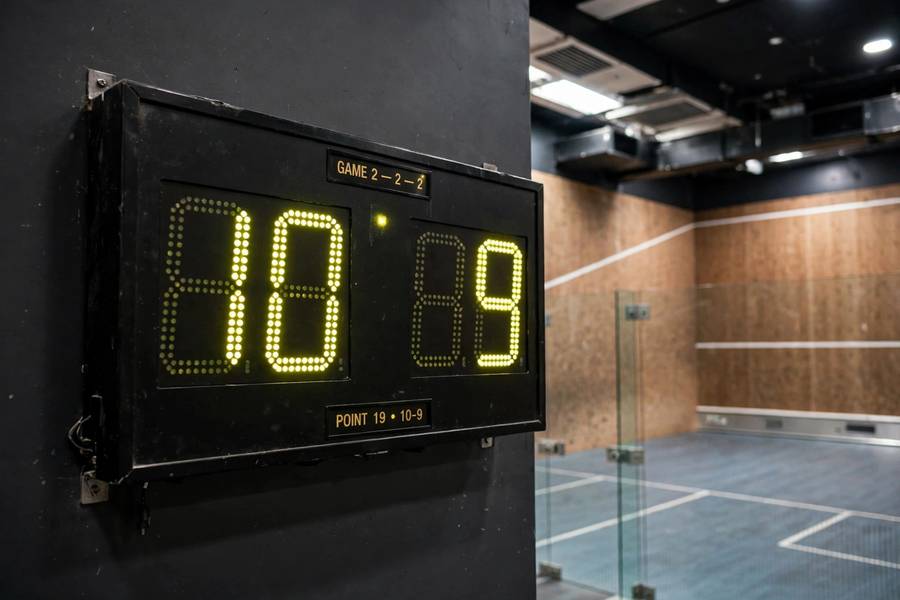
That’s scoring, fully demystified. Next time you watch the pros, you’ll know exactly why a 10–9 scoreline makes the whole crowd hold its breath — and you’ll understand the tactical chess happening behind every single point.Squash uses point-a-rally scoring (PAR) to 11: every rally awards one point to the winner, whether they served or not. Games must be won by 2 points (so 10–10 continues to 12–10 or beyond), and matches are best of five games.
PAR stands for point-a-rally. It means each rally directly produces a point for the rally winner. This replaced the old system where only the server could score, making matches faster and every rally meaningful.
Yes, once the score reaches 10–10. Below that, games simply end at 11 (e.g., 11–7). From 10–all, play continues until one player leads by two points, with no maximum score.
A standard squash match is best of five games — the first player to win 3 games takes the match. Club and social play often uses best of three to fit shorter court bookings, which also keeps weeknight leagues running on schedule.
The World Squash Federation moved from the old server-only scoring to PAR 11 in the 2000s because the old system made match lengths unpredictable and produced long stretches with no change on the scoreboard. PAR made squash more spectator-friendly.