


Here’s a statistic that sounds made up until you watch a professional squash match: elite players’ heart rates regularly sit above 170 beats per minute during rallies, and a single point can involve twenty, thirty, forty shots in a space smaller than most living rooms. Squash has been called the healthiest sport in the world by people who measure such things, and anyone who’s played a competitive game understands why within about four minutes.
But here’s the other thing about squash: the rules look simple until someone yells “let!” and play stops for a discussion that sounds like a courtroom objection. This guide covers the actual rules — scoring, serves, faults, lets, and strokes — so you can play your first game or finally follow a pro match without confusion.
- The Court and the Equipment
- The Objective: What You’re Trying to Do
- Scoring: How Games and Matches Are Won
- The Serve: Rules and Rotation
- Playing the Rally: What’s Legal
- Faults: Ways to Lose a Point
- Lets and Strokes: Squash’s Most Confusing Rules
- Conduct and the Code of the Court
- Quick-Start: Your First Game
The Court and the Equipment
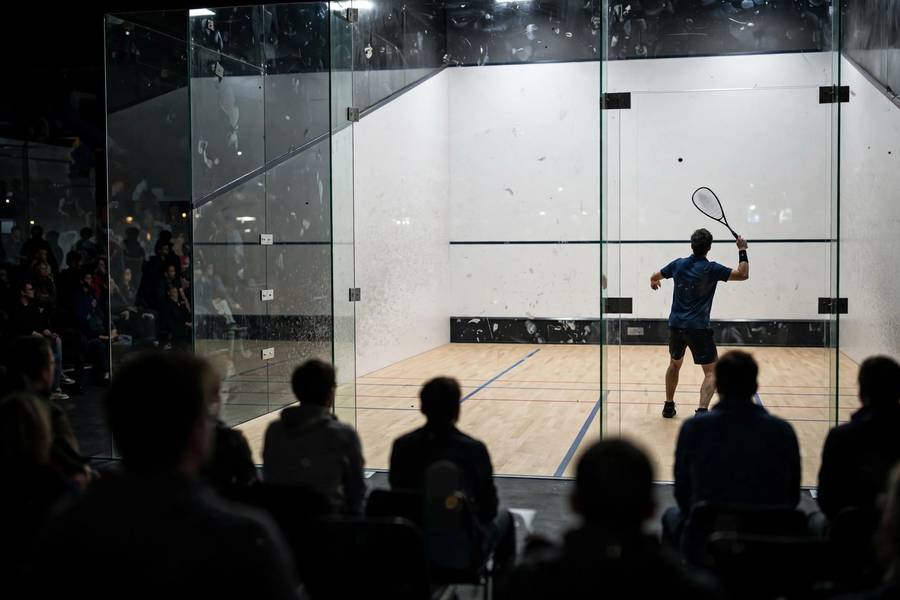
The court. A squash court is a walled box: 32 feet long, 21 feet wide, with a front wall 15 feet high. The back wall is lower (7 feet), and the side walls slope down from front to back. Lines on the walls matter enormously — the tin (a 17-to-19-inch strip at the bottom of the front wall), the service line, the short line, and the half-court line all define legal play.
The racket. Squash rackets are light — around 110 to 145 grams strung — with a head no larger than about 500 square centimeters. Lighter than a tennis racket, built for whip-fast swings in tight spaces.
The ball. This is where squash gets interesting. Squash balls come in different speeds, marked by colored dots. Beginners use a ball with a blue or red dot (bouncier, more forgiving). Club and professional play uses the double yellow dot — the slowest, least bouncy ball, which demands real power and technique to keep in play. The ball must be warmed up before play; a cold double-yellow ball barely bounces at all, which is why you’ll see players knocking it around before a match starts.

The Objective: What You’re Trying to Do
Two players (or four, in doubles, though singles is the standard game) alternate hitting the ball against the front wall. The rally continues until someone can’t return it legally. The core challenge: every shot must hit the front wall above the tin and below the outline (the top line), and it may hit the side or back walls before or after the front wall — but the front wall must be struck, and the ball can bounce on the floor only once between your shot and your opponent’s return.
Win the rally, win the point. It’s that simple at the top level — and brutally hard in practice, because your opponent is trying to put the ball where you aren’t.
Scoring: How Games and Matches Are Won
Squash uses point-a-rally scoring to 11, which replaced the old hand-in/hand-out system years ago and made the sport dramatically more watchable:
- Every rally scores a point, regardless of who served. Win the rally, get the point — no more “side out” dead rallies.
- Games go to 11 points. You must win by 2 — so at 10-10, play continues until someone leads by two.
- At 10-10, there’s a cap: if the score reaches 10-10, the game continues to a two-point margin with no upper limit in most rulesets (some casual games cap at 15, but official play has no cap).
- Matches are best of 5 games at the professional level (first to 3 games wins). Club and casual play is often best of 3.
- The winner of a rally serves next. The server chooses which service box to serve from, alternating sides after each point they win consecutively — actually, the server must alternate boxes on each serve, and the receiver must stand in the opposite box.
The point-a-rally system means every single rally matters, which is why squash matches have that relentless, no-breathing-room quality. There’s no coasting through someone else’s serve.
The Serve: Rules and Rotation
The serve starts every rally, and it has specific rules:
- Foot placement. The server must have at least one foot inside the service box (one of the two small squares near the back of the court) when striking the ball. Stepping on or over the line is a foot fault.
- The serve must hit the front wall between the service line and the outline, then land in the opposite quarter court (the receiver’s box area, past the short line).
- The receiver must stand in the opposite service box and can’t volley the serve — it must bounce first.
- A legal serve that the receiver can’t return is an ace, same as tennis. Rare at high levels, common among beginners.
After the serve, normal rally rules take over: the ball can be hit before or after bouncing (once), off any walls, in any order — as long as the front wall is hit above the tin on every shot.
Playing the Rally: What’s Legal
During a rally, the rules are refreshingly permissive about how you hit the ball and strict about where it goes:
- The ball may hit any walls in any sequence, as long as it hits the front wall above the tin before bouncing twice on the floor.
- You may volley (hit before the bounce) or let it bounce once. Two bounces and the rally is over.
- You can hit the ball after it rebounds off the back or side walls — the “boast” (a shot that hits a side wall first) is a staple attacking shot.
- You must not hit your opponent with the ball or racket, and you must make every effort to get out of your opponent’s way. This is where lets and strokes come in (see below).
- A shot that hits the tin (the bottom strip of the front wall) or below it is out — the tin is essentially part of the floor. You’ll hear its distinctive metallic thunk when someone hits it, followed by groans.
Faults: Ways to Lose a Point
You lose the rally (and your opponent gains a point) if you:
- Hit the ball into the tin or below the service line on the serve
- Fail to hit the front wall above the tin
- Let the ball bounce twice before your return
- Hit the ball out — above the outline on any wall, or out of the court entirely
- Hit the ball twice with your racket (a “double hit”), or carry it
- Touch the ball with your body or clothing before it bounces twice
- Serve with a foot fault (foot outside the service box)
- Obstruct your opponent (interference — see lets and strokes)
Most beginner games are decided by tins and double bounces. Most professional games are decided by interference calls and millimeter-perfect length. The rules are the same; the margins are not.
Lets and Strokes: Squash’s Most Confusing Rules
This is the part that stops play and starts arguments. Because both players share a small box, interference is constant. The rules handle it with two calls:
A “let” means the rally is replayed — no point awarded. It’s called when interference occurred but the obstructed player probably wouldn’t have won the rally anyway, or when the situation is genuinely accidental and unclear. Play stops, everyone resets, the point is replayed.
A “stroke” awards the point to the obstructed player. It’s called when the interference prevented a likely winning shot — for example, the opponent was directly in the path of a straight drive to the front wall, or the player was blocked from swinging at a ball they could have put away.
The referee (or the players themselves in casual games, by mutual agreement) decides based on:
- Was there interference? Did the opponent block the path to the ball or the swing?
- Could the player have reached it? If not, it’s a “no let” — play on, point stands as played.
- Would it have been a winning shot? If yes, stroke. If the player was merely inconvenienced, let.
In casual play, the etiquette is simple: if you blocked someone, offer the let. Squash runs on sportsmanship — the rules assume both players are trying to give each other fair access to the ball, and deliberate blocking is a conduct issue, not a tactic. Players who consistently block get penalized, and at the pro level, referees have conduct warnings and strokes to enforce it.
Conduct and the Code of the Court
Squash has a formal conduct system because tempers in a small hot box are a known quantity:
- Conduct warning for minor offenses (arguing calls, mild racket abuse).
- Conduct stroke — a point awarded to the opponent — for continued or more serious offenses.
- Conduct game or match for the worst behavior: the referee can award a game or the entire match.
Deliberate dangerous play — swinging recklessly when an opponent is close, hitting the ball directly at someone — draws immediate penalties. The sport’s culture treats safety as non-negotiable: you’re sharing a box with someone holding a racket, and everyone involved knows it.
Quick-Start: Your First Game
If you’re picking up a racket for the first time, here’s the minimum you need:
- Use a bouncy ball (blue or red dot). The pro ball will make you miserable as a beginner. No shame in it — everyone starts here.
- Warm the ball up by hitting it against the front wall for a few minutes before you start.
- Aim for length, not winners. Hit the ball high and deep so it lands near the back of the court. Long rallies are the goal; winners come later.
- Clear after every shot. Move back toward the center (the “T”) after you hit. Beginners lose points mostly by standing where they hit and blocking their opponent.
- Call your own lets generously. When in doubt, replay the point. Nobody’s keeping official score on your first game, and good habits start early.
Squash rewards fitness like few other sports — if you’re building a base for it, bodyweight exercises are a solid start, and thinking about the best time to exercise helps you actually show up. And if the rules bug has bitten you, pickleball’s rules make a fun comparison: another racket sport where the rulebook looks simple until you play.

Frequently Asked Questions
Squash uses point-a-rally scoring: every rally wins a point, regardless of who served. Games go to 11 points and must be won by 2. Professional matches are best of 5 games; casual matches are often best of 3.
A let means the rally is replayed with no point awarded. It’s called when interference occurred but the obstructed player probably wouldn’t have won the point anyway, or when the interference was accidental and unclear. If the interference prevented a likely winning shot, a stroke is awarded instead, giving the point to the obstructed player.
The tin is the strip along the bottom of the front wall, about 17 to 19 inches high. Any shot hitting the tin or below it is out — the tin is effectively part of the floor. It makes its distinctive metallic sound when struck, which is how everyone in the building knows you just lost the rally.
No. The ball may bounce only once on the floor between shots. If it bounces twice before your opponent returns it, the rally is over and you win the point. You may also volley the ball before it bounces.
Beginners should use a blue-dot or red-dot ball, which is bouncier and more forgiving. The double yellow dot ball used in club and professional play is the slowest and least bouncy — it demands real power and technique, and a cold one barely bounces at all. Always warm the ball up before playing.
A best-of-5 professional match typically lasts 45 to 90 minutes depending on how competitive the games are. Best-of-3 club matches usually run 30 to 45 minutes. Because every rally scores a point, there’s no dead time — the clock runs on pure effort.