


The first darts match I watched properly, I lasted about four minutes before asking the dumb question out loud: “Wait — why did he win? He had 40 left and the other guy had 200.” A friend sighed, paused the stream, and explained the double-out rule. Ten minutes later I was hooked, because darts scoring is secretly one of the most elegant systems in sports — a countdown, a puzzle, and a pressure cooker all at once.
For a deeper dive, see our guide to tennis scoring explained.
I’m Ryan. I spend my days buried in sports numbers, and darts might be the purest numbers game there is. Every throw is arithmetic under pressure. Here’s the full breakdown: how the board scores, how a game of 501 works, what “checkout” means, and why the pros make the math look easy.
In This Guide
- The Dartboard: Zones and Values
- The Standard Game: 501 Countdown
- Starting and Finishing: The Double-Out Rule
- Common Checkouts Pros Aim For
- Darts Scoring Terms You’ll Hear
- Legs, Sets, and Match Formats
- Other Darts Games Worth Knowing
- How Scores Are Kept
- Frequently Asked Questions

The Dartboard: Zones and Values
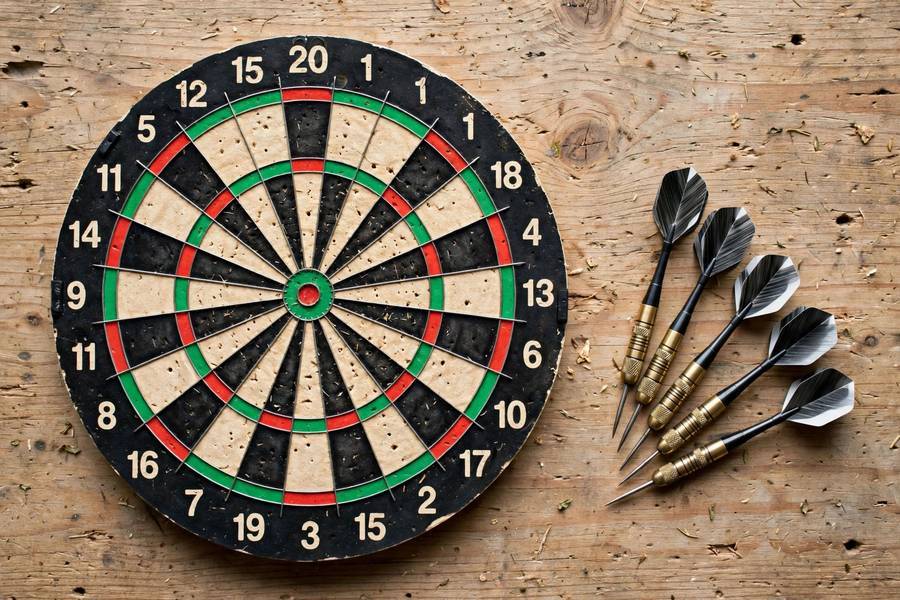
A standard bristle dartboard has 20 numbered segments arranged in a specific order around the face: 20, 1, 18, 4, 13, 6, 10, 15, 2, 17, 3, 19, 7, 16, 8, 11, 14, 9, 12, 5. The sequence looks random, and that’s the point — it punishes inaccurate throws. Miss the 20 by a fraction and you land in the 1 or the 5. The board’s designer supposedly laid it out in 1898 to penalize sloppy aim, and the layout has barely changed since.
Each segment is divided into scoring zones:
- Single. The large wedge areas score the segment’s face value. Hit the single 20, score 20.
- Double ring. The thin outer ring doubles the segment’s value. Double 20 scores 40. This ring matters enormously because of the finishing rule (more on that below).
- Treble (triple) ring. The thin inner ring triples the segment’s value. Treble 20 scores 60 — the highest single-dart score on the board.
- Outer bull (25). The green ring around the center scores 25.
- Bullseye (50). The red center scores 50. It counts as a double of 25, which matters for finishing.
Wire dividers separate the zones, and a dart only scores if its point is touching the board inside the playing area when the throw is complete. Darts that bounce out or fall before the player retrieves them score nothing. The oche (throw line) sits 7 feet 9.25 inches from the board face, and the bullseye hangs 5 feet 8 inches off the floor. Those measurements are standardized worldwide.
Quick math on maximums: three treble 20s in one visit to the board is 180 — the famous “one hundred and eighty!” the crowd chants. It’s the highest possible three-dart score.
The Standard Game: 501 Countdown
Professional darts is almost always played as 501. Both players start at 501 points, and each “visit” to the board (three darts, or fewer if the game ends mid-visit) subtracts from the total. The winner is the first player to reach exactly zero.
Here’s a sample leg to show the rhythm:
- Player A starts at 501, throws treble 20, treble 20, treble 20 → 180 scored → 321 remaining.
- Player B throws treble 20, single 20, treble 19 → 137 scored → 364 remaining.
- Back and forth, subtracting, until someone gets down to a finishable number.
The player who throws first in a leg is decided by a “bull-off” — one dart each at the bullseye, closest wins the throw. In set play, players alternate who starts each leg.
Starting and Finishing: The Double-Out Rule
This is the rule that confused me on day one, and it’s the heart of darts scoring.
We break down how golf scoring works step by step in a separate guide.
You must finish on a double. To win a leg of 501, your final dart must land in the double ring (or the bullseye, which counts as a double). So if you have 40 remaining, you need double 20. If you have 32 remaining, you need double 16. If you have 50 remaining, you need the bullseye.
Two wrinkles make this brutal:
- The bust rule. If you score more than your remaining total, or leave yourself at 1, or finish without a double, your entire visit is void — your score reverts to what it was before the visit. Hit a single 20 when you needed double 20 with 40 left? You now have 20 left — that’s not a bust, so you keep throwing your remaining darts (the turn only passes if that was your last dart). The pros call this “busting,” and it happens at every level.
- You can’t finish on 1. Since every double is an even number (and the bullseye is 50), a remaining score of 1 is unfinishable. Smart players set up their scoring so they never leave themselves on an odd number they can’t convert — they plan two or three visits ahead.
Do you have to start on a double? In standard 501, no — that’s called “double-in” and it’s only used in some variants. In regular 501, you start scoring from the first dart. (In 301, some pub rules require double-in, but that’s a house rule, not the professional standard.)
Common Checkouts Pros Aim For
A “checkout” is the combination of darts that finishes a leg from a given score. The pros have these memorized like multiplication tables. 170 is the highest possible checkout: treble 20, treble 20, bullseye.
Here are the finishes you’ll see most often, with the standard routes:
| Remaining | Checkout route |
|---|---|
| 170 | T20, T20, Bull |
| 167 | T20, T19, Bull |
| 164 | T20, T18, Bull |
| 161 | T20, T17, Bull |
| 160 | T20, T20, D20 |
| 100 | T20, D20 |
| 80 | T20, D10 |
| 64 | T16, D16 |
| 50 | Bull |
| 40 | D20 |
| 36 | D18 |
| 32 | D16 |
Notice the pattern: pros love leaving themselves on 32 and 40. Double 16 and double 20 sit at the top of the board, right next to the treble 20 they’ve been aiming at all leg. If they miss inside the double 16, they often land in single 16, leaving 16 — which is double 8, another clean two-dart path. The whole endgame is about leaving yourself outs that forgive a miss.
Commentators track a stat called checkout percentage — the share of finishing opportunities a player converts. The elite pros sit around 40-45%. Think about that: the best in the world, with a finish on the board, still miss more than half the time. That’s the pressure of the double-out rule.
Darts Scoring Terms You’ll Hear
Watch any televised match and you’ll hear this vocabulary constantly:
- 180 (a “maximum”). Three treble 20s. The crowd goes feral.
- Ton. A visit scoring 100 or more. “Ton-plus” for 100+, and commentators track ton-plus averages as a measure of scoring power.
- Checkout. The finishing combination, as above.
- Break of throw. Winning a leg against the throw (when your opponent started). In set play, breaks are gold.
- Nine-darter. Finishing a 501 leg in the minimum nine darts — the perfect leg. Two 180s followed by a 141 checkout (T20, T19, D12) is the classic route. It’s darts’ equivalent of a hole-in-one, and it remains rare even at the top level.
- Bogey numbers. Scores that can’t be finished in three darts or less: 169, 168, 166, 165, 163, 162, and 159. If you’re stuck on one, you have to score down to a finishable number first.
Legs, Sets, and Match Formats
A leg is one game of 501, from 501 down to zero. A set is a group of legs — usually best of 5 legs in PDC (Professional Darts Corporation) play, meaning first to 3 legs takes the set. A match is a group of sets.
Major tournament formats vary, which is worth knowing when you tune in:
- PDC World Championship: sets, best of 5 legs per set, with the final played as best of 13 sets. Matches can run for hours.
- Premier League: a league phase of weekly legs (best of 11 legs — first to 6 — in the nightly format used since 2022), then a playoff night.
- World Matchplay: legs only, no sets — and with a twist: you must win by two clear legs, which has produced some legendary marathons.
The “against the throw” dynamic shapes everything. The player who throws first in a leg has a built-in advantage, so holding your throw and breaking your opponent’s is the strategic backbone of every match. Analysts track it the way tennis tracks breaks of serve — same concept, different sport.
Other Darts Games Worth Knowing
501 dominates the professional game, but the pub world is bigger:
- 301. Same countdown idea, shorter game. Often played with double-in/double-out rules in casual settings.
- Cricket. The tactical game. Players “close” the numbers 15 through 20 and the bullseye by hitting each three times, scoring points on closed numbers the opponent hasn’t closed yet. It’s chess to 501’s sprint.
- Around the Clock. Hit 1 through 20 in order, then the bull. Simple, and brutally good for accuracy training.
- Killer. Each player gets a number and must hit its double to become a “killer,” then eliminates opponents by hitting their doubles. Chaotic, loud, and the best pub game ever invented.
How Scores Are Kept
In professional matches, a chalker (official scorer) stands beside the board, calls each score, and marks it on the board. Modern broadcasts overlay live graphics, but the chalker is still the authority — their call is what counts.
In pubs and at home, it’s usually the next player who chalks, or an electronic dartboard does the math automatically. Electronic boards are forgiving; chalking by hand is where you learn the arithmetic that makes watching the pros so satisfying. My advice: chalk a few games by hand. You’ll start calculating checkouts in your head right along with the commentators.

Frequently Asked Questions
In 501, each player starts at 501 points and subtracts their score with each visit of up to three darts. The first player to reach exactly zero wins the leg — but the final dart must land in the double ring or the bullseye (the double-out rule).
180 — three treble 20s. The treble 20 scores 60 per dart, so three of them make 180, the maximum three-dart score in darts.
Double-out means a leg of 501 can only be won with a final dart in the double ring (or the bullseye, which counts as a double 25). If you score more than your remaining total or finish without a double, you bust and your score reverts to what it was before the visit.
170 — treble 20, treble 20, bullseye. It’s the highest score that can be finished in three darts under the double-out rule. Scores of 169, 168, 166, 165, 163, 162, and 159 cannot be checked out and are called bogey numbers.
A nine-darter is finishing a 501 leg in the minimum nine darts — the perfect leg. The classic route is two 180s followed by a 141 checkout (treble 20, treble 19, double 12). It’s extremely rare even among professionals.
The oche (throw line) is 7 feet 9.25 inches (2.37 meters) from the face of the board, and the bullseye hangs 5 feet 8 inches (1.73 meters) above the floor. These measurements are standardized worldwide.