

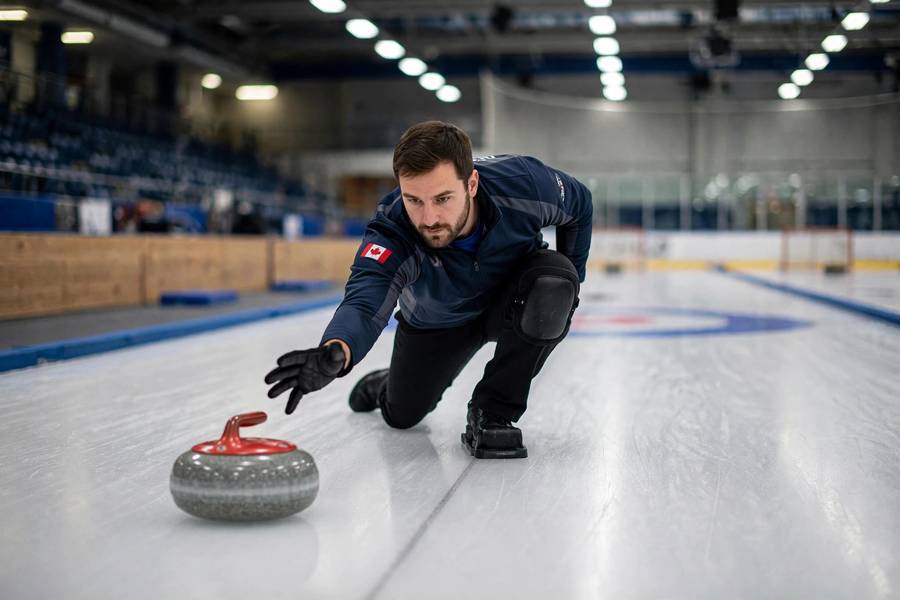
Every four years, the Winter Olympics turn millions of non-fans into 2 a.m. curling obsessives shouting about guard zones and the hammer — then the Games end and everyone forgets until next time.
Curling deserves that attention every year, not just every four. Beneath the brooms lies one of the most tactical sports on earth — chess at walking speed on ice, where a millimeter at release decides the game two hours later. Here’s how it works.
- The Basic Idea: What Curling Is Trying to Do
- The Ice, the Stones, and the House
- The Players: Four Roles on a Team
- How a Game Unfolds: Ends, Delivery, and Sweeping
- Scoring: How Points Are Counted
- The Rules That Shape Strategy
- The Hammer and Why It Matters
- Common Strategies You’ll See
- Curling at the Olympics and Beyond
The Basic Idea: What Curling Is Trying to Do
Two teams take turns sliding heavy granite stones down a sheet of ice toward a circular target called the house. After all the stones have been thrown in a round (called an “end”), the team with the stone closest to the center of the house scores points. Most points after the scheduled number of ends wins.
That’s the entire sport in three sentences. Everything else — the sweeping, the shouting, the elaborate strategy — exists to influence where those stones end up and which ones stay there.
The Ice, the Stones, and the House
The sheet. A curling sheet is about 150 feet long and 15 feet wide — roughly the length of a basketball court laid end to end, but much narrower. The ice isn’t smooth like a hockey rink; it’s “pebbled” with tiny frozen droplets of water, which is what lets the stones curl (curve) as they travel.
The stones. Each granite stone weighs between 38 and 44 pounds — about the weight of a large bag of dog food, slid with precision. They’re made from a specific dense granite (traditionally from Ailsa Craig, an island off Scotland) because it resists chipping and absorbs almost no water.
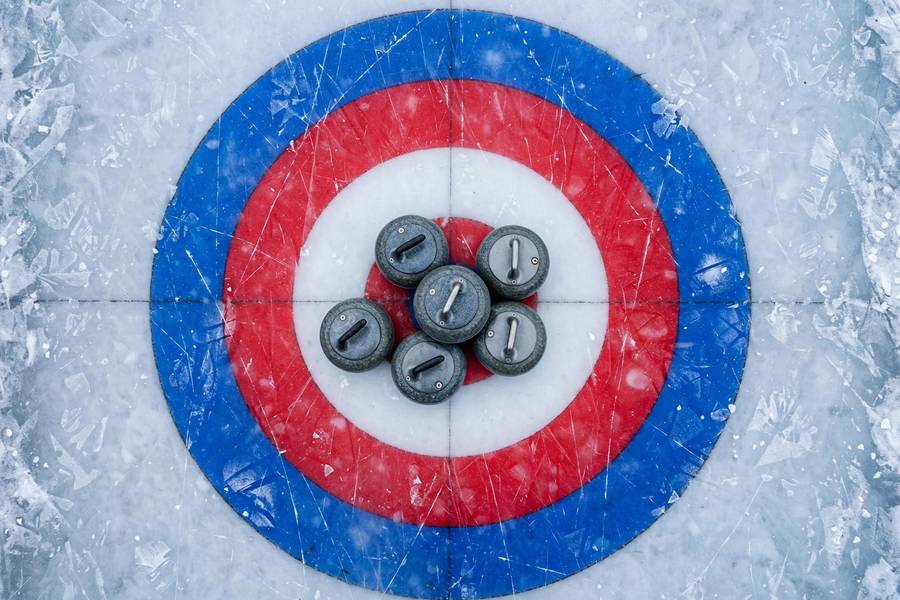
The house. At each end of the sheet is the house: concentric circles in red, white, and blue, 12 feet across. The very center is called the button. Only stones touching the house (or in it) can score.
The brooms. Sweepers use them to melt a microscopic film of water on the ice in front of a moving stone. This reduces friction, which makes the stone travel farther and curl less. Sweeping is the only way to influence a stone after it’s released — and at the elite level, it’s the difference between winning and losing.
The Players: Four Roles on a Team
A curling team has four players, each throwing two stones per end (eight stones per team per end, sixteen total). Each position has a distinct job:
- Lead. Throws the first two stones. The lead’s job is usually to set up guards — stones placed in front of the house to protect later stones. Precision and consistency matter more than flash.
- Second. Throws stones three and four. Often tasked with takeouts — knocking opponent stones out of play — or building on the lead’s setup.
- Third (or vice-skip). Throws stones five and six, and holds the broom as the target for the skip’s shots. The third is the skip’s chief strategist, discussing every call.
- Skip. The captain. Throws the last two stones — the highest-pressure shots in the game — and calls the strategy for every shot from the far end of the sheet, usually with dramatic sweeping instructions.
When a player delivers, the other two teammates sweep (except the skip, who watches from the house end and judges the line).
How a Game Unfolds: Ends, Delivery, and Sweeping
A standard game is 8 or 10 ends, depending on the level (Olympic and championship games are 10). Here’s what happens inside one end:
The delivery. The thrower pushes off from the hack (a foothold in the ice), slides forward on one foot, and releases the stone before crossing the hog line — a line 21 feet from the house. Release after the hog line and the stone is removed from play. The thrower gives the stone a slight rotation (the “handle”), which is what makes it curl left or right as it travels.
The sweeping. The moment the stone is released, the sweepers judge its speed and line. If it needs to go farther, they sweep hard in front of it. If it’s already curling too much, they ease off. The skip shouts instructions — “hurry!” means sweep harder, “whoa” means back off. The communication is constant and loud, and yes, this is the part that looks the strangest to newcomers and matters the most to players.
The sixteen stones. Teams alternate throws, one stone at a time, with the team that scored in the previous end throwing first (a disadvantage, as we’ll see). Stones can knock each other, guard each other, or be knocked clean out of the house. After all sixteen are thrown, the end is scored.
Scoring: How Points Are Counted
Scoring happens only after all sixteen stones in an end are thrown:
- Only one team scores per end — the team with the stone closest to the button.
- They get one point for each of their stones that is closer to the button than the opponent’s nearest stone.
- Stones must be touching or inside the house to count.
So if Team A has the two closest stones and Team B’s nearest is third-closest, Team A scores 2. A “blank end” — no stones in the house — means nobody scores, and the team that threw last keeps the hammer.
Games are often decided by a single point — which is why every stone in the tenth end feels like a final exam.

The Rules That Shape Strategy
A handful of rules turn curling from a throwing contest into a strategy game:
The free guard zone. For the first five stones of each end, stones in the free guard zone (the area between the hog line and the house, excluding the house itself) cannot be removed by the opponent. This forces teams to build around guards rather than just blasting everything away — it’s the rule that creates curling’s famous tactical depth.
No-tick rule (elite play). In top-level competition, a stone touching the center line in the free guard zone can’t be moved sideways off that line by an opponent’s stone. Another layer of protection for early stones.
The hog line. As mentioned, stones must be released before the near hog line, and must fully cross the far hog line to stay in play. A stone that stops short is removed.
Touching a moving stone. If a player touches a moving stone (a “burned” stone), the opposing skip gets to choose: leave it where it stopped, or remove it and put the disturbed stones back. At the elite level, this is a nightmare scenario.
Conceding. Teams can concede at any point — and in a sport built on etiquette, trailing teams routinely shake hands early when the math becomes impossible. It’s not quitting; it’s respect for everyone’s time.
The Hammer and Why It Matters
The hammer is the last stone of the end, and it’s the single most valuable asset in curling. Throwing last means you get the final word — the last chance to knock an opponent’s stone out, draw to the button, or freeze onto their shot.
The team that didn’t score gets the hammer next (or keeps it after a blank end). The team with the hammer wants to score two or more; the team without it tries to “steal” — scoring despite throwing first. A steal of even one point is a genuine momentum swing, and steals of two or more are the stuff of highlight reels.
Managing the hammer across ten ends — when to play aggressively and when to blank an end to keep it — is the core strategic drama of the sport, the same kind of hidden architecture as tournament formats in other sports.
Common Strategies You’ll See
Watch a few ends with these patterns in mind and the sport opens up:
- The guard-and-draw game. With the hammer, teams often play defensively early: guards in front, draws behind them, building a wall the opponent has to pick apart. Boring to describe, nerve-shredding to watch.
- The aggressive takeout game. Without the hammer, teams try to keep the house clean — knocking guards away, removing stones — hoping to steal or at least limit the opponent to one point.
- The freeze. A stone delivered so it stops touching an opponent’s stone, nearly impossible to remove without disturbing both. The freeze is curling’s equivalent of a perfectly placed chess piece.
- The double takeout. One stone removing two opponents’ stones at once. Rare, difficult, and the crowd goes absolutely wild.
Curling at the Olympics and Beyond
Curling has been an Olympic medal sport since 1998 (with a retroactively recognized appearance in 1924). The Olympic tournament features men’s, women’s, and mixed doubles competitions. Mixed doubles — two players per team, six stones per end, with pre-placed stones — is faster and even more tactical, and it’s become many fans’ favorite format.
Beyond the Olympics, the World Curling Championships run annually and the Grand Slam of Curling tour gathers the sport’s biggest names. Canada and Sweden have historically dominated, but Scotland (the birthplace), Switzerland, and increasingly Asian teams have all won major titles.
And if the rules bug has bitten you, other precision sports reward the same kind of study — pickleball’s rules and even soccer’s offside rule have the same satisfying quality: simple on the surface, endlessly deep once you look.

Frequently Asked Questions
After all 16 stones are thrown in an end, only the team with the stone closest to the button scores. They receive one point for each of their stones closer to the button than the opponent’s nearest stone. Only one team scores per end, and games are usually 10 ends at championship level.
The hammer is the last stone thrown in an end, and it’s a major advantage because it gets the final say on the end’s outcome. The team that didn’t score in the previous end gets the hammer next. Managing the hammer — when to score big and when to blank an end to keep it — is central to curling strategy.
Sweeping melts a microscopic film of water on the pebbled ice, reducing friction. This makes the stone travel farther and curl (curve) less. Sweepers judge the stone’s speed and line in real time and sweep harder or back off based on the skip’s calls — it’s the only way to influence a stone after release.
The free guard zone is the area between the hog line and the house (excluding the house itself). During the first five stones of each end, stones in this zone cannot be removed by the opponent. This rule forces teams to play tactically around guards instead of just knocking everything away.
A 10-end championship game typically lasts about two to two and a half hours. Eight-end games at club level run closer to two hours. Teams may concede early when the score makes a comeback mathematically impossible, which can shorten games.
A curling stone weighs between 38 and 44 pounds (about 17–20 kg). They’re made from dense granite — traditionally from Ailsa Craig off the coast of Scotland — chosen because it resists chipping and absorbs almost no water.