How to Stay Motivated to Exercise Regularly: Systems, Not Willpower


If you are searching for how to stay motivated to exercise regularly, I am going to tell you something the fitness industry does not want you to hear: motivation is unreliable, and building your exercise habit on it is like building a house on sand. I have coached people for over a decade, and the ones who are still training years later are not the most motivated — they are the ones with the best systems. This guide is about those systems: the behavioral science of showing up when you do not feel like it.
Here is the core insight from behavioral research: motivation gets you started, but systems keep you going. Motivation is an emotion — it spikes on January 1st and evaporates by February. Systems are structures — they work whether you feel like it or not. Every strategy below is a system, not a pep talk.
System 1: Implementation Intentions (The “When-Then” Plan)
This is the most research-backed habit technique in existence, and it takes two minutes. An implementation intention is a specific plan in the format: “When [situation], then I will [behavior].” Not “I will exercise more” — that is a wish. Instead: “When I finish my morning coffee, then I will put on my workout clothes and do 30 minutes.”
Why it works: your brain pre-loads the decision. When the trigger situation arrives, the behavior fires almost automatically — no deliberation, no negotiation with yourself at 6 p.m. when you are tired. Studies consistently show that people who form implementation intentions exercise significantly more than people with identical goals but no specific plan.
Make yours concrete:
- Bad: “I will work out three times a week.” (When? Where? Doing what?)
- Good: “When I get home from work on Monday, Wednesday, and Friday, then I will change into gym clothes immediately and do my 40-minute routine before anything else.”
The details matter — the time, the place, the exact first action. “Put on workout clothes” is a better trigger action than “exercise,” because it is so small you cannot talk yourself out of it, and once the clothes are on, momentum takes over.
System 2: Temptation Bundling
Temptation bundling pairs something you should do with something you want to do: you only get the want while doing the should. The classic research example: participants who could only listen to addictive audiobooks while exercising worked out significantly more than the control group.
Your versions:
- Only watch your favorite show while on the treadmill or stationary bike.
- Only listen to that true-crime podcast during runs.
- Save your favorite album for lifting sessions.
- Only get your fancy coffee on gym mornings — on the way there, as the reward trigger.
The key is exclusivity: the tempting thing must be genuinely restricted to workout time. If you watch the show on the couch too, the bundle breaks. It feels slightly absurd to bribe yourself this way. Do it anyway — it works because it stops relying on discipline and starts relying on desire.
System 3: Never Miss Twice
You will miss workouts. Travel, illness, life — it happens, and the research is clear that one missed session has essentially zero impact on long-term habit formation. What kills habits is the second miss, then the third, then the quiet abandonment.
The never-miss-twice rule: missing once is an accident; missing twice is the start of a new habit (the habit of not exercising). So the rule is absolute — you may miss once, but the next scheduled session is non-negotiable. Not “I will make it up” (vague). Not “next week” (too far). The very next one.
This rule works because it replaces perfectionism with resilience. Perfectionism says “I missed Monday, the week is ruined, I will restart next month.” Never-miss-twice says “I missed Monday; Wednesday is happening no matter what.” One mindset ends habits; the other sustains them for decades.

System 4: Design Your Environment
Willpower is weakest at the moment of decision, so eliminate the decision. Environmental design means making exercise the path of least resistance:
- Sleep in your workout clothes (or lay them out). Removing the “getting ready” step removes the most common quitting point.
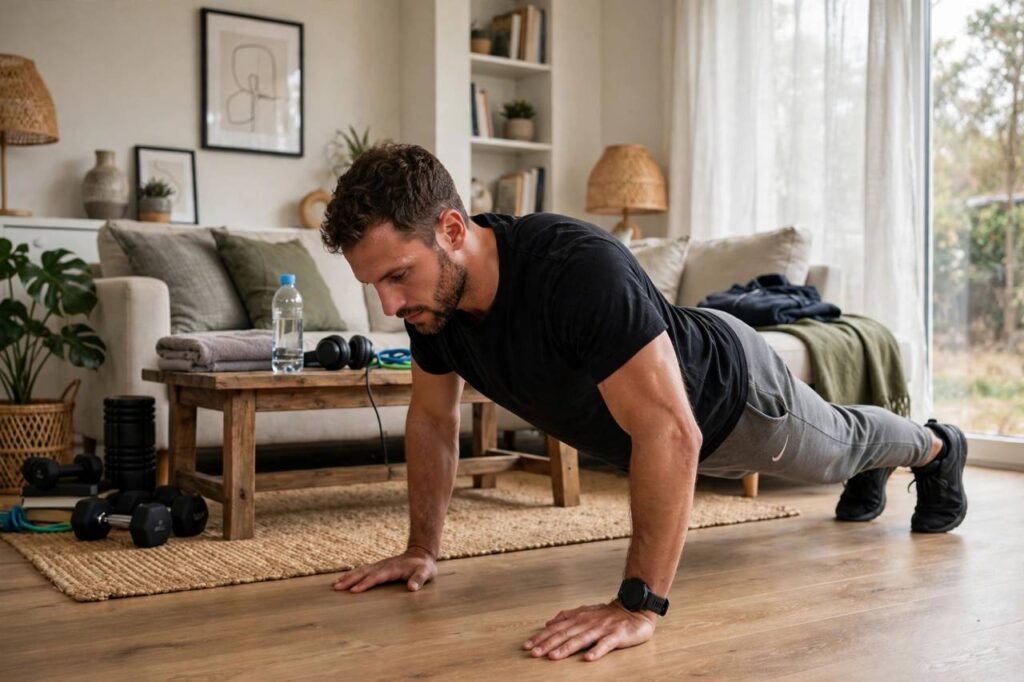
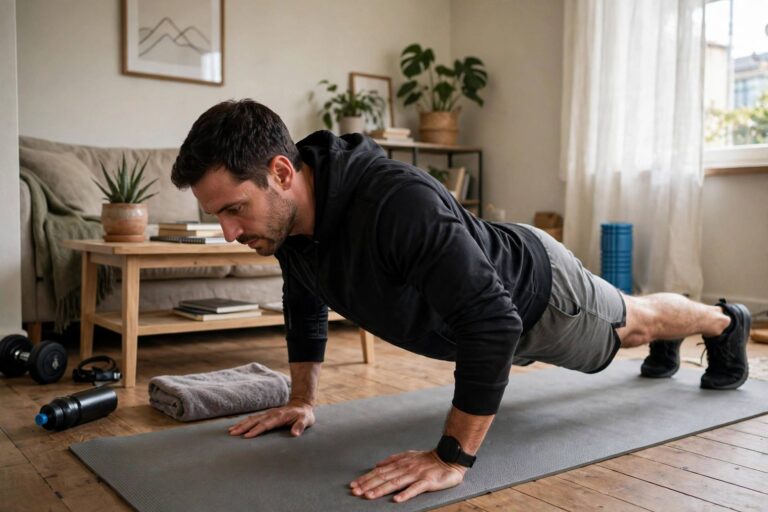
- Keep equipment visible. Dumbbells in the living room get used; dumbbells in the garage get forgotten. Out of sight is out of mind, literally.
- Join the gym on your route. A gym between work and home gets visited; a gym twenty minutes in the wrong direction does not. Location beats quality of equipment every time.
- Schedule it like a meeting. Put workouts in your calendar with alerts. What gets scheduled gets done; what floats in “sometime today” evaporates.
- Find your people. A workout partner, a class, a running group — social commitment is the strongest adherence tool in the research. You will show up for others on days you would not show up for yourself.
System 5: Track the Right Thing
What gets measured gets managed — but measure the right thing. Beginners should track adherence (did I show up?), not performance (how much did I lift?). A simple calendar with an X on workout days is the gold standard: the growing chain of X’s becomes its own motivation (the “don’t break the chain” method).
Three tracking rules:
- Track showing up, not results. Results lag by months; adherence is daily. Celebrate the behavior you control.
- Review monthly, not daily. Daily weight or performance fluctuations are noise. Monthly trends are signal.
- Never track punitively. The log is data, not a judge. A blank week is information (“my schedule broke — fix the schedule”), not a moral failure.
If you are just building your routine, our beginner workout routines give you something concrete to plug into these systems — because the best system in the world still needs a plan to execute.
How to Stay Motivated to Exercise Regularly After 40
The systems in this guide work at any age, but exercise after 40 has specific realities worth addressing directly — because the motivational challenges change, and pretending they do not is why so many people quit in their forties and fifties.
Recovery is the new training variable. In your twenties, you could train hard daily and bounce back. After 40, recovery slows — and the motivational killer is not laziness, it is the injury-frustration cycle: push too hard, get hurt, stop for six weeks, lose the habit, restart from zero. The system fix: program recovery as deliberately as workouts. Hard days followed by genuinely easy days. Sleep treated as training. And the never-miss-twice rule applied to easy sessions too — a 15-minute walk counts as “not missing” and keeps the chain alive through sore weeks.
Motivation shifts from aesthetics to function. Younger exercisers are often driven by appearance; after 40, the durable motivators become functional: playing with grandchildren without pain, hiking without knee complaints, getting up off the floor easily, bone density, balance, independence. Reframe your “why” around capability, not cosmetics — functional goals are more motivating because they connect to daily life, and they are more honest about what exercise actually delivers at this stage.
Strength training becomes non-negotiable. After 40, adults lose 3–8% of muscle mass per decade (sarcopenia), accelerating after 60 — unless they resistance train. This is not about bodybuilding; it is about maintaining the muscle that keeps you independent. Two to three full-body sessions weekly, progressive overload, good form. If you do one thing from this entire guide after 40, make it this: the cardio can be walking, but the strength work is mandatory.
Adjust the systems, do not abandon them. Implementation intentions still work — but the “when” may need to dodge joint stiffness (late morning beats crack-of-dawn for many). Temptation bundling still works — the podcast is the same. Environment design matters more, not less: the home gym setup that removes the commute becomes increasingly valuable. The systems do not expire at 40; they just need recalibrating for the new hardware. Which, fittingly, is exactly what the workouts are for.
Frequently Asked Questions
How long does it take to form an exercise habit?
The popular “21 days” is a myth. Research (notably Phillippa Lally’s work) puts the average at about 66 days, with wide variation — 18 to 254 days depending on the person and behavior. Plan for two to three months of deliberate system use before it starts feeling automatic. The systems above are what carry you through those months.
What if I genuinely hate exercise?
You probably hate a specific type of exercise, not movement itself. The person who hates running may love swimming, dancing, martial arts, hiking, or lifting. Experiment broadly before concluding — and remember that “exercise” includes walking, which counts fully. The best exercise is the one you will actually do.
Is it better to exercise in the morning or evening?
Whichever you will do consistently. Morning has a slight adherence advantage (fewer competing demands, decision fatigue is low), but evening works fine if mornings are impossible. Consistency at your sustainable time beats optimal timing you abandon. Pick the slot with the fewest conflicts in your real life.
How do I restart after falling off for months?
Start embarrassingly small — ten-minute walks, not hour-long sessions. The goal of week one is rebuilding the identity (“I am someone who exercises”), not fitness. Ramp gradually over 3–4 weeks. And use the never-miss-twice rule from day one: the restart counts as your fresh start, protect it.
Does motivation ever become unnecessary?
Largely, yes — that is the point of systems. Long-term exercisers report that working out feels automatic, like brushing teeth. You will still have low days, but the systems (scheduled time, laid-out clothes, waiting workout partner) carry you through without requiring enthusiasm. Automaticity is the destination; systems are the vehicle.
Build the System, Skip the Pep Talk
How to stay motivated to exercise regularly? Stop trying to stay motivated. Write your when-then plan tonight. Bundle one temptation this week. Commit to never missing twice. Redesign one thing in your environment. Start your X-chain calendar. None of this requires feeling inspired — that is exactly why it works. A year from now, you will not be the person with the most motivation. You will be the person with the best systems. Build them now.