How Does a Filibuster Work? Senate Rule Explained

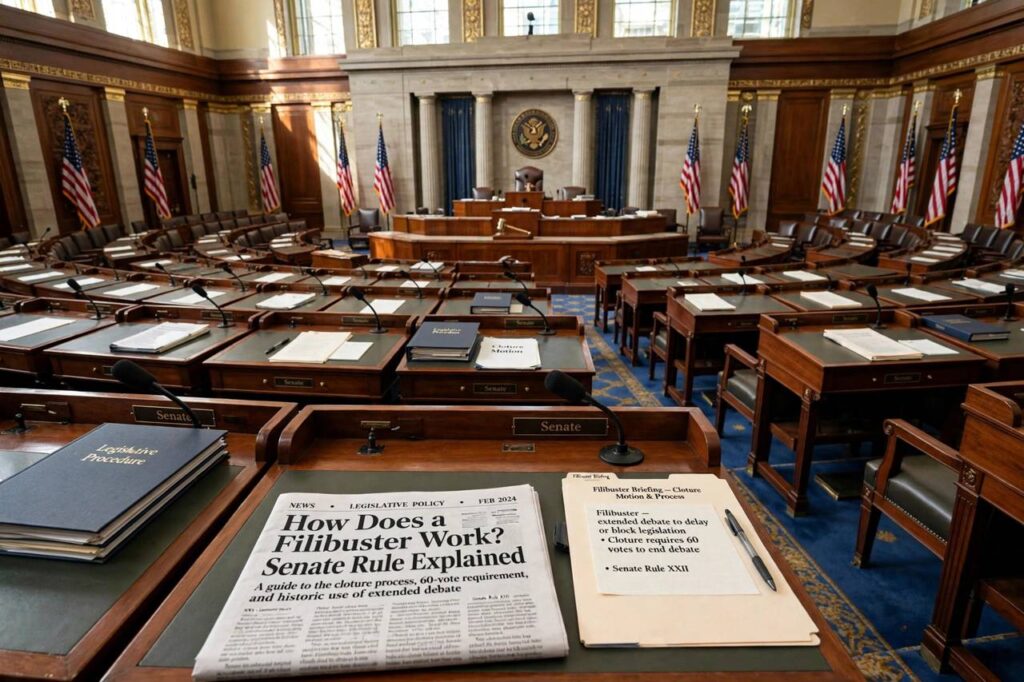
The filibuster might be the strangest rule in American lawmaking: a minority of senators can block a bill supported by the majority simply by refusing to stop talking — or, in its modern form, by threatening to. If you are asking how does a filibuster work, the short version is that Senate rules allow unlimited debate unless sixty senators vote to end it, which means most legislation needs a supermajority, not a simple majority, to pass. It has shaped everything from civil rights to judicial appointments, survived multiple attempts to kill it, and remains one of the most argued-over features of the U.S. Senate. Here is where it came from, how it operates today, and why it still matters.
Where the Filibuster Came From
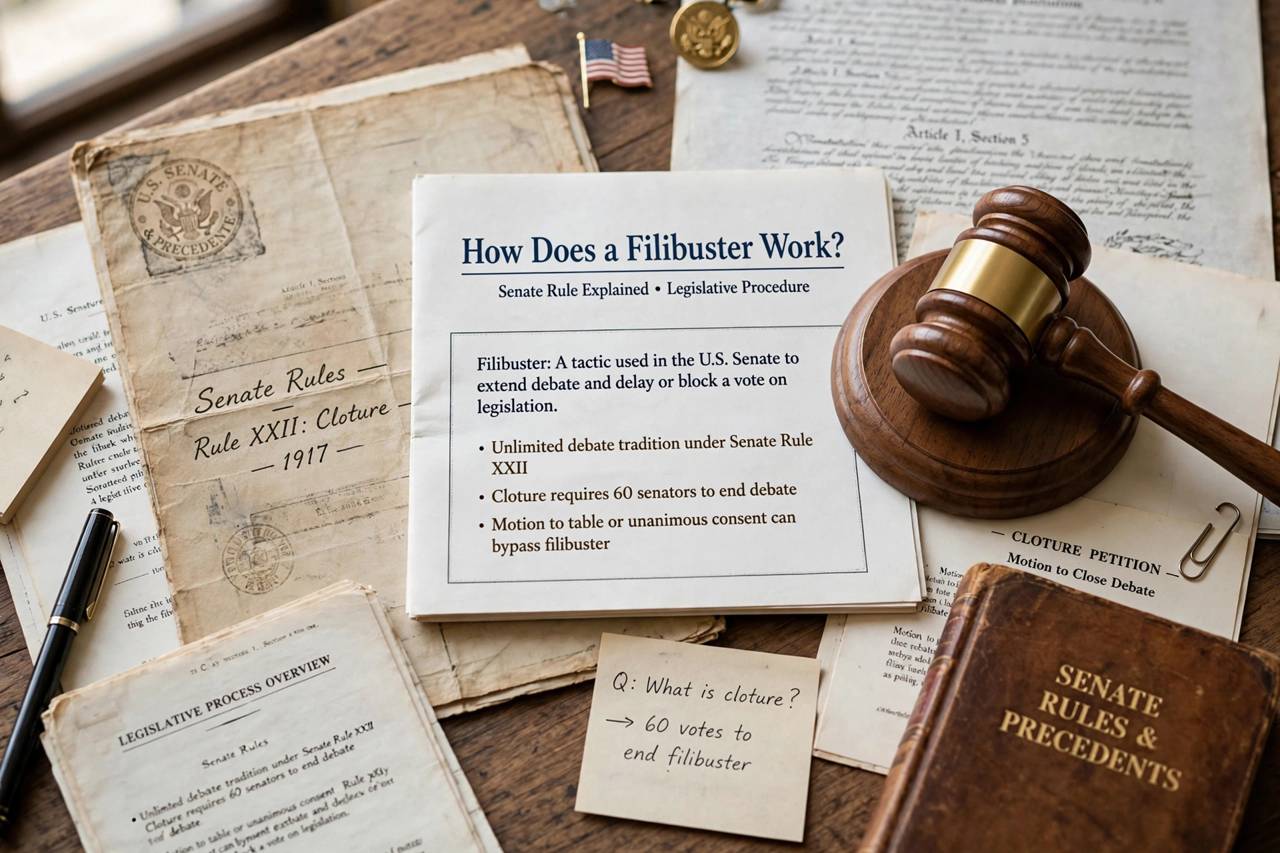
The filibuster was not in the Constitution, and nobody designed it on purpose. It emerged from an 1806 rules cleanup, when Vice President Aaron Burr suggested the Senate drop its “previous question” motion — the rule that let a majority end debate. The Senate agreed, tidying up what looked like a redundant rule, and accidentally created a chamber with no mechanism to cut off discussion. For decades nobody exploited the gap. The first real filibusters appeared in the 1830s and 1840s, and the tactic grew through the late nineteenth century as senators realized endless debate could kill bills the majority supported. The Senate finally created a way to end debate in 1917, adopting Rule 22 — the cloture rule — initially requiring two-thirds of senators present to invoke it. The threshold was lowered to three-fifths of the full Senate, or sixty votes, in 1975. That sixty-vote line is the number that defines modern Senate math: with rare exceptions, nothing controversial passes the Senate without sixty supporters. An accident of parliamentary housekeeping became the most consequential rule in American legislation.
How a Filibuster Works in Practice
The classic image — a senator reading the phone book through the night, à la Mr. Smith Goes to Washington — describes the “talking filibuster,” and it still exists in theory. In practice, the modern filibuster rarely requires anyone to actually talk. Here is how it works now. When the majority leader wants to bring a bill to a final vote, any senator can signal that the bill lacks sixty votes for cloture. Rather than waste days on doomed debate, the Senate typically moves on to other business — a second legislative “track” — while the filibustered bill sits in limbo. This is the “silent” or “procedural” filibuster: no speeches required, just the persistent threat that debate cannot be ended. To break it, supporters file a cloture motion, wait through a mandatory delay, and then need sixty votes to limit debate and force a final vote. If they get sixty, debate ends and the bill passes or fails by simple majority. If they fall short, the bill is effectively dead unless supporters negotiate changes, wait for the political winds to shift, or find another vehicle. The talking filibuster still happens occasionally as theater or protest, but the silent version does the real work — quietly, constantly, and without a single speech.
What the Filibuster Can and Cannot Block
Not everything in the Senate can be filibustered. The biggest exception is the budget reconciliation process, created in the 1970s, which lets certain tax and spending bills pass with a simple majority and limited debate — this is how major fiscal legislation often moves when sixty votes are unavailable. Presidential nominations were once filibusterable, but both parties have now carved them out: judicial nominees below the Supreme Court in 2013, Supreme Court nominees in 2017, each change made by a majority reinterpreting the rules. Executive branch appointments move by simple majority as well. What remains subject to the filibuster is ordinary legislation — the vast bulk of what Congress does. Voting rights bills, immigration reform, gun legislation, labor law: all need sixty votes in practice, which is why so many high-profile bills pass the House and die in the Senate. Treaties require two-thirds for ratification under the Constitution itself, a separate and even higher bar. Understanding these carve-outs explains the pattern of modern governance: presidents lean on executive action and reconciliation because regular legislation through a sixty-vote Senate is so difficult.
The Case For and Against
Defenders argue the filibuster forces consensus and protects the minority — that a Senate where fifty-one senators could do anything would lurch wildly with each election, and that the sixty-vote requirement produces more stable, broadly supported law. They point out that the Senate was designed as the cooling saucer of democracy, the chamber where passions slow down, and the filibuster is its most powerful cooling mechanism. Small states’ advocates add that it prevents large-state majorities from steamrolling regional interests. Critics counter that the modern silent filibuster bears no resemblance to the principled last stand of legend — it takes no effort, carries no political cost, and has been normalized into a routine sixty-vote requirement the founders never intended. They argue it entrenches gridlock, lets a minority representing a fraction of the population veto the majority’s agenda, and has historically been used to block civil rights legislation. The data point both sides cite: filibuster use has exploded since the 1970s, from dozens of cloture votes per Congress to hundreds, suggesting the tool changed character from rare protest to everyday veto. Reasonable people disagree on whether that evolution corrupted the Senate or revealed its true function.
Famous Filibusters in History
A few filibusters have entered legend. In 1957, Senator Strom Thurmond spoke for 24 hours and 18 minutes against the Civil Rights Act — the longest single-person filibuster in Senate history — reading state election laws, the Declaration of Independence, and even recipes to fill the time. The bill passed anyway two weeks later. In 1964, southern senators filibustered the Civil Rights Act for 60 working days, the longest collective filibuster ever, before cloture was finally invoked — the first time cloture had ever succeeded on a civil rights bill. More recently, Senator Ted Cruz spoke for 21 hours in 2013 against the Affordable Care Act, reading Green Eggs and Ham to his daughters during the night hours. Senator Rand Paul’s 13-hour filibuster in 2013 over drone policy drew bipartisan attention and a response letter from the administration. And in 2021, the talking filibuster returned briefly as senators held the floor on voting rights legislation. Each of these moments followed the same arc: dramatic speeches, national attention, and — usually — the underlying math unchanged. The famous filibusters are memorable precisely because the effective ones are invisible.
Could the Filibuster Be Eliminated?
Yes — and both parties have chipped away at it without fully removing it. The mechanism is the “nuclear option”: a majority vote to reinterpret Senate rules, establishing a new precedent that the filibuster does not apply to a particular category. That is how nominations were exempted. Eliminating the legislative filibuster entirely would take the same maneuver — fifty-one senators willing to change the rules. It has not happened because senators in both parties value the tool when they are in the minority, and abolishing it means surrendering it forever. Reform proposals short of abolition circulate constantly: requiring actual talking filibusters again (making obstruction costly and visible), lowering the cloture threshold gradually, or exempting specific topics like voting rights. Each proposal stalls on the same rock — the senators who would have to vote for it are the ones who benefit from the status quo. Public opinion polls show voters split and often confused about what the filibuster even is. For now, the sixty-vote Senate endures: the most powerful number in American politics, born from an 1806 clerical decision, shaping every major legislative fight more than two centuries later.
How Does a Filibuster Work in State Legislatures?
The filibuster is not exclusive to the U.S. Senate — many state legislatures have their own versions, and some are more dramatic than anything Washington produces. Texas is famous for marathon talking filibusters because its rules still require senators to remain standing, stay on topic, and avoid leaning on anything or taking breaks — Wendy Davis’s nearly thirteen-hour filibuster in 2013, conducted under those strict rules, became a national story and launched her political career. Several other states allow extended debate tactics, though the specifics vary widely: some require continuous speaking like the classic Senate model, others have adopted cloture-style rules of their own. State filibusters tend to be rarer than federal ones simply because most state legislatures have smaller chambers, shorter sessions, and rules written with the federal experience in mind — many deliberately included debate limits to avoid the gridlock they watched in Washington. The strategic logic is identical, though: a determined minority can force the majority to spend precious floor time, and in a legislature with a hard adjournment date, burning the clock can kill a bill as surely as voting it down. If anything, state-level filibusters are purer theater, because the smaller stage and stricter speaking rules make them genuine physical ordeals. The talking filibuster that Washington mostly abandoned lives on in state capitols, where standing and talking for twelve hours straight remains one of the most grueling feats in American politics.
Frequently Asked Questions
How many votes does it take to break a filibuster?
Sixty senators — three-fifths of the full Senate — must vote for cloture to end debate. If cloture succeeds, the bill then passes or fails by a simple majority. If supporters cannot reach sixty, the filibuster holds and the bill stalls.
Do senators still have to actually talk during a filibuster?
Rarely. The modern filibuster is usually “silent” — the mere threat that sixty votes for cloture do not exist is enough to sideline a bill. Talking filibusters still happen occasionally as protest or theater, but they are the exception, not the rule.
Is the filibuster in the Constitution?
No. It arose accidentally from an 1806 Senate rules change and evolved through custom and Rule 22. The Constitution requires supermajorities only for specific actions like treaty ratification, impeachment conviction, and constitutional amendments.
What is the nuclear option?
A procedure where a Senate majority votes to reinterpret the rules, creating a new precedent — for example, exempting certain matters from the filibuster. It was used in 2013 and 2017 to remove the filibuster for presidential nominations, including Supreme Court justices.
Can the House of Representatives filibuster?
No. The House has strict debate limits and a Rules Committee controlling floor time, so extended debate tactics do not work there. The filibuster is unique to the Senate, where unlimited debate is the default unless cloture is invoked.