How to Read Tire Sidewall Numbers: A Simple Decoder Guide

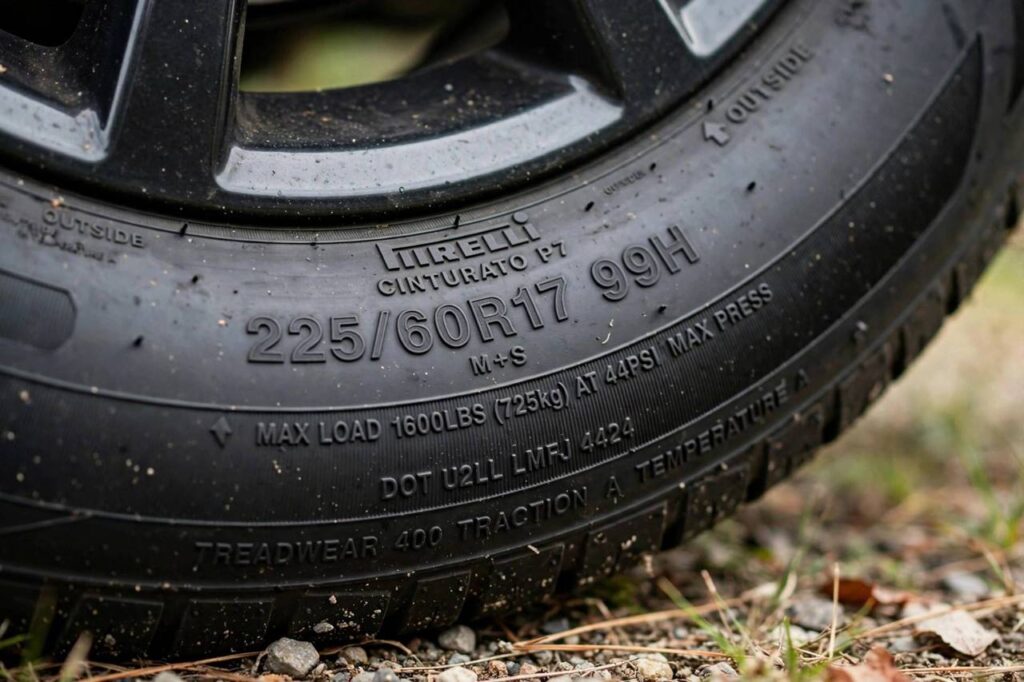
Walk up to any parked car, crouch down by a wheel, and look at the rubber next to the rim. You will find a ring of raised letters and numbers that looks like a serial code from a spy film. Learning how to read tire sidewall numbers is one of the most useful skills a driver can pick up, because those few characters tell you the exact size of the tire, how much weight it can carry, how fast it is rated to go, and even the week it was manufactured. Once you know the code, you can buy the right replacement tire, check that a shop fitted the correct one, and understand what your car was designed to run on. This guide decodes every part of the sidewall, in the order you will meet it, with a worked example at the end so you can read your own tires with confidence.
Where to Find the Sidewall Code
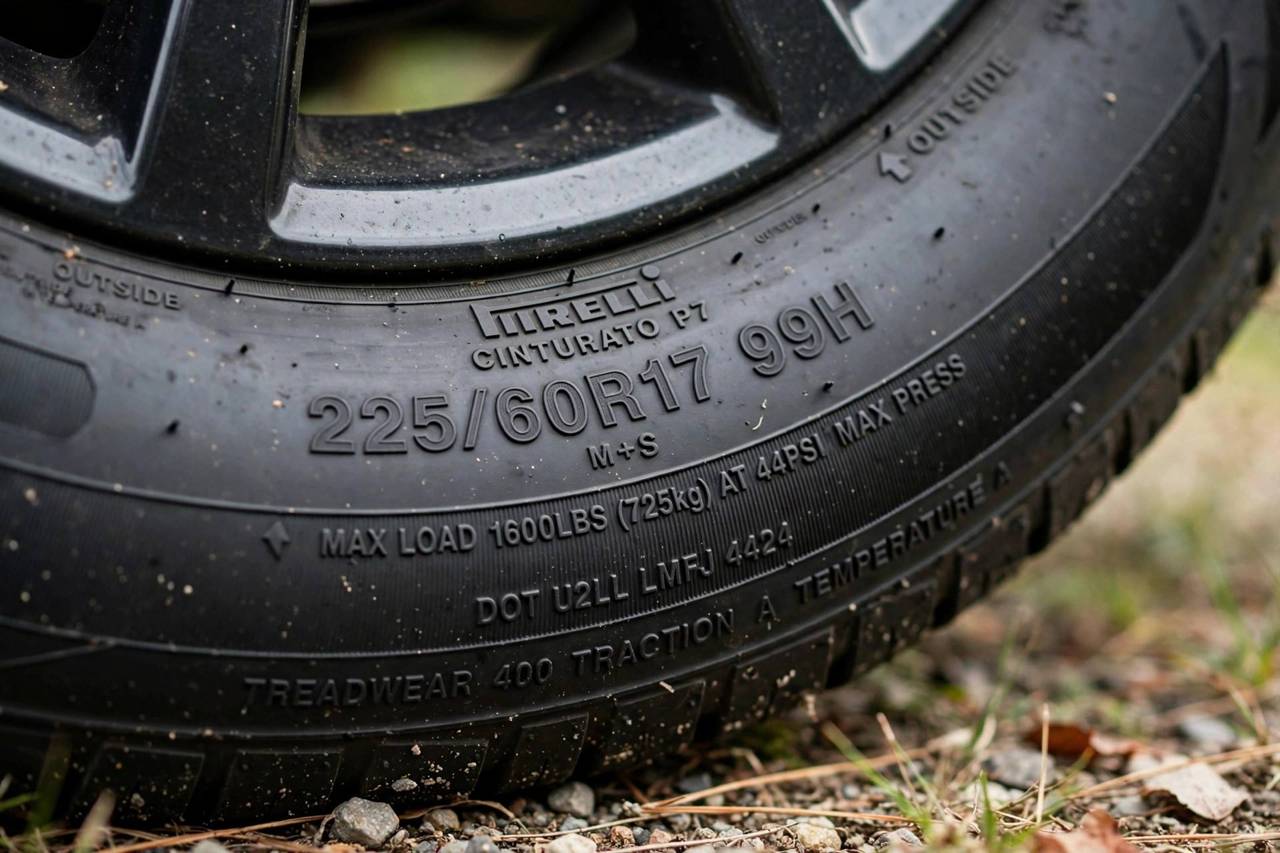
The main service description — the big code like P215/65R16 98H — is molded into the outer sidewall of every modern tire, usually right next to the brand name. It is raised rubber, so it stays readable for the life of the tire even when the tread is worn. If you have a tire with a raised white-letter look, the code sits on the black side. The DOT code, which reveals the tire’s age, is on the same sidewall but often stamped in a smaller oval near the bead. Some tires only carry the full DOT code on one side, so if you cannot find it, check the inner sidewall the next time the car is on a lift. Nothing on the wheel rim itself matters for this job; the rim carries its own separate markings.
The Main Size Code, Broken Down
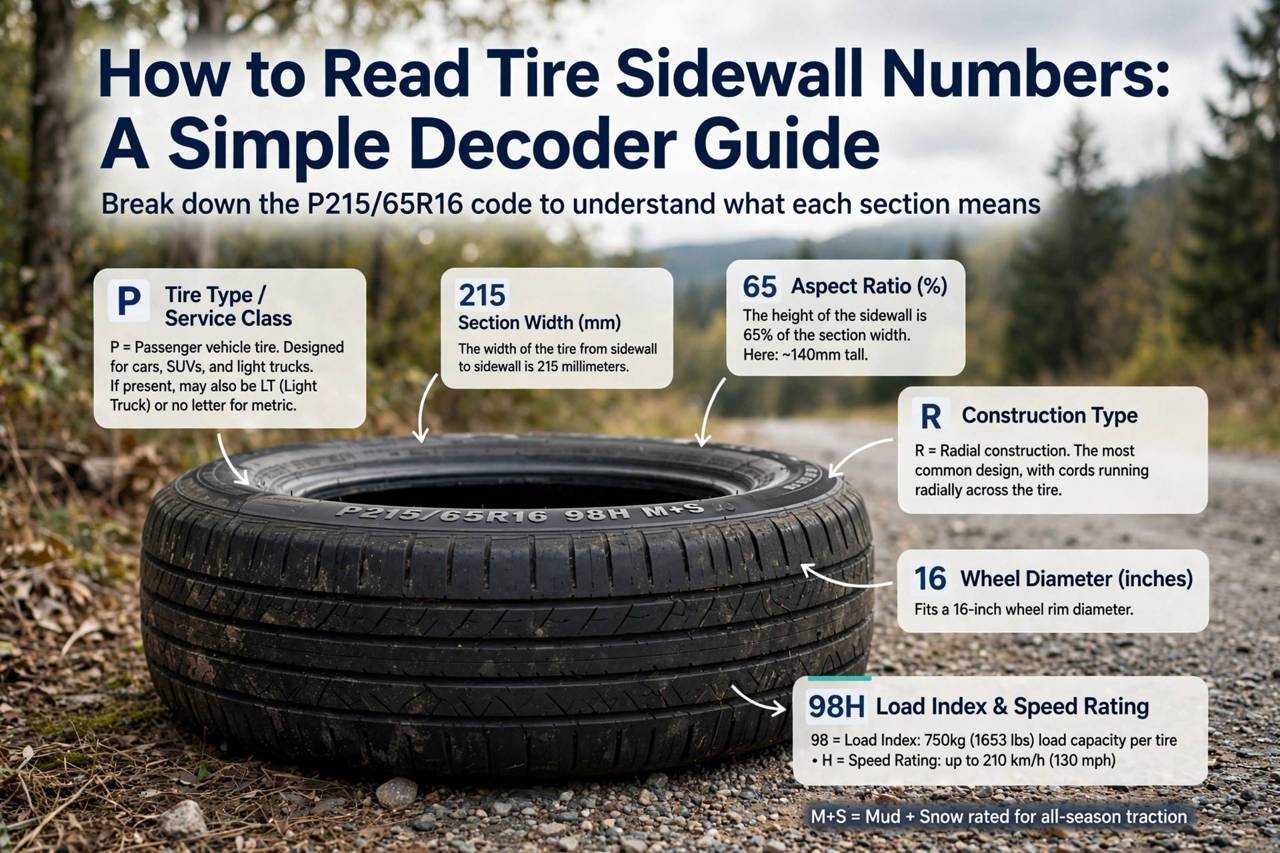
Almost every passenger tire starts with a code in this format: P215/65R16. Read left to right and each chunk tells you something specific. The letter at the start is the tire type: P means a passenger-car tire, LT means light truck, ST means special trailer service, and T means a temporary spare. If there is no letter at all, it is a metric tire built to European sizing, which is common on many modern cars. The first number, 215, is the section width in millimeters — the width of the tire from one sidewall to the other at its widest point. The 65 after the slash is the aspect ratio, the sidewall height expressed as a percentage of the width. So a 65-series tire has a sidewall height equal to 65 percent of 215 millimeters. The R stands for radial construction, which is how virtually every modern tire is built. The 16 at the end is the wheel diameter in inches that the tire fits. Get any of these wrong when buying tires and the new tire physically will not fit, or will throw off your speedometer and handling.
Load Index: How Much Weight Each Tire Carries
After the size code comes a number like 98, and right after it a letter like H. The number is the load index, a code that translates to the maximum weight a single tire can support when properly inflated. A load index of 98, for example, corresponds to 750 kilograms per tire, which means a set of four supports 3,000 kilograms. Never fit a replacement tire with a lower load index than the original equipment spec, because an under-rated tire can overheat and fail under a loaded car. Your car’s correct load index is listed on the driver’s door jamb placard and in the owner’s manual — not necessarily on the tire that happens to be fitted now, since a previous owner may have chosen something close-but-wrong. When in doubt, match or exceed the placard number.
Speed Rating: What the Final Letter Means
The letter after the load index is the speed rating, which tells you the maximum sustained speed the tire was tested to handle. Common ratings on family cars include S (up to 180 km/h), T (190 km/h), H (210 km/h), and V (240 km/h). This is not a suggestion to drive that fast; it is a measure of how the tire handles heat buildup at speed, and a higher rating generally means better high-speed stability. As with the load index, never go below the manufacturer’s specified speed rating. Going one step above is harmless but usually costs more and can ride slightly firmer. If you are buying winter tires, note that they often carry a lower speed rating than the summer set — that is normal and legal in most places as long as you respect the limit.
DOT Code: Reading Your Tire’s Birthday
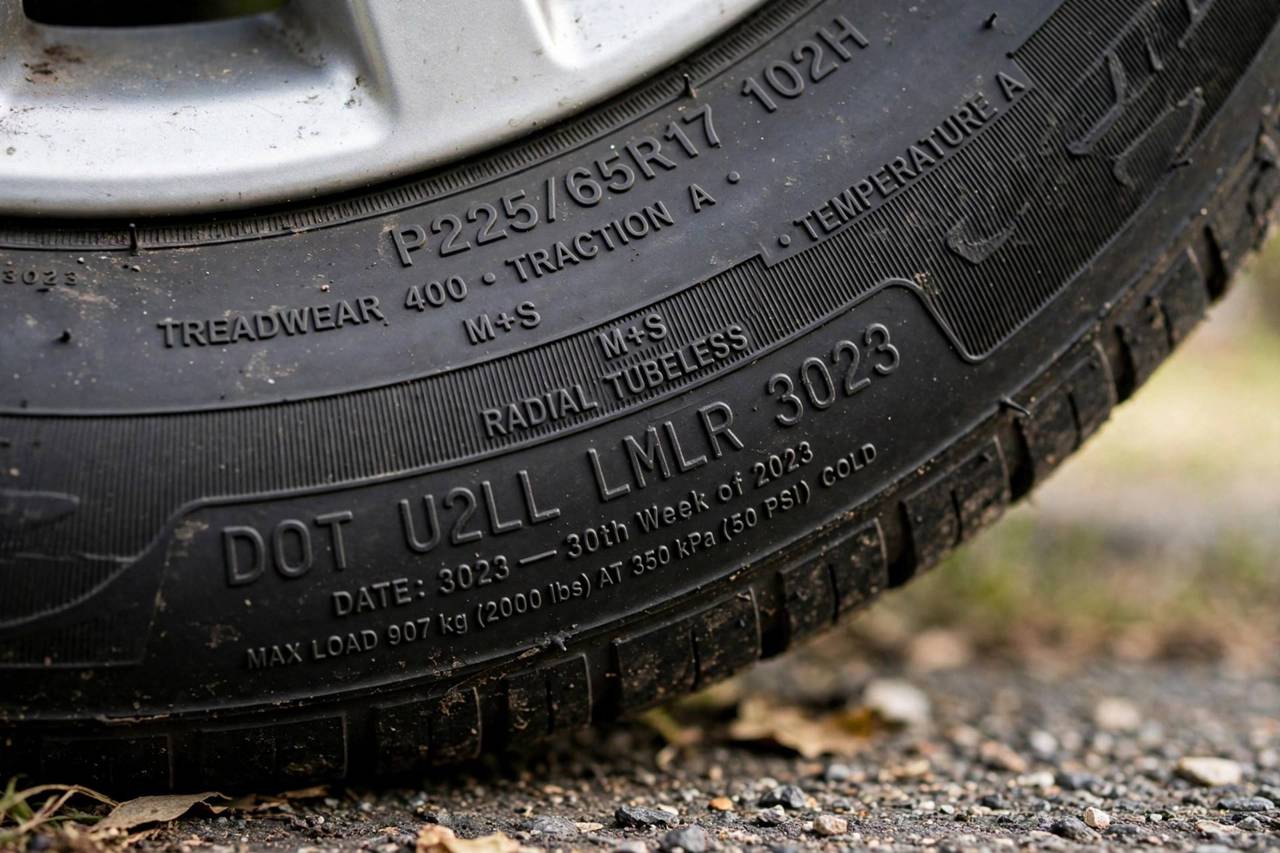
Every tire sold in many markets carries a DOT code, and the last four digits are the most useful numbers on the whole sidewall. They are the week and year of manufacture in WWYY format. A stamp reading 2319 means the tire was made in the 23rd week of 2019. This matters because rubber hardens with age even if the tread looks fine, and most tire professionals recommend replacing tires around six years after manufacture, regardless of tread depth. If you only see three digits, the tire was made before the year 2000 and should have been replaced long ago. When buying a “new” tire from a shop, always check the DOT date — a tire that has sat in a warehouse for four years is already most of the way through its safe life before it ever touches your car.
Treadwear, Traction, and Temperature Grades
Many tires also carry a UTQG stamp — the Uniform Tire Quality Grading — with three ratings. Treadwear is a number like 500: higher means the manufacturer expects longer tread life relative to a reference tire, so a 600 should outlast a 300 driven the same way. Traction is graded AA, A, B, or C and describes straight-line wet braking performance in testing, with AA the best. Temperature is also A, B, or C and rates how well the tire resists heat buildup. These grades let you compare tires within a brand reasonably well, though they are less reliable for comparing across different manufacturers since the testing is self-reported. Treat them as a rough guide alongside professional reviews and real owner feedback, not as gospel.
Extra Markings Worth Knowing
A few extra stamps appear depending on the tire. M+S or M/S means mud and snow, a basic all-season designation — it is not the same as the mountain-snowflake symbol, which marks a tire that passed a proper severe-snow traction test. XL or Extra Load means a reinforced tire that can carry more weight at higher pressure than the standard version of the same size. An arrow with the word ROTATION shows a directional tread that must be fitted to spin the right way; fitting it backwards ruins wet-weather grip. The word TUBELESS appears on nearly all modern tires. Finally, a small colored dot (usually red or yellow) near the bead is a factory balancing mark used during mounting, not something you need to decode as a driver.
A Worked Example: Reading Your Own Tire
Let us put it together with a real example you might find on a family sedan: P215/65R16 98H M+S. Reading left to right: P means a passenger-car tire; 215 means it is 215 millimeters wide; 65 means the sidewall height is 65 percent of that width; R means radial construction; 16 means it fits a 16-inch wheel; 98 is the load index, good for 750 kilograms per tire; H means it is rated for sustained speeds up to 210 km/h; M+S marks it as an all-season tire. Check the DOT code on the same tire for its birth week. Now walk out to your own car and read yours — it takes about thirty seconds per tire once you know the pattern, and you will never feel lost in a tire shop again.
Tire Pressure and Wear: Why the Numbers Matter Together
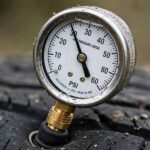
The sidewall numbers tell you what the tire is, but they do not tell you the pressure to run. That figure comes from the vehicle manufacturer, on the door jamb placard, because the same tire size on a heavier car needs more air. This is where drivers get into trouble: an underinflated tire flexes more, builds heat, wears the shoulders, and can fail at speed. Learn how to check your tire pressure with a gauge so pressure checks become a two-minute habit. It is also worth knowing uneven tire wear patterns, since the wrong size or pressure shows up there first. And if you are ever unsure what the placard asks for, read our guide to the correct tire pressure for your car before you guess.

How to Read Tire Sidewall Numbers: A 60-Second Reference
Here is the whole system on one tire, decoded in order. Take the example P215/65R16 98H. The P means passenger-car tire — the category the tire was built for. The 215 is the width in millimeters, measured across the tread. The 65 is the aspect ratio: the sidewall height is 65 percent of the width, so a lower number means a shorter, sportier sidewall and a higher number means a taller, more comfort-oriented one. The R means radial construction, standard on everything modern. The 16 is the wheel diameter in inches — this must match your wheels exactly. The 98 is the load index, the weight rating per tire, and the H is the speed rating. Then check the DOT code’s last four digits for the birth week and year. Photograph your sidewall before visiting a shop; having the exact code on your phone ends every sizing argument before it starts, and it lets you verify that the tires fitted match what you paid for.
Frequently Asked Questions
What do the numbers on a tire mean?
They describe the tire’s size, construction, load capacity, and speed rating. For example, in P215/65R16 98H, 215 is the width in millimeters, 65 is the sidewall height as a percentage of width, R means radial, 16 is the wheel diameter in inches, 98 is the load index, and H is the speed rating.
How do I read the tire manufacture date?
Find the DOT code on the sidewall. The last four digits give the week and year of manufacture — 2319 means the 23rd week of 2019. If there are only three digits, the tire was made before 2000 and should be replaced.
Can I fit a tire with a higher load index?
Yes. Matching or exceeding the manufacturer’s specified load index is safe. Never fit a tire with a lower load index or speed rating than the car was designed for.
What does M+S mean on a tire?
It stands for mud and snow, a basic all-season designation. It does not guarantee severe winter performance — look for the mountain-snowflake symbol for a tire tested in real snow conditions.
Do all four tires need the same sidewall numbers?
Ideally, yes. All four tires should match in size, load index, and speed rating. Mixing sizes can upset handling, braking balance, and all-wheel-drive systems, and it may be illegal in some jurisdictions.