What Is a Deposition? The Legal Process, Step by Step


The word “deposition” has two completely different meanings. In chemistry, it is the phase transition where gas becomes solid — frost forming on a window is deposition. But what is a deposition in legal terms? It is sworn, out-of-court testimony taken before trial. If you are ever a party or witness in a lawsuit, this is the deposition that will consume one very long day of your life.
What Is a Deposition? The Legal Definition
A deposition is a formal question-and-answer session, conducted under oath outside the courtroom, where a witness (called the deponent) answers questions from the attorneys in a lawsuit. A court reporter transcribes every word, creating an official transcript. Depositions are part of discovery — the pretrial phase where each side gathers evidence — and their purpose is to lock in testimony, uncover facts, and assess how a witness will perform at trial.
Think of it as a trial rehearsal with legal consequences: everything you say is recorded, under oath, and can be used later.
Who Can Be Deposed?
Almost anyone with relevant information. Parties to the lawsuit — plaintiffs and defendants — can be deposed by the opposing side as a matter of course. Non-party witnesses — bystanders, employees, experts — can be compelled to appear via subpoena. Expert witnesses hired by either side are routinely deposed about their opinions and methodology. Even corporate executives can be deposed about company matters, though courts sometimes limit “apex depositions” of high-level officials to prevent harassment.
How a Deposition Works, Step by Step
1. The notice or subpoena. The questioning attorney sends formal notice scheduling the deposition — date, time, location (usually a law office conference room). Non-parties receive a subpoena compelling attendance.
2. The oath. The court reporter swears the witness in, exactly as in court. From this moment, deliberate falsehoods carry perjury exposure.
3. Direct questioning. The attorney who noticed the deposition asks questions — about background, the events at issue, documents, conversations. This can run for hours; in federal court, depositions are generally limited to one day of seven hours.
4. Objections. The witness’s own attorney may object to improper questions (privileged information, harassment, form). In most cases the witness still answers “subject to the objection,” with the court ruling on admissibility later. The main exception: instructions not to answer on privilege grounds.
5. Cross-questioning. Other parties’ attorneys get their turn, probing or clarifying the testimony.
6. The transcript and errata. The court reporter produces a written transcript. The witness reviews it and may correct transcription errors (not change substantive answers freely) via an errata sheet.
Who Is in the Room?
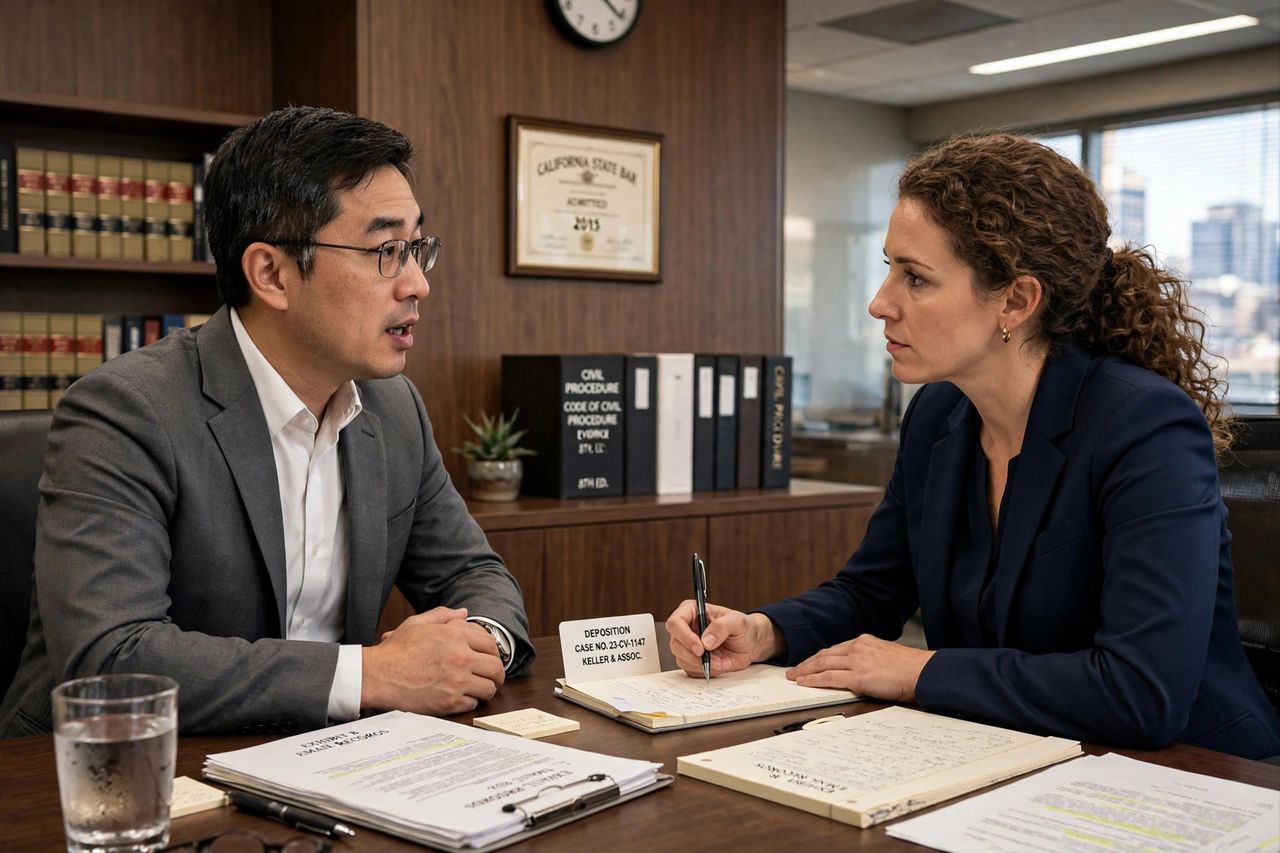
A deposition is less crowded than a courtroom but still formal. Present are the deponent (the witness), attorneys for each party, and the court reporter recording everything. A videographer may also record, creating video that can be played for a jury. There is no judge — which is precisely why attorneys prepare their clients so carefully beforehand.
Deposition vs. Trial Testimony vs. Interrogatories
These three discovery tools are easy to mix up. A deposition is live, oral, in-person (or remote) questioning under oath. Trial testimony happens before a judge or jury, months or years later, with formal rules of evidence enforced in real time. Interrogatories are written questions answered in writing, under oath, with the help of counsel — slower and more rehearsed, but useful for pinning down basic facts. Depositions are where lawyers do their real investigating: spontaneous answers reveal what polished interrogatory responses conceal.
How Deposition Testimony Gets Used at Trial
The transcript is a multipurpose weapon. If a witness testifies differently at trial, the attorney confronts them with the deposition — impeachment, devastating to credibility. If a witness becomes unavailable (illness, absence from the jurisdiction), the deposition can be read into the record as substitute testimony. Admissions made in deposition can be quoted in summary judgment motions. This is why lawyers drill one rule into clients: the deposition is not a conversation — it is testimony.
How to Behave in a Deposition: Practical Rules
Tell the truth. Always. Perjury in a deposition is perjury, full stop.
Listen to the entire question before answering. Half-heard questions produce damaging half-answers.
Answer only the question asked. Volunteering extra information hands the other side free ammunition.
Do not guess. “I don’t know” and “I don’t remember” are complete, honorable answers when true.
Pause before answering. It gives your attorney time to object and gives you time to think.
Stay calm and polite. Hostility reads terribly on a transcript — and worse on video.
Ask for breaks. You are entitled to them (though not mid-question to dodge an answer).
Can You Refuse to Be Deposed?
Parties to a lawsuit generally cannot refuse — depositions are a standard discovery right. Non-party witnesses served with a valid subpoena must appear or face contempt, though they can ask a court to quash or limit the subpoena for good cause (undue burden, privilege). The Fifth Amendment right against self-incrimination can be invoked question-by-question, but blanket refusals to attend are not an option.
What Is a Deposition? Remote vs. In-Person
The pandemic normalized remote depositions by video conference, and they have remained common — especially for out-of-state witnesses. The oath, the court reporter, and the transcript work the same way; only the room is virtual. Remote depositions save travel costs and scheduling headaches, but they introduce new dynamics: coaching concerns (is someone off-camera feeding answers?), exhibit-handling awkwardness, and the subtle credibility cues lost through a screen. Many attorneys still prefer in-person depositions for key witnesses, where they can read body language and control the environment. Courts generally allow remote depositions by agreement or order, and the trend favors their continued use for routine witnesses.
Deposition Objections, Explained
Objections in depositions work differently than at trial — there is no judge to rule on them in the moment. The main categories:
“Objection, form.” The question is leading, compound, vague, or otherwise poorly constructed. The witness usually still answers, and the objection is preserved for trial.
“Objection, privilege.” The question seeks attorney-client communications or other privileged material. Here the attorney may instruct the witness not to answer — one of the few situations where silence is proper.
“Objection, harassing / argumentative.” The questioning has crossed from inquiry into badgering. Typically noted for the record; the witness answers.
Speaking objections. Lengthy objections that suggest answers to the witness (“objection — don’t you mean you didn’t see the contract?”) are improper in most jurisdictions; objections should be stated concisely.
The practical rule for witnesses: when your lawyer objects, pause — let them finish — then answer unless they explicitly instruct you not to. The transcript records both the objection and your answer, and the court sorts it out later.
Preparing for Your Deposition: The Attorney’s Playbook
Good lawyers prepare clients with a preparation session covering three areas. Substance: reviewing key documents and timelines so testimony is accurate and consistent. Mechanics: the rules above — listen, pause, answer only what’s asked, never guess. Psychology: staying calm under provocative questioning, not treating the opposing lawyer as an enemy, and understanding that “I don’t remember” is honorable when true but suspicious when overused. Mock questioning — the attorney playing the opponent — is the gold standard of preparation. Witnesses who have been “deposed” in practice before the real thing perform markedly better: less volunteering, fewer contradictions, steadier demeanor.
Deposition Transcripts: The Errata Sheet Rules
After the deposition, you receive the transcript for review — and the right to correct it via an errata sheet. The legitimate uses: fixing transcription errors (the reporter heard “can’t” as “can”), correcting names and dates, clarifying garbled passages. The controversial use: changing substantive answers because you thought of a better one later. Courts are split on how freely witnesses may rewrite testimony via errata; many hold that material changes are permissible but the original answer stays in the record too — and opposing counsel will gleefully confront you with the change at trial (“so which is it?”). The errata sheet is a proofreading tool, not a second chance. Treat it accordingly.
Depositions and Settlement: The Hidden Leverage
Depositions rarely make headlines, but they drive settlements constantly. A strong deposition — where a key witness admits damaging facts or crumbles under cross-examination — often triggers settlement talks within days, because both sides can now price the trial risk accurately. Conversely, a witness who performs brilliantly may harden the other side’s resolve to fight. Experienced litigators describe depositions as the moment a case’s true value reveals itself: the posturing of pleadings gives way to sworn testimony, and fantasy settlement numbers collide with reality. This is why preparation matters so much — the deposition does not just record your testimony; it sets the price of your case.
Frequently Asked Questions
Is a deposition under oath?
Yes. The court reporter administers an oath before questioning begins, and the testimony carries the same perjury consequences as statements made in court.
What happens if you lie in a deposition?
Deliberately false testimony under oath is perjury, punishable by fines and imprisonment. Deposition lies are also easily exposed later, since the transcript preserves the exact words for comparison with other evidence.
How long does a deposition take?
Most last several hours; federal rules generally cap them at one day of seven hours of testimony. Complex cases with expert witnesses can run longer across multiple sessions.
Can a deposition be used in court?
Yes — to impeach a witness who changes their story, as substantive evidence if the witness is unavailable, and in pretrial motions. The transcript is one of the most versatile documents in litigation.
Who pays for the court reporter?
Typically the party who noticed (scheduled) the deposition pays the reporter’s appearance fee, while each side pays for its own copy of the transcript. Video recording costs follow the same pattern.
What should you bring to a deposition?
Your attorney will advise you, but generally: identification, any documents you were asked to produce, and nothing else. Leave the editorializing at home — short, truthful answers win depositions.
A deposition is where cases are quietly won and lost, months before any jury is seated. Treat it with the gravity of trial testimony — because legally, that is exactly what it is.