Are Verbal Contracts Legally Binding? The Honest Answer


“We shook on it.” For most of human history, that was enough — a person’s word was the contract. So are verbal contracts legally binding today? The honest answer is yes, with exceptions big enough to swallow the rule. An oral agreement can be every bit as enforceable as a signed document — if it has the right ingredients and does not fall into one of the categories the law insists must be written down.
Are Verbal Contracts Legally Binding? The Short Answer
Yes. In general, oral contracts are enforceable provided they contain the same essential elements as written ones. Courts routinely enforce handshake deals, verbal service agreements, and spoken promises — the absence of paper does not make an agreement imaginary. The practical problem is never validity; it is proof. When memories differ and no document exists, enforcing the contract becomes a credibility contest.
The Five Elements Every Contract Needs
Written or spoken, a contract requires the same building blocks:
1. Offer. One party proposes specific terms — “I’ll paint your house for $3,000.”
2. Acceptance. The other party agrees to those terms — “Deal.”
3. Consideration. Each side gives something of value — money for services, goods for payment. Promises without consideration are generally not contracts.
4. Mutual assent (meeting of the minds). Both parties understood and agreed to the same terms. If one thought “paint the house” meant exterior only and the other meant interior too, there may be no real agreement.
5. Capacity and legality. The parties must be legally able to contract (adults of sound mind, generally), and the subject matter must be lawful. A verbal agreement to commit a crime is not an enforceable contract.
Miss any element and there is no contract — written or otherwise.
The Big Exception: The Statute of Frauds
Some agreements must be in writing to be enforceable, under a doctrine called the Statute of Frauds (originating in 17th-century England, adopted across the U.S. with variations). The classic categories:
Real estate transactions. Buying, selling, or leasing land for extended terms must be written. The handshake sale of a house is not enforceable.
Contracts that cannot be performed within one year. A verbal three-year employment agreement generally fails here.
Promises made in consideration of marriage. Prenuptial-type promises require writing.
Guarantees of another person’s debt (suretyship). “I’ll cover his loan if he defaults” needs to be written.
Sales of goods above a statutory threshold. Commercial law sets a dollar threshold above which goods contracts must be written.
States add their own variations, but these five are the core. If your agreement falls in one of these buckets and it is only verbal, a court will likely refuse to enforce it — no matter how clear the promise was.

How Do You Prove a Verbal Contract in Court?
This is where oral agreements live or die. Courts accept several forms of evidence:
Witness testimony. Someone who heard the agreement being made is the most direct proof.
Partial performance. If one side already did the work or paid money under the agreement, that conduct strongly corroborates the contract’s existence and terms.
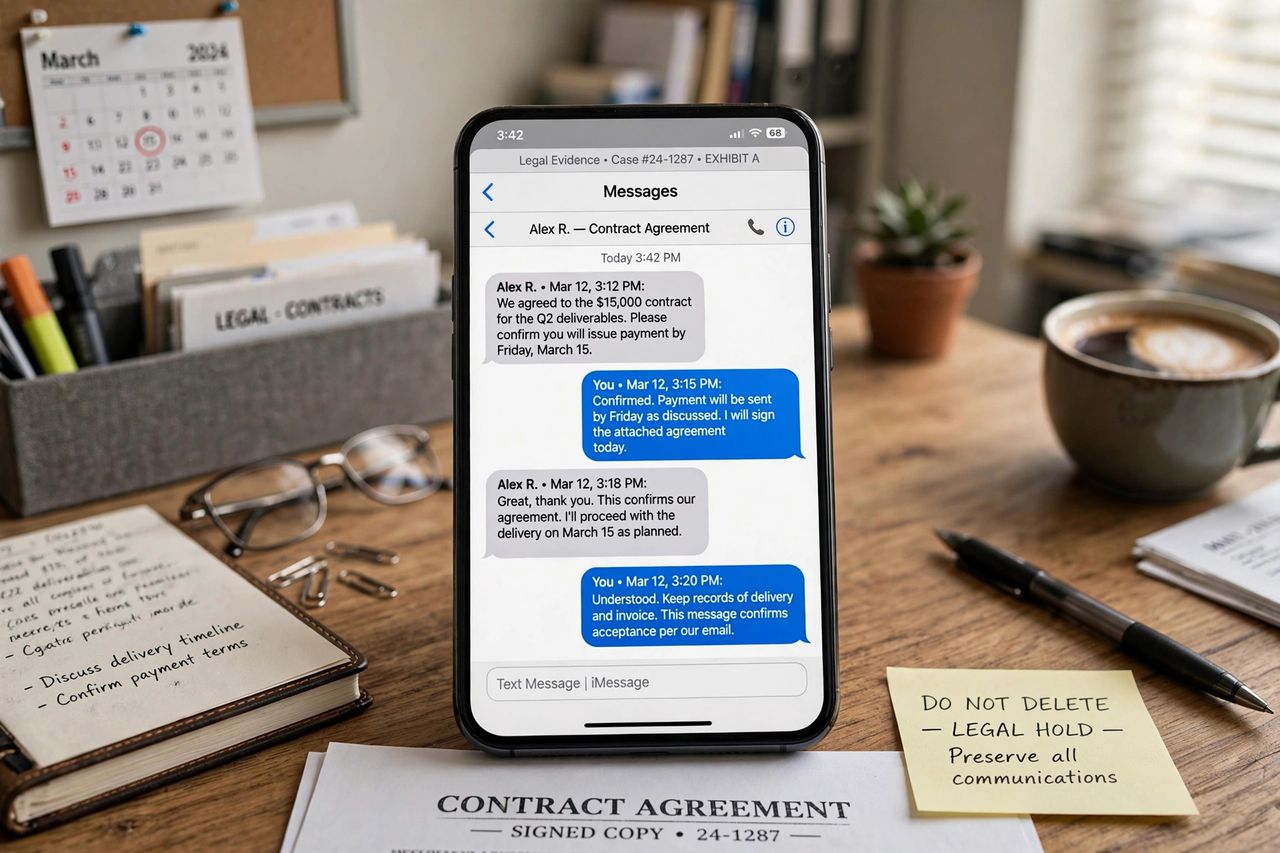
Texts, emails, and messages. A follow-up text saying “great, see you Monday to start the paint job” can memorialize a verbal deal — and may even satisfy writing requirements in some contexts.
Receipts and payment records. Money changing hands in amounts matching the claimed terms tells a persuasive story.
Prior dealings. A history of similar transactions between the parties helps establish what was agreed.
Judges decide these cases by weighing credibility — which is why contemporaneous notes, messages, and witnesses matter enormously.
When Verbal Contracts Commonly Work Fine
Everyday life runs on oral agreements: hiring a babysitter, agreeing to mow a neighbor’s lawn for cash, small freelance gigs, restaurant reservations with catering terms. For low-stakes, short-term, immediately performed exchanges, verbal contracts are perfectly functional — the deal is done before anyone could dispute it.
When You Should Absolutely Get It in Writing
Real estate. Always. The Statute of Frauds demands it.
Employment terms. Salary, duties, duration, non-competes — memories of these diverge fast.
Loans between friends and family. Money plus informality is the classic relationship-destroyer; write it down.
Business partnerships. Profit splits, responsibilities, and exit terms must be documented.
Anything long-term or high-value. The bigger the stakes or the longer the timeline, the more essential the paper.
The rule of thumb: if you would be upset losing the amount involved, put it in writing.
What Happens If a Verbal Contract Is Breached?
The remedies mirror those for written contracts: compensatory damages (money to cover the loss), and in some cases specific performance (a court order to fulfill the promise, common in real estate — which, note, must be written anyway). The injured party must prove the contract existed, its terms, and the breach — the same proof problem discussed above, now with money on the line.
Protecting Yourself When Deals Stay Verbal
Sometimes writing a formal contract is impractical. In those cases: send a confirmation message afterward summarizing the terms (“Just confirming: $500 for the full yard cleanup this Saturday”); keep records of payments and performance; have a witness present for important terms; and note the date and details in your own records immediately. These habits cost nothing and can save a case.
Are Verbal Contracts Legally Binding Across Different States?
The short answer — yes, with Statute of Frauds exceptions — holds nationwide, but the details shift at state lines. Statutes of limitations for oral contracts vary: some states allow six years, others only two or three, and nearly all give written contracts longer. Statute of Frauds thresholds differ too — the goods-sale threshold and the real estate rules have state-specific quirks. A few states recognize implied contracts more readily, inferring agreement from conduct even without explicit words. And small-claims courts, where most verbal-contract disputes actually land, have their own simplified procedures and dollar limits that vary by state.
The practical implication: the general principles in this article travel well, but the deadlines and dollar thresholds do not. If you are enforcing (or defending) an oral agreement, the law of the state where the deal was made controls — and a quick consultation with a local attorney beats internet research when money is on the line.
Famous Disputes Over Verbal Agreements
History is littered with handshake deals that ended in courtrooms. Entertainment-industry lore is full of them — profit-participation promises made over dinners, later denied when the money arrived. Business partnerships formed on verbal equity splits have generated some of the bitterest litigation on record, with founders disputing percentages years after the company became valuable. Real estate has its share too: buyers who “agreed” on a price verbally, only to find the seller accepted a higher written offer — learning the hard way that the Statute of Frauds means what it says.
The pattern across these cases is remarkably consistent: the dispute is never about whether verbal contracts can bind — courts accept that they can. It is about what the terms were, with each side remembering the conversation differently. Every famous verbal-contract lawsuit is really a monument to the same lesson: write it down.
Promissory Estoppel: When There’s No Contract At All
Sometimes there is no contract — no consideration, no clear acceptance — yet courts still enforce a promise. The doctrine is promissory estoppel: if one person makes a clear promise, reasonably expects the other to rely on it, the other does rely on it to their detriment, and injustice can only be avoided by enforcement, the court may enforce the promise anyway. Classic example: an employer verbally promises a pension, the employee works decades relying on it, the employer reneges — courts have enforced such promises despite the absence of formal contract elements. Promissory estoppel is the law’s safety net for handshake deals that fail the technical test but offend basic fairness.
The One-Page Contract: Minimum Viable Paperwork
If formal contracts feel like overkill, use the middle path: a simple written memorandum. It needs only the essentials — who (full names), what (the work or goods), how much (price and payment timing), when (deadlines), and signatures (even electronic). One page, plain language, signed by both sides — emailed as a PDF for good measure. This is not legal paranoia; it is the cheapest insurance in business. The entire body of contract litigation exists because people skipped this step. Do not be a case study.
Verbal Contracts and the Gig Economy
Freelancers live in the world of informal agreements — a client call, a quoted price, a “let’s do it.” Platform-based gig work (rideshare, delivery, task apps) actually reduces verbal-contract risk, because the app’s terms create a written framework around every job. The danger zone is off-platform freelance work: design, writing, consulting, trades. For gig workers, the confirmation-text habit is career self-defense — a two-sentence message after every verbal agreement (“Confirming: $X for [deliverable] by [date]”) creates an enforceable record in seconds. Clients who balk at written confirmation are telling you something worth hearing before the work starts.
Frequently Asked Questions
Are verbal agreements enforceable in court?
Yes, if they contain the essential contract elements (offer, acceptance, consideration, mutual assent, capacity, legality) and do not fall under the Statute of Frauds categories requiring writing.
What evidence proves a verbal contract?
Witness testimony, partial performance, text messages or emails referencing the deal, payment records, and the parties’ prior course of dealing. The more corroboration, the stronger the case.
Which contracts must be in writing?
Under the Statute of Frauds: real estate transactions, agreements unperformable within one year, promises in consideration of marriage, guarantees of another’s debt, and goods sales above the statutory threshold — plus state-specific additions.
Can a text message count as a written contract?
Often yes. Many courts accept text messages and emails as satisfying writing requirements, since they create a fixed, attributable record of the terms. A confirmation text after a verbal deal is genuinely valuable evidence.
What if the other person denies the agreement existed?
Then it becomes a credibility contest decided by the judge or jury, weighing each side’s testimony against corroborating evidence. This is exactly why documentation matters — the party with texts, witnesses, or payment records usually wins.
How long do you have to sue over a verbal contract?
Statutes of limitations for oral contracts are set by state law and are typically shorter than those for written contracts — often just a few years. If you suspect a breach, do not wait to get advice.
A handshake is still a contract. It is just a contract with no backup copy — so make sure the terms are worth remembering, or better yet, worth writing down.