What Is Reasonable Doubt? The Criminal Standard Explained

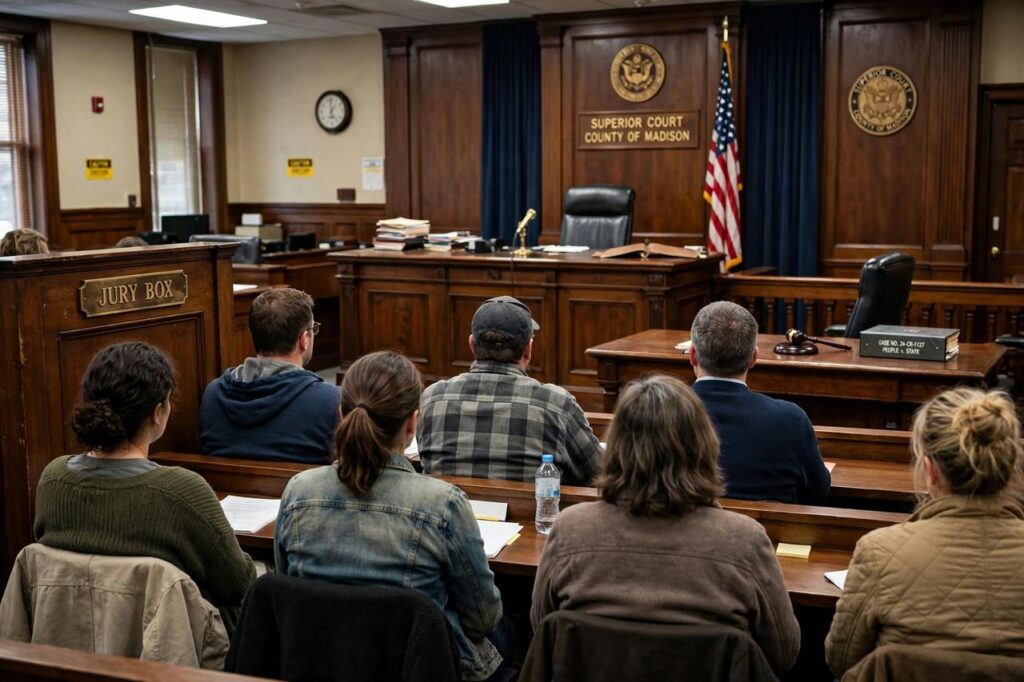
It is the most famous phrase in criminal law, the standard behind every “not guilty” verdict you have ever seen on screen. But what is reasonable doubt, precisely? It is not defined by a percentage, not written in any statute with mathematical precision — and yet it is the highest burden of proof known to the law, the barrier the state must clear before taking someone’s liberty.
What Is Reasonable Doubt? The Definition
Proof beyond a reasonable doubt is the standard the prosecution must meet to convict a defendant in a criminal case. It means the evidence must be so convincing that a reasonable person would have no reasonable hesitation about the defendant’s guilt. It does not mean proof beyond all doubt — absolute certainty is impossible in human affairs, and the law does not demand it. It demands the elimination of reasonable doubts, the kind grounded in reason and common sense rather than speculation or fanciful theories.
Judges typically instruct juries in language like this: reasonable doubt is not a mere possible doubt, but a doubt based on reason arising from the evidence (or lack of evidence). If, after considering all the evidence, you have such a doubt, you must acquit.
Why the Bar Is Set So High
The standard flows from a foundational principle: it is worse to convict an innocent person than to let a guilty one go free. The jurist William Blackstone famously formulated it as better that ten guilty persons escape than one innocent suffer — a ratio debated ever since, but the underlying value is settled. The state wields enormous power in a criminal prosecution — investigators, laboratories, the threat of prison — so the law counterbalances that power with the heaviest burden of proof it has.
This is also why the burden never shifts. The defendant does not have to prove innocence. The presumption of innocence means the accused arrives in court legally innocent, and stays that way unless the prosecution proves otherwise beyond a reasonable doubt.
Reasonable Doubt vs. Other Burdens of Proof
The law uses a ladder of proof standards, and reasonable doubt sits at the top:
Preponderance of the evidence — the standard in most civil cases. The claim is “more likely than not” true, just over 50 percent. This is the lowest rung.
Clear and convincing evidence — a middle standard used in certain civil matters like fraud or termination of parental rights. The claim must be highly probable, substantially more likely than not.
Beyond a reasonable doubt — the criminal standard. The highest rung, requiring near-moral certainty.
Probable cause — often confused with the trial standards, but it is far lower: the reasonable belief needed for an arrest or search warrant, decided long before trial.
The same set of facts can thus produce different outcomes in different courts — famously, a defendant acquitted criminally can still lose a civil case over the same events, because the civil standard is so much easier to meet.

What Reasonable Doubt Looks Like in Practice
Juries apply the standard to the evidence as a whole, not to each isolated fact. Consider how doubt operates across case types:
In a theft case: The prosecution shows the defendant’s fingerprints on a display case. The defense shows the defendant worked at the store and handled the case daily. A juror might reasonably doubt the fingerprint proves theft.
In an assault case: The only witness identifies the defendant, but the lighting was poor and the witness admitted uncertainty. Reasonable doubt can live in that uncertainty.
In a fraud case: Documents show misleading statements, but the defense produces emails suggesting the defendant genuinely believed them true. Criminal fraud requires intent — and doubt about intent is reasonable doubt about guilt.
Notice the pattern: reasonable doubt is not about whether something happened, but whether the evidence proves this defendant committed this crime with the required mental state.
Circumstantial Evidence Counts — Fully
A persistent myth holds that convictions require direct evidence like eyewitnesses or confessions. Not so. Circumstantial evidence carries the same legal weight as direct evidence — fingerprints, DNA, financial records, and timelines convict people every day. The question is never “was the evidence direct?” but “does the totality of the evidence eliminate reasonable doubt?” Many of the strongest cases ever prosecuted were built entirely on circumstantial evidence.
What Happens When Doubt Remains?
If even one juror retains a reasonable doubt, the jury cannot convict. If the jury cannot reach unanimity either way, the result is a hung jury — a mistrial, after which the prosecution may retry the case, offer a plea deal, or drop the charges. An acquittal, by contrast, is final: the Double Jeopardy Clause bars retrial after a not-guilty verdict, no matter what new evidence emerges.

Common Misconceptions
“Reasonable doubt means 95 percent sure” (or any number). Courts consistently refuse to quantify the standard. Assigning a percentage misleads more than it clarifies, and judges routinely reject attempts to put a number on it.
“The defense must prove innocence.” Never. The defense may present no evidence at all and still win, if the prosecution’s case leaves reasonable doubt.
“An acquittal means the defendant is innocent.” It means the prosecution failed to meet its burden. The verdict is “not guilty,” not “innocent” — a legal conclusion about proof, not a factual finding about what happened.
“Reasonable doubt applies in civil cases.” It does not. Civil cases use preponderance or clear-and-convincing standards — which is why the same conduct can lead to civil liability after a criminal acquittal.
What Is Reasonable Doubt? How Juries Are Actually Instructed
The concept reaches jurors through jury instructions — the judge’s plain-language explanation of the law before deliberation. While wording varies by jurisdiction, the classic formulations share DNA. Jurors are told that reasonable doubt is not a mere possible or imaginary doubt, but a doubt based on reason and common sense arising from the evidence or the lack of it. They are told the defendant is presumed innocent, that the presumption alone is sufficient to acquit unless overcome, and that the prosecution bears the burden throughout — it never shifts to the defense.
Appellate courts police these instructions carefully. An instruction that dilutes the standard — suggesting, say, that jurors convict if they feel the defendant is “probably” guilty — can reverse a conviction. The phrasing matters because the standard is the entire difference between a criminal trial and an educated guess.

Famous Cases That Turned on Reasonable Doubt
O.J. Simpson (1995). The archetypal reasonable-doubt acquittal. The prosecution presented substantial evidence, but the defense attacked the investigation’s integrity — mishandled evidence, a detective’s credibility collapse — until at least some jurors retained reasonable doubt. Whatever one’s view of the verdict, the case demonstrated the standard operating exactly as designed: doubt, reasonably grounded, requires acquittal.
Casey Anthony (2011). Acquitted of murder charges despite intense public conviction of guilt. The prosecution’s forensic evidence could not conclusively establish cause of death, and the jury found the remaining gaps constituted reasonable doubt — a verdict that outraged the public but followed the instruction.
The principle in both: public certainty is not legal proof. The standard deliberately frustrates the crowd’s desire for punishment when the evidence, however suggestive, leaves reasonable room for doubt. That frustration is the price of the protection.
Reasonable Doubt and Plea Bargaining
Here is the quiet truth about the criminal system: the vast majority of criminal cases never test reasonable doubt at trial, because they end in plea bargains. Defendants plead guilty — often to lesser charges — in exchange for reduced sentences, and prosecutors accept certainty over the risk of acquittal. The reasonable-doubt standard still shapes these negotiations profoundly: it is the prosecution’s trial risk that gives the defense bargaining leverage, and the defense’s fear of conviction that gives the prosecution theirs. The standard casts its shadow over every deal cut in every courthouse hallway, even when no jury is ever seated.
Does the Standard Work?
Critics argue reasonable doubt sets the bar so high that guilty people routinely escape justice; defenders answer that wrongful convictions — documented in the hundreds through DNA exonerations — prove the bar is barely high enough. Both sides cite the same reality: the system tolerates some guilty acquittals to minimize innocent convictions. Whether that trade-off is calibrated correctly is among the oldest debates in criminal justice, and it will not be settled here. What is settled is the rule itself: in a criminal courtroom, doubt that is reasonable is doubt that acquits.
Reasonable Doubt in Bench Trials
Not every criminal case gets a jury. In a bench trial, the judge serves as both legal referee and fact-finder, applying the reasonable-doubt standard directly. Defendants sometimes prefer this — particularly in technically complex cases (financial fraud, for instance) where they trust a judge to follow intricate evidence better than a lay jury, or in emotionally charged cases where they fear jury passion. The standard does not change: the judge must still be convinced beyond a reasonable doubt, and must acquit otherwise. Appellate courts review bench-trial verdicts with deference to the judge’s factual findings, reversing only where no reasonable fact-finder could have convicted — the same protective logic, wearing a different robe.
Frequently Asked Questions
What percentage is reasonable doubt?
There is none. Courts deliberately avoid quantifying the standard — it is a qualitative judgment about whether the evidence leaves room for reasonable hesitation, not a mathematical threshold.
Who decides whether reasonable doubt exists?
The jury (or the judge, in a bench trial). It is a factual determination made by the fact-finder after weighing all the evidence, not a legal ruling the judge makes for them.
Does reasonable doubt apply in civil cases?
No. Civil cases use lower standards — usually preponderance of the evidence. Reasonable doubt is reserved for criminal prosecutions, where liberty is at stake.
Can someone be convicted on circumstantial evidence alone?
Yes. Circumstantial evidence has the same legal standing as direct evidence. What matters is whether the evidence as a whole eliminates reasonable doubt, not what category it falls into.
Does the defendant have to prove anything?
No. The burden of proof rests entirely on the prosecution from start to finish. The defendant is presumed innocent and may remain silent without penalty.
What happens if the jury cannot agree?
The jury is “hung,” resulting in a mistrial. The prosecution then decides whether to retry the case, negotiate a plea, or dismiss the charges.
Reasonable doubt is the law’s admission of its own fallibility — a built-in humility that says the power to punish must always clear the highest bar we have. That is not a loophole. It is the point.