How to Style a Trench Coat for Every Occasion


There are few garments with the staying power of the trench coat. It has been in fashion for over a century, survived every trend cycle, and still manages to make any outfit underneath it look more intentional. But knowing how to style a trench coat — really style it, beyond just throwing it over things — is a skill worth developing. I have worn trenches through a decade of springs and autumns, and I have learned that this single coat contains multitudes: office armor, weekend ease, evening polish. Here is how to unlock all of it.
The trench’s magic is structural: the belted waist creates shape, the length adds drama, the gabardine drapes beautifully, and the neutral color goes with everything. It is the rare outerwear that elevates rather than covers. But like any strong piece, it rewards a little thought about proportion, layering, and occasion.
Getting the Fit Right
Before styling, fit. A trench should skim, not swallow. The shoulder seams should sit at your shoulders, the sleeves should end at the wrist (showing a sliver of cuff is classic), and the belt should cinch at your natural waist without pulling. The classic length hits around the knee — timeless and versatile. Shorter trenches read more casual and modern; full-length ones are dramatic and best on taller frames.
The belt is the styling tool built into the coat. Tied in front at the waist is the classic. Tied at the back creates a looser, more relaxed silhouette that shows off what is underneath. And the half-tuck — belting loosely with the front open — is the insouciant French way that looks effortless and takes practice to actually look effortless.
How to Style a Trench Coat for the Office
The trench is office outerwear royalty. Over a suit or tailored separates, it is the professional finishing layer — the coat equivalent of a firm handshake. Belt it closed over a sheath dress or trousers-and-blouse, add structured shoes (loafers, low heels, polished boots), and carry a structured bag. The color palette underneath can be anything; the beige trench harmonizes with all of it.
For business-casual offices, the trench works open over the everyday uniform: dark jeans or trousers, a knit top, clean sneakers or loafers. The coat does the “professional” work so the rest can relax. This is the trench’s great gift to office dressing — it makes the commute outfit and the meeting outfit the same outfit.
Weekend and Casual Styling
Off-duty, the trench gets thrown over everything: jeans and a tee, leggings and an oversized sweater, a hoodie and sneakers. The contrast between the coat’s polish and the casualness underneath is the whole look — it is why the trench-and-sneakers combination has endured. Tie the belt loosely or leave it open; the vibe is “I just grabbed my good coat,” even if you planned it.
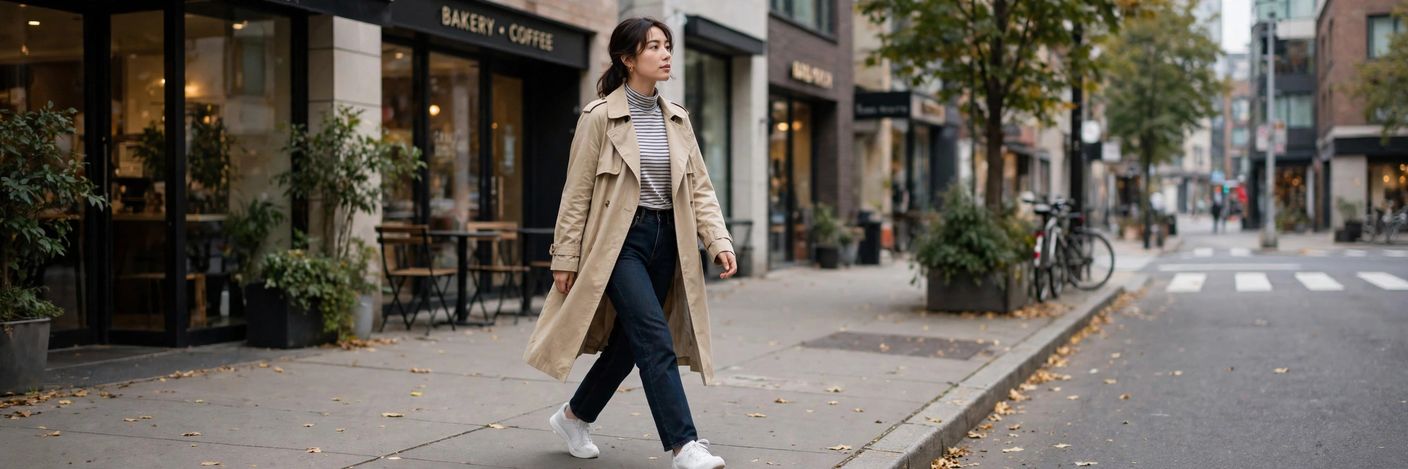
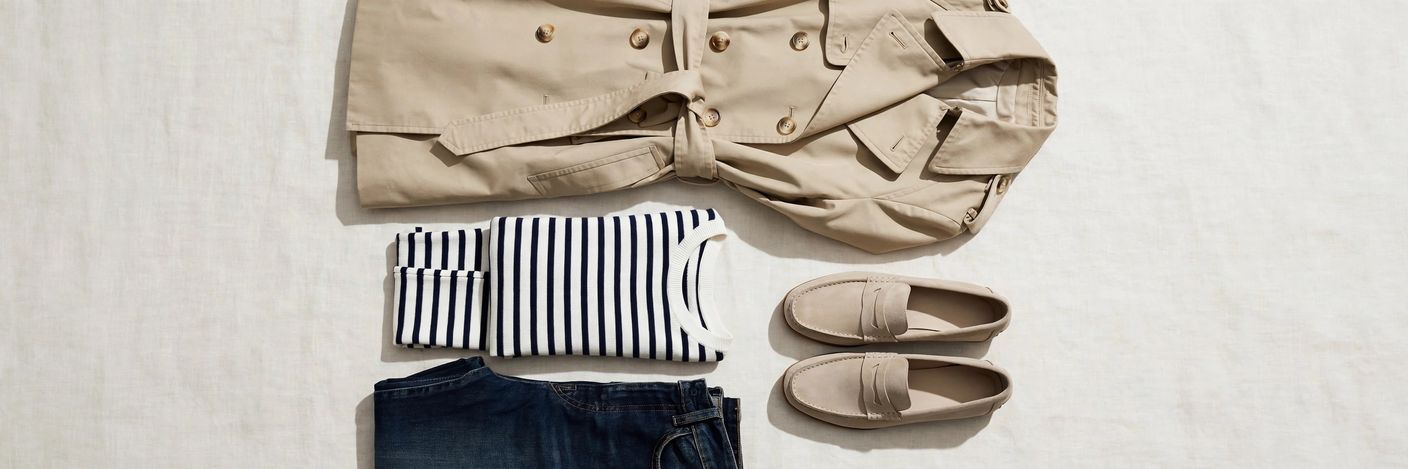
A striped Breton top under a trench is the Franco-casual cliché that works every single time. White sneakers, straight-leg jeans, trench: done. It is practically a uniform, and uniforms exist because they work.
Evening: Dressing the Trench Up
For evenings, the trench becomes outerwear for occasions. Over a cocktail dress or an elegant jumpsuit, belted closed, with heels and a clutch, it is the sophisticated layer that gets you from the car to the venue. The key detail: what shows below the hem. A dress that ends well above the trench’s hem looks deliberate; a dress that ends at an awkward mid-point with the coat looks accidental. Match the lengths or let the dress be clearly shorter.
Black trenches deserve mention here — while beige is the classic, a black trench over evening wear is sleek, dramatic, and arguably more versatile after dark. If you own both, you have every evening covered.
Seasonal Styling
Spring: The trench’s home season. Over light layers — a tee and jeans, a spring dress with bare legs (or not), sneakers or loafers. The classic trench weather is 50–65°F with a chance of drizzle, which is exactly what the coat was invented for.
Fall: Layer underneath: a sweater, a scarf, boots. The trench handles autumn’s temperature swings better than a heavy coat because you can adjust what is under it. This is also the season for the trench’s richer companions — burgundy knits, brown leather boots, plaid scarves.
Winter: The trench is not a winter coat on its own, but layered over a warm sweater with a scarf, hat, and gloves, it works for mild winter days. In genuinely cold climates, it is a transitional piece — know its limits.
Summer: Lightweight, unlined trenches work for cool summer evenings and air-conditioned everything. A trench over a summer dress for an evening event is a classic warm-weather move.
The Trench With Different Outfits
With dresses: The trench loves dresses. Midi dresses in any style, mini dresses with the coat adding coverage and contrast, maxi dresses with the coat open and flowing. The belt defines the waist over looser dresses; worn open, the coat frames the dress like a gallery frame.
With skirts: Pleated midi skirts and trenches are a match made in heaven — the swish factor doubles. Pencil skirts with a belted trench read office-powerful. Keep the skirt’s hem at or above the coat’s hem for the cleanest line.
With trousers: Wide-leg trousers and a trench are the fashion-editor combination — dramatic, modern, endlessly chic. Straight-leg and slim trousers work too; the coat adds the volume on top. Cuff the trousers slightly to show ankle and shoe — proportion matters when there is this much fabric.
With denim: The trench elevates denim instantly. Dark jeans for polish, light-wash for casual contrast, denim skirts for a double-denim-adjacent look that somehow works when a trench is involved.
Color Variations
Beige (or “trench” / stone) is the classic for a reason — it goes with everything and it is the color the coat is famous in. But the trench comes in a full wardrobe now. Black is sleek and evening-ready. Navy is the quiet professional alternative to beige. Olive and khaki green lean casual and modern. And then there are the fashion colors — burgundy, camel, even pastels — which are fun as a second trench but rarely as the first.
If you are buying your first trench, buy beige. If you are buying your second, buy for your wardrobe’s gaps. The beige trench is the foundation; everything else is personality.
Styling Details That Elevate
A few details separate trench-wearers from trench-stylers. Pop the collar — the upturned collar is the coat’s signature insouciance. Push up the sleeves to show cuff and bracelet. Cinch the belt’s buckle at the back for the relaxed drape. Let the back vent move — the trench is designed to flow when you walk, so walk like it.
Scarves and trenches are natural partners: a silk scarf at the neck for polish, a chunky knit for warmth, a blanket scarf for drama. Bags: structured for office, crossbody for weekend, clutch for evening. Shoes set the register — sneakers say casual, boots say autumn, heels say evening, loafers say classic. The trench adapts to all of them.
Caring for Your Trench
A good trench is an investment, so treat it like one. Most cotton-gabardine trenches can be machine washed on gentle, but check the label — some need dry cleaning. Reproof water-resistant coatings every couple of seasons with a spray. Store on a sturdy hanger to keep the shoulders’ shape, belt tied loosely to avoid creasing. A well-kept trench lasts decades; the vintage ones in thrift stores are proof.
And if you are building a wardrobe around versatile, hard-working pieces like the trench, the same philosophy applies to everything else you own — a thoughtfully built capsule wardrobe is how a trench coat earns its keep across hundreds of outfits instead of dozens.
The Trench as a Travel Coat
Frequent travelers swear by the trench for a practical reason beyond style: it is the perfect airplane and travel coat. It layers over anything, the belt keeps it compact when carried, and it looks polished on arrival in a way that a puffer never will. For travel, choose a water-resistant gabardine trench, wear it over your bulkiest layers to save luggage space, and use the deep pockets for passport, phone, and boarding pass.
The wrinkle factor is kinder than you would expect — gabardine bounces back from being folded in an overhead bin far better than wool or linen. Hang it the moment you arrive and it is ready for dinner. One coat that handles the plane, the meeting, and the evening is the definition of packing smart.
Vintage and Secondhand Trenches
Some of the best trench coats in the world are not in stores — they are in thrift shops, vintage boutiques, and estate sales, waiting for someone who recognizes quality. The classic makers’ vintage trenches are legendary for a reason: the gabardine, the construction, the hardware were built to last generations, and a well-kept vintage trench often outclasses a new mid-range one.
What to look for: intact lining, working buttons and buckles, a belt without fraying, and fabric without thinning at the stress points (elbows, pocket edges, collar fold). Minor issues — a missing button, a loose hem — are cheap fixes at a tailor. Musty smell airs out; set-in stains do not. And always check the size with the belt cinched, since vintage sizing runs differently — try it on, belt it, move in it, and trust the mirror over the label.
Frequently Asked Questions
What is the difference between a trench coat and a raincoat?
A trench is a specific classic design — belted waist, epaulettes, storm flap, usually in gabardine — while a raincoat is any waterproof coat. Every trench handles rain, but not every raincoat is a trench.
Can petite women wear trench coats?
Yes. Choose a cropped or above-the-knee length, keep the belt cinched to define your waist, and make sure the sleeves do not swallow your hands. A full-length trench can overwhelm a small frame.
How do I clean a trench coat?
Check the label first — most classic trenches need dry cleaning because of the bonded fabric and construction. Spot-clean small marks with a damp cloth, and never machine-wash a structured trench unless the label allows it.
What shoes go with a trench coat?
Almost everything: loafers, ankle boots, white sneakers, ballet flats, knee-high boots. The trench is neutral enough to anchor any of them — match the shoe to the occasion, not the coat.
Can men wear trench coats casually?
Absolutely. Worn open over a t-shirt and jeans with sneakers, a trench reads as effortless rather than formal. The casual styling is half the point of owning one.
Common Questions
What do you wear under a trench coat?
Almost anything — that is the point. Dresses, jeans and a top, tailored trousers, skirts, even athleisure. The trench adapts to the formality of what is underneath.
Should a trench coat be belted or open?
Both, for different effects. Belted is polished and defines the waist; open is relaxed and shows off the outfit underneath. Belted at the back is the in-between — relaxed but still shaped.
What length trench coat is most flattering?
Knee-length is the most versatile and flattering on most figures. Petite frames often do better with slightly shorter cuts; taller frames can carry full-length dramatically.
Can you wear a trench coat in winter?
As a standalone coat, only in mild winters — but layered over warm knits with scarf, hat, and gloves, it works for transitional cold. In deep winter, it is a layering piece, not the main event.
Are trench coats still in style?
Perennially. The trench has been in style for over a century and shows no signs of leaving. It is one of the safest fashion investments in existence.