Small Apartment Wall Decor Ideas That Make Tiny Rooms Feel Bigger

When I moved into my first 480-square-foot apartment (a studio, so studio apartment decorating ideas were my bible that year), I made the classic mistake: I bought furniture first and completely ignored the walls. For three months I lived in a beige box that felt smaller every single day, and I couldn’t figure out why. Then a friend came over, looked around, and said, “Olivia, your walls are doing absolutely nothing for you.” She was right. Within a weekend of hanging art, adding a mirror, and putting up two floating shelves, the same apartment felt twice as interesting and somehow larger. I’ve been mildly obsessed with walls ever since.
Here’s the thing most people get wrong about small apartment wall decor: they treat walls as an afterthought, or they go the opposite direction and cover every inch until the room feels like a cluttered cave. The sweet spot is in the middle. Your walls are the largest “furniture” you own — they just happen to be vertical. Used well, they add personality — and for the rest of the room, these small apartment decorating ideas cover the bigger picture, create the illusion of space, and give you storage without stealing a single square foot of floor.
Everything below is renter-friendly unless I say otherwise, because most of us in small apartments don’t own the drywall. No giant holes, no lost security deposits.
In this guide:
- Start With a Plan, Not a Shopping Cart
- Gallery Walls That Don’t Shrink the Room
- Mirrors: The Oldest Trick That Still Works
- Shelves That Decorate and Store
- Large-Scale Art in Small Spaces (Yes, Really)
- Renter-Friendly Ways to Hang Almost Anything
- Mistakes That Make Small Walls Feel Smaller
Start With a Plan, Not a Shopping Cart
Before you buy a single frame, do what I call the “wall audit.” Stand in the doorway of each room and photograph the walls. You’ll immediately see what I mean: most small apartments have one wall doing all the visual work (usually wherever the TV or bed is) and three walls doing nothing. Your goal is to spread interest around so the eye travels, which is what makes a room feel bigger.
Next, decide on one job per wall. A wall can be a focal point (the star), a supporting player (texture or color that backs up the focal wall), or a quiet wall (mostly empty, giving your eyes a rest). Small rooms need at least one quiet wall. I know that sounds counterintuitive when you’re trying to decorate, but negative space is what makes the decorated walls look intentional instead of chaotic. It is a very minimalist instinct — here is what minimalism actually means beyond the white-box stereotype.
Finally, pick a loose color story before you shop. You don’t need to be precious about it — mine was “warm neutrals with green and brass” for two years — but having three to four colors in mind keeps a gallery wall from looking like a yard sale exploded. Lay everything on the floor and arrange it there first. I trace each frame on kraft paper, tape the paper to the wall, and live with it for a day before committing. It feels fussy. It saves you from the special regret of eleven nail holes in a rental wall.
Gallery Walls That Don’t Shrink the Room
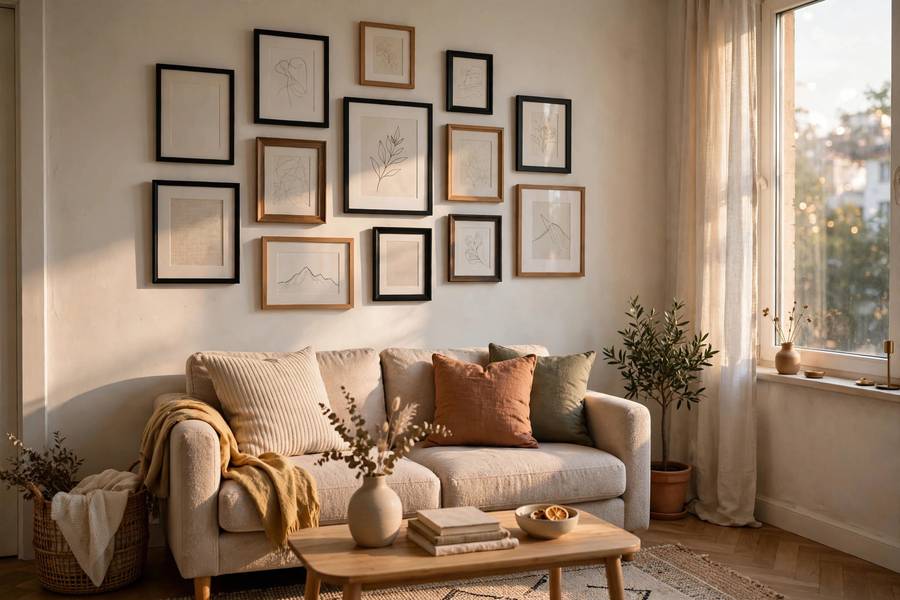
Gallery walls get a bad reputation in small spaces, and honestly, most of the ones I see deserve it. The problem is never the gallery wall itself — it’s scale and spacing. Tiny frames with wide gaps read as visual clutter. The fix is simple: keep spacing tight (two to three inches between frames), and anchor the whole arrangement with at least one larger piece.
My favorite layout for small apartments is the “controlled cluster”: five to seven pieces arranged in a rough rectangle over a sofa, console, or bed. Start with your biggest piece slightly off-center, then build outward. Mix frame styles if you want — I like black frames with one or two natural wood ones — but repeat at least one element (same mat color, same frame finish, or a recurring subject like plants) so it reads as a collection, not a pile.
What goes in the frames matters less than you think. I’ve framed pages torn from old calendars, my grandmother’s recipe cards, black-and-white photos printed at the drugstore for a dollar each, and one very good postcard from a museum gift shop. The most complimented piece in my apartment is a $4 print of a botanical illustration in a $12 frame. Nobody has ever asked what I paid. They ask where I found it, which tells you everything about how people actually experience wall decor.
Where gallery walls work best
Hallways are the unsung heroes here. A narrow hallway with a tight row of same-size frames at eye level feels like a gallery instead of a tunnel. Stairwells, the wall beside your bed, and the dead space above a desk all work. The one place I’d skip: directly opposite a mirror or window, where reflections can make the arrangement feel doubled and busy.
Mirrors: The Oldest Trick That Still Works
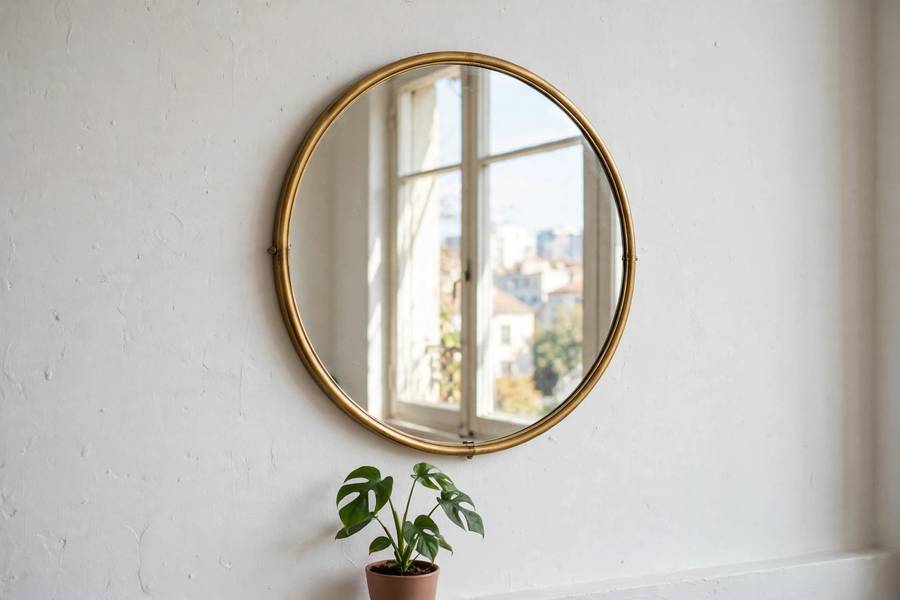
Every decorator on earth will tell you mirrors make small rooms feel bigger, and they’re right, but placement is everything. A mirror opposite a window doubles your natural light — genuinely the single highest-impact thing you can do to a dark small apartment. I put a 24-by-36-inch mirror on the wall perpendicular to my living room window and the afternoon light started reaching the kitchen. It felt like I’d added a window.
What doesn’t work: a mirror facing a cluttered wall (it doubles the clutter), a mirror at an angle that reflects the TV (distracting glare), or a tiny decorative mirror hung so high nobody sees anything in it but ceiling. Hang mirrors at a height where they reflect something worth seeing — a window, a plant, a nice piece of art — and where you can actually see yourself if it’s near an entryway.
If one big mirror feels like too much commitment, try a set of three small round mirrors in a vertical or horizontal line. Arched mirrors are having a long moment for good reason: the curve softens all the rectangles in a small room (sofa, TV, bookshelf, rug) and they photograph beautifully if you care about that sort of thing.
Shelves That Decorate and Store
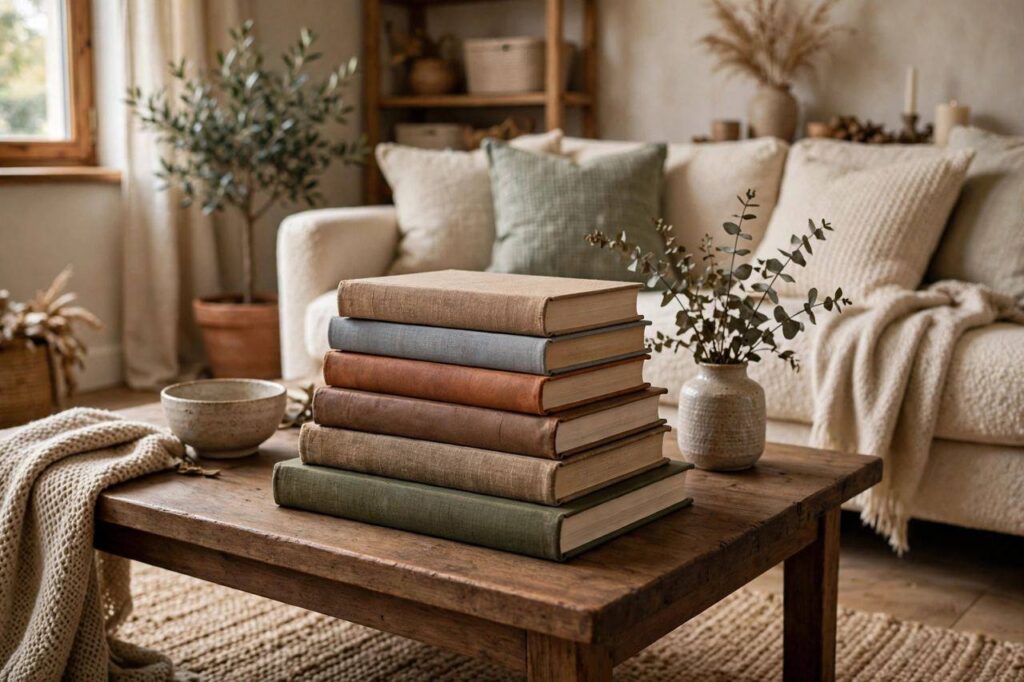
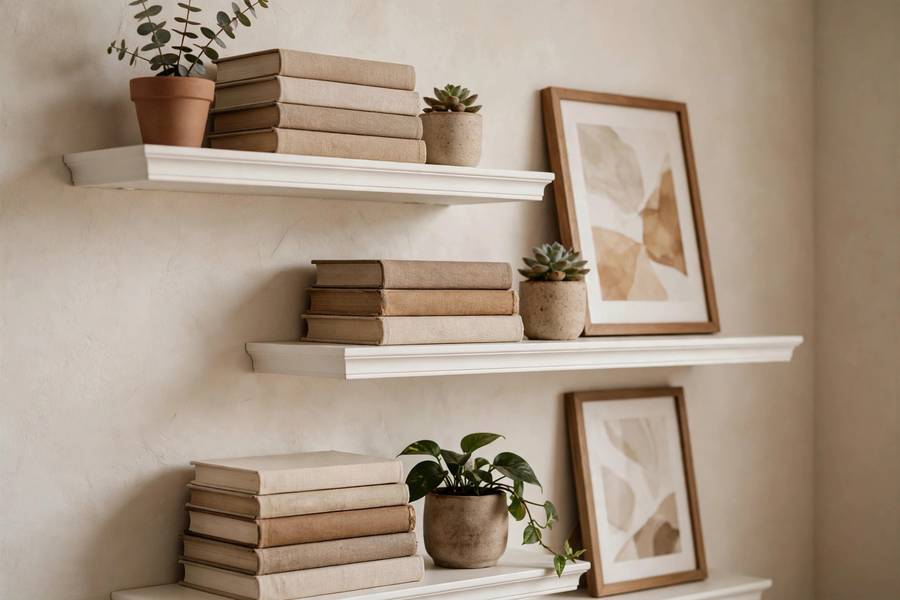
In a small apartment, every decor choice should earn its keep, and floating shelves are the hardest workers on your walls. Two shelves above a desk hold books, a plant, and a candle while looking like a styled vignette. The trick is the 70/30 rule I stole from a stylist friend: 70 percent functional (books, baskets, things you actually use), 30 percent purely pretty. Flip that ratio and your shelves look like a store display; go all-functional and they look like a storage unit.
Picture ledges deserve a special mention because they’re the lowest-commitment shelf in existence. A 24-inch ledge holds three or four framed prints leaned against the wall — no hanging, no leveling, and you can swap the art in seconds when you’re bored. I have one in my hallway and I change it with the seasons: travel photos in summer, moody landscapes in fall. It takes five minutes and makes the whole apartment feel refreshed.
For renters worried about weight: most floating shelves hold 10 to 20 pounds per stud-mounted bracket, which is plenty for books and ceramics. Use a stud finder (or the knock-and-listen method) for anything heavy, and save the adhesive strips for frames under five pounds. If your lease is strict, a tall leaning ladder shelf needs zero wall attachment and gives you five tiers of display. For everything beyond the walls, this guide to how to organize a small apartment keeps the rest in order in about eighteen inches of floor space.
Styling shelves without the clutter
Group items in odd numbers, vary the heights, and leave breathing room — a shelf packed edge to edge reads as storage, while the same items with gaps read as decor. Stack two books horizontally, put a small plant on top, lean a frame behind them. Repeat that rhythm down the shelf and it looks effortless, even though you just followed a formula. All good styling is a formula wearing a casual outfit.
Large-Scale Art in Small Spaces (Yes, Really)
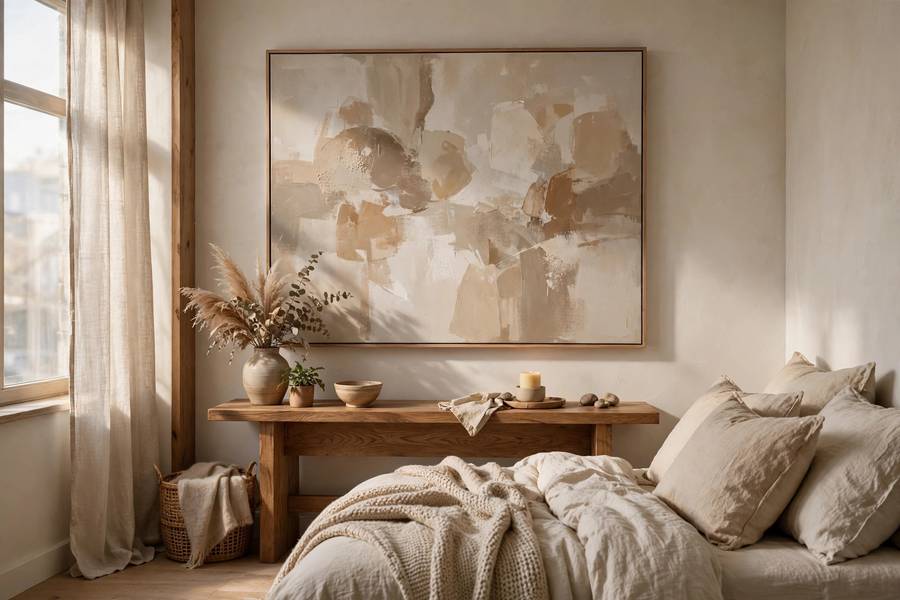
This is the advice people argue with me about, so let me say it plainly: one large piece of art makes a small room feel bigger than six small pieces. A big canvas gives the eye one place to land, which reads as calm and spacious. Six small frames give the eye six places to land, which reads as busy. If your small apartment feels chaotic, the answer is often fewer, bigger pieces.
“Large” doesn’t have to mean expensive. An oversized print in an affordable poster frame, a tapestry or textile wall hanging (which also softens echoey rooms — a real bonus in small apartments with hard floors), or even a DIY abstract canvas in colors that match your room can fill a wall for under fifty dollars. I painted a 30-by-40-inch canvas with three colors of house paint samples once. Total cost: eleven dollars. It’s still hanging in my bedroom and guests assume it’s from a gallery.
The rule of thumb for sizing: art above furniture should be roughly two-thirds the width of the furniture below it. A 48-inch-wide console wants a 30-to-36-inch-wide piece above it. Hang the center of the piece at about 57 inches from the floor — that’s gallery eye level, and it keeps small rooms feeling grounded instead of top-heavy.
Renter-Friendly Ways to Hang Almost Anything
Let’s talk about the thing standing between most renters and decorated walls: fear of the security deposit. Modern adhesive hanging strips genuinely work for frames up to about 15 pounds if you follow the instructions, which nobody does — clean the wall with rubbing alcohol first, press for thirty seconds, and wait the full hour before hanging. Skip any of those steps and the strips fail, and then people blame the product.
For heavier pieces, small nail holes are your friend, not your enemy. A standard picture-hanging nail leaves a hole the size of a pinhead, which a dab of spackle and a touch of paint makes invisible. Most landlords consider these normal wear. What actually costs people their deposits: large anchors, toggle bolts, and the dreaded “I hung a 40-pound mirror with a drywall screw and no stud.” Don’t be that tenant.
Peel-and-stick wallpaper has also grown up. The newer versions go on smoothly, come off cleanly, and can transform one accent wall for the cost of a nice dinner out. I did the wall behind my bed in a subtle grasscloth-look print and it changed the entire feel of the bedroom. Just order a sample first — colors look wildly different on your wall than on your phone screen — and avoid the cheapest options, which are the ones that take paint off on removal.
Mistakes That Make Small Walls Feel Smaller
After years of helping friends decorate small apartments (and making every mistake myself first), here are the patterns I see most. Hanging art too high is number one — when the center of your frames is closer to the ceiling than to your furniture, the wall feels disconnected and the room feels shorter. When in doubt, hang it lower than feels natural.
Number two: decorating every wall equally. A small room with four busy walls feels like it’s closing in. Pick one or two walls to carry the visual weight and let the others breathe. Number three: ignoring scale. A single 5-by-7 photo floating alone on a big empty wall looks lost; that same photo in a larger mat inside an 11-by-14 frame looks intentional. Mats are the cheapest upgrade in wall decor — they make inexpensive prints look expensive.
And the mistake I made for years: buying wall decor before I had a plan, ending up with a drawer of random frames that matched nothing. Now I keep a running note on my phone — wall dimensions, what each wall needs, my color story — and I only buy when something fits the plan. My walls got better and my spending got saner at the same time. Funny how that works.
Walls are the highest-leverage surface in a small apartment: they cost nothing in floor space and change how every square foot feels. Start with one wall this weekend — the mirror opposite the window is my vote — and see how different the whole place feels by Sunday night.
Adhesive hanging strips handle most frames up to about 15 pounds when you prep the wall with rubbing alcohol and wait the full cure time before hanging. For heavier pieces, small picture-hanging nails leave pinhead holes that a dab of spackle makes invisible, which most landlords consider normal wear. Peel-and-stick wallpaper and leaning shelves need no wall attachment at all.
One large piece of art or a mirror opposite a window has the biggest impact in a tiny living room — both make the space feel larger, while lots of small scattered frames tend to make it feel busier. If you want a gallery wall, keep frames close together (2-3 inches apart) and anchor it with one larger piece.
Hang art so the center sits around 57 inches from the floor, which is standard gallery eye level. Above a sofa or console, leave 6 to 8 inches between the top of the furniture and the bottom of the frame. Hanging art too high is the most common mistake and makes ceilings feel lower.
Not at all — the problem is usually scale and spacing, not the concept. Keep spacing tight, include at least one larger anchor piece, and stick to a loose color story so the arrangement reads as one collection. Avoid putting a busy gallery wall directly opposite a mirror or window where reflections double the visual noise.
Start with one focal wall per room, use renter-friendly hanging methods, and choose pieces with personal meaning — framed photos, postcards, even recipe cards — rather than generic store art. A peel-and-stick wallpaper accent wall behind the bed or sofa adds the most personality per dollar of any rental-friendly upgrade I’ve tried.