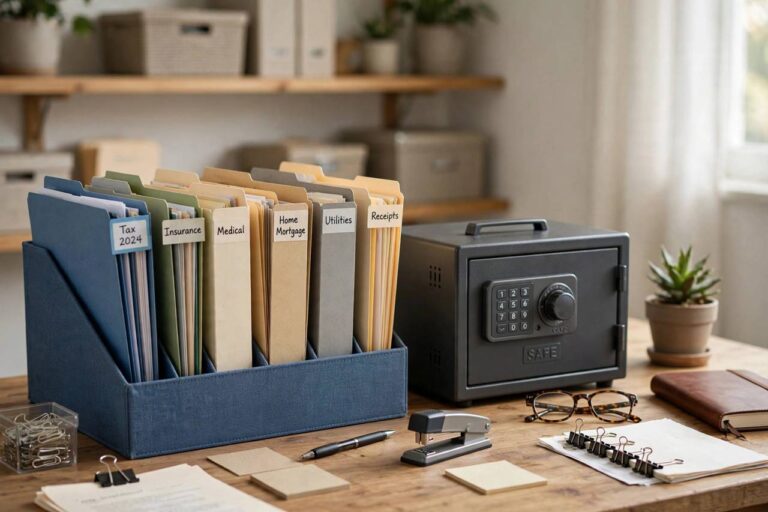
Small Apartment Organization Ideas That Work

Small apartment organization ideas are not really about storage products — they are about decisions. I have lived in apartments of every size, including one memorable studio where the “dining room” was a chair, and I can tell you the people with the tidiest small spaces are not the ones who bought the most organizers. They are the ones who decided what deserves to live in their home and gave everything a specific place to go. If you are drowning in a small apartment, this room-by-room system will help you take it back, one zone at a time.
We will go through the whole apartment — entry, kitchen, living area, bedroom, closet, and bathroom — with the storage tricks and multi-use thinking that actually work in tight quarters. And we will start where every good small-space reset starts: with less stuff, not more bins.
Start With the Declutter Rule: One In, One Out
Before you organize anything, you have to confront the math of small spaces: every item you own occupies a percentage of your home that would be trivial in a house and significant in a studio. The most powerful small apartment organization idea is not a product. It is a rule: for every new item that enters, one leaves.
Do a first pass with three bags — donate, trash, relocate — and be honest about the “someday” items. The bread maker you used twice, the stack of magazines you will never reread, the clothes that do not fit and might someday: they are paying rent in square footage. In a small apartment, clutter is not a moral failing; it is a space problem with a space solution.
If decluttering feels overwhelming, work in 20-minute bursts with a timer, one category at a time. And if you want a deeper method for the big purge, our guide to decluttering your house covers the room-by-room process in detail — the principles scale down perfectly to apartment life.
The Entryway: Five Minutes That Change Everything
The entry is the smallest zone and the highest-impact one. It is where keys vanish, mail piles up, and shoes multiply. Give it a system: a hook or small tray for keys, a wall-mounted mail sorter (not a table pile), and a shoe solution that fits your actual shoe count — a slim rack, an over-door organizer, or a bench with storage inside.
The rule for entries: nothing lives on the floor that does not have to. Coats get hooks, not a chair. Bags get one hook each. If your entry is literally just a door that opens into the living room, a narrow console table or a wall-mounted shelf creates the zone psychologically. Your brain needs the signal that “arriving home” has a place, even if that place is twelve inches wide.
Kitchen: Vertical Space Is Your Extra Cabinet
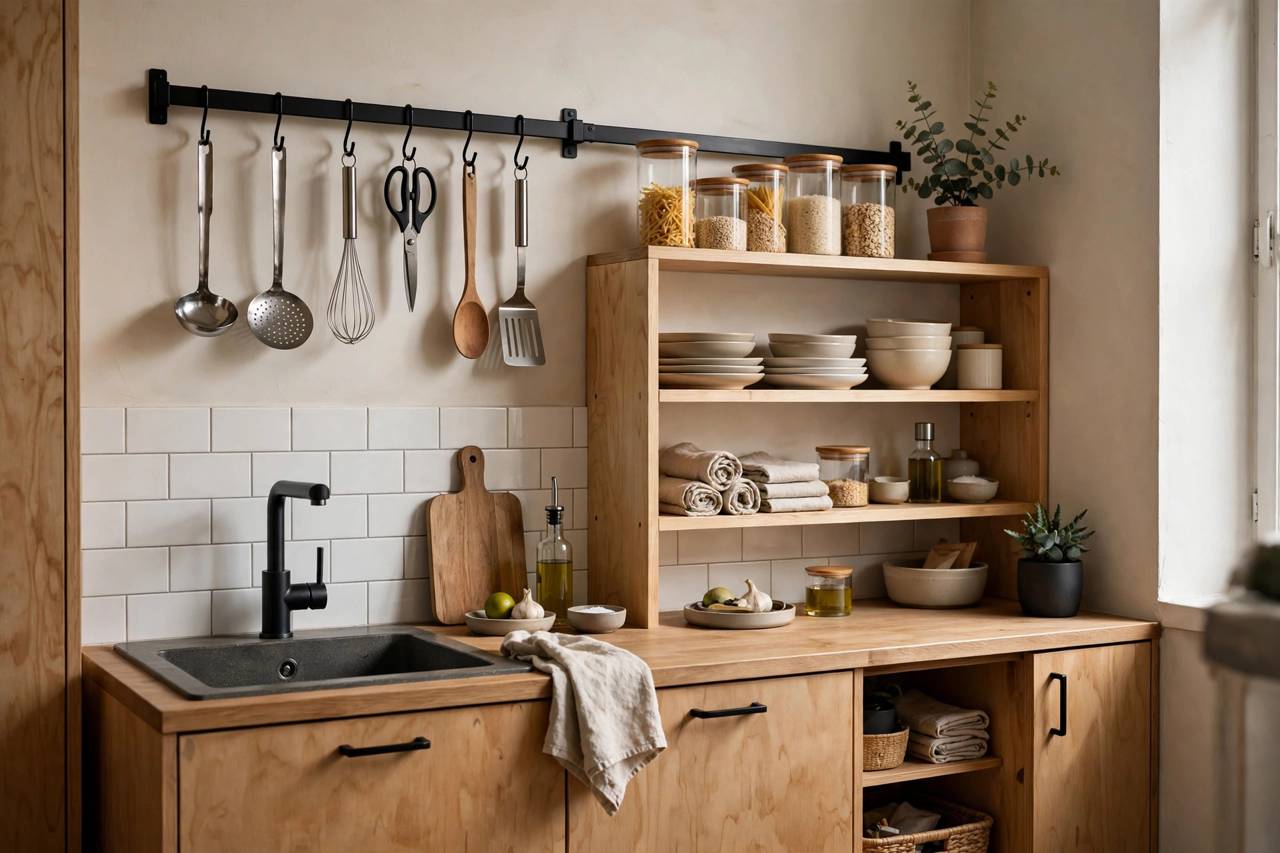
Small kitchens punish horizontal thinking. The counters are tiny, the cabinets are few, and the answer is almost always up.
- Use the walls. A magnetic knife strip frees a drawer. Hanging rails with hooks hold utensils, mugs, and small pans. A wall-mounted spice rack reclaims an entire cabinet shelf.
- Stack inside cabinets. Shelf risers double every shelf. Under-shelf baskets hang from existing shelves for mugs and wraps. Lazy Susans end the dark-corner problem in deep cabinets.
- Exploit the insides of doors. Over-cabinet-door organizers hold cutting boards, foil, and cleaning supplies. The inside of the under-sink door is prime real estate for spray bottles.
- Audit your tools. Small kitchens cannot host unitaskers. The avocado slicer, the banana hanger, the third spatula — a good chef’s knife, one cutting board, and a few versatile pans cover nearly everything.
- Decant thoughtfully. Matching containers for pantry staples are not just aesthetic; uniform shapes stack efficiently and show you what is running low. But do not decant everything — only the things you buy in bulk.
One more kitchen truth: the counter is workspace, not storage. The toaster you use twice a week lives in a cabinet. A clear counter makes a small kitchen feel twice as big and makes cooking genuinely more pleasant.
Living Area: Furniture That Works Twice as Hard
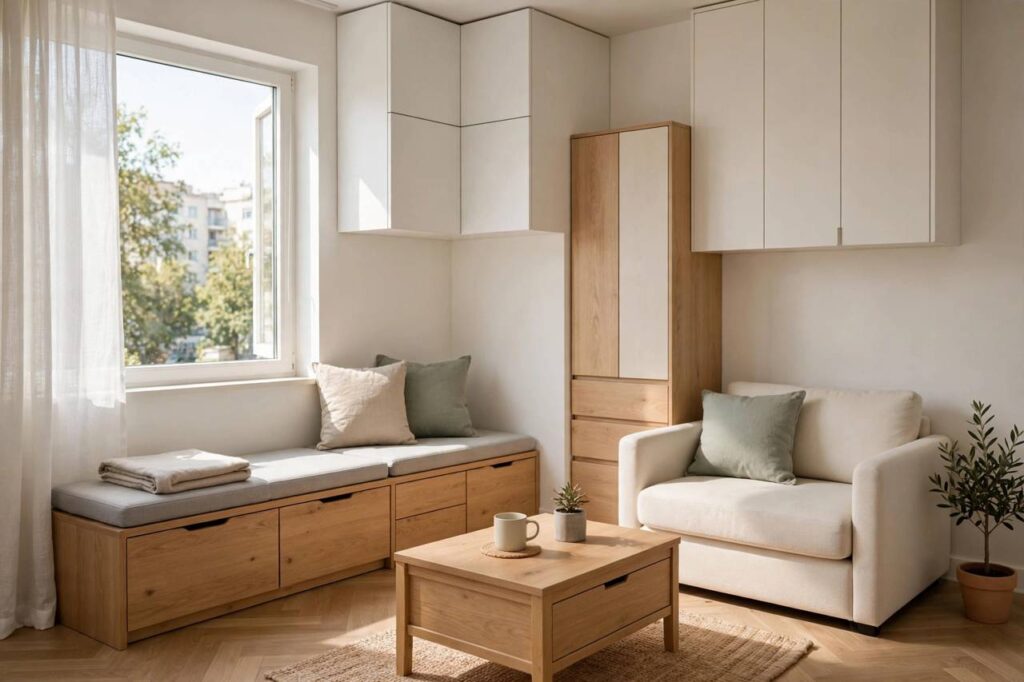
In a small apartment, every piece of furniture should justify its footprint — ideally by doing two jobs. This is the core of small-space living, and it is where a little investment pays enormous dividends.
- Storage ottomans and benches. Seating that opens up to hold blankets, games, or off-season clothes. A storage bench under a window becomes a reading nook and a closet simultaneously.
- A coffee table with storage. Lift-top coffee tables are the unsung heroes of small apartments — they store remotes and chargers inside and convert to a work surface for laptops.
- Nesting and folding pieces. Nesting side tables expand when guests come and disappear when they do not. A drop-leaf or wall-mounted folding table can be a dining table, a desk, and wall art in the course of a day.
- Go vertical with media. A wall-mounted TV with a floating shelf replaces an entire entertainment center. Books go on wall shelves, not a bookcase that eats floor space.
Zone the room even if it is one open space. A rug under the seating area, a different light source over the reading corner — these visual cues make a studio feel like it has rooms. For layout inspiration, our small apartment decorating ideas pair well with everything in this section.
Bedroom: The Under-Bed Opportunity
The average bed occupies roughly 30 square feet, and the space beneath it is the largest unused storage zone in most small apartments. Use it properly: flat rolling bins for off-season clothes, vacuum bags for bulky bedding, or — the premium move — a platform bed with built-in drawers.
Nightstands should have drawers or shelves, not just a surface. If there is no room for nightstands, wall-mounted shelves or a headboard with storage niches keep the essentials within reach. Keep clothing systems tight: a capsule-ish wardrobe where everything mixes and matches means fewer clothes, less decision fatigue, and a closet that closes.
And make the bed every morning. I know it sounds like a platitude, but in a small apartment — especially a studio — an unmade bed makes the entire home look unfinished. It is the highest-return two minutes in home organization.
Closet: Small Apartment Organization Ideas for Tiny Closets
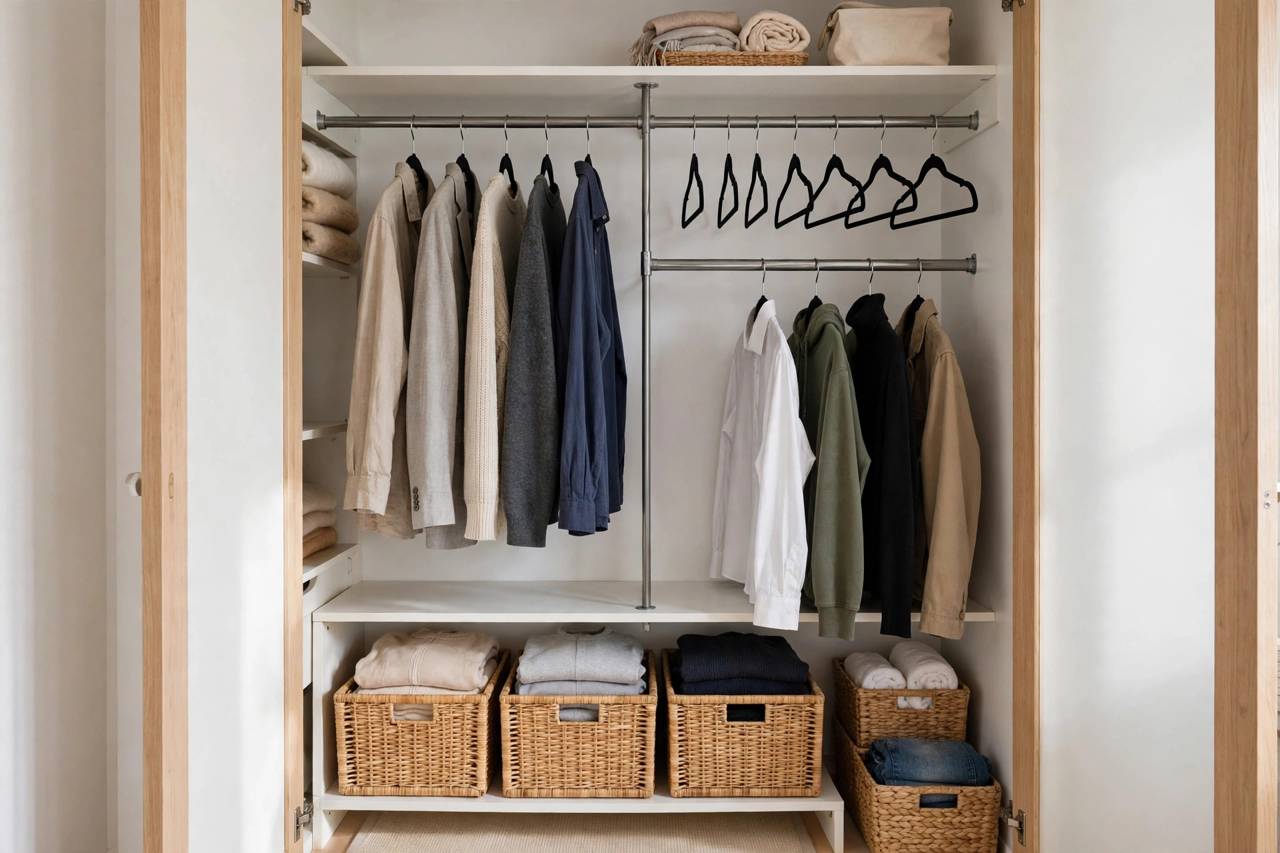
Apartment closets are famously inadequate, so treat the closet as a system to engineer, not a box to fill:
- Double the hanging rod. A second tension rod below the main one doubles hanging capacity for shirts and folded pants.
- Use slim hangers. Velvet slim hangers take up a fraction of the space of plastic ones and keep clothes from sliding. Switching a full closet can reclaim several inches.
- Shelf dividers and bins. Open shelves become avalanches without dividers. Bins labeled by category — gym, accessories, off-season — keep stacks stable.
- The door and the floor. Over-door hooks for tomorrow’s outfit, bags, or robes. The closet floor holds shoe racks or rolling drawers, not a pile.
- Seasonal rotation. If you have any storage — a high shelf, under-bed bins, a suitcase — rotate clothes by season. A closet holding only this season’s clothes feels twice as big.
If your closet situation is truly dire, a freestanding garment rack with a lower shelf can supplement it — choose one with a clean design, because in a small space it is furniture, not just storage. Our closet decluttering guide is the right first step before reorganizing.
Bathroom: Small Space, Ruthless Editing
Bathrooms accumulate products faster than any room in the house. Be ruthless: keep the daily routine, relocate the occasional-use items, and discard the expired and the aspirational. A shower caddy or corner shelf replaces bottles lined up on the tub edge. Over-toilet shelving or a slim cabinet adds storage without footprint. Magnetic strips inside the medicine cabinet hold bobby pins and tweezers. And decant nothing in the bathroom — humidity and half-used products are a bad combination.
The Maintenance System: 10 Minutes a Day
Here is the part most organization guides skip: the system that keeps it organized. A small apartment does not stay tidy by itself — but it also does not require heroic effort. It requires ten minutes:
- The nightly reset. Ten minutes before bed: dishes in the dishwasher, cushions straightened, items returned to their zones. Wake up to a home that feels intentional.
- One load a day. Laundry is the silent killer of small apartments. One small load daily — or a strict twice-weekly schedule — beats the weekend mountain.
- The weekly 30. Once a week, thirty minutes: bathroom wipe-down, floors, one trouble spot (the junk drawer, the mail pile). Rotate the trouble spots.
- The monthly audit. Once a month, one category gets reviewed: clothes, kitchen gadgets, papers. Anything unused leaves. This is how one-in-one-out actually happens.
For a dedicated walkthrough of apartment-specific systems, see our guide to organizing a small apartment — it complements the room-by-room ideas here with whole-home strategies.
Frequently Asked Questions
How do I organize a small apartment with no storage?
Start by creating storage where none exists: use vertical wall space (shelves, hooks, rails), the insides of cabinet doors, under-bed space, and over-door organizers. Then reduce what needs storing — decluttering has a bigger impact than any product when storage is scarce. Multi-use furniture (storage ottomans, beds with drawers) adds capacity without adding footprint.
What is the best way to organize a studio apartment?
Zone it. Use rugs, lighting, and furniture placement to create distinct sleeping, living, and working areas within the open space. Keep the bed made and visually calm since it dominates the room. Maximize vertical storage, choose furniture that does double duty, and be strict about one-in-one-out — studios have zero tolerance for clutter creep.
How can I make a small bedroom feel bigger?
Light colors, mirrors placed to reflect windows, and furniture with visible legs (which reveals floor space) all help. Keep surfaces clear, use vertical storage instead of wide dressers where possible, and choose bedding in lighter tones. The single biggest visual change is usually decluttering surfaces — clear nightstands and dressers read as spaciousness.
Where should I store seasonal items in a small apartment?
Use the least accessible spaces for the least-used items: the highest closet shelf, under-bed bins, the top of wardrobes, or inside luggage you already own. Vacuum bags compress bulky winter bedding and coats dramatically. If your building offers any storage — even a small cage or locker — reserve it strictly for seasonal and rarely-used items, not overflow clutter.
How do I keep a small apartment tidy with kids or pets?
Contain their zones: a specific toy bin (not toy sprawl), a pet supply station by the door. Build cleanup into the routine — a five-minute family tidy before dinner works at any age. Choose washable, durable materials, and accept a slightly higher baseline of lived-in: the goal is functional calm, not a showroom.
Small Space, Big Calm
A small apartment done well is not a compromise — it is an advantage. Less to clean, less to maintain, everything within reach, and every object chosen on purpose. Start with the declutter, build the zones, give everything a home, and keep the ten-minute reset. Your square footage did not change. Your relationship with it did.