Small Apartment Storage Ideas: 20 Ways to Find Space

Every small apartment I have lived in taught me the same lesson: the storage is there, it is just hiding. Behind doors, under beds, above cabinets, inside furniture, in the six inches beside the fridge you have never measured. Small apartment storage ideas are not really about buying organizers; they are about seeing your space with fresh eyes and giving every category of stuff a specific home. In this guide, I am sharing twenty hiding spots and systems I have actually used, room by room, almost all renter-friendly and most nearly free. For the decluttering that comes first, my guide to organizing a small apartment is the companion; this is the space-finding manual.
The Golden Rule: A Home for Everything
Before a single organizer is bought, the rule: everything you own gets a specific home, and homes are labeled or obvious. Clutter in small apartments is rarely about owning too much; it is about homeless items migrating to counters, chairs, and floors. Walk through your apartment with a notepad and list every item currently living where it should not. Each one needs a home assigned, and the homes must be where you actually use the things: keys by the door, chargers where you sit, cleaning supplies where you clean.
The corollary: if you cannot find a sensible home for something, you probably do not need it. Label makers are worth their weight in small apartments. A labeled bin gets used; an unlabeled one becomes a junk drawer with a lid. Label the shelf, the bin, and the zone, and everyone in the household can maintain the system without asking where things go.
This is the gentle decluttering engine that runs underneath all storage advice. Storage systems organize what you keep; they cannot organize what you should have released. Assign homes first, buy containers second, and only after you know exactly what needs containing and where it lives.Bedroom: Under the Bed & Behind the Door
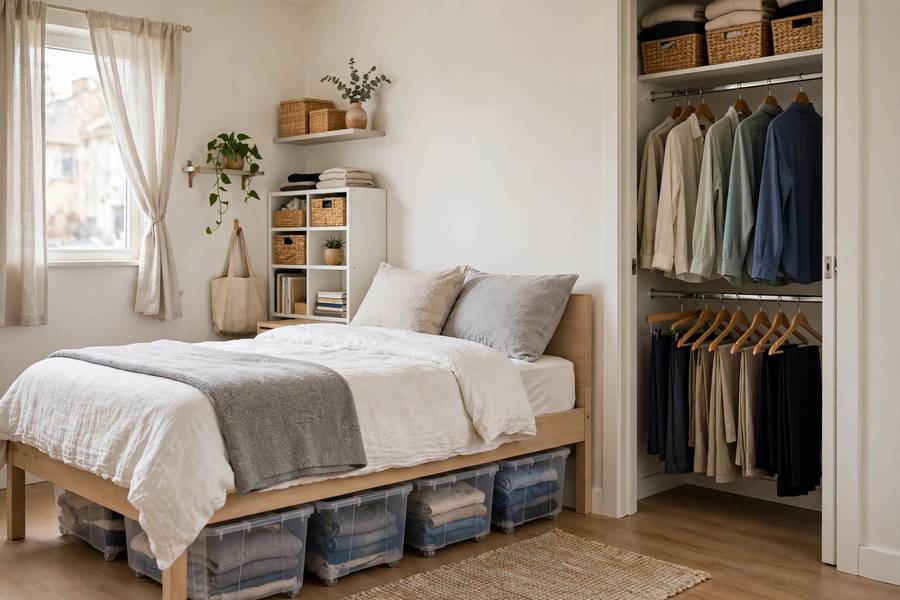
The bedroom hides the most storage in the apartment. Under the bed is the big one: low-profile rolling bins or vacuum bags hold off-season clothes, linens, and shoes in the otherwise dead space. A bed riser adds inches of clearance if needed; even four extra inches doubles usable under-bed volume. Choose a bed frame with built-in drawers if buying new; it is the highest-value storage furniture in a small bedroom.
Behind the bedroom door, an over-door organizer holds shoes, accessories, or cleaning supplies invisibly. The closet gets the full treatment: double-hang rods (one high, one low) instantly double hanging space, shelf dividers tame stacks, slim velvet hangers save inches per garment, and the closet door’s inside face holds an organizer for small items. Above the closet rod, labeled bins use the forgotten top shelf. Nightstands with drawers beat nightstands with just a surface; the drawer swallows the book, glasses, and charger that would otherwise colonize the top.
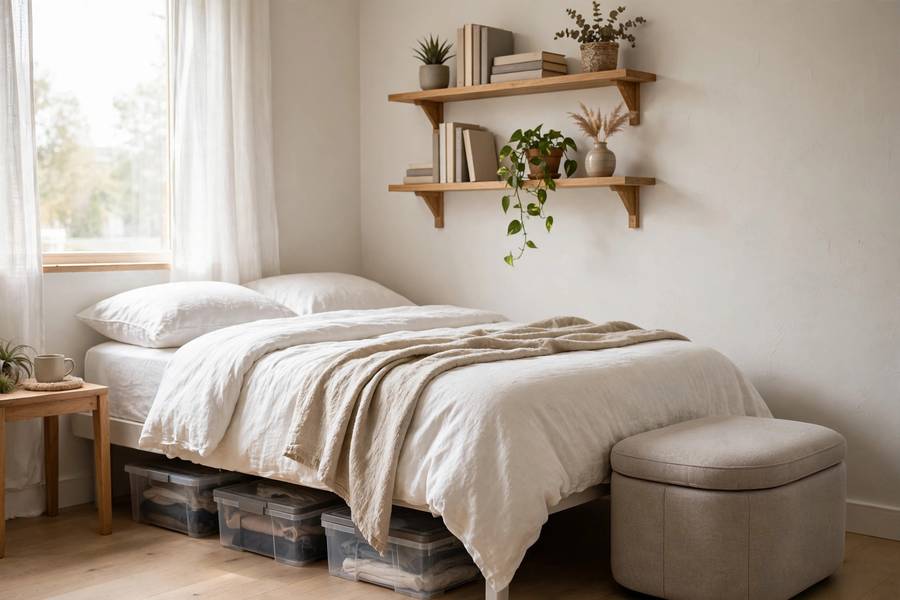
Under-bed storage only works if it is accessible; bins you cannot reach become tombs. Rolling bins on smooth floors, or bags with handles you can slide, get used. Buried boxes do not.
Living Room: Furniture That Hides Things
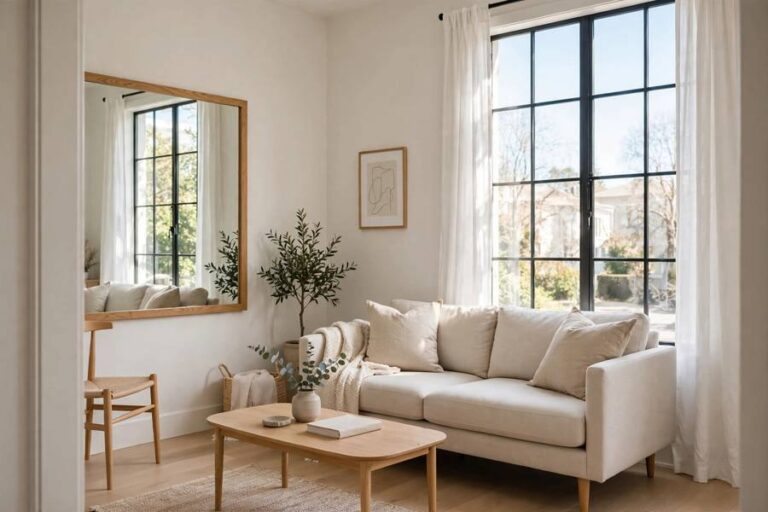
Living room storage must be invisible, because this is the room everyone sees. The storage ottoman is the hardest-working piece: footrest, extra seat, coffee table with a tray on top, and a cavern inside for blankets, games, or remotes. A coffee table with drawers or a lift-top hides the laptop, chargers, and magazines. Side tables with cabinets beat side tables with just a surface.
Media storage goes vertical and closed: a tall narrow bookcase uses wall space efficiently, and baskets on its shelves hide the unsightly categories. Cord management is storage too: a cable box and cord covers erase the tangle behind the TV that reads as clutter. Blankets live in one beautiful basket, not draped over every surface. The living room rule: if guests can see it, it should be beautiful or hidden, and storage furniture makes both possible at once.
Kitchen & Bathroom: Every Inch Working
Kitchens reward the same vertical thinking. Inside cabinets: risers, under-shelf baskets, door-mounted racks, and turntables. Above cabinets: the dusty gap becomes storage for rarely used items in attractive bins. Beside the fridge: that six-inch gap fits a rolling slim cart for spices and cans. Under the sink: stackable drawers and a tension rod for spray bottles transform the chaotic cabinet.
Bathrooms are small but storage-rich when you look up and behind. Over-toilet shelving or cabinets use the room’s tallest free wall. Inside the vanity, tiered organizers and door-mounted holders multiply space. A rolling cart beside the vanity holds daily products and tucks away. Magnetic strips inside medicine cabinets hold bobby pins and tweezers; shower caddies that hang from the shower head need no drilling. In both rooms, decanting into uniform containers is half the battle: matching jars and bottles look organized even before they are.
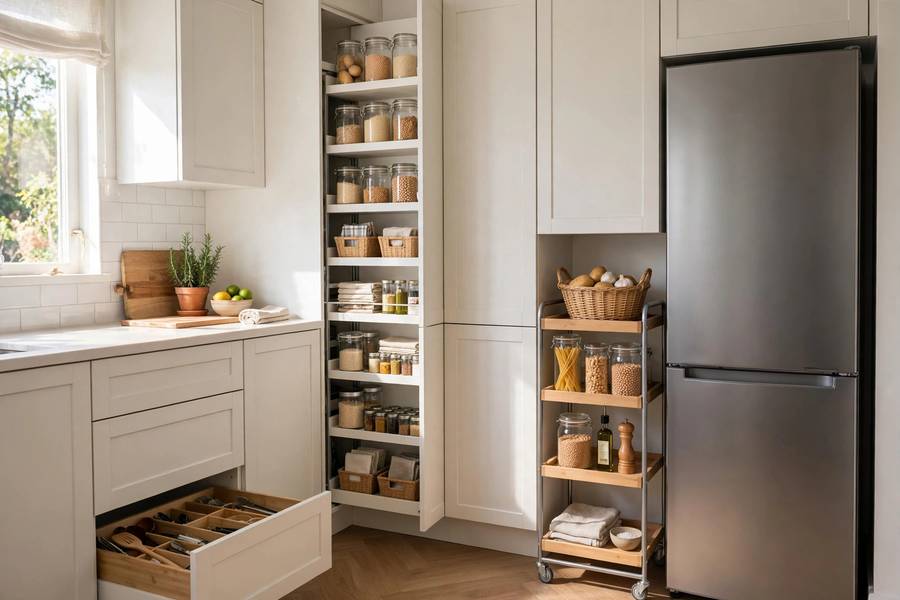
Measure before buying any organizer, especially for under-sink and beside-fridge spots. Those spaces are always an inch smaller than you remember.
Entryway, Closets & the Forgotten Zones
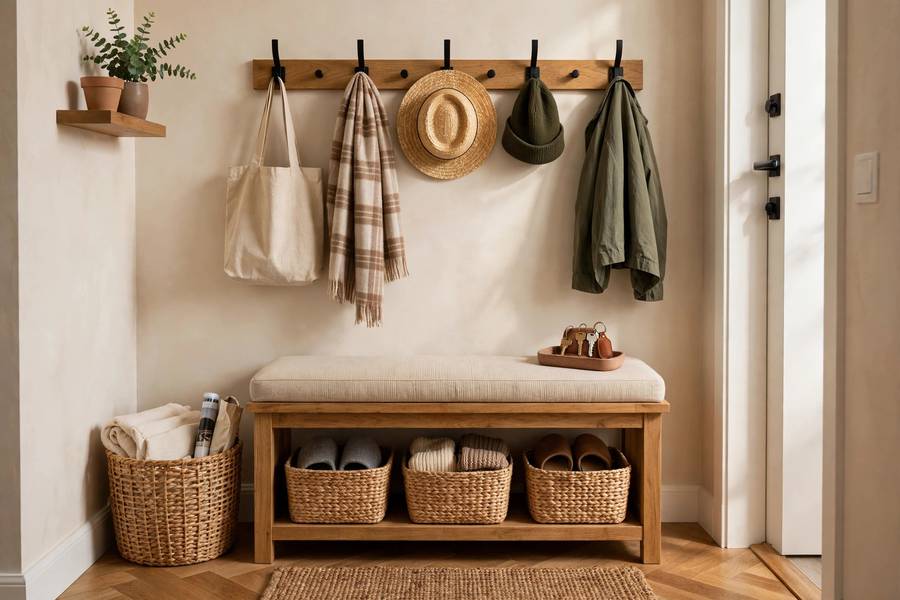
The entryway sets the tone: a wall-mounted (adhesive for renters) key hook, a slim console or floating shelf for the mail tray, a basket for shoes, and hooks for coats and bags. Everything that enters with you gets parked here instead of migrating through the apartment. A small bench with shoe storage underneath handles both sitting and stowing.
Closets anywhere get the system: double rods, door organizers, top-shelf bins, slim hangers. The hallway, if you have one, takes a narrow bookcase or a row of hooks; hallways are rooms too, just thin ones. Above doorways, a single shelf holds the rarely touched: luggage, seasonal decor, memory boxes. Under stairs or in odd nooks, custom-cut shelving or a small dresser claims dead space. Walk your apartment slowly and look for air: any empty volume bigger than a shoebox, behind, beneath, above, or beside something, is storage waiting to be claimed. For keeping these zones working long-term, my organizing guide covers the maintenance habits.
20 Ideas at a Glance & Where to Start
The quick list: under-bed rolling bins, bed risers, over-door organizers, double closet rods, slim hangers, storage ottoman, lift-top coffee table, tall narrow bookcases, cable management boxes, blanket baskets, cabinet risers and door racks, above-cabinet bins, slim rolling carts, under-sink drawers, over-toilet storage, vanity tiered organizers, entryway hooks and shoe bench, hallway shelving, above-door shelves, and uniform decanting containers.
Start where the pain is worst: the room whose clutter stresses you most. Revisit your storage twice a year, ideally with the seasons. Winter gear swaps with summer gear under the bed, holiday items rotate through the above-door shelf, and anything that has sat untouched for a year gets honestly reassessed. Storage systems drift; a thirty-minute reset each season keeps them true.
Implement three ideas there this weekend, live with them for two weeks, then continue. Storage is iterative; the perfect system reveals itself through use, not planning. And remember the order of operations from my small apartment decorating ideas guide: edit first, assign homes second, buy containers last. Twenty hiding spots, one calm apartment, zero renovations required.The One-In-One-Out Rule for Small Spaces
No storage system survives a growing pile of stuff, which is why I live by the one-in-one-out rule in my apartment. Every time something new comes through the door — a kitchen gadget, a pair of shoes, a decorative object — something else has to leave, whether it gets donated, sold, or recycled. It sounds strict, but it forces a useful pause before every purchase: do I want this enough to give something up? Pair this habit with a twice-yearly reset where you pull everything out of one zone, like the hall closet or the bathroom cabinet, and honestly assess what you actually used. I do mine when the seasons change, and it takes less than an hour per zone. Small apartments reward this kind of maintenance far more than any single organizing product, because the real constraint is never the number of bins — it is the volume of belongings competing for the same square footage.
Under the bed, behind doors, above cabinets and closets, inside furniture (ottomans, lift-top tables), beside the fridge, under the sink, over the toilet, above doorways, in hallways, and inside cabinet doors. Walk your apartment looking for empty volume bigger than a shoebox; it’s all claimable storage.
Use over-door organizers, freestanding tall bookcases, rolling carts, tension rods inside cabinets, adhesive hooks, under-bed rolling bins, storage ottomans, and stacking drawers. Nearly all small-apartment storage can be achieved with freestanding and tension-mounted solutions.
Storage ottomans (seat + table + hidden storage), beds with built-in drawers, lift-top coffee tables, tall narrow bookcases, rolling carts, and entryway benches with shoe storage. Prioritize pieces that serve two or three functions; every furniture item should earn its footprint twice.
Install a double-hang rod (doubles hanging space), switch to slim velvet hangers, add shelf dividers and labeled bins on the top shelf, use the door’s inside face for an organizer, and store off-season items under the bed. Most closets hold twice their apparent capacity with these five changes.
No. Edit first, assign every item a specific home second, and buy containers last, only for what actually needs containing. Organizers bought before decluttering just become expensive clutter themselves. Measure every space before buying; spots are always an inch smaller than remembered.