Minimalist Wardrobe Basics: The Pieces That Do Everything

I used to own 120+ items of clothing and wear the same 20 on rotation. The rest was a museum of bad decisions: “someday” sizes, aspirational lifestyles, sale-rack regrets, and eleven nearly-identical black t-shirts of wildly varying quality. Getting dressed took 20 minutes of staring. Then I rebuilt my wardrobe from scratch — about 35 pieces, essentially a capsule wardrobe built on basics — and something unexpected happened: I started getting compliments on my style. With fewer clothes. The paradox resolved itself quickly: when everything fits, flatters, and matches, you look better with less.
This is the practical guide to minimalist wardrobe basics — wardrobe minimalism being what minimalism actually means applied to clothes: the essential pieces that do everything, how to pick your palette, the formulas that multiply a small wardrobe, and how to build it without replacing everything at once. No 33-item dogma — just a system that works.
In this guide:
- Why Fewer Clothes Work Better
- The Core Pieces (the Actual List)
- Choosing Your Palette
- The Formulas: 30 Pieces, 100 Outfits
- What to Spend On (and What to Save On)
- Building It Without Starting Over
- Maintaining It
Why Fewer Clothes Work Better
The average person wears 20% of their wardrobe 80% of the time — the rest is decision fatigue in fabric form. Every “nothing to wear” morning happens in front of a full closet, which tells you the problem was never quantity. A minimalist wardrobe fixes the actual problem: everything fits right now, everything matches, everything gets worn. Getting dressed becomes a 5-minute non-decision, which is genuinely life-changing on busy mornings — how to be more organized in its purest form.
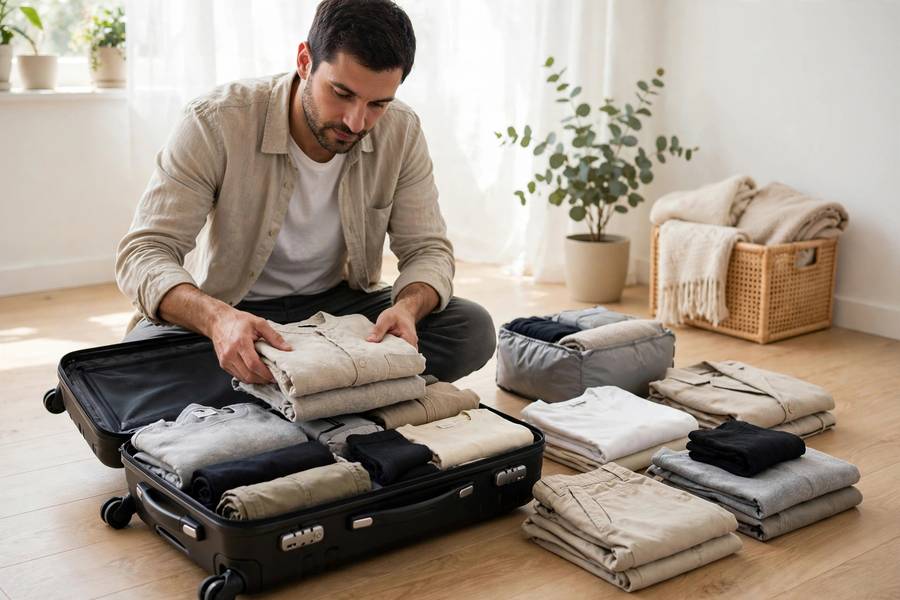
There’s also the hidden cost of a bloated wardrobe: the dry cleaning for “special” items worn twice a year, the storage, the seasonal swaps, the mental overhead of tracking it all. My 35-piece wardrobe lives in one closet and two drawers, needs no seasonal storage shuffle, and I can pack for any trip in ten minutes. Less wardrobe, more life — the usual minimalist arithmetic.
The Core Pieces (the Actual List)
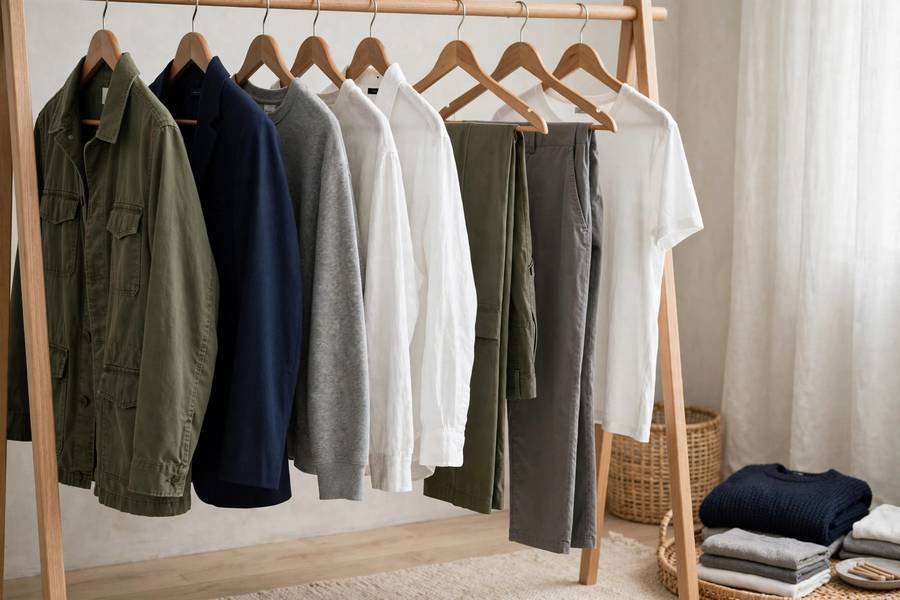
Here’s the foundational list — adapt for your climate, dress code, and life. Tops (8-10): 3-4 quality t-shirts or everyday tops, 2-3 button-downs or blouses (one white, others in your palette), 1-2 sweaters or knits, 1 nicer top for evenings. Bottoms (5-6): 2 pairs of jeans or everyday pants (one dark, one medium), 1-2 trousers or chinos, 1 skirt or shorts option if you wear them, 1 pair of “nice” pants.
Layers (3-4): 1 blazer or structured jacket, 1 casual jacket (denim, utility, or leather), 1 coat appropriate for your winters, 1 cardigan or light layer. Dresses/jumpsuits (1-3, if worn): 1 versatile day dress, 1 occasion dress. Shoes (4-5): everyday sneakers or flats, one dressier shoe, boots or sandals per climate, workout shoes, and that’s honestly enough for most lives.
Accessories and the rest: 1 good bag for daily, 1 small evening option, a scarf or two, minimal jewelry you actually wear, 7-10 each of underwear and socks (the real number nobody lists — running out of socks ruins minimalism fast), 1 set of workout clothes per workout day plus one, sleepwear, and outerwear per your actual weather. Total: roughly 35-45 pieces, every one earning its place.
The work-wardrobe variant
For business-casual or formal dress codes, shift the ratios: more trousers/blouses, fewer casual pieces, but the same principle. A “uniform” approach works brilliantly — my friend in finance wears five variations of the same formula (navy trouser, light top, blazer) and nobody’s ever noticed the repetition. They’ve noticed she always looks polished.

Choosing Your Palette
The palette is the magic. When everything matches everything, 35 pieces create hundreds of combinations; when nothing matches, 100 pieces create stress. Pick 2-3 neutrals as your base (navy, gray, black, white, olive, beige — choose the ones that suit your coloring) and 1-2 accent colors you love. Every new purchase must work with the palette, no exceptions. This one rule does 80% of the wardrobe-minimizing work.
To find your palette, look at what you already reach for — your favorite 10 items probably share colors. That’s your palette trying to tell you something. Mine revealed itself as navy, gray, white, and olive with rust as the accent; I stopped fighting it (goodbye, the pastel phase) and getting dressed got dramatically easier. Work with your instincts, not against them.
Patterns: keep them minimal and in-palette — stripes, subtle checks, small prints. One patterned piece per outfit is the safe formula. And don’t fear color if you love it — a friend’s jewel-tone palette (emerald, sapphire, burgundy, black) is stunning and just as mixable as neutrals. The rule is coherence, not beige.
The Formulas: 30 Pieces, 100 Outfits
Outfit formulas are how small wardrobes feel infinite. The base formula: fitted top + structured bottom + third piece (jacket, cardigan, or blazer). The third piece is what makes it look intentional — it’s the difference between “clothes” and “an outfit.” Learn five formulas that suit your life and rotate them; nobody tracks your repetitions, I promise.
My five: jeans + white tee + blazer (smart casual everything); trousers + knit + coat (winter polish); dress + jacket + boots (one-step dressing); jeans + sweater + scarf (weekend); black pants + nice top + heels (evening). Five formulas, endless small variations via accessories and layers. Getting dressed is now: pick formula, grab pieces, done.
The accessory multiplier: scarves, jewelry, bags, and shoes change an outfit’s entire register. The same jeans-and-tee with sneakers reads casual; with a blazer, nice bag, and boots reads dinner-ready. Invest in accessories — they’re small, cheap relative to clothes, and do the heaviest styling lifting in a minimal wardrobe.
What to Spend On (and What to Save On)
With fewer pieces, each one works harder — so quality matters more, strategically. Spend on: shoes (you stand in them all day — good shoes are health equipment), outerwear (cost-per-wear is tiny over a decade), jeans/trousers (fit is everything; tailoring is worth it), and the bag you carry daily. These are the high-rotation, high-visibility items where quality shows.
Save on: t-shirts and basic layers (they wear out regardless — buy decent, replace as needed), trendy accents (the fun earrings, the seasonal scarf), workout clothes (function over fashion), and underwear/socks (comfort matters, brand doesn’t). The 80/20 of wardrobe spending: 80% of your budget on the 20% of items you wear daily.
And tailor. A $20 hem or taper transforms a $40 garment into something that looks $200. Fit is the entire game in a minimal wardrobe — with fewer pieces, each one’s fit is visible. Find a good tailor; it’s the highest-ROI fashion spending that exists. And if your closet lives in a tight space, these small apartment organization ideas will help you squeeze maximum order out of minimum square footage.
Building It Without Starting Over
Do not purge everything and rebuy — that’s the expensive mistake. Build gradually: Phase 1 (month 1): remove what doesn’t fit, what’s worn out, and what you haven’t worn in a year. Live with what’s left and notice the gaps. Phase 2 (months 2-3): identify your palette from favorites, and fill genuine gaps one piece at a time — the good jeans, the blazer, the winter coat. Buy the best you can afford; these are decade purchases.
Phase 3 (ongoing): one-in-one-out, forever. New sweater in, old sweater out. This maintains the wardrobe automatically. And the hanger trick for maintenance: hang everything backward; after six months, anything still backward gets released (more in how to declutter your closet). Your wardrobe will self-optimize if you let it.
Budget approach: build over a year, one quality piece per month. Twelve intentional purchases transform a wardrobe more than fifty impulse ones. Thrift stores are goldmines for this — quality pieces at fraction prices, especially blazers, coats, and silk tops. My best blazer cost $12 at a thrift store and gets compliments weekly.
Maintaining It
Maintenance is simple: care for what you own (good hangers, proper washing, prompt repairs — a loose button fixed today saves a shirt), seasonal mini-reviews (15 minutes at each season change: anything worn out? any gap?), and the eternal one-in-one-out. That’s it. A minimalist wardrobe maintains itself because there’s so little to maintain.
The payoff compounds: faster mornings, less laundry chaos, easier packing, lower spending, and — the surprise — better style. Constraint is the mother of style; when every piece must earn its place, only the good stuff survives. Your 35 pieces will serve you better than 120 ever did. I know, because I’ve lived both. There’s no contest.
There’s no required number — typically 30-50 pieces including shoes and outerwear, but the count matters less than the function: everything fits, everything gets worn, everything matches, and getting dressed takes five minutes. Build to your life, climate, and dress code rather than an arbitrary target.
The core: 8-10 tops, 5-6 bottoms, 3-4 layers (blazer, casual jacket, coat, cardigan), 4-5 pairs of shoes, 1-2 bags, plus underwear, sleepwear, and workout clothes. Choose a coherent color palette (2-3 neutrals + 1-2 accents) so every piece works with every other piece.
Don’t purge and rebuy — build gradually. First remove what doesn’t fit or you don’t wear, identify your palette from favorites, then fill genuine gaps one quality piece per month. Thrift stores are excellent for blazers, coats, and staples. Twelve intentional purchases beat fifty impulse ones.
A base of 2-3 neutrals that suit your coloring (navy, gray, black, white, olive, beige) plus 1-2 accent colors you love. Coherence matters more than specific colors — a jewel-tone palette works as well as neutrals as long as everything mixes. Keep patterns minimal and in-palette.
One-in-one-out for all purchases, the hanger trick (backward hangers; anything still backward in 6 months goes), seasonal 15-minute reviews, and proper care (good hangers, prompt repairs). The wardrobe largely maintains itself because there’s little to maintain.