Reading Comprehension Practice Passages: Where to Find Good Ones

Students constantly ask me where to find good practice passages, and I understand the frustration — the internet is full of low-quality worksheets with trivial questions that teach nothing. Good practice passages share three traits: interesting, well-written text; questions that require real thinking; and answer explanations that teach. Here is where to find them and how to use them.
This guide covers free sources by level and purpose, what makes a practice passage worth your time, and the practice method that turns passages into actual skill gains.
I will also show you how to turn any article into a practice passage with self-written questions — because the best practice material is often the reading you are already doing.
In this guide:
- What Makes a Practice Passage Worth Your Time
- Free Sources Worth Using
- Matching Passages to Level
- The Practice Method That Works
- Beyond Worksheets
- Writing Your Own Practice Questions
What Makes a Practice Passage Worth Your Time
A good passage is worth reading even without the questions. If the text is dull, simplified, or obviously written for a worksheet, your brain will not engage — and unengaged practice builds nothing. The best practice material is real writing: essays, articles, and book excerpts that respect the reader.
Good questions test understanding, not memory. 'What color was the car?' is trivia. 'Why did the author mention the car?' is comprehension. Look for questions about main ideas, inferences, author's purpose, and vocabulary in context — and be suspicious of any set where every answer is stated word-for-word in the text.
Answer explanations are the difference between practice and learning. A good source explains why the right answer is right and why each wrong answer is wrong. Without explanations, you are just taking tests; with them, every mistake becomes a lesson.
Free Sources Worth Using
For test prep, official materials are unmatched: the College Board's free SAT practice, ACT's official samples, and AP English released passages. These are real test questions with real explanations — nothing third-party matches their quality, and they are free. how to prepare for the SAT
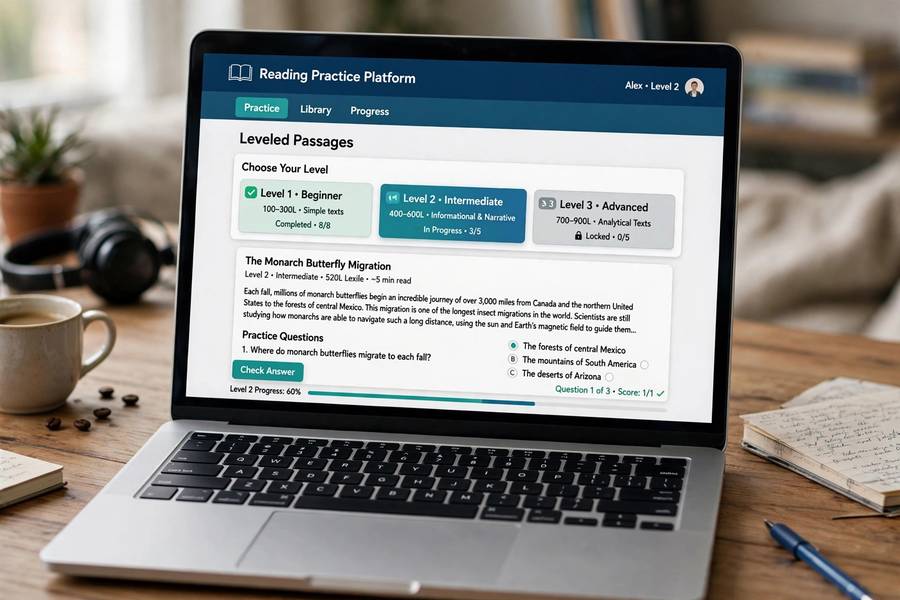
For general skill-building, CommonLit offers thousands of leveled passages with genuinely good questions and discussion prompts, free for students and teachers. ReadWorks provides similar quality with excellent nonfiction. Both are designed by literacy experts, not worksheet mills.
For adults, the best 'practice passages' are not labeled as such: long-form journalism (The Atlantic, NYT, Aeon), scientific American-style explainers, and classic essays. Pair any article with self-written questions — main idea, two inferences, author's purpose — and you have better practice than most paid products.
Matching Passages to Level
Elementary and middle school: CommonLit and ReadWorks let you filter by grade level and Lexile. Start where the child reads comfortably with light challenge — frustration passages teach avoidance, not skill. Move up when questions feel easy, not when you feel impatient.
High school and test prep: official SAT/ACT/AP materials first, then challenging nonfiction — science and history writing at the adult level. The jump from school textbooks to real test passages is where most students need the most practice. tips for studying history exams
Adult learners and ESL: News in Levels and VOA Learning English publish the same content at multiple difficulties — read the easier version, then the harder one. Graded reader publishers offer passages with proper comprehension questions at every level.
The Practice Method That Works
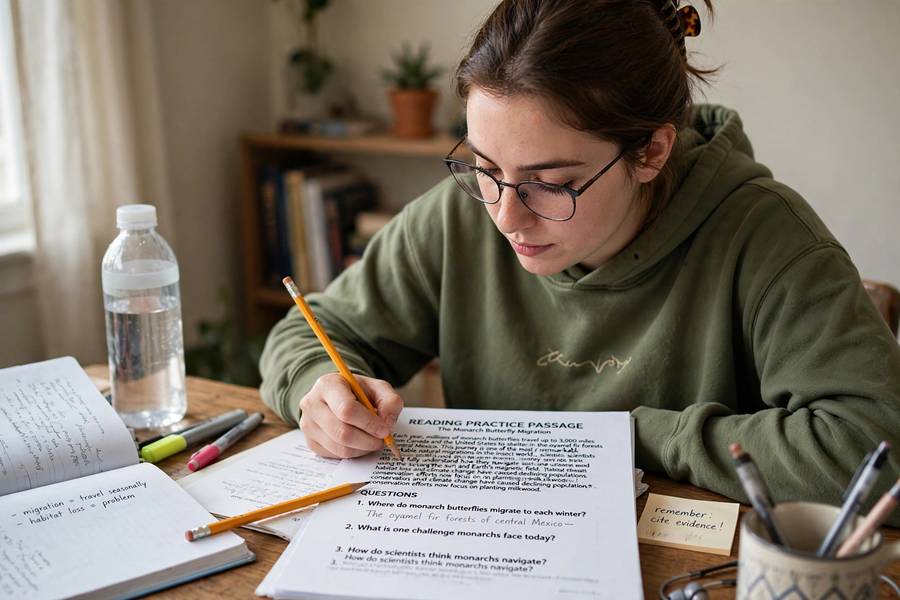
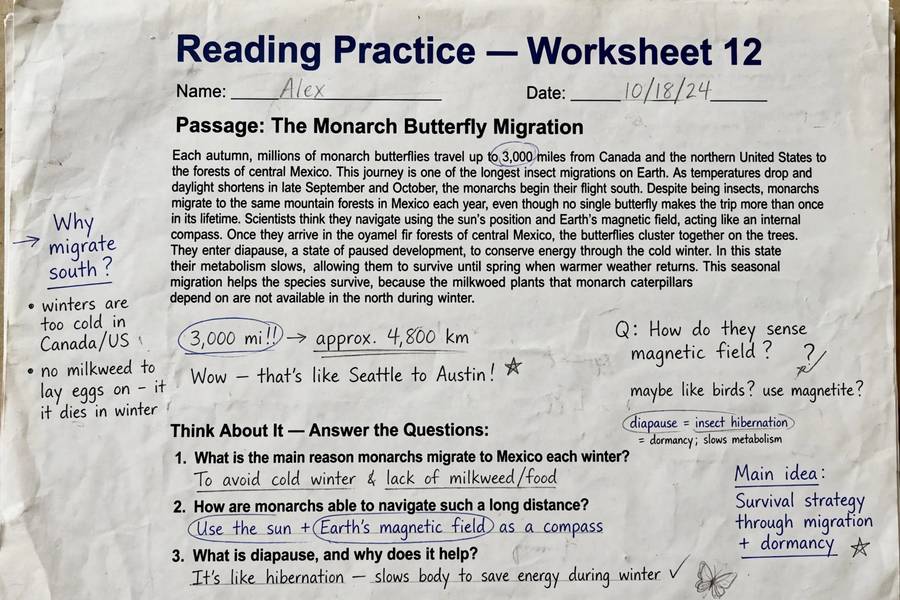
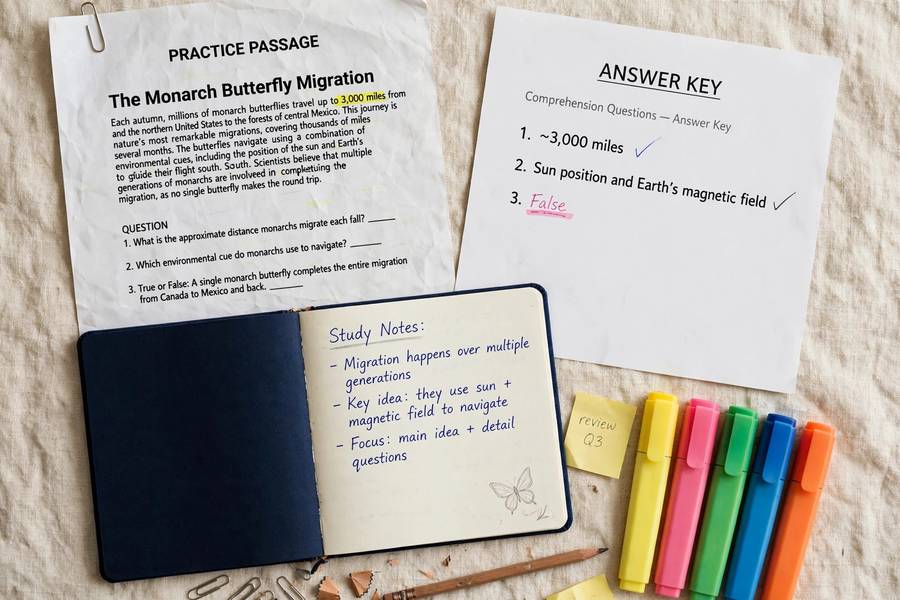
Read actively first: preview, read with a pencil, pause to summarize each paragraph in a phrase. Then answer questions without looking back — this trains the comprehension the test actually measures. Only then re-check the text for questions you flagged.
Review every mistake with the explanation, then classify it: was it a vocabulary gap, a missed inference, a misread question, or rushing? Keep a simple error log. Within weeks, patterns emerge — and a pattern is a fixable problem, while 'I got some wrong' is not.
Space your practice: three 25-minute sessions weekly beats one long weekend session. And re-do missed passages after two weeks — if you truly learned the skill, the re-do feels easy; if you just memorized answers, it will not.
Beyond Worksheets
The ultimate practice passage is a book you discuss. Join or start a reading group — even two people — where you argue about what chapters meant. Defending an interpretation against questions builds deeper comprehension than any worksheet, because it requires the full skill stack: recall, inference, evidence, articulation. what active recall is
Write about what you read. A one-paragraph response — what the author argued, whether you buy it, what evidence mattered — forces the precise understanding that passive reading skips. Students who write weekly responses improve faster than those who only answer questions.
Teach a passage to someone else. Explaining why an answer is right, with textual evidence, is the highest form of practice. Study partnerships where members take turns teaching outperform solo practice consistently in my experience. how to study for final exams
Writing Your Own Practice Questions
The most underrated practice technique is writing questions instead of answering them. After reading a passage, write five questions: one main idea, two inferences, one vocabulary-in-context, one author's purpose. Then answer them a day later without looking. Question-writing forces you to identify what matters — the core comprehension skill.
Study the anatomy of good questions by dissecting official ones. Notice how SAT inference questions stay one logical step from the text, how main-idea questions punish detail-focused answers, how vocabulary questions hinge on context. Imitate these patterns in your own questions; you will start recognizing them instantly on tests.
Trade questions with a study partner: you write questions for a passage, they write for another, then swap and answer. Grading each other's answers with textual evidence required builds the evidence habit faster than any solo practice, because defending your answer key forces precision.
Keep a question journal: your best self-written questions, organized by type. Review it before tests as a reminder of what each question type demands. Students who do this walk into exams with the test's logic internalized rather than memorized.
Teach the technique downward: write questions for a younger sibling's reading. Explaining why your inference question's wrong answers are tempting — to someone else — cements your own understanding of trap design. Teaching is the final level of mastery, even for test skills.
Start small: three questions per article you read this week, any article. The habit of interrogating text transfers everywhere — to textbooks, to tests, to the news. Readers who question habitually comprehend habitually.
One more source people forget: past exam papers from other countries and states. British GCSE papers, Australian NAPLAN reading sections, and IB English materials all offer high-quality passages with rigorous questions — free, legal, and refreshingly different from the materials you have overused.
Build a personal passage bank: every great article you read, save with your self-written questions attached. In six months you will own a custom practice library perfectly matched to your interests — and re-doing your own questions after months is a superb retention check.
Time your practice realistically but not obsessively. About 80 percent of practice should be untimed and analytical; 20 percent timed and test-like. Students who invert this ratio practice panic instead of skill.
Vary your sources deliberately to avoid format overfitting. If every practice passage comes from the same publisher, you learn their question style rather than comprehension itself. Rotate across at least three sources monthly to keep the skill general.
Do occasional 'cold' practice: a passage type you have never seen, timed, no preparation. Discomfort is diagnostic — it shows exactly where your skills are fragile. Students who only practice comfortable formats get shocked by novel ones on test day.
Keep your best-annotated passages in a binder or folder. Revisiting them months later shows how far your reading has come — and re-reading a once-hard passage effortlessly is one of the most satisfying experiences in learning. Save a few for that purpose alone.
CommonLit and ReadWorks for leveled school passages; official College Board and ACT sites for test prep; News in Levels and VOA Learning English for ESL learners — all free and high quality.
Interesting real writing, questions requiring inference and analysis (not just recall), and answer explanations that teach. Avoid worksheets with trivial who-what-where questions and no explanations.
Three focused 25-minute sessions per week beats one long session. Review every mistake with an error log, and re-do missed passages after two weeks to confirm real learning.
Official test-prep books (College Board, ACT) are worth it for test-takers. For general skill, free sources like CommonLit plus real articles with self-written questions match or beat most paid workbooks.
Track accuracy by question type over time, re-do old missed passages to confirm durable skill, and notice whether real-world reading — textbooks, articles — feels easier. All three should move together.
Three focused sessions of 25 minutes beats daily grinding. Quality of review matters more than quantity — one passage deeply analyzed teaches more than five rushed through.