Reading Comprehension Exercises for Adults That Aren’t Childish

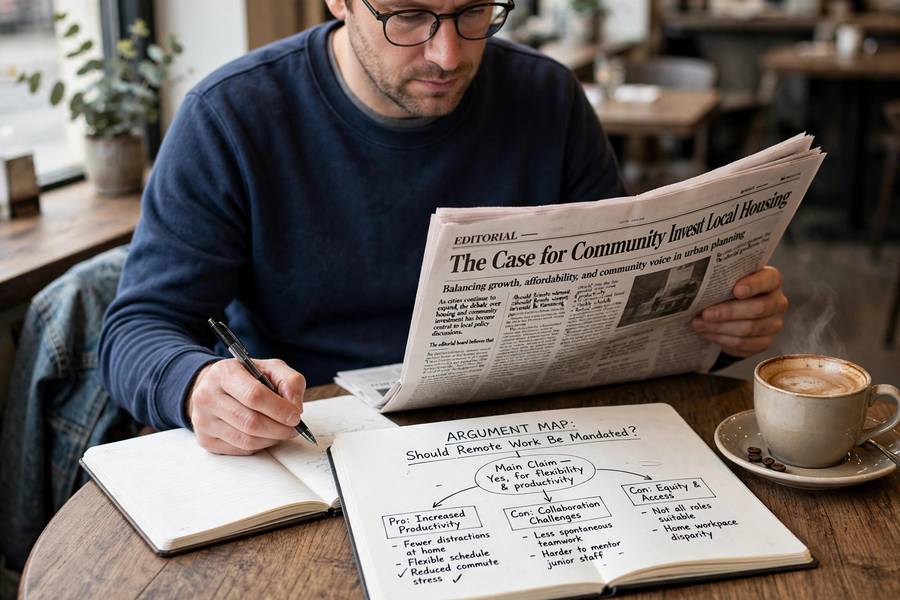
Here is a problem nobody talks about: nearly all reading comprehension exercises are written for children. Adults who want sharper reading — for work, for study, for citizenship — get picture books and third-grade worksheets. I have built comprehension programs for adult learners, and the exercises that work look nothing like school worksheets. They look like what skilled readers actually do.
Below are the exercises I assign: close reading drills, inference ladders, argument mapping, and vocabulary-in-context practice. Twenty minutes a day, real adult material, measurable progress.
No worksheets, no cartoons, no condescension — just the drills strong readers actually use, adapted for busy adults with twenty minutes to spare.
In this guide:
- Close Reading Drills
- The Inference Ladder
- Argument Mapping
- Vocabulary in Context Practice
- A 20-Minute Daily Routine
- Reading Difficult Texts at Work
Close Reading Drills
Pick a short, dense paragraph — an editorial, a scientific abstract, a legal summary — and read it three times with three different jobs. First read: what is the literal claim? Second read: what is implied but not stated? Third read: what is the author trying to get me to feel or do? Write one sentence for each. This triple-pass builds the layered attention that strong comprehension requires.
Do this with opinion pieces you disagree with. It is easy to close-read things you already believe; the skill grows when you must fairly state an opposing argument before critiquing it. Steel-manning — stating the other side's case in its strongest form — is both a comprehension exercise and an intellectual virtue.
Time yourself monthly on a standard passage with questions you write yourself: main idea, two inferences, author's purpose, one vocabulary-in-context. Score honestly. Adults love this because the progress is visible and the material respects their intelligence.
The Inference Ladder
Most adult comprehension failures are inference failures — readers get the literal words but miss what follows. Train it explicitly with the ladder: read a short scenario, then answer three levels. Level one: what does the text directly state? Level two: what probably follows? Level three: what might follow, and how confident are you?
Example: 'Maria glanced at her watch for the third time and began gathering her papers.' Level one: Maria looked at her watch repeatedly and collected her papers. Level two: she is in a hurry or running late. Level three: she may be about to leave a meeting — moderate confidence. Practicing the confidence calibration matters: strong readers know what they know and what they are guessing.
News articles are perfect ladder material — read the first three paragraphs of a complex story and ladder the implications before reading on. Then check your inferences against the rest. This builds the predictive reading that makes long articles feel effortless.
Argument Mapping
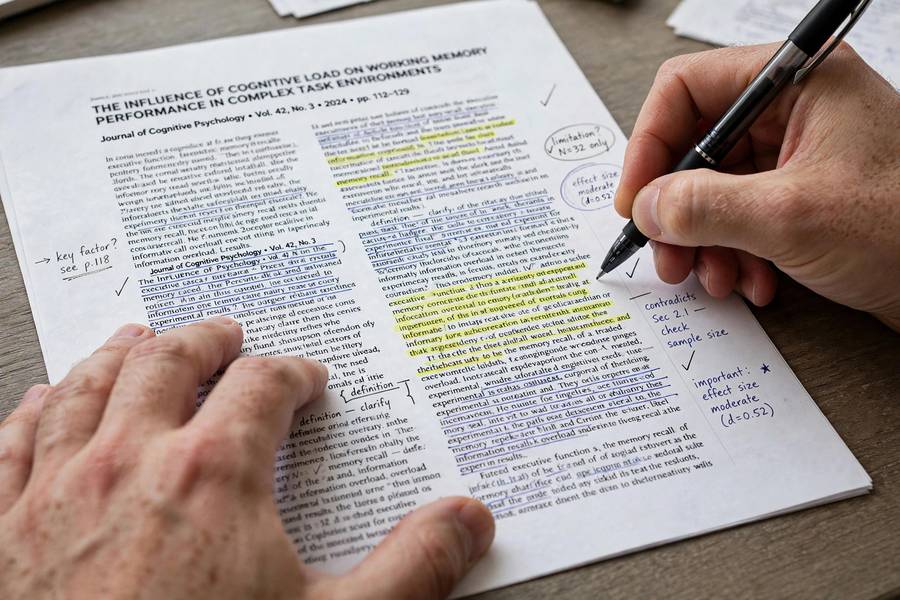
Take an editorial or essay and map its argument visually: main claim at the top, supporting reasons below, evidence under each reason, objections and replies off to the side. You can do this on paper in ten minutes, and it transforms vague 'I kind of agree' into precise understanding of what is actually being argued.
This exercise exposes the difference between understanding words and understanding reasoning. Many adults discover they have been 'reading' opinion pieces for years while absorbing only the conclusion and the emotional tone. Mapping forces engagement with the structure — and weak arguments become visible instantly.
Do it with one article weekly, alternating topics you care about and topics you do not. The unfamiliar topics build more comprehension muscle, because you cannot coast on background knowledge — you must actually follow the reasoning.

Vocabulary in Context Practice
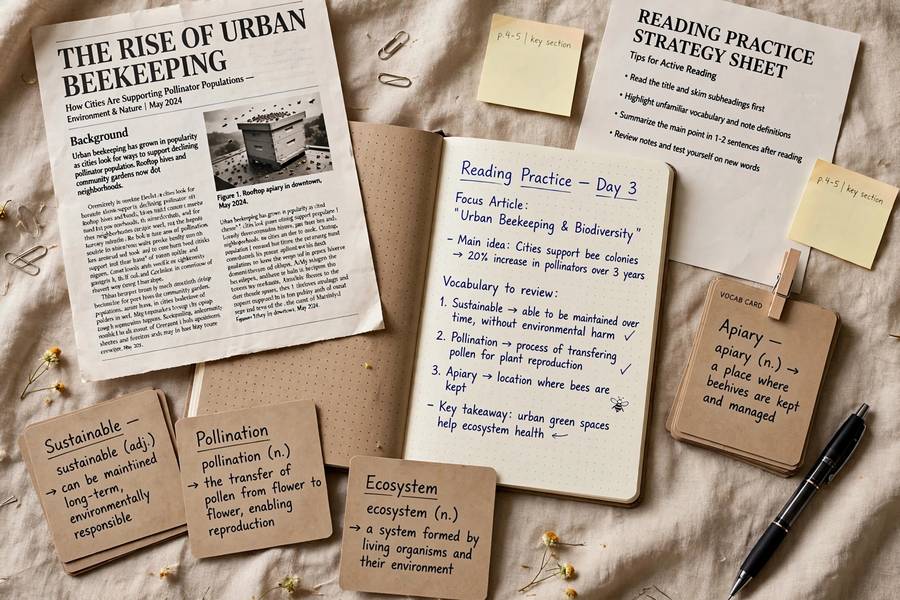
Choose five unfamiliar words from your week's reading — real words you actually met, not list words. For each, write the sentence you found it in, your guess from context, the dictionary definition, and a new sentence of your own using it. The own-sentence step is what moves the word into usable vocabulary.
Study word parts systematically: thirty common prefixes, roots, and suffixes unlock thousands of words. 'Bene-' (good), 'mal-' (bad), '-cide' (kill), 'contra-' (against) — ten minutes with a roots list pays dividends across every serious text you will ever read. how to study for final exams
Read one level up deliberately: material slightly above comfort, in small doses, with the context-guessing habit engaged. This is progressive overload for reading — the same principle as physical training. Comfortable reading maintains; challenging reading builds. tips for studying history exams
A 20-Minute Daily Routine
Monday, Wednesday, Friday: close reading drill — one dense paragraph, triple-pass, three written sentences. Tuesday, Thursday: inference ladder on news articles. Weekend: one argument map of an editorial, plus vocabulary review of the week's five words. what active recall is
Track two metrics monthly: reading speed with comprehension questions, and a self-rating of confidence on difficult texts. Adults stay motivated by evidence, so make the evidence visible — a simple log works. how to prepare for the GRE
After eight weeks, raise the difficulty: longer texts, denser topics, tighter time limits. Comprehension, like fitness, plateaus without progressive challenge. The readers I have coached who kept progressing all share one trait: they never stopped making it slightly harder.
Reading Difficult Texts at Work
Workplace reading — contracts, technical specs, policy documents, research reports — is where adult comprehension pays rent. The strategies transfer directly, but the stakes change the approach: at work, misunderstanding has consequences, so verification matters more than speed.
Read consequential documents twice with different jobs: first pass for structure (what is this saying overall?), second pass for obligations (what does this require of me?). Contracts especially punish single-pass reading — the structure pass prevents you from missing the clause that redefines everything.
Build a personal glossary for your field's jargon. Every profession runs on terms that are precise to insiders and opaque to everyone else; writing down definitions as you encounter them builds the vocabulary that makes the next document easier. Senior colleagues' fluency is mostly vocabulary plus pattern recognition.
Ask clarifying questions early and without embarrassment. 'Can you walk me through what this section requires?' is not ignorance — it is diligence, and experienced professionals respect it. The expensive mistakes come from people who nodded along instead of asking.
Schedule difficult reading for your sharp hours. A dense report at 4pm after six meetings gets skimmed; the same report at 9am gets understood. Protecting ninety morning minutes for consequential reading is one of the highest-value calendar decisions a professional can make.
Treat workplace reading as continuing comprehension practice: the argument-mapping and inference skills from your exercises apply directly. Adults who keep training read their industry's difficult material with an ease that looks like talent and is actually practice.
One more exercise for advanced practitioners: the hostile summary. Summarize an article you strongly disagree with so fairly that its author would endorse your summary. This is brutally difficult and enormously valuable — it separates comprehension from agreement, a distinction most adults never practice.
Try reading in translation: pick a great work in translation and notice what the translator's choices reveal about meaning. Comparing two translations of the same passage is a masterclass in how much comprehension lives between the words.
Volunteer as a literacy tutor if your schedule allows. Teaching beginning readers forces you to articulate everything you do automatically — and nothing deepens a skill like teaching it from the ground up. Many tutors report their own reading improving dramatically.
Track your practice the way athletes track training: a simple log with date, exercise, duration, and one observation. Adults sustain habits they can see, and the log reveals plateaus before frustration sets in. When progress stalls for three weeks, change the exercise type — plateaus usually mean adaptation, not failure.
Pair up if you can. An exercise partner — even one video call weekly — adds accountability and turns solitary drills into conversation. Discussing an argument map with another person deepens it beyond what solo work achieves, because their questions expose your blind spots.
Remember that comprehension is cumulative across years, not weeks. The adults I have coached who improved most were not the most intense — they were the most consistent. Twenty minutes daily for a year transforms a reader; two hours weekly for a month merely tires one.
Close reading triple-passes on dense paragraphs, inference ladders on news articles, weekly argument maps of editorials, and vocabulary-in-context practice with real encountered words — about 20 minutes daily.
Structured daily practice with adult-level material: preview, read actively with written summaries, self-test with your own questions, and progressively increase difficulty every few weeks.
Yes — editorials, long-form journalism, and scientific abstracts provide excellent free practice material. Public libraries offer adult literacy programs and reading groups in many areas.
With 20 focused minutes daily, most adults see measurable improvement in 8 to 12 weeks. Progress accelerates as vocabulary and background knowledge compound.
Yes, up to a point — fixing regressions and previewing strategically typically adds 50 percent speed with comprehension intact. Beyond that, speed and comprehension trade off, so prioritize understanding.
Absolutely — the adult brain remains plastic, and adults often improve faster than children because they practice deliberately and have richer background knowledge to connect new ideas to.