


Let me tell you about the most common study session I have ever witnessed. A student sits down, opens the textbook, and reads. Reads the chapter. Reads it again. Highlights a bit. Closes the book feeling productive. Takes the test. Bombs it.
Then the student says: “But I studied for hours!” And they are right — they did. They just studied wrong. Reading feels like learning. It is not. Active recall is what learning actually looks like, and once you understand it, you will never study the old way again.
Table of Contents
- Active Recall, Simply Defined
- Why It Works: The Science in Plain English
- Active Recall vs Passive Review
- 7 Ways to Practice Active Recall
- Using Active Recall for Different Subjects
- Common Mistakes Beginners Make
- Frequently Asked Questions
Active Recall, Simply Defined
Active recall is the practice of retrieving information from your memory — pulling answers out of your brain — instead of putting information in by re-reading.
That is the whole technique. Instead of reading “mitochondria is the powerhouse of the cell” for the tenth time, you close the book and ask yourself: “What does the mitochondria do?” Then you answer from memory. The effort of retrieving is what builds the memory.
It feels harder than re-reading. That difficulty is not a bug — it is the entire point. Your brain strengthens exactly the pathways you force it to use.
Why It Works: The Science in Plain English
Decades of cognitive science research converge on one finding: retrieval practice beats review. In landmark studies, students who practiced recalling material consistently outperformed students who spent the same time re-reading — often by a full letter grade or more.
Why? Three reasons:
- It exposes gaps. Re-reading feels fluent because the book is doing the work. Recall shows you exactly what you do not know — which is the most valuable information a student can have.
- It strengthens memory traces. Each successful retrieval makes the next retrieval easier. You are literally paving the neural road by driving on it.
- It trains the test skill itself. Exams ask you to retrieve under pressure. Practicing retrieval is practicing the exam; re-reading is practicing… reading.
This is also why reading comprehension strategies like self-quizzing work — they are active recall in disguise.
Active Recall vs Passive Review
| Passive (feels productive) | Active (is productive) |
|---|---|
| Re-reading chapters | Closing the book and summarizing |
| Highlighting | Writing questions, then answering them |
| Watching video lectures twice | Pausing videos to explain concepts aloud |
| Copying notes neatly | Brain-dumping everything you remember onto blank paper |
| Reviewing flashcards by flipping immediately | Trying to answer before flipping |
Notice the pattern: passive methods keep the information in front of you. Active methods take it away and make you rebuild it. Uncomfortable? Yes. Effective? Enormously.

7 Ways to Practice Active Recall
1. The Blank Page Brain Dump
Close everything. On a blank page, write down everything you remember about a topic — no peeking. Then open your notes and check what you missed in a different color. The missing parts are your real study list. Repeat until the page is nearly complete from memory.
2. Self-Made Flashcards
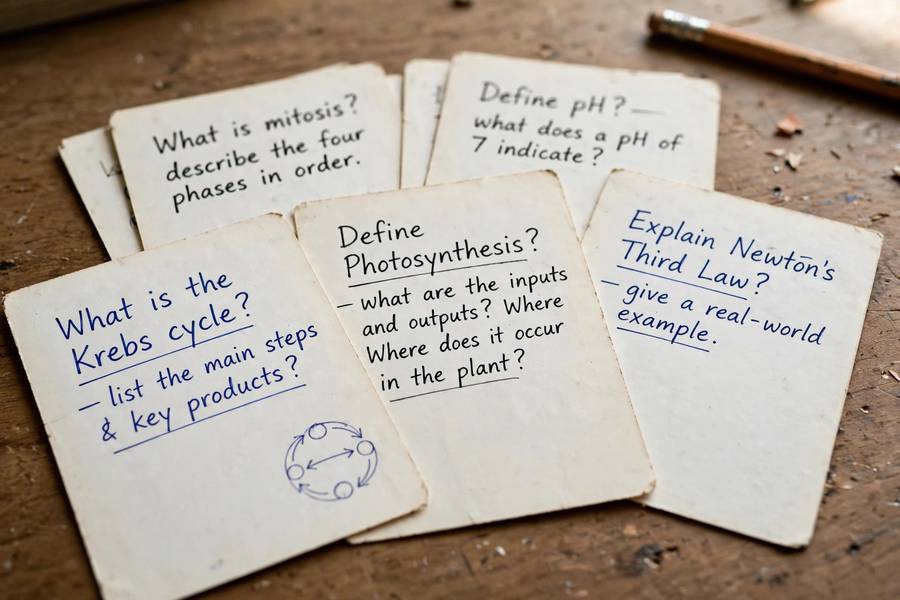
Write questions (not just terms) on cards. “What were the three causes of the war?” beats “War causes.” Digital tools with spaced repetition automate the scheduling — but paper cards work fine.
3. The Feynman Technique
Explain the concept out loud as if teaching a smart twelve-year-old. No jargon allowed. Wherever you stumble or reach for fancy words to hide confusion — that is the gap. Go relearn that part, then explain again.
4. Past Questions First
Before studying a topic, attempt past exam questions on it cold. You will do badly. Good — now you know exactly what matters, and your brain will hunt for those answers as you study. Then re-attempt the questions from memory after studying.
5. Cornell Notes, Recalled
Take notes in a question-and-answer format, then cover the answers column and use only your cue questions to reconstruct the content aloud.
6. Teach Someone (or No One)
Grab a friend, a sibling, a stuffed animal — explain the topic start to finish. Teaching forces organization, reveals gaps, and the social pressure keeps you honest. Solo explaining to an empty room works nearly as well.
7. Interleaved Practice
Do not just recall one topic per session. Mix them: five questions on topic A, five on topic B, back to A. Interleaving feels messier but produces far better long-term retention and discrimination between similar concepts.
Using Active Recall for Different Subjects
- Math/Science: Close the book and redo problems from scratch — not “following along” with solutions, but genuinely solving. Cover the worked example, reproduce each step.
- History: Timeline brain dumps. Write the sequence of events and causes from memory, then check.
- Languages: Recall vocabulary both directions (native→target and target→native), and force yourself to produce sentences, not just recognize words.
- Literature: Summarize plots, themes, and character arcs from memory; generate your own essay questions and outline answers.
For exam-season application, see my guide on how to study for final exams.
Common Mistakes Beginners Make
Quitting because it feels bad. Struggling to recall feels like failing. It is not — the struggle is the learning happening. If recall feels easy, you are probably testing yourself on things you already know.
Testing recognition instead of recall. Multiple-choice-style “do I recognize this?” is weak. Free-response “can I produce this from nothing?” is strong. Always prefer production.
Only recalling once. One successful recall is not mastery. Space your recall sessions: today, in three days, in a week. Each round should feel a little easier — that is the trace strengthening.
Recalling trivia instead of structure. Do not just drill isolated facts. Recall explanations, causes, connections. “Why” questions build understanding; “what” questions build trivia.
Tools That Make Active Recall Easier
You do not need fancy apps, but the right tool removes friction:
- Paper flashcards: Free, tactile, and surprisingly effective. Best for small batches and kinesthetic learners.
- Spaced repetition apps: These schedule your reviews automatically using algorithms based on how well you remembered each card. Ideal for large volumes (languages, medicine, law).
- Blank-page method: Zero tools required — just paper. Best for big-picture understanding and essay subjects.
- Study groups: Take turns quizzing each other. Explaining answers aloud adds the teaching effect on top of retrieval.
- Past papers: The most exam-realistic recall practice available. Always prioritize these as exams approach.
The tool matters far less than the habit. Pick the one you will actually use daily — the best system is the one that survives contact with a busy semester.

Frequently Asked Questions
Active recall means testing yourself from memory — closing the book and retrieving answers — instead of passively re-reading. The mental effort of retrieval is what builds strong, lasting memories.
Yes, decisively. Decades of research show retrieval practice outperforms re-reading by wide margins, often a full letter grade. Re-reading feels fluent because the book does the work; recall forces your brain to do it.
Start with the blank-page brain dump: close your materials, write everything you remember about a topic, then check what you missed. Or make question-based flashcards and always try to answer before flipping.
Yes — cover worked examples and reproduce each solution step from memory, rather than following along. Genuinely solving (not recognizing) is the math version of active recall.
Because it is real work — you are forcing your brain to retrieve rather than recognize. That difficulty is the mechanism, not a flaw. If it feels easy, you are likely testing things you already know.
Space it out: recall a topic today, again in three days, then in a week. Spaced retrieval beats massed cramming for long-term retention every time.