Reading Comprehension Strategies for Students That Actually Work

I have taught reading strategies to hundreds of students, and I will tell you what the research says plainly: a handful of strategies work remarkably well, and most of the rest are filler. The effective ones share a trait — they force the reader to actively process meaning instead of passively moving eyes across words.
This guide covers the strategies with real evidence behind them, shows exactly how to use each one, and explains how to combine them into a reading routine that works for textbooks, novels, and tests alike. what active recall is and how to use it
These are the same strategies reading researchers have validated for decades — I have just translated them from academic language into things you can actually do tonight.
In this guide:
- 1. Previewing: The Two-Minute Head Start
- 2. Questioning: Read Like an Interrogator
- 3. Summarizing: The Understanding Test
- 4. Monitoring: Noticing When You're Lost
- 5. Combining Them Into a Routine
- Adapting Strategies for Struggling Readers
1. Previewing: The Two-Minute Head Start
Before reading, spend two minutes on reconnaissance: read the title, headings, subheadings, and any summary or review questions. Look at pictures, charts, and captions. Read the first and last paragraphs. This is not cheating — it is building the mental framework that new information attaches to.
Turn headings into questions. 'The Causes of the Civil War' becomes 'What were the causes of the Civil War?' Now you are reading to answer, which focuses attention dramatically. Students who do this consistently report that chapters feel shorter — because purposeful reading is faster reading.
Previewing is the highest return-on-time strategy I know: two minutes of preview routinely saves ten minutes of confused re-reading. Yet it is the strategy students skip most, because it feels like 'not really reading.' Teach yourself that it is the most important part.
2. Questioning: Read Like an Interrogator
Generate questions as you read — not afterward. Who is doing what? Why does this matter? How does this connect to what I already know? What would the author say to an objection? Active questioners comprehend more because questions keep the brain in retrieval mode, constantly checking understanding.
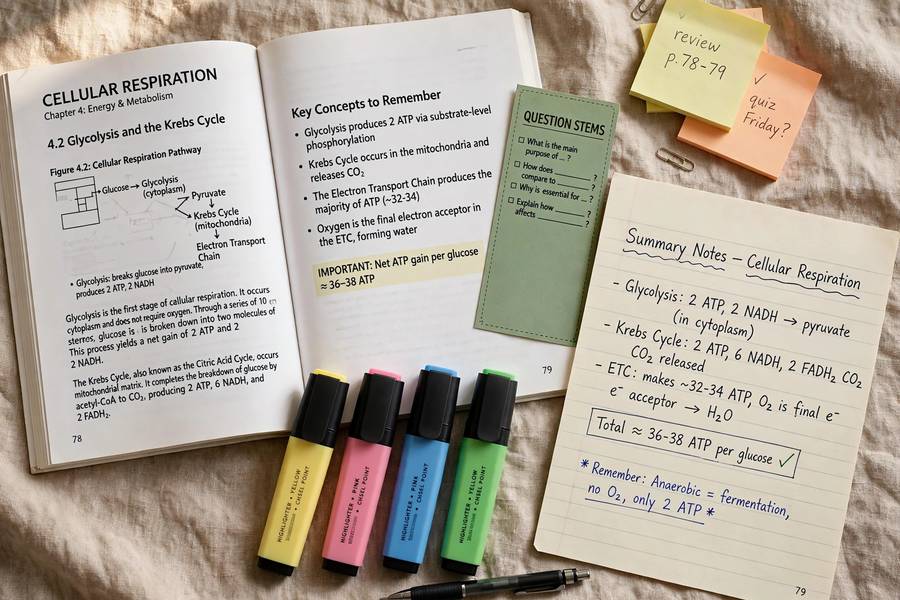
Use question stems if you get stuck: 'Why did…?', 'What would happen if…?', 'How is X different from Y?', 'What evidence supports…?' Post these on a bookmark until they become automatic. Within weeks, students internalize them and question spontaneously.
The levels matter: literal questions (what does it say?), inferential (what does it mean?), and evaluative (do I agree? is it convincing?). Weak readers ask only literal questions; strong readers live in the inferential and evaluative levels. Push yourself up the ladder deliberately.
3. Summarizing: The Understanding Test
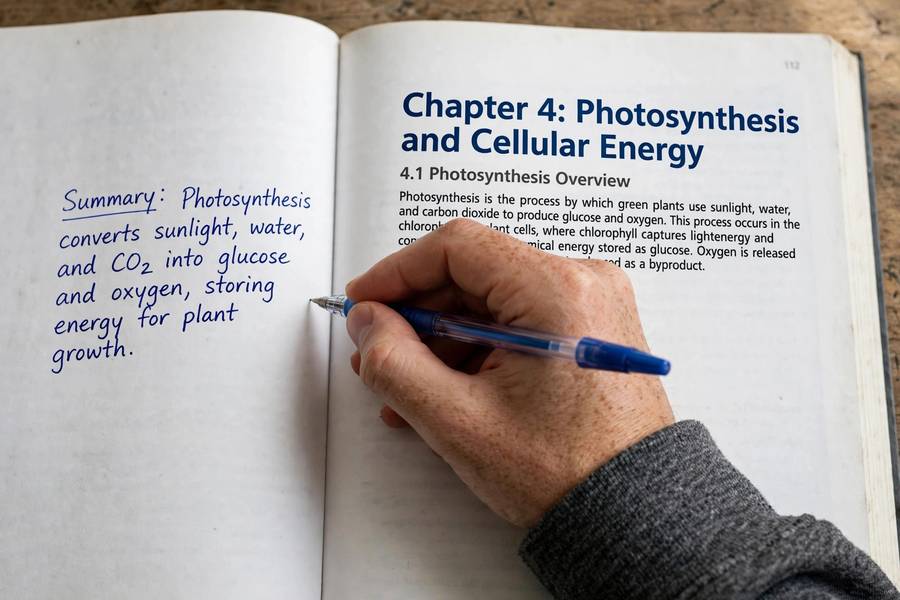
After each section, close the book and summarize in one or two sentences — in your own words, never copied. If you cannot, you did not understand it, and re-reading now (while the context is fresh) is ten times more efficient than discovering the gap during exam review.
Teach the 'somebody-wanted-but-so' frame for narratives: somebody (character) wanted (goal), but (obstacle), so (outcome). For nonfiction: 'The author argues X because of Y and Z.' These frames force extraction of structure, not just details.
Shrink summaries progressively: a paragraph per section, then a page per chapter, then three sentences per chapter. Each compression forces deeper decisions about what matters — and that decision-making is comprehension itself.
4. Monitoring: Noticing When You're Lost
Strong readers constantly monitor their understanding; weak readers do not notice they are lost until the chapter ends. Build the monitoring habit with click-and-clunk: as you read, notice 'clicks' (this makes sense) and 'clunks' (I am lost here). Mark clunks and fix them immediately — re-read, look up the word, check the earlier section.
Teach yourself fix-up strategies for clunks: re-read the confusing part slowly, read on for context then come back, break long sentences into parts, connect to what you know. Having named strategies turns 'I'm confused' from a dead end into a procedure. how to prepare for the GRE
Monitor at three scales: word level (unknown vocabulary), sentence level (tangled syntax), and text level (lost the thread of the argument). Different clunks need different fixes, and naming the level is half the solution. how to study for final exams
5. Combining Them Into a Routine
Here is the full routine I give students. Before: preview two minutes, turn headings into questions. During: question actively, mark clicks and clunks, fix clunks immediately. After each section: summarize in your own words. After the chapter: write the three-sentence version and generate two test-style questions. tips for studying history exams
Start with one strategy, not all five. Master previewing for two weeks — it is the easiest win — then add questioning, then summarizing. Students who try to adopt everything at once adopt nothing; sequential mastery builds a permanent toolkit.
Use the strategies on real schoolwork from day one, not on practice worksheets. Strategies learned on artificial exercises often fail to transfer; strategies built on actual textbooks and novels become habits because they solve real problems immediately.
Adapting Strategies for Struggling Readers
Struggling readers need the same strategies with different scaffolding — smaller steps, more modeling, and texts at the right level. The worst approach is handing a frustrated reader harder material with a list of strategies; the best is demonstrating one strategy on accessible text until it clicks.
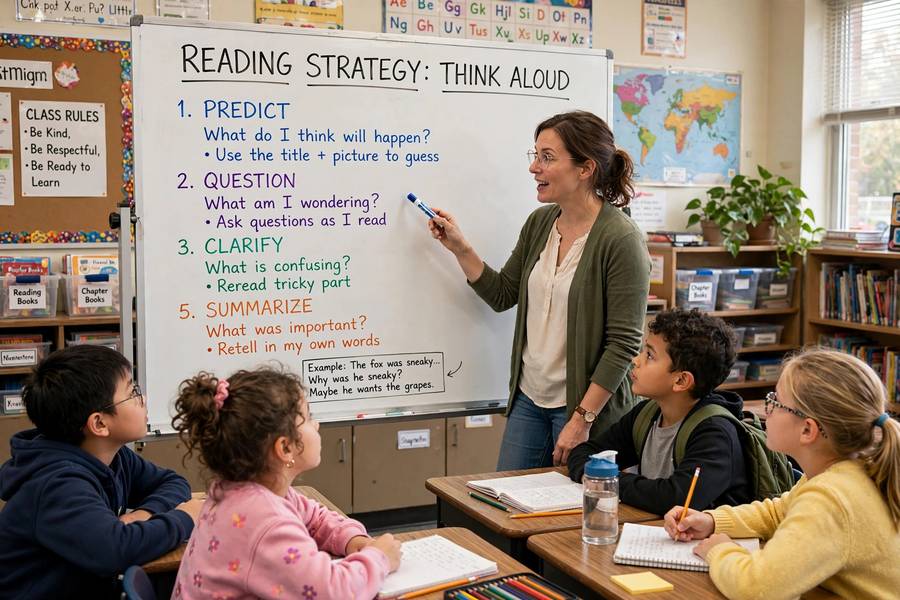
Model with think-alouds: read a paragraph and narrate your thinking — 'I'm confused by this sentence, so I'm re-reading it slowly… now I see it connects to the heading.' Students cannot imitate invisible thinking; making it audible gives them a template. Do this daily for two weeks and watch them start narrating their own reading.
Pair strategies with texts at the independent level first — where the student reads fluently — so the strategy itself is the only new challenge. Once previewing works on easy text, move it to instructional-level text. Layering a new strategy onto already-hard text guarantees failure and blame placed on the strategy.
Reduce the load: one strategy per week, practiced in ten-minute sessions, with immediate success experiences. Struggling readers have long histories of reading failure; the program must manufacture wins early. Celebrate the first successful self-caught confusion like the breakthrough it is.
Involve the student in tracking: a simple chart of 'strategies I used today' builds metacognition — thinking about thinking — which is the actual goal. The strategies are tools; the awareness of when to use them is the skill. Students who can say 'I need to re-read because I clunked' own their reading.
Coordinate with the student's actual schoolwork rather than isolated exercises. Strategies practiced on tonight's science chapter transfer automatically; strategies practiced on worksheets often do not. The most effective intervention is also the most practical: use the strategies on real assignments, starting today.
One more strategy for the toolkit: text coding with symbols. Mark margins with ? (confusing), ! (surprising), * (important), and → (connects to…). This lightweight annotation keeps hands and minds active without the burden of full notes — and the symbols become a visual map for review.
Try partner reading for difficult texts: alternate paragraphs aloud, pausing to summarize for each other. The social accountability prevents zoning out, and hearing your partner's summary often clarifies what yours missed. Difficult chapters become manageable in pairs.
End every reading session with a two-minute 'exit ticket': the most important thing I learned, and one question I still have. This tiny ritual guarantees every session ends with retrieval and curiosity — the two engines of comprehension growth.
Previewing, active questioning, summarizing in your own words, and monitoring understanding (noticing and fixing confusion). These four have the strongest research support and work across all text types.
Start with previewing and pause-and-summarize — the simplest active strategies. Add questioning stems on a bookmark, teach click-and-clunk monitoring, and practice on real schoolwork, one strategy at a time.
A monitoring strategy where readers notice 'clicks' (understanding) and 'clunks' (confusion) as they read, marking clunks and applying fix-up strategies — re-reading, reading on, breaking down sentences — immediately.
Use the full routine on study material: preview, question, summarize per section, and write practice questions afterward. Self-testing with your own questions is the closest simulation of exam thinking.
Yes — explicit strategy instruction is among the most effective interventions for struggling readers. Start with one strategy, model it with think-alouds, and practice on texts at the right difficulty level.
Previewing — two minutes before reading, every time. It is the easiest to adopt, the hardest to forget once felt, and it improves every other strategy's effectiveness.
On timed tests, read the questions first so you know what to hunt for, then skim the passage for structure before reading carefully. Mark the lines that answer each question as you go so you can jump back quickly. If a question stumps you, eliminate obviously wrong answers and move on — bank the easy points first, then return with remaining time. Practicing under real time limits is what makes this feel natural on test day.