Reading Comprehension Tips for Tests: Score Higher on Any Exam

Test reading is its own skill. I have watched strong readers underperform on exams and average readers outperform them — the difference was never intelligence, it was test craft. Exams reward specific behaviors: finding evidence fast, managing time ruthlessly, and recognizing trap answers on sight.
These tips work across the SAT, ACT, GRE, state assessments, and classroom exams, because all reading tests share the same DNA: a passage, a question, and answer choices designed to separate careful readers from hasty ones. how to prepare for the ACT
These tips assume you know the material — they are about test craft, not content review. Craft is the multiplier that turns knowledge into scores.
In this guide:
- Tip 1: Make Evidence a Habit
- Tip 2: Triage Your Time
- Tip 3: Learn the Trap Catalog
- Tip 4: Attack Passages Strategically
- Tip 5: Test-Day Execution
- Handling Test Anxiety on Reading Sections
Tip 1: Make Evidence a Habit
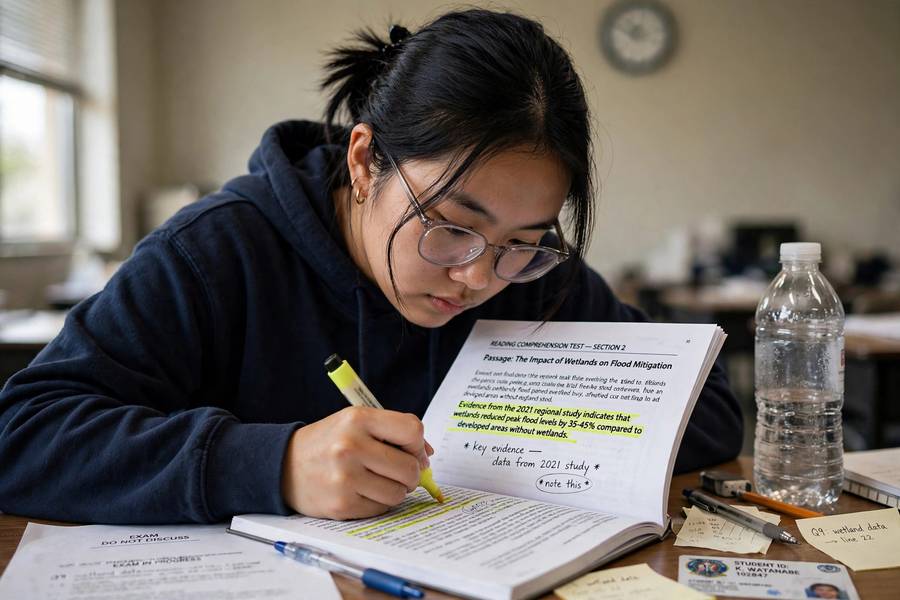
Every answer must be traceable to the text. Before finalizing any answer, point to the words that support it — literally underline or mentally flag them. Students who build this habit stop losing points to 'it felt right' answers, which are the single biggest score leak I see.
When stuck between two choices, the tiebreaker is always textual support, not plausibility. Test makers design distractors to sound reasonable; only the correct answer has the text behind it. Ask 'where does it say that?' like a skeptical lawyer, and watch trap answers collapse.
For 'most nearly means' vocabulary questions, cover the choices, predict your own word from context, then match. For inference questions, check that your inference is small — one logical step from the text, not a leap. Big leaps are almost always wrong.
Tip 2: Triage Your Time
Not all questions deserve equal time. On most tests, easy and hard questions are worth the same points — so the optimal strategy is to secure all easy points first and spend leftover time on hard ones. Perfectionists who polish question 3 while question 30 goes unanswered are donating points.
Set a per-question budget before the test (total time divided by questions, minus a review buffer) and enforce it loosely: if a question passes 50 percent over budget with no progress, mark it and move on. Return with fresh eyes if time remains — distance often reveals what staring could not.
Never leave blanks unless the test penalizes guessing — and most modern tests do not. An educated guess among narrowed choices beats a blank every time. Practice the art of the fast elimination: kill the two obviously wrong choices in seconds, then decide between survivors.
Tip 3: Learn the Trap Catalog
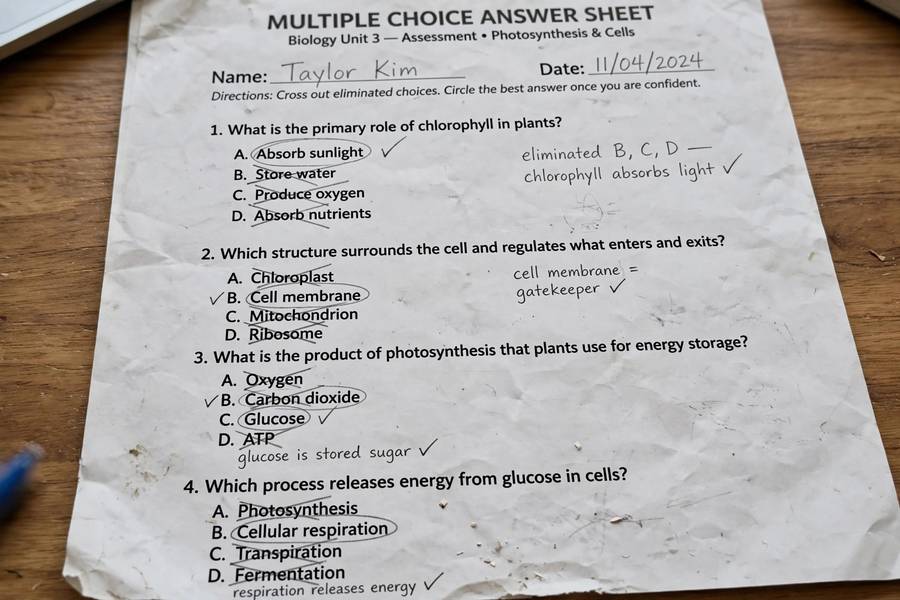
Trap answers repeat across tests because they exploit the same reader habits. Learn them by name: the Extreme (uses 'always/never' the text does not support), the True-But-Irrelevant (factually correct, does not answer the question), the Half-Right (first half matches, second half contradicts), the Out-of-Scope (brings in outside knowledge), and the Word-Match (repeats passage words with changed meaning).
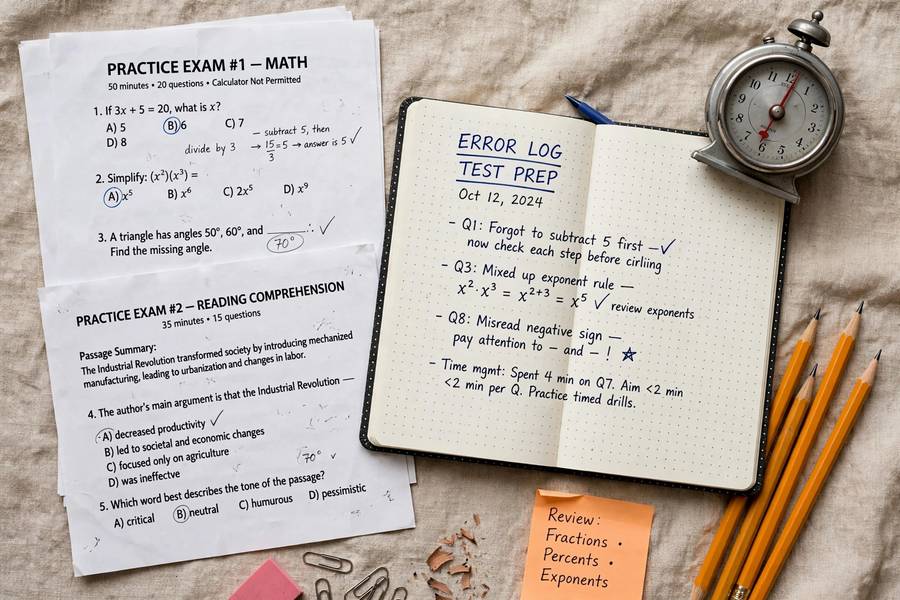
Study your own wrong answers and label each with its trap type. Within a few practice tests, you will see your personal trap profile — most students have one or two traps they fall for repeatedly. Knowing yours is like knowing the test's playbook against you specifically. how to study for final exams
The word-match trap deserves special attention: test makers deliberately reuse passage vocabulary in wrong answers. Train yourself to distrust familiar words and verify meaning — the right answer often paraphrases, while the trap quotes.
Tip 4: Attack Passages Strategically
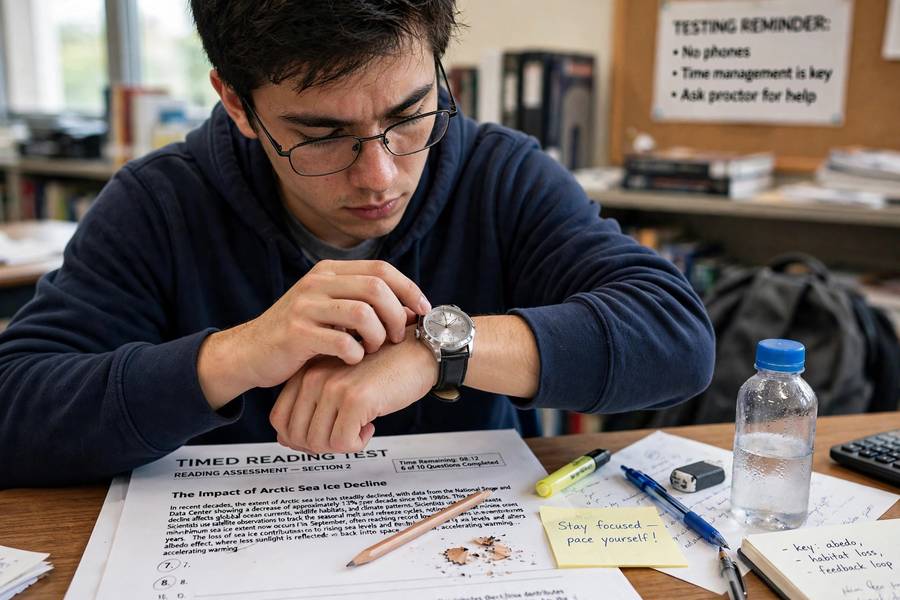
Read the questions' stems first (not full choices) so you know what to look for — main idea, details, inferences. Then read the passage once, actively: mark structural shifts, circle strong opinions, note where evidence lives. One engaged read beats two passive ones.
For long passages, jot a three-word summary per paragraph in the margin. This takes seconds and creates a map you will use for every detail question — instead of re-reading the whole passage, you scan your map. Students who resist this as 'wasting time' are the ones re-reading paragraphs five times.
Handle paired passages and dual texts by reading each separately with its own mini-summary before comparing. The comparison questions become trivial once each passage's position is clear; they become nightmares when the passages blur together.
Tip 5: Test-Day Execution
Warm up your reading brain: read something dense for ten minutes before the test — a news analysis, a challenging article. Cold readers start slow; warmed-up readers hit their stride on question one. This small ritual measurably improves early-section performance. what active recall is
Manage energy, not just time. Reading sections are marathons of focus — if your test has breaks, use them to reset, not to cram. During the section, notice when focus dips (usually around the two-thirds mark) and deliberately re-engage: sit up, re-read the question stem, re-anchor to evidence.
Trust your preparation in the final minutes. Do not change answers unless you find concrete textual evidence you missed — first instincts, when built on the evidence habit, outperform anxious second-guessing. Statistically, changed answers go wrong more often than right.
Handling Test Anxiety on Reading Sections
Test anxiety hits reading sections hardest because anxiety consumes working memory — the exact resource reading comprehension needs. The research-backed fix is not 'calm down' but structured routines that reduce uncertainty, because anxiety feeds on unpredictability.
Build a pre-section ritual and rehearse it in every practice: three slow breaths, read the directions even though you know them, do the first question with exaggerated care. Rituals signal safety to your nervous system; students with rituals show measurably lower anxiety spikes when the section begins.
Reframe arousal as readiness. The physical symptoms of anxiety — faster heartbeat, alertness — are identical to the symptoms of being prepared and focused. Students taught to interpret the feeling as 'my body getting ready' outperform students taught to suppress it. You do not need calm; you need functional.
Have an anxiety protocol for mid-test spirals: when panic hits, stop, plant your feet, take one slow breath, and re-read the current question stem slowly. This thirty-second reset breaks the spiral and re-anchors you to the task. Practice it during timed practice so it is available under pressure — coping skills unused in practice vanish in the real test.
Prepare the controllables obsessively: sleep, logistics, materials, timing plan. Anxiety shrinks when the list of unknowns shrinks. The night-before checklist is not fussiness; it is anxiety management disguised as organization. how to prepare for the SAT
Keep perspective in the room: one test is one data point, retakes exist, and your worth is not on the answer sheet. Paradoxically, students who hold outcomes lightly perform better — desperation tightens thinking, while perspective frees it. You prepared; now let the preparation work.
One more test-day essential: manage your bubbling or clicking mechanics. On digital tests, know exactly how to flag, strike through, and navigate — fumbling the interface under pressure costs minutes. Do a full interface practice run before test day, not during it.
For paper tests, circle answers in the booklet first and transfer in batches — it is faster and lets you re-verify. Never leave transfer to the final minute; mistransferred answers are the most heartbreaking lost points in testing.
After the test, write down everything you remember about hard questions within an hour — for your own error analysis if you retake, and because the reflection converts test experience into skill. Every test taken reflectively makes the next one easier.
Build a pre-test checklist and use it every time: materials packed, route known, sleep banked, warm-up done, trap journal reviewed. Checklists feel unglamorous, but pilots and surgeons use them because they work — and test day has the same 'do not forget the basics under pressure' structure.
During the test, monitor your energy like a resource meter. If focus crashes mid-section, spend thirty seconds on the reset protocol rather than pushing through fog — thirty seconds spent recovering buys back minutes of effective reading. Pushing through fatigue just produces confident wrong answers.
After scores arrive, do a full debrief regardless of outcome: what worked, what broke down, what surprised you. Winners debrief too — the goal is a repeatable system, not a lucky day. Every test is tuition; make sure you get the education.
Build the evidence habit (every answer traceable to the text), learn the five trap answer types, triage time so easy points come first, and practice with official materials while logging your trap profile.
Yes — reading question stems first focuses your passage reading and saves re-reading. Do not read full answer choices first, which biases your interpretation.
The Extreme, the True-But-Irrelevant, the Half-Right, the Out-of-Scope, and the Word-Match. Learn to name them and label your own misses — most students have one or two repeat traps.
Budget time per question, move past anything stuck over budget, secure easy points first, and never leave blanks on tests without guessing penalties.
Only with new textual evidence. Anxious second-guessing statistically hurts more than it helps — trust answers built on the evidence habit.
Yes — evidence-based answering, time triage, and trap recognition transfer across all standardized reading tests. Only the format-specific tactics need adjusting per exam.