Follow-Through in Basketball Shooting: The Goose Neck Done Right

Ask any shooting coach for the one cue they’d tattoo on a player and half of them will say “hold your follow-through.” It sounds like nagging until you understand what’s actually happening: the follow-through is the only part of your shot you can fully control after the ball leaves, which makes it the most honest diagnostic tool in basketball. A clean finish means a clean release. A sloppy finish means something broke upstream.
This guide covers follow-through in basketball shooting properly: what the “goose neck” finish looks like, why it matters biomechanically, the common flaws, and the drills that make it automatic. For the full shooting motion, see our guide to proper shooting form.
In this guide:
- What Good Follow-Through Looks Like
- Why It Actually Matters (It’s Not Cosmetic)
- The Goose Neck: Breaking It Down
- Checkpoints From Dip to Finish
- Common Follow-Through Flaws
- Drills That Lock It In
- Follow-Through Across Different Shots
- Follow-Through Under Pressure
What Good Follow-Through Looks Like
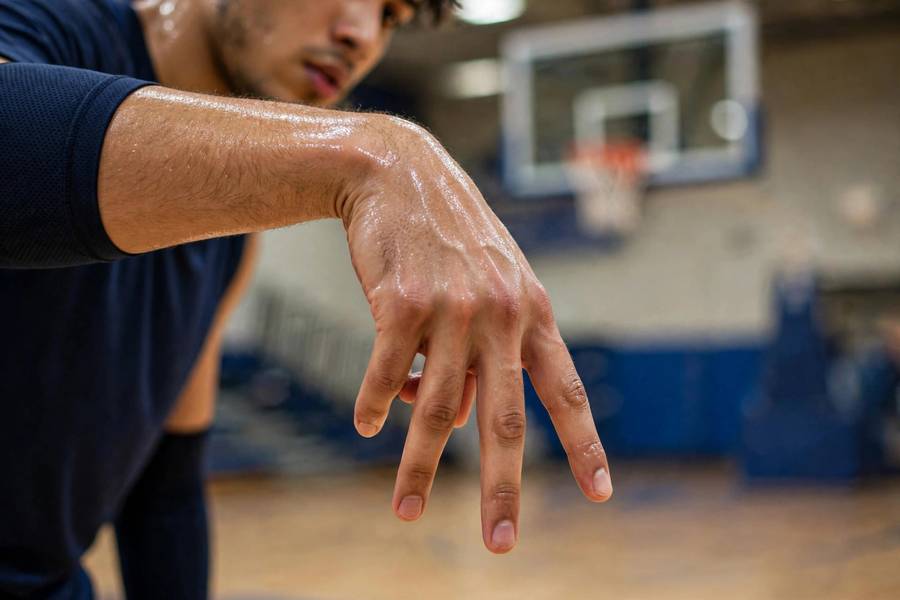
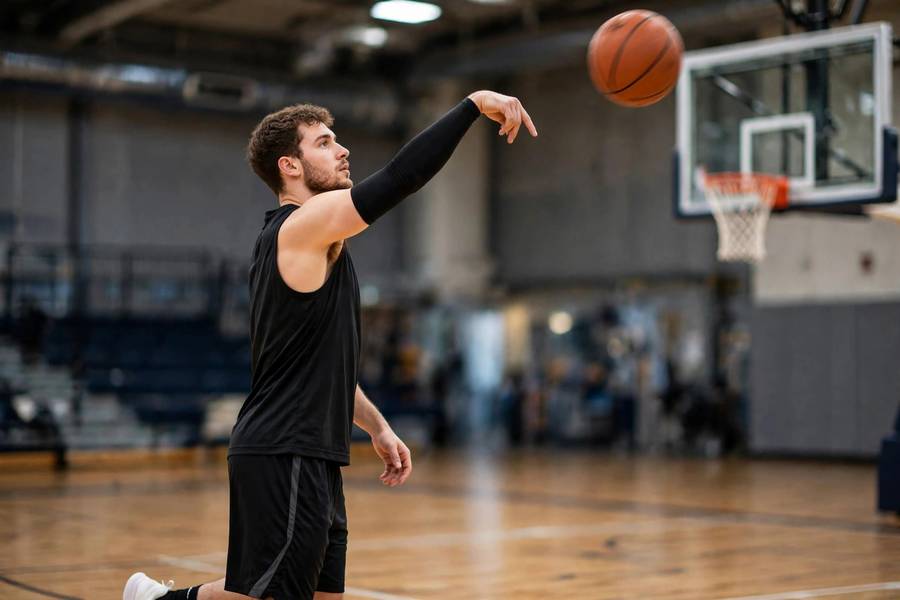
Freeze any great shooter at the moment of completion and you’ll see the same picture: shooting arm fully extended toward the basket, elbow high and locked, wrist snapped downward so the fingers point at the floor (the “goose neck”), guide hand frozen up near the forehead with fingers to the sky, eyes still on the rim, body balanced on the landing. The whole pose holds for a beat — it’s a period at the end of the sentence, not a comma.
Watch ten different elite shooters and the finish is eerily identical despite wildly different styles everywhere else. Curry’s quick snap, Thompson’s textbook hold, Durant’s high release — different deliveries, same signature ending. That’s not coincidence; it’s convergence on what works.
Why It Actually Matters (It’s Not Cosmetic)
Three real reasons, none of them about looking pretty:
- It stabilizes the release point. Your release point is determined by where your hand finishes, not where it starts. A consistent finish means a consistent release point, which means a consistent shot. Players with wandering follow-throughs have wandering release points — and wandering results.
- It guarantees full extension. Short-arming the shot — not extending fully through the release — is a top cause of flat, short misses. You cannot short-arm and still finish in a full goose neck; the finish forces the extension.
- It’s instant feedback. Your hand tells you what happened: fingers pointing left means your wrist turned; a collapsed wrist means you rushed; a low finish means you short-armed it. Learn to read your own finish and you become your own shooting coach in real time.
Think of it like a golf swing or a tennis serve — in every striking sport, the finish dictates the quality of the contact. Basketball is no different; we just talk about it less.
The Goose Neck: Breaking It Down
The “goose neck” name comes from the shape: wrist fully flexed downward, fingers dangling toward the floor like a goose’s neck curving down. Here’s the sequence that creates it:
- Extension: the shooting arm drives up and out, elbow finishing above the eyes, arm essentially straight.
- The snap: at full extension, the wrist flexes sharply downward — this is the last force applied to the ball and the primary source of backspin.
- The dangle: fingers finish pointing down, relaxed, not rigid. Tension in the fingers at the finish usually means tension through the whole release.
- The hold: freeze the entire pose — arm up, wrist down, eyes on rim — until the ball hits the rim. Count “one-one-thousand” in practice.
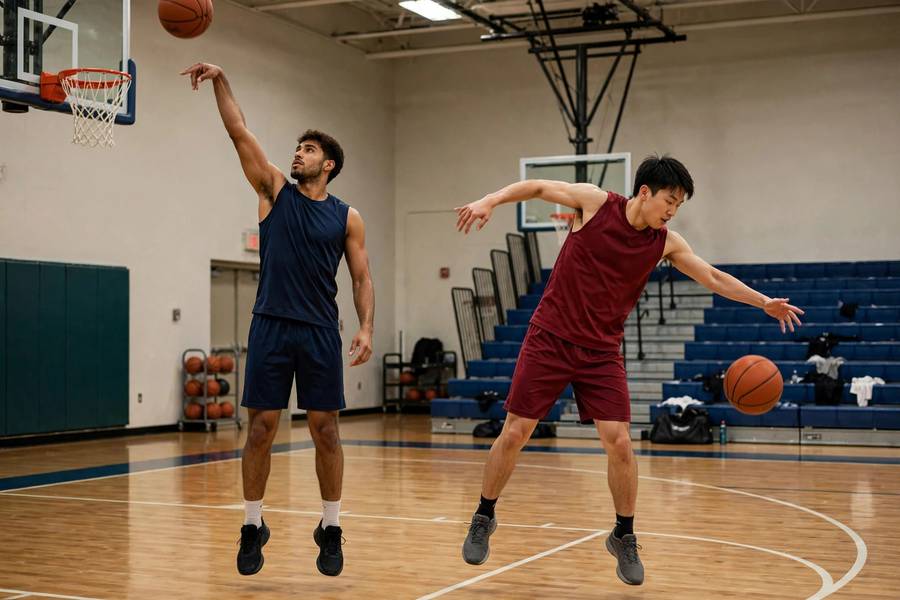
The guide hand has its own finish: it stays up, fingers pointing to the sky, like a statue of liberty frozen mid-wave. If your guide hand drops or flies sideways during the shot, it was involved in the release — and that’s the thumb-flick flaw wearing a disguise.
Checkpoints From Dip to Finish
The follow-through doesn’t start at the release — it’s the end of a chain. Check the links:
- Dip: quick and shallow, ball on the shot line. A bad dip makes a rushed finish.
- Lift: legs drive, ball rises straight. If the ball loops wide here, the finish can’t save it.
- Release: ball rolls off the index and middle fingers last — that’s what creates the clean backspin. If it rolls off the side of your hand, your finish will show it.
- Finish: full goose neck, held. This is where you verify everything above.
When something feels off, don’t start by changing the finish — trace backward. Nine times out of ten, a follow-through problem is a dip or lift problem expressing itself at the end of the chain.
Common Follow-Through Flaws
- The quick drop: hand falls the instant the ball leaves. Usually means rushing — the player is already thinking about the next play. Fix with the freeze drill (hold and count).
- The sideways finish: fingers point left or right instead of down. The wrist turned during release — often tied to a flared elbow or guide-hand interference. Fix the elbow first.
- The half-snap: wrist barely flexes, fingers point at the rim instead of the floor. Weak backspin, flat shots. Exaggerate the snap in form shooting until it feels theatrical.
- The guide-hand fly: non-shooting hand drops or waves. It was pushing the ball. One-hand form shooting to isolate, then reintroduce.
- The lean-back finish: upper body falls away while the arm extends. Balance issue — the base was wrong before the shot started. Fix the feet.
Drills That Lock It In
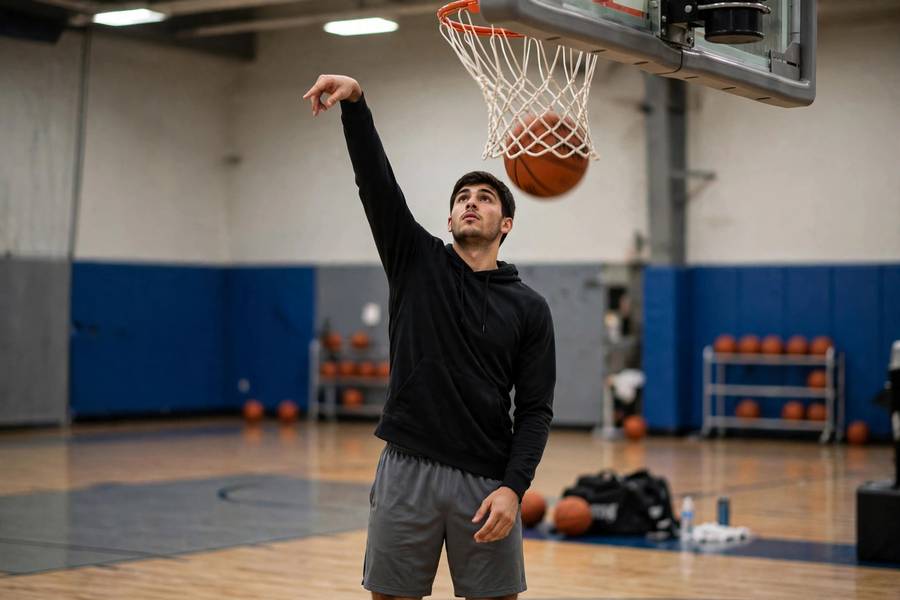
- Freeze shooting: every shot in a 50-rep form session ends with a full one-one-thousand hold. No exceptions. These follow through basketball shooting drills build an automatic finish. This is the foundational drill — everything else is refinement.
- Mirror shooting: shoot form shots facing a mirror or your phone’s front camera. Watch your finish in real time and correct it rep by rep.
- Partner call-out: a partner watches only your finish and calls it: “clean,” “dropped,” “sideways.” External feedback accelerates the fix dramatically.
- Fatigue freeze: sprint, then shoot 10 free throws with perfect held finishes. The follow-through is the first thing fatigue steals — train it tired.
- Backspin only: one-hand form shots where the only goal is perfect backward rotation.
Wrist and forearm strength make the snap more repeatable — our best arm exercises include the wrist and grip work shooters need.
Backspin is the fingerprint of a correct release and finish.
Follow-Through Across Different Shots
The finish stays constant while everything before it changes — that is the point. On free throws, the held follow-through doubles as your composure anchor; it is the last thing you control in a high-pressure moment, so make it deliberate. On threes, the finish looks identical to a free throw finish — if your three-point follow-through is collapsing, your legs are not giving you enough lift and your arms are compensating. On pull-up jumpers, the challenge is finishing balanced while moving; the cue is “stop the body, finish the arm” — your momentum halts, but the shooting arm completes its full motion regardless. On floaters and runners, the finish is softer and shorter by necessity, but the wrist still snaps and the eyes still find the rim. Different shots, same signature ending.
Follow-Through Under Pressure
Here’s what separates practice shooters from game shooters: under pressure, the follow-through is the first casualty. Adrenaline shortens everything — the dip gets skipped, the extension gets cut, the hold disappears. The shots still feel normal, which is why players blame luck instead of mechanics.
The antidote is making the held finish so automatic that pressure can’t strip it. That means thousands of held reps in practice — not hundreds. When your finish survives the fourth quarter, your release point survives the fourth quarter, and your percentages stop collapsing late in games. Coaches notice this. Teammates trust it. And the physical foundation matters too — strong, conditioned legs keep your whole motion stable when you’re tired, which is why programs like our strength training for runners have a direct line to late-game shooting.
Follow-through is the completion of the shooting motion after release: shooting arm fully extended, wrist snapped down into the ‘goose neck’ (fingers pointing at the floor), guide hand held high, pose frozen until the ball reaches the rim. It’s the signature finish shared by all great shooters.
It stabilizes your release point (consistent finish = consistent release), guarantees full arm extension (preventing short-armed misses), and gives instant feedback — your hand position at the finish tells you exactly what went right or wrong in the release.
The goose neck is the ideal shooting finish: wrist fully flexed downward with fingers dangling toward the floor, resembling a goose’s curved neck. It’s created by the final wrist snap at full arm extension and produces the backspin characteristic of good shooters.
Until the ball reaches the rim — in practice, count ‘one-one-thousand’ before moving. Holding the finish feels exaggerated at first but it’s what ingrains a stable release point; dropping the hand early is one of the most common shooting flaws.
The guide hand should stay up passively near the forehead with fingers pointing skyward — it stabilizes, never pushes. If your guide hand drops or flies sideways during the shot, it was interfering with the release.