History of Machine Learning Timeline: From Perceptrons to LLMs

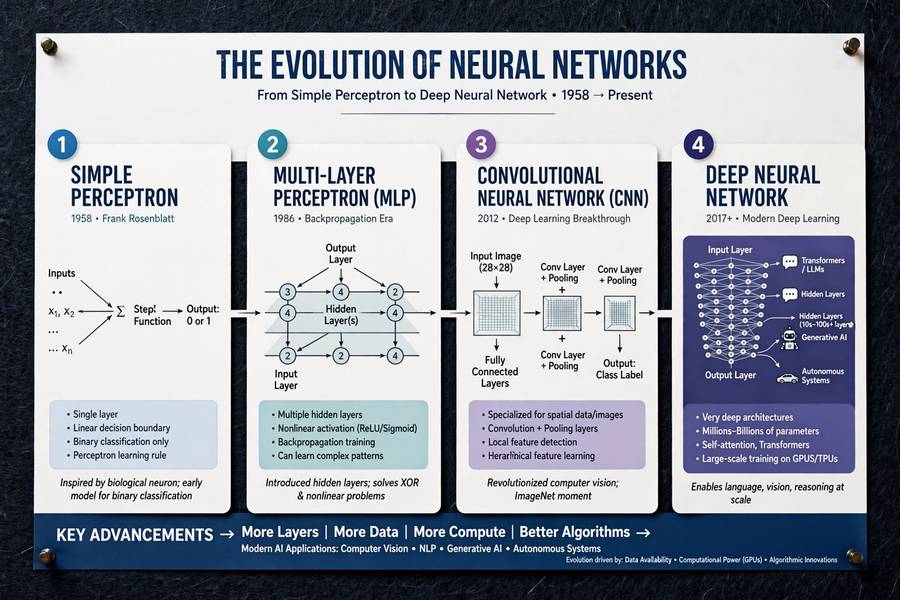
Machine learning has a strange history: it spent decades as AI’s unfashionable sibling, then ate the entire field. The symbolic AI researchers of the 70s and 80s looked down on it — too statistical, too unprincipled, not “real” intelligence. Then ML methods started winning at everything, and suddenly the sibling owned the house. Understanding this history explains why modern AI looks the way it does: it’s not the triumph of a single idea but the vindication of an approach.
I think of ML history as three acts: the early neural dreams, the statistical interregnum (when the unfashionable sibling quietly took over), and the deep learning revolution that made ML synonymous with AI. Here’s the timeline. For the broader story, see history of artificial intelligence.
Act 1: The Neural Dreams (1943–1969)
1943 — McCulloch and Pitts. Warren McCulloch and Walter Pitts publish “A Logical Calculus of the Ideas Immanent in Nervous Activity” — the first mathematical model of a neural network. They show that networks of simple neuron-like units can compute logical functions. It’s theoretical, but it plants the seed: intelligence might emerge from connected simple units, not from programmed rules.
1957 — The Perceptron. Frank Rosenblatt builds a machine that learns to classify visual patterns — literally, with potentiometers and electric motors. The Perceptron learns from examples, adjusting its weights when wrong. The press goes wild: the New York Times reports it as “the embryo of an electronic computer that [the Navy] expects will be able to walk, talk, see, write, reproduce itself and be conscious of its existence.” The hype cycle is born alongside the technology.
1959 — “Machine Learning” is named. Arthur Samuel, studying checkers-playing programs at IBM, coins the term: programming computers to learn from experience rather than explicit instruction. His checkers program improves by playing against itself — a preview of self-play methods that would triumph 60 years later in AlphaGo.
1969 — The fall. Minsky and Papert’s Perceptrons proves single-layer networks can’t learn simple functions (like XOR). The critique is technically narrow — multilayer networks overcome it — but the effect is broad: neural network funding collapses for over a decade. The baby goes out with the bathwater, and ML’s first winter begins.
The tragedy of Act 1: the core ideas were right, but the compute, data, and algorithms to realize them didn’t exist. The field would wait 40 years for the world to catch up to its dreams.
Act 2: The Statistical Interregnum (1970s–2000s)
While neural networks languished, a different tradition quietly built the methods that would dominate for 30 years. These researchers didn’t try to mimic brains — they tried to make optimal decisions under uncertainty, using statistics.
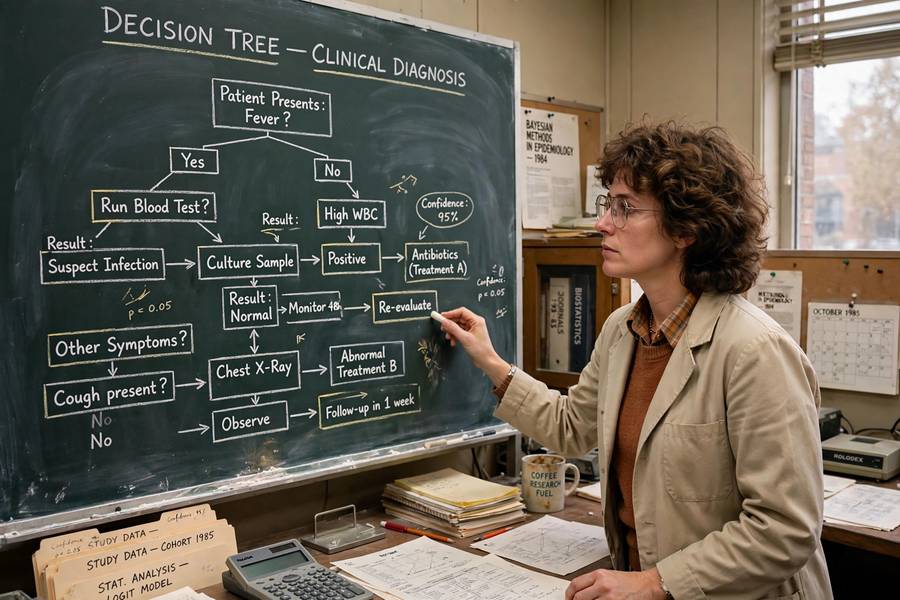
Decision trees (1960s–80s). Simple, interpretable flowcharts learned from data: if tenure > X and risk score < Y, approve the application. Quinlan’s ID3 (1986) and C4.5 made them practical. Their virtue — you can explain every decision — kept them in regulated industries (banking, clinical practice) long after fancier methods arrived.
The k-nearest neighbors and early instance learning. Don’t build a model — just remember the examples and compare. Embarrassingly simple, surprisingly effective, and the conceptual ancestor of modern retrieval methods.
1980s — Backpropagation (rediscovered). Rumelhart, Hinton, and Williams popularize backprop for training multilayer networks (1986). The algorithm that would power everything was now available — but on 1980s hardware, with 1980s datasets, it couldn’t do much. The seed waits.
1990s — SVMs and the kernel trick. Vladimir Vapnik’s support vector machines, with their elegant mathematics and strong theoretical guarantees, become the prestige method. They dominate classification tasks through the 2000s. The field’s culture shifts toward mathematical rigor — proofs of convergence, generalization bounds, the whole apparatus.
Random forests (2001). Leo Breiman’s ensemble of decision trees — individually weak, collectively strong. Unglamorous, robust, and dominant in industry competitions for a decade. The working data scientist’s best friend.
Bayesian methods mature. From naive Bayes classifiers to Bayesian networks to probabilistic programming — the tradition of treating uncertainty as a first-class citizen. Less flashy than neural nets, more honest about what models don’t know.
Boosting (1990s–2000s). AdaBoost, then gradient boosting (XGBoost would dominate Kaggle in the 2010s). The idea: combine many weak learners sequentially, each fixing the last one’s mistakes. Simple, powerful, and the last great victory of the statistical era.
By the late 2000s, machine learning worked — it powered spam filters, recommendations, fraud detection, search ranking. But it was infrastructure, not revolution. Nobody wrote headlines about random forests. The field was respected, useful, and boring. Then everything changed.
The Wilderness Years: What Happened Between 1969 and 1986
The Perceptrons critique nearly killed neural network research — but a handful of researchers kept the flame alive in near-total obscurity, doing work that would only be appreciated decades later.
1974 — Backprop is invented (and ignored). Paul Werbos describes backpropagation in his Harvard PhD thesis — the exact algorithm that would later train every deep network. Nobody pays attention. It sits in the literature for over a decade, waiting for the field to be ready.
1979–1980 — The Neocognitron. Kunihiko Fukushima builds a hierarchical neural network for visual pattern recognition — the direct ancestor of convolutional networks. It works, on 1980 hardware, for simple patterns. The world shrugs; symbolic AI is where the funding is.
1982 — Hopfield networks. John Hopfield shows that neural networks can be understood as physical systems with energy landscapes — memories as valleys the network settles into. The paper is a sensation in physics and draws new talent into neural research. It also gives the field something it desperately needed: mathematical respectability.
1985 — Boltzmann machines. Hinton and Sejnowski extend Hopfield’s ideas with stochastic units that can learn probability distributions. Conceptually enormous — networks that learn the shape of data, not just decision boundaries — but computationally brutal on 1980s machines.
1986 — Backprop returns. Rumelhart, Hinton, and Williams publish “Learning representations by back-propagating errors” in Nature. The timing is everything: computers are finally fast enough for multilayer training on toy problems, and the symbolic AI establishment is starting to crack. The paper doesn’t just revive neural nets — it gives them a training algorithm that actually works.
The wilderness years teach something important: ideas don’t die, they hibernate. Every one of these “failures” — Werbos’s ignored thesis, Fukushima’s underappreciated architecture — became load-bearing infrastructure within 30 years. The 2012 revolution was built from parts manufactured in the 1970s and 80s.
The Algorithm Zoo: What Each Method Contributed
Each era’s dominant method left permanent gifts:
- Perceptrons → the neuron as computational unit; online learning from mistakes
- Decision trees → interpretability as a value; feature importance
- k-NN → instance-based reasoning; the idea behind retrieval-augmented generation
- SVMs → the kernel trick (implicit high-dimensional features); margin maximization
- Random forests → ensembles; robustness through diversity
- Boosting → sequential error correction; the ancestor of iterative refinement
- Bayesian methods → uncertainty quantification; priors as knowledge injection
- Backprop → the training algorithm for everything that followed
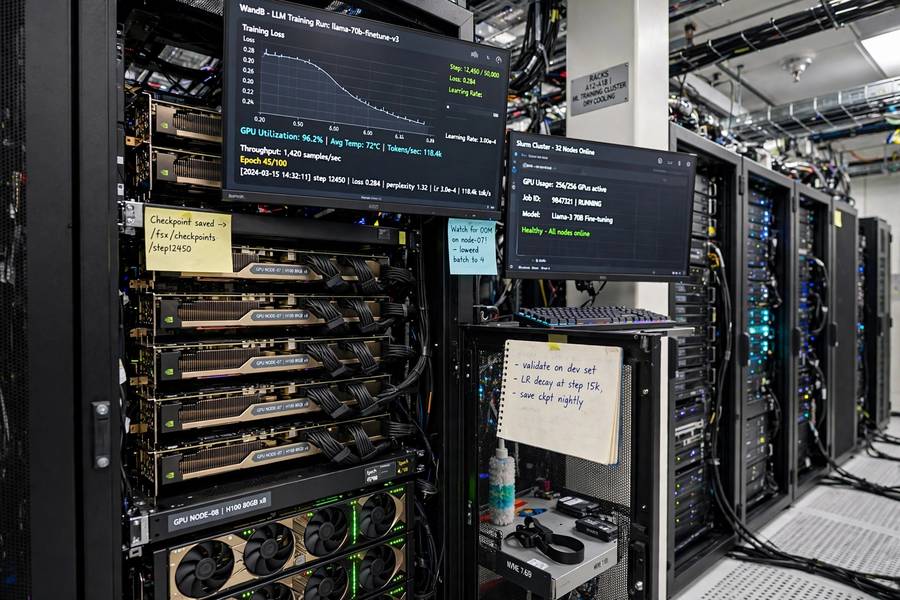
Modern deep learning didn’t replace these ideas — it absorbed them. Ensembles became dropout; kernels became attention; boosting became iterative refinement. The zoo lives on inside the neural networks.
Act 3: Deep Learning Takes All (2006–Today)
2006 — The restart. Hinton’s deep belief networks demonstrate layer-wise pretraining. “Deep learning” enters the vocabulary. Few notice.
2009–2012 — The ingredients gather. ImageNet provides data; GPUs provide compute; ReLU activations and better initialization fix training pathologies. The table is set.
2012 — AlexNet. Krizhevsky, Sutskever, and Hinton’s deep CNN halves ImageNet error rates. The moment the field pivots — within two years, deep learning dominates vision, then speech, then everything.
2014–2016 — Generative and sequential. GANs (2014) generate images; seq2seq and attention (2014–15) transform translation; AlphaGo (2016) shows deep RL mastering Go. Deep learning isn’t just classifying anymore — it’s creating, translating, strategizing.
2017 — Transformers. “Attention Is All You Need” — originally for translation, quickly universal. The architecture that eats the world: vision transformers, speech transformers, and eventually language models that do everything.
2018–2020 — Scale era. BERT, GPT-2, GPT-3: pretraining on internet text at increasing scale produces startling generality. The bitter lesson (Sutton, 2019) is vindicated: general methods leveraging computation beat hand-crafted knowledge, eventually and overwhelmingly.
2022–today — ML becomes AI. ChatGPT, diffusion models, multimodal systems, agents. “Machine learning” as a distinct term fades — it’s all just AI now. The sibling didn’t just take over the house; it became the house.
For how this intertwines with broader AI history, see how AI models are trained — and machine learning vs deep learning for the paradigm contrast.
Why ML Won: Data, Compute, and Humility
Three reasons, in increasing order of importance:
3. Compute. GPUs (built for games, repurposed for math) provided the parallel processing neural networks needed. Without them, deep learning stays theoretical.
2. Data. The internet created training sets of unprecedented scale. ML methods are data-hungry; the data finally arrived. ImageNet, Common Crawl, LAION — infrastructure masquerading as datasets.
1. Humility. This is the deep reason. Symbolic AI tried to program intelligence — to hand-craft knowledge and rules. ML admitted ignorance: don’t tell the machine how to recognize cats; show it a million cats and let it figure it out. The humility to learn from data, rather than dictate from theory, is what scaled. Every attempt to hand-engineer intelligence hit a complexity wall; learning climbed over it.
The philosophical shift matters more than any algorithm: from “intelligence is what we can formalize” to “intelligence is what emerges from learning at scale.” That shift — from programming to training, from rules to examples, from design to discovery — is the real story of machine learning’s history. Everything else is implementation details.
Frequently Asked Questions
Three acts: early neural dreams (1943 McCulloch-Pitts, 1957 Perceptron, 1959 “machine learning” coined, 1969 Perceptrons critique ends the era), the statistical interregnum (1970s–2000s: decision trees, SVMs, random forests, boosting — unglamorous but effective), and deep learning’s triumph (2012 AlexNet, 2017 Transformers, 2022 ChatGPT) making ML synonymous with AI.
Arthur Samuel coined “machine learning” in 1959 for his checkers program that learned from experience. Foundational work includes McCulloch and Pitts (1943 neural model), Rosenblatt (1957 Perceptron), and later Vapnik (SVMs), Breiman (random forests), and Hinton, LeCun, and Bengio (deep learning).
AlexNet’s 2012 ImageNet victory came from three converging factors: GPUs providing massive parallel compute, ImageNet’s 14 million labeled images providing training data, and refined techniques (ReLU, dropout, better initialization) making deep networks trainable. The core algorithm (backprop) dated to 1986 — scale was the missing ingredient.
AI history includes symbolic approaches (logic, expert systems, knowledge representation) that dominated for decades; ML history is the statistical/learning tradition that was long secondary. Around 2012, ML methods began outperforming symbolic ones across domains, and by the 2020s ML had effectively become AI — the traditions merged with learning triumphant.
Possibly — history suggests today’s paradigm will eventually hit limits (reasoning, efficiency, data constraints) and something new will emerge, likely incorporating deep learning as a component rather than replacing it entirely. Each era’s methods survived inside the next: ensembles live on as dropout, kernels as attention. The pattern is absorption, not extinction.