Best AI Courses for Non-Technical People: No Code Required


Here’s something the AI education world doesn’t say loudly enough: you don’t need to code to benefit enormously from AI. The marketers, managers, writers, designers, analysts, and founders I know who get the most from AI tools have never written a line of Python — they just understand what the tools do, what they’re good at, and how to direct them. That understanding is learnable, and it doesn’t require a single equation.
But most “AI for everyone” courses are either too technical (sneaking in code by week two) or too shallow (buzzword tours that teach nothing usable). Finding the ones that respect non-technical learners — teaching genuine capability without the math — is the trick. This guide is that filter. For the full course landscape, see the best AI courses online.
Table of Contents
- What “Non-Technical” Should Mean (and Often Doesn’t)
- What You Can Realistically Achieve Without Code
- The Course Types That Work for Non-Technical Learners
- AI Literacy: The Essential First Step
- Role-Specific Courses: Where the ROI Lives
- What to Demand From a Non-Technical Course
- Warning Signs: Courses to Skip
- Beyond Courses: Learning by Doing
- How Much Time This Really Takes
- Frequently Asked Questions
What “Non-Technical” Should Mean (and Often Doesn’t)
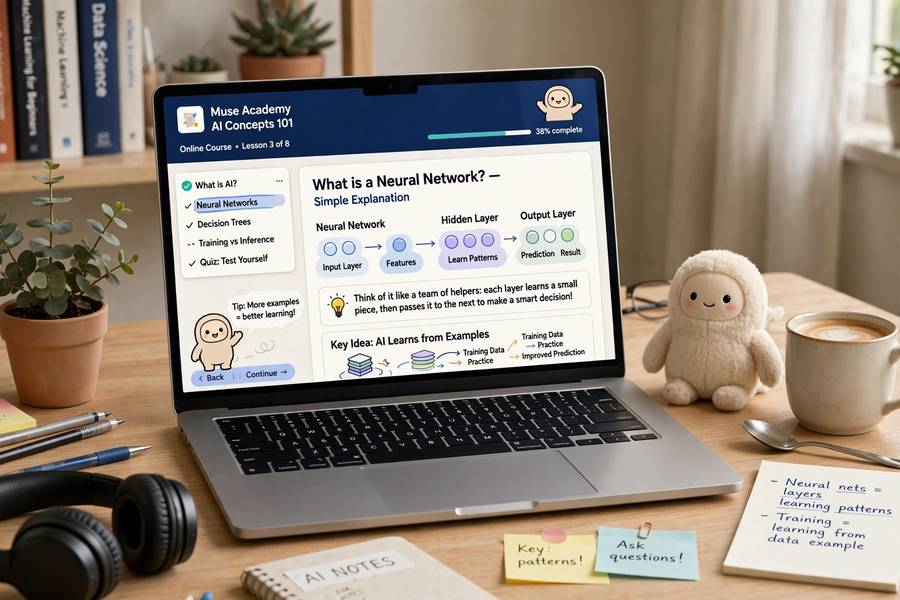
“Non-technical” should mean: no programming, no math beyond arithmetic, no assumed engineering background. Concepts explained through analogies and examples, skills taught through doing, jargon decoded on first use.
What it often means in course marketing: “we won’t make you code… much.” Then week three introduces APIs, week four wants you to read JSON, and by the end you’re debugging something. This isn’t malice — course creators are usually technical people who underestimate how foreign their world is. But it means you must verify, not trust, the “no code” claim. Check the syllabus week by week. Look at the tools used. Read reviews from explicitly non-technical completers.
The genuinely non-technical courses exist — they’re just outnumbered. This guide helps you find them.
What You Can Realistically Achieve Without Code
Set expectations correctly — the ceiling is higher than most assume:
Fluent AI tool use. Prompting skill, knowing which tool for which job, chaining tools into workflows. This alone transforms productivity in most knowledge work — and it’s entirely code-free.
AI-assisted creation. Writing, design, analysis, research, planning — all augmented. The skill is directing the AI well and judging its output, not building the AI.
Informed decision-making. Evaluating AI products, hiring AI talent, setting AI strategy, spotting AI hype. This “AI literacy for leaders” is arguably the highest-ROI non-technical outcome.
Automation of personal workflows. No-code automation platforms plus AI tools can eliminate hours of repetitive work — no programming required, just systematic thinking.
What you CAN’T do without code: build custom AI applications, fine-tune models, do ML engineering. That’s fine — it’s not your job. The non-technical AI skill set is about leverage and judgment, not construction.
The Course Types That Work for Non-Technical Learners
AI literacy / fundamentals. What AI is, how it works (intuitively), capabilities and limits. The universal starting point — take this regardless of your role. Usually 4–10 hours, often free.
AI for your profession. Marketing, HR, finance, education, healthcare administration — domain-specific courses teaching AI applications in your field. The highest practical ROI, because everything is contextualized to work you actually do.
Prompt engineering for non-technical users. Practical prompting taught without technical framing — focused on writing, analysis, and creative tasks rather than API parameters.
AI strategy / leadership. For managers and executives: evaluating AI opportunities, leading AI adoption, governance, build-vs-buy decisions. Conceptual, strategic, zero code.
No-code AI building. Using visual builders and automation platforms to create AI-powered workflows and simple apps. Real building without code — more capable than most expect.
Start with literacy, then go role-specific. The generic-to-specific sequence prevents the most common failure: learning abstract AI concepts with no idea how they apply to your Tuesday.
AI Literacy: The Essential First Step
Whatever your role, start here. A good AI literacy course gives you:
A mental model. How these systems work at an intuitive level — prediction machines trained on data, not magic brains. This single mental model inoculates against most AI hype and most AI fear.
Capability mapping. What current AI does well (drafting, summarizing, brainstorming, coding assistance, data analysis) versus poorly (precise facts, real-time info, judgment, accountability). Knowing the boundary is the skill.
Limitation literacy. Hallucinations explained plainly — why they happen, how to catch them, when to verify. This is safety equipment, not trivia.
Vocabulary. Enough terminology to read AI news and vendor pitches critically — tokens, training, fine-tuning, agents — decoded without math.
A few hours here pays dividends forever. It’s also the course to recommend to colleagues, teams, and leadership — organizational AI literacy starts with individuals.

Role-Specific Courses: Where the ROI Lives
Generic AI knowledge is good; applied-to-your-job AI knowledge is transformative. The best non-technical courses are role-specific:
For marketers: AI for content creation, campaign ideation, audience analysis, personalization. The field adopted AI early — good courses abound.
For managers: Leading AI adoption, evaluating tools, team workflows, measuring ROI, change management. The human side of AI transformation.
For writers/creatives: AI as creative partner — ideation, drafting, editing, style work. Plus the essential topic of disclosure and ethics in creative industries.
For analysts: AI-assisted data analysis, interpretation, reporting — using AI to work with data without becoming a data scientist.
For educators: AI in teaching and learning — assignment design, academic integrity, personalized learning support.
For founders: AI for lean startups — doing more with less, evaluating build-vs-buy, AI-native business models.
When choosing, prefer courses taught by practitioners in your field over generic AI educators. A marketer teaching AI for marketing beats an AI expert teaching “AI for business” — context is everything.
What to Demand From a Non-Technical Course
Zero code, verified. Check the syllabus and tools week by week. “No programming required” should survive scrutiny.
Analogies over equations. Concepts explained through everyday comparisons. If the preview lesson leads with math, it’s not for you.
Your-domain examples. Marketing examples for marketers, teaching examples for teachers. Generic examples signal a generic course.
Hands-on with real tools. You should be using actual AI tools during the course — not just hearing about them. Learning AI without touching AI is like learning swimming from lectures.
Jargon decoded. Every technical term explained on first use, in plain language. Good non-technical courses are almost militant about this.
Takeaways you can use Monday. Each module should end with something applicable to your actual work. If it doesn’t, it’s entertainment.
Warning Signs: Courses to Skip
“No technical background needed!” + Python in the syllabus. The classic bait-and-switch. Verify, don’t trust.
Taught entirely by engineers with no non-technical co-instructor. They’ll unconsciously assume background you don’t have. The best non-technical courses involve non-technical practitioners in design.
All theory, no practice. Concepts without application evaporate. If there’s no hands-on component with real tools, pass.
Hype-heavy framing. “AI will replace your job unless…” — fear-based marketing usually indicates thin content underneath. Good courses are honest about both potential and limits.
One-size-fits-all. “AI for everyone!” courses are usually AI for no one in particular. Prefer targeted over universal.
No free preview. If they won’t show you a lesson, the teaching probably doesn’t survive inspection.
Beyond Courses: Learning by Doing
Courses are the start, not the method. The real learning happens in practice:
Daily use. Pick one work task daily and do it with AI assistance. The reps build intuition no course can give.
The prompt journal. Save what works. You’ll build a personal playbook more valuable than any course’s templates.
Teach someone. Explaining AI to a colleague cements your understanding and reveals gaps. The best test of literacy is teaching.
Stay current lightly. AI changes fast; you don’t need to track everything. A good newsletter or community keeps you oriented without overwhelm.
Experiment with new tools. When a notable new tool launches, spend an hour with it. Hands-on beats hearsay for understanding what’s actually new.
The goal isn’t expertise — it’s confident, capable, critical use. That’s achievable, valuable, and entirely code-free. And for the work-application side, my guide on how to use AI at work picks up where courses leave off.
How Much Time This Really Takes
Realistic timelines for non-technical learners — because “learn AI in a weekend” marketing is aimed at you specifically:
AI literacy: one focused week. A few evenings with a good fundamentals course, plus daily experimentation. You’ll emerge able to talk about AI sensibly and use the main tools — which puts you ahead of most professionals, frankly.
Practical proficiency: one to two months. Daily use of AI tools in your actual work. This is where the real skill forms — not in courses, but in the fifty small experiments of applying AI to your real tasks. The course gets you started; the reps make you good.
Role-specific mastery: three to six months. Learning AI for marketing, or management, or teaching — deeply enough that it’s a genuine professional advantage. This includes building your personal playbook: the prompts, workflows, and judgment calls specific to your work.
Ongoing: an hour a week, forever. AI changes fast enough that standing still means falling behind. But “keeping up” for a non-technical professional is light — a good newsletter, occasional experimentation with new tools, updating your playbook quarterly.
The total upfront investment for genuine, durable AI capability: roughly two to three months of part-time effort. That’s it. The barrier was never time — it was knowing where to start.
Frequently Asked Questions
Absolutely — for using AI tools well, making informed decisions, and integrating AI into your work, no coding is needed. The skills are prompting, tool selection, workflow design, and limitation literacy. Only building custom AI applications requires programming.
Start with an AI literacy course (no code, a few hours), then take a course specific to your profession — AI for marketing, management, education, etc. Role-specific courses deliver the highest ROI because everything is contextualized to your actual work.
Check the syllabus week by week for hidden coding (APIs, JSON, “light scripting”), look at the tools used, and read reviews from explicitly non-technical completers. Don’t trust “no code required” marketing — verify it against the actual curriculum.
A great deal: fluent tool use and prompting, AI-assisted creation (writing, design, analysis), informed decisions about AI products and strategy, and no-code workflow automation. The ceiling is leverage and judgment — only custom model-building needs code.
Not for using AI well or making informed decisions — good non-technical courses explain concepts through analogies, not equations. Math becomes necessary only for building models or doing ML engineering, which are separate (and optional) paths.
Keep reading: