AI Search vs Traditional Search: What’s Actually Different?

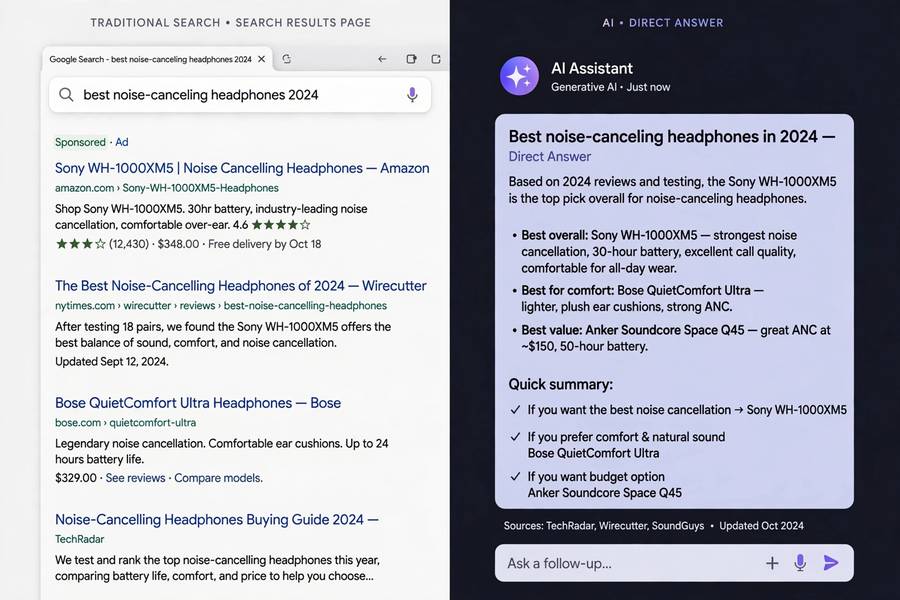
For twenty years, “search” meant one thing: type keywords, get ten blue links, click through. Then AI search arrived — you ask a question, get a synthesized answer — and suddenly the familiar ritual feels antiquated. But the difference between AI search and traditional search runs deeper than interface. They’re different philosophies of information retrieval, with different strengths, different failure modes, and different ideal uses. Understanding the distinction helps you use each where it excels instead of treating them as interchangeable.
This guide compares them head-on. For the AI side in depth, see what AI search is, and for the classic mechanics, how a search engine works.
The Core Difference: Answers vs Pointers
The fundamental distinction:
Traditional search gives you pointers. It finds documents matching your query and ranks them. YOU do the synthesis — opening pages, comparing sources, forming conclusions. The search engine is a librarian handing you a reading list.
AI search gives you answers. It retrieves information, synthesizes it, and presents a direct response. The AI does the reading and summarizing; you get the conclusion. The search engine is a research assistant delivering a brief.
This isn’t just UI — it’s a different division of cognitive labor. Traditional search keeps you in the loop (you evaluate sources); AI search abstracts you out (you evaluate the answer). Each has profound implications for reliability, learning, and trust.
How Traditional Search Works (Briefly)
The classic pipeline:
- Crawl — bots continuously fetch web pages.
- Index — pages analyzed and stored in a massive searchable index.
- Rank — for your query, the engine scores pages on relevance, authority, freshness, and hundreds of signals.
- Present — ranked list of links with snippets.
The key properties: transparent (you see the sources), controllable (you choose what to open), and verifiable (you can check the original). The engine doesn’t claim anything — it points. What you conclude is your responsibility, informed by sources you selected.
The weakness: it outsources the hard work (synthesis, comparison, judgment) to you. For complex questions, that’s significant labor — opening a dozen tabs, cross-referencing, resolving contradictions yourself.
How AI Search Works (Briefly)
The AI search pipeline:
- Understand — parse your natural-language question (not just keywords).
- Retrieve — find relevant sources (like traditional search, often using similar infrastructure).
- Synthesize — read the sources and generate a direct answer, with citations.
- Present — the answer, with source links for verification.
The key properties: convenient (answer, not homework), natural (ask like you’d ask a person), but opaque (the synthesis process is invisible). The engine makes claims — and you must trust its reading of sources you haven’t checked.
The weakness: the synthesis can be wrong in ways that are hard to detect — misread sources, blended contradictions, confident hallucinations. The convenience comes with a verification burden.
Understanding how ChatGPT works illuminates the generation side — the same LLM mechanics that make chatbots fluent make AI search articulate, with the same hallucination risks.
Where AI Search Wins
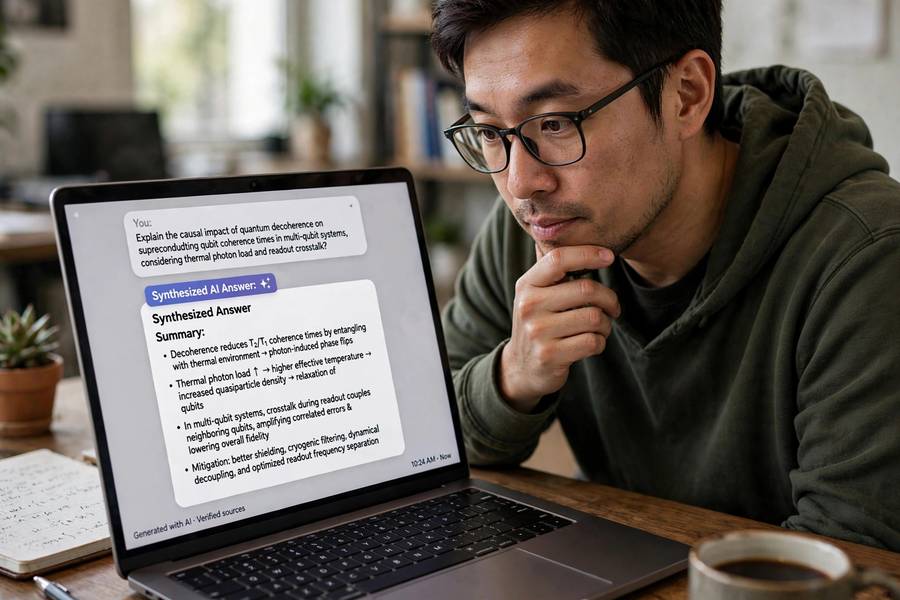
Complex questions. “What are the trade-offs between these three approaches?” Traditional search gives you twenty tabs to synthesize; AI search gives you the synthesis. The more complex the question, the bigger the advantage.
Explanations. “Explain this concept simply.” AI search excels at pedagogy — adapting explanations to your level, using analogies, building understanding progressively.
Comparisons. “X vs Y for my use case.” The synthesis across sources, weighed and presented, is exactly what AI does well.
Conversational follow-up. “What about for beginners?” — refining with context. Traditional search restarts each query; AI search continues the conversation.
Summarization. “What’s the consensus on this?” Aggregating views across sources into a coherent picture.
Low-effort information needs. When you want a quick answer, not a research project. Most everyday questions fall here — which is why AI search feels so transformative for casual use.
Where Traditional Search Wins
Verification. When accuracy matters, traditional search’s transparency wins — you see sources, evaluate credibility yourself, check originals. AI search asks you to trust its synthesis.
Diverse perspectives. Traditional search shows you the range — different sources, different views. AI search compresses to a consensus that may not exist, hiding disagreement.
Primary sources. Need the actual paper, the official documentation, the original statement? Traditional search takes you there. AI search gives you its interpretation.
Real-time and niche. Breaking news, obscure topics, very recent developments — traditional search’s index breadth often covers what AI search’s retrieval misses.
Learning deeply. The process of reading multiple sources builds understanding that consuming a summary doesn’t. For genuine learning (not just answers), the “inefficiency” of traditional search is pedagogically valuable.
When the AI is wrong. And it is, sometimes, confidently. Traditional search is the verification tool — the check on AI search’s claims. The two are complements, not competitors, here.

The Hallucination Problem: AI Search’s Achilles Heel
The central weakness, stated plainly: AI search can generate plausible-sounding answers that are wrong — misquoting sources, inventing facts, blending contradictory information into false coherence. Citations help (you can check), but:
- Citation ≠ verification. A cited source might not say what the AI claims. Check, don’t trust.
- Confident tone misleads. Fluency feels like accuracy. It’s not.
- The errors are subtle. Not obvious nonsense — plausible distortions, the hardest kind to catch.
- High stakes amplify risk. Medical, legal, financial questions — where wrong answers cause harm — demand traditional verification regardless.
The discipline: treat AI search as a smart intern’s brief — useful starting point, verify before acting. For anything important, the citations are the real product; the answer is the index.
The Filter Problem: Traditional Search’s Weakness
Traditional search has its own deep flaw, less discussed: it filters your reality invisibly.
Ranking is editorial. The order of results shapes what you believe — top results get trusted disproportionately. The ranking algorithm is an unseen editor with enormous influence.
SEO gaming. Results are gamed — optimized, manipulated, sometimes outright deceptive. The “best” result is often the best-optimized, not the best information.
The paradox of choice. Twenty tabs is freedom and burden — most users never go past result three, making the “choice” illusory.
Filter bubbles. Personalization narrows what you see — comfortable, but epistemically dangerous.
AI search doesn’t solve these (it has its own opacity problems), but it’s worth noting traditional search isn’t the neutral baseline it’s sometimes framed as. Both systems mediate reality; they just mediate differently.
How They Handle Different Query Types
| Query type | Traditional | AI Search |
|---|---|---|
| Simple fact | Fast, verifiable | Fast, but verify |
| Complex explanation | Labor-intensive | Excellent |
| Comparison | Manual synthesis | Strong |
| Current events | Often better | Catching up |
| Obscure/niche | Breadth wins | May miss |
| Learning deeply | Better (process) | Good (product) |
| High-stakes accuracy | Essential | Verify here |
| Exploratory browsing | Natural | Awkward |
The pattern: use AI search for synthesis and understanding, traditional search for verification and depth. They’re tools for different jobs — the skill is knowing which job you’re doing.
The Convergence: Each Becoming the Other
The interesting truth: they’re merging.
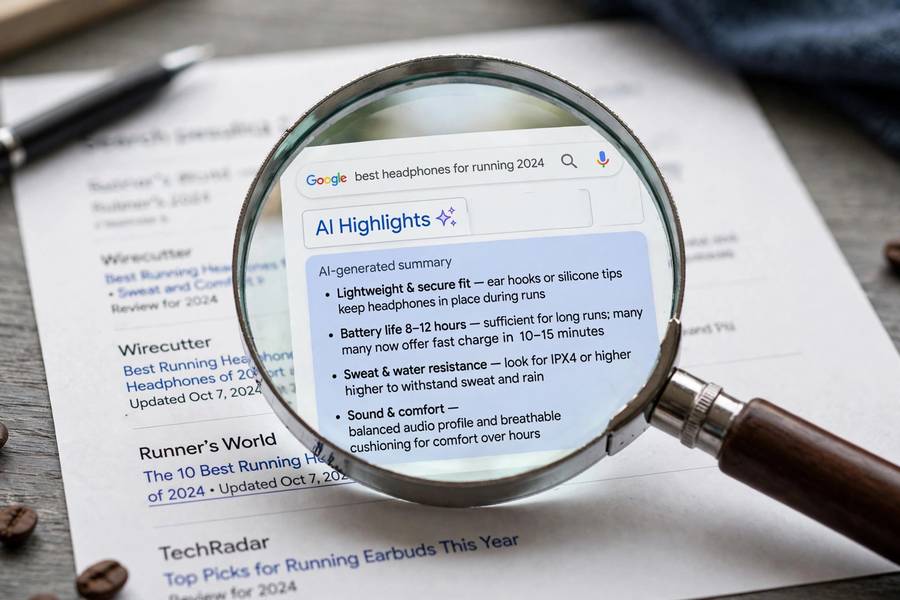
Traditional search adds AI. Snippets become generated summaries; “AI overviews” answer directly. The ten blue links now come with an AI brief on top.
AI search adds traditional. Citations, source links, “show your work” features — AI search increasingly exposes the traditional machinery underneath.
The endpoint: probably a hybrid — AI synthesis with transparent sourcing, conversational refinement with verifiable claims. The distinction between “AI search” and “search with AI” is already blurring.
What persists is the underlying tension: convenience versus verifiability, synthesis versus transparency. No interface resolves it — it’s a fundamental trade-off in how humans consume information. The tools will keep evolving; the judgment about when to trust and when to verify remains yours.
What Most Comparisons Miss: The Cost of Offloading Thinking
Every comparison of AI versus traditional search obsesses over the answer — speed, accuracy, convenience. Almost none ask what happens to the searcher.
Traditional search forced you to do the cognitive work: skim sources, weigh credibility, resolve contradictions, assemble the conclusion yourself. That labor was also training. Each research session sharpened your judgment — which sources to trust, how to spot motivated reasoning, how to hold two conflicting claims without prematurely collapsing one.
AI search removes that labor, which quietly removes the training. You get the conclusion without building the muscle that produces it. The skill of independent information assessment doesn’t vanish overnight — it atrophies, session by session, because you stop practicing it.
This isn’t an argument against AI search. It’s an argument for deliberate practice: keep doing some research the hard way. Read primary sources yourself. Argue with the AI’s synthesis. The people who gain the most from AI search will be the ones whose judgment was already strong — because they can tell when the brief is brilliant and when it’s beautifully wrong.
The fix is a habit, not a feature. Pick one question a week and research it the traditional way — open the raw sources, read the methodology sections, check who funded the study. Then compare your conclusion against the AI’s summary. The points of divergence are exactly where your judgment grows.
AI search is at its best as a drafting assistant for thinking, not a replacement for it. Use it to map the territory quickly, then walk the ground yourself where the stakes are high. The labor it removes is a gift; just don’t let it become a debt.
Frequently Asked Questions
Traditional search returns ranked links for you to explore and synthesize yourself; AI search retrieves sources and generates a direct synthesized answer. Traditional offers transparency and verifiability; AI offers convenience and natural interaction. They divide the cognitive labor differently.
Better for complex questions, explanations, comparisons, and quick answers — the synthesis is the advantage. Worse for verification, diverse perspectives, primary sources, and high-stakes accuracy where you must check originals. Use each where it excels; they’re complements.
Treat them as a smart intern’s brief — useful starting point, verify before acting on anything important. Check the citations (they’re the real product), watch for confident hallucinations, and use traditional search to verify high-stakes claims. Fluency isn’t accuracy.
They’re converging rather than replacing — traditional search adds AI summaries, AI search adds citations and source links. The likely endpoint is hybrid: AI synthesis with transparent sourcing. The convenience-vs-verifiability trade-off persists regardless of interface.
When accuracy is critical (verify AI claims), when you need primary sources or diverse perspectives, for breaking news and niche topics, when learning deeply (the reading process builds understanding), and whenever the AI’s answer will drive important decisions.
Keep reading: