Minimalist Small Apartment Decor: Calm, Not Cold

People hear ‘minimalist small apartment decor’ and picture a white box with one chair and no personality, like a showroom nobody lives in. That was my fear too, until clutter in a tiny apartment started genuinely stressing me out and I began editing with intention. What I found was not coldness but calm: a small space where everything earns its place feels larger, quieter, and honestly more luxurious than a packed one. Minimalism in a small apartment is not about owning nothing; it is about owning the right things and giving them room to breathe. In this guide, I will show you my editing method, the pieces worth keeping, and the styling rules that keep minimalism warm and human. For the philosophy underneath it all, my guide to minimalism goes deeper; this is the room-by-room application.
Minimalism Is an Editing Method, Not a Look
Let us retire the idea that minimalism means white walls and suffering. Real minimalism is a decision-making method: everything in your home should be useful, beautiful, or meaningful, ideally more than one. In a small apartment, this method is not aesthetic preference; it is survival strategy. Every unnecessary object in 500 square feet is visual noise you cannot escape, and visual noise raises stress whether you notice it consciously or not.
My editing method has three passes. First pass: remove everything obviously broken, unused, or guilt-kept. Second pass: box up the maybes for thirty days; what you do not retrieve gets donated. Third pass, the important one: for what remains, ask whether each item earns its footprint. A beautiful chair you sit in daily earns it. A decorative object you dust resentfully does not. This is not deprivation; it is curation. A fifteen-item living room where you love all fifteen beats a fifty-item room where you love ten.
The Warm Minimalist Palette & Materials
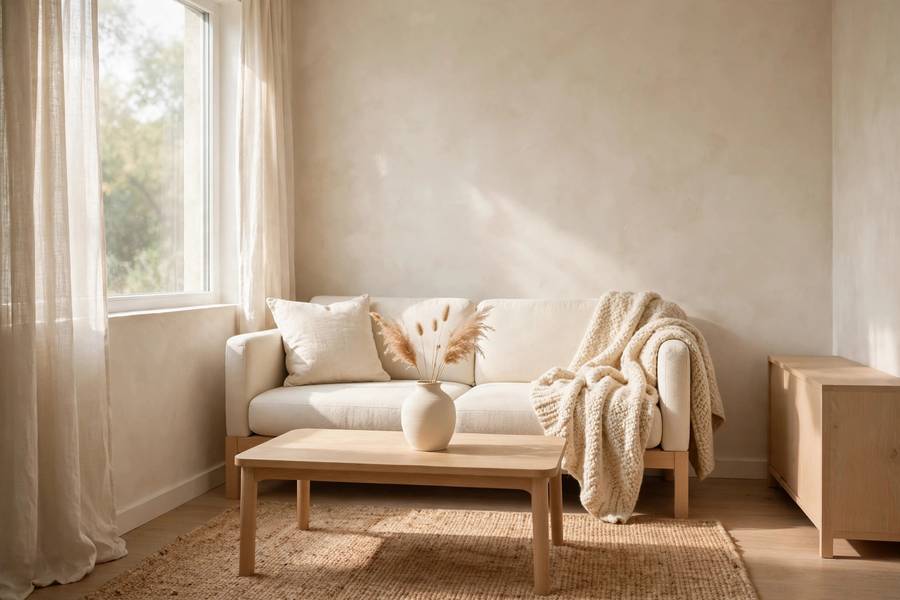
Cold minimalism comes from a palette of pure white, gray, and chrome with nothing soft to land on. Warm minimalism, the kind that works in real small apartments, builds on creamy whites, warm woods, natural fibers, and texture. My palette across every apartment: warm white walls, light oak or walnut wood, black accents in small doses, and textiles in cream, oatmeal, and one muted color I love. Everything matches everything, which means everything looks intentional.
Materials do the heavy lifting that clutter used to do. A wool throw, a jute rug, linen curtains, a ceramic vase, a wooden bowl: natural materials add visual richness without adding visual noise. This is the core styling insight of warm minimalism. When you have fewer objects, each object’s material and texture matters more. One beautiful wooden bowl on an empty shelf says more than five knickknacks ever did. Buy fewer things, but let each one be the good version.
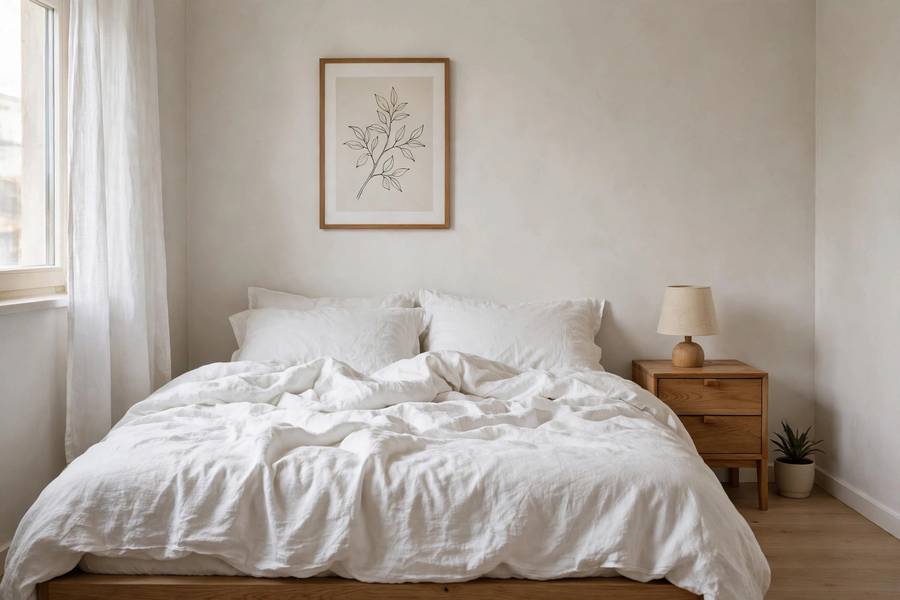
Lighting warms minimalism more than any object. Warm bulbs, a paper lantern, a candle on the table: glow makes sparse rooms feel held rather than empty. Never light a minimalist room with a single cool overhead; it is the fastest route to the showroom chill people fear.
Key Pieces: What Earns Its Place
In a minimalist small apartment, each furniture piece works harder. My keep-list after years of editing: a comfortable sofa in a light neutral (the room’s anchor), a coffee table with storage or a nesting set that disappears, one good reading chair with a floor lamp beside it (the best seat in the house), a dining table that fits daily life and extends or folds for guests, and a bed with storage underneath or a simple platform frame with visible floor beneath.
Storage must be closed, not open. Open shelving in a minimalist apartment is a maintenance contract: every object on display must be beautiful and dusted. Closed cabinets, baskets, and storage ottomans hide the necessary mess of real life and preserve the calm. One exception I allow: a single styled shelf or a small art ledge with a rotating few objects. Constraint makes the display better; when only five objects fit, you choose the five you truly love.
Styling Rules: The 3-Object Surface & Negative Space
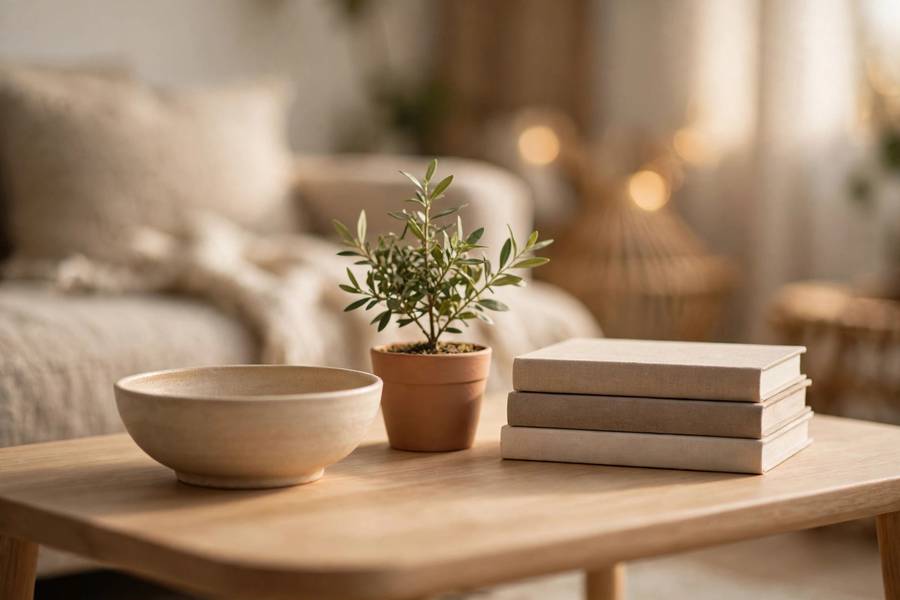
Minimalist styling has simple rules that anyone can follow. The three-object rule: no surface holds more than three intentional objects. A coffee table gets a tray, a candle, and a small plant, or a stack of books, a bowl, and nothing else. Three objects read as styled; seven read as cluttered. Leave negative space deliberately: empty wall, clear counter sections, bare floor areas. Negative space is not wasted space; it is what makes the kept things feel precious.
Group by odd numbers, vary heights, and repeat materials across the room so everything feels related. Edit seasonally: I do a light pass every three months, removing what crept in and reassessing what earns its place. Minimalism is not a one-time purge; it is an ongoing relationship with your space. And give yourself grace: a minimalist apartment with a lived-in Sunday morning, coffee cups out, blanket unfolded, is still minimalist. The goal is calm baseline, not museum stasis.
Photograph your rooms when they look right. The photo reveals clutter your eyes have learned to ignore, and it gives you a reference for resetting after busy weeks.
Minimalism With Kids, Pets & Real Life
The objection I hear most: minimalism cannot survive kids, pets, or actual living. It can, with systems. Kids’ things live in closed bins, one per category, in one zone; the toy rotation (some put away, some out, swapped monthly) keeps novelty high and clutter low. Pets need their zone too: a beautiful basket for toys, a designated blanket on the sofa, grooming supplies in one caddy. The animals do not care about minimalism, but containing their gear preserves yours.
Hobbies and work-from-home gear follow the same rule: a closed home for everything. My art supplies live in one rolling cart that tucks into a closet; the laptop closes into a drawer. The principle is not that these things do not exist, but that they rest out of sight when not in use. A small apartment can hold a full life; it just cannot display all of it at once. For the organizational systems that make this sustainable, my guide to organizing a small apartment is the practical companion.
Starting Your Edit This Weekend
Do not try to minimalize the whole apartment in a day; you will burn out and quit. My weekend method: one room, three boxes labeled keep, relocate, and donate. Work surface by surface, not drawer by drawer; visible progress keeps you motivated. Finish the room completely, including putting the donate box in your car immediately, before starting the next. One finished calm room motivates more than three half-edited ones.
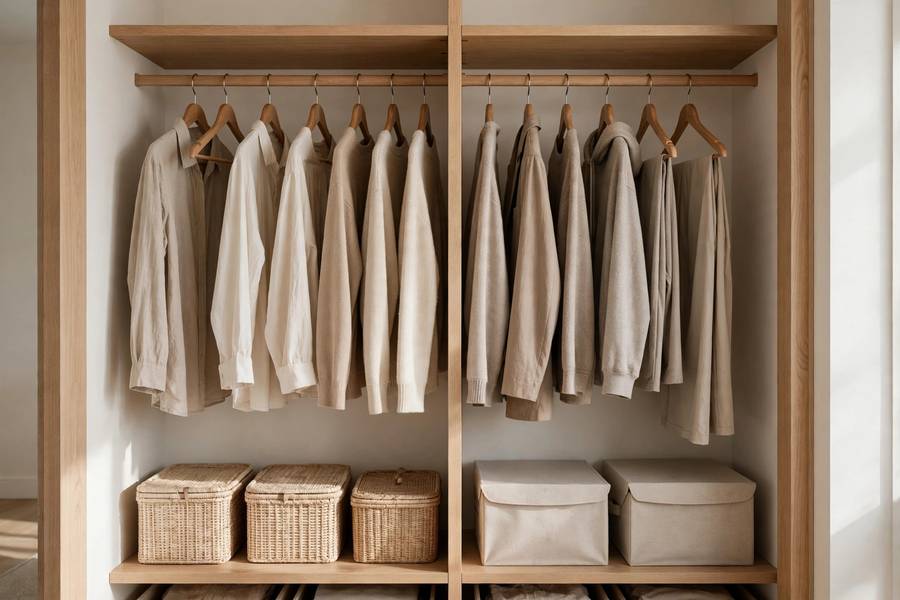
Then live with it for two weeks before buying anything. Minimalism often reveals that the room was fine; it was the stuff that was the problem. When you do add pieces, add slowly and deliberately, one at a time, checking each against the earn-its-place standard. For the full design context around these choices, my small apartment decorating ideas guide covers layout and style; and my guide to minimalism covers the mindset that makes it last. Calm is a practice, not a purchase.
Use warm whites instead of stark white, natural materials (wood, wool, linen, jute, ceramic), warm lighting at multiple heights, and texture variety. Cold minimalism comes from gray/chrome palettes and single overhead lighting; warm minimalism comes from creamy tones, natural fibers, and glow.
Keep only multi-working essentials: a comfortable neutral sofa, storage coffee table or nesting tables, one good reading chair with floor lamp, a right-sized dining table, and a bed with storage or visible floor beneath. All storage should be closed (cabinets, baskets, ottomans), not open shelving.
Follow the three-object rule: no surface holds more than three intentional items. Leave deliberate negative space on walls, counters, and floors. When only a few objects fit, you naturally choose the ones you truly love, which makes each one more meaningful.
Yes, with containment systems. Kids’ toys live in closed bins by category in one zone, with toy rotation keeping clutter low. Pet gear gets a designated basket and blanket zone. Hobbies and work equipment get a closed home (a cart, drawer, or closet). The principle: everything rests out of sight when not in use.
One room at a time, surface by surface, with three boxes: keep, relocate, donate. Finish each room completely (donations go to the car immediately) before starting the next. Live with the edited room for two weeks before buying anything; often the room was fine and only the stuff was the problem.