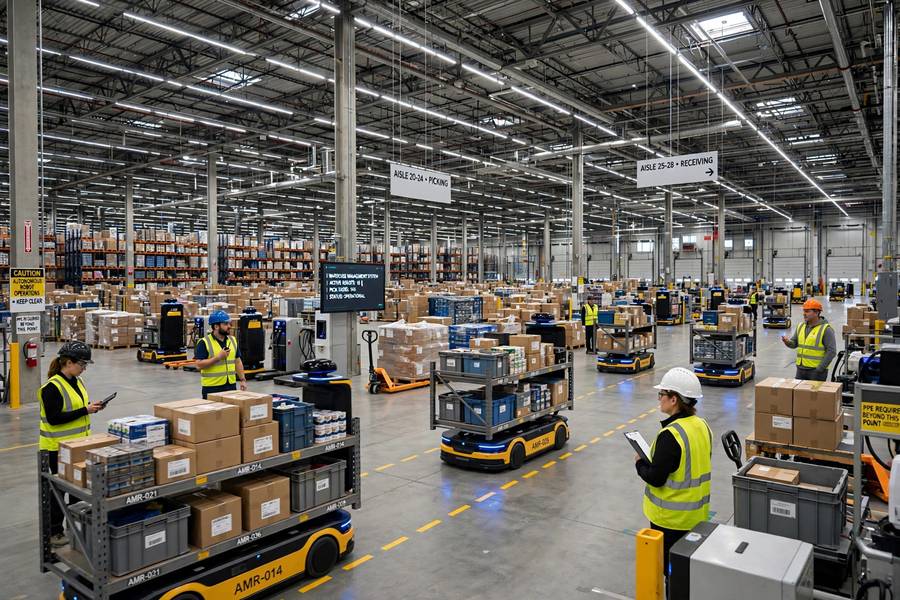
Stand at the edge of a modern distribution center at 2 AM and you’ll see the future already working the night shift: robots gliding between shelves, algorithms deciding which truck leaves when, and demand forecasts adjusting orders before a human has had coffee. Logistics was doing optimization math before AI was fashionable — which is exactly why it’s one of the industries where AI fits most naturally.
The AI use cases in logistics aren’t speculative. They’re running in production, moving your packages, stocking your shelves, and shaving percentage points off costs that decide who survives in thin-margin businesses. Here’s where the technology actually earns its keep, end to end across the supply chain. The business context is covered in my overview of how AI is used in business.
Table of Contents
- Demand Forecasting: Ordering Before the Rush
- Route Optimization: The Million-Dollar Math Problem
- Warehouse Automation: Robots That Never Sleep
- Last-Mile Delivery: The Expensive Final Stretch
- Predictive Maintenance for Fleets
- Customs and Documentation
- Network Design: Where Should the Warehouse Be?
- Getting Started: A Sensible Order of Operations
- Cold Chain Monitoring
- The Sustainability Dividend
- Reverse Logistics: The Returns Problem
- Frequently Asked Questions
Demand Forecasting: Ordering Before the Rush
Every logistics operation lives or dies on one question: how much of what, where, and when? AI forecasting models ingest sales history, seasonality, promotions, weather, local events, and even social trends to predict demand at the SKU-and-location level.
The payoff is measured in two currencies: fewer stockouts (lost sales) and less overstock (tied-up cash, spoilage, markdowns). One distributor I followed cut excess inventory by a fifth while improving fill rates — the kind of result that funds the next three AI projects. The prerequisite, as always, is clean historical data; a model trained on three years of messy records will confidently predict nonsense. Good inventory management practices are the foundation AI forecasting stands on.
Route Optimization: The Million-Dollar Math Problem
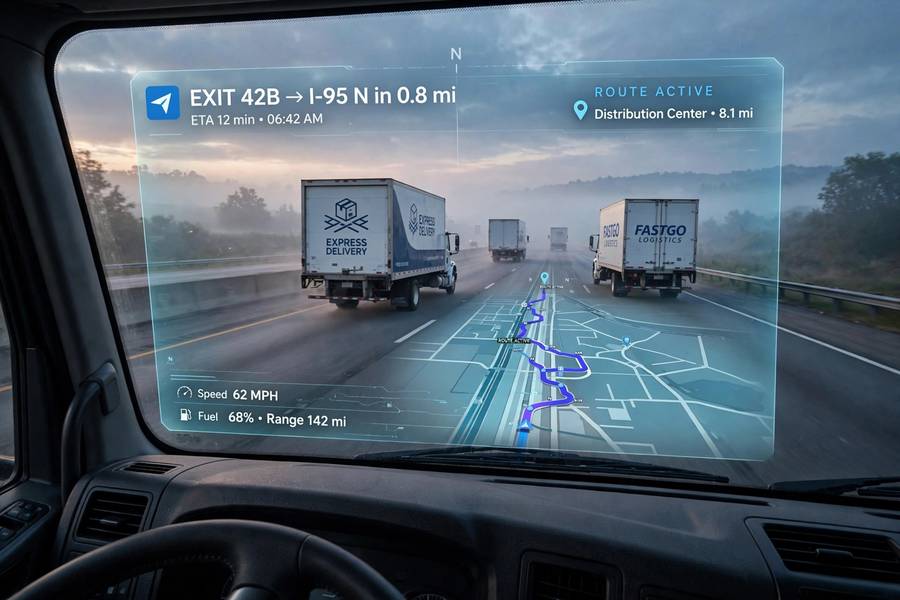
Planning delivery routes is a famously hard computational problem — the number of possible routes explodes as stops are added. AI doesn’t just solve the textbook version; it handles the real-world mess: traffic patterns, driver hours regulations, vehicle capacities, delivery time windows, and last-minute order changes.
Modern systems re-optimize continuously as conditions change. A truck breaks down? The system redistributes its stops across the fleet in seconds. Traffic jam on the main artery? Routes shift before drivers even notice. For fleets, fuel and driver hours are the two biggest costs, and route optimization attacks both directly. Companies running AI agents in real operations often start here because the savings are immediate and undeniable.
Warehouse Automation: Robots That Never Sleep
The modern warehouse is a choreography of machines. Autonomous mobile robots ferry shelves to human pickers (goods-to-person), robotic arms handle repetitive picks, and AI vision systems verify what’s in each box. The AI layer does the orchestration: deciding which robot goes where, balancing workloads, and predicting bottlenecks before they form.
What surprises newcomers: the robots aren’t the hard part — the software conducting them is. A warehouse with fifty robots and bad orchestration is just an expensive traffic jam. The facilities getting real throughput gains treat the AI control layer as the actual product and the robots as its hands. Labor dynamics matter here too: the best-run facilities retrain pickers as robot supervisors and exception-handlers rather than simply cutting headcount, which keeps institutional knowledge in the building.
Last-Mile Delivery: The Expensive Final Stretch
Last-mile delivery — the final leg from local hub to doorstep — can account for over half of total shipping costs. It’s where all the efficiency of the upstream supply chain goes to die in traffic, failed delivery attempts, and apartment buildings with no concierge.
AI attacks this from several angles: smarter delivery time windows based on customer behavior patterns, dynamic routing that clusters stops efficiently, predictive models for failed-delivery risk (so high-risk stops get scheduled when someone’s likely home), and locker placement optimization. Drone and autonomous vehicle pilots get the headlines, but the unglamorous routing math delivers the actual savings today. Failed first attempts are pure cost — every avoided one is margin.
Predictive Maintenance for Fleets
A truck that breaks down on a highway during peak season is a catastrophe measured in missed deliveries, spoiled cargo, and emergency repair premiums. Predictive maintenance uses sensor data — engine telemetry, vibration, brake wear, battery health — to flag components likely to fail before they do.
The economics finally work for mid-size fleets: sensor costs have fallen, and the models need only months of history to start producing useful warnings. Maintenance shifts from fixed schedules (replace parts too early, waste money) or reactive repair (replace too late, lose more money) to condition-based — fix what’s actually wearing out. Understanding how AI agents work helps here, since modern fleet systems increasingly act autonomously on their predictions, scheduling shop visits without human prompting.
Customs and Documentation
Cross-border logistics drowns in paperwork: customs declarations, certificates of origin, bills of lading, compliance checks that vary by country and product. AI document processing extracts data from the inevitable PDFs and scans, validates it against requirements, and flags discrepancies before shipments reach the border — where a paperwork error means days of delay and demurrage fees.
This is deeply unsexy work and enormously valuable. One freight forwarder told me their AI document checker paid for itself the first time it caught a misclassified shipment that would have sat in customs for a week. The pattern repeats across logistics: the biggest AI wins are in the boring operational details, not the futuristic set pieces.
Network Design: Where Should the Warehouse Be?
The most strategic AI use case is also the least visible: deciding where facilities should be in the first place. Network optimization models simulate thousands of scenarios — customer locations, transport costs, service-level targets, risk factors — to recommend warehouse placements and capacity.
Get this right and everything downstream gets cheaper: shorter last-mile distances, fuller trucks, faster delivery promises. Get it wrong and you’re paying a location penalty on every shipment for a decade. Companies revisit these models every few years as demand patterns shift; the AI doesn’t just answer the question once, it keeps the network honest as the business evolves.
Getting Started: A Sensible Order of Operations
If you’re evaluating AI for a logistics operation, here’s the order I’d tackle things: first, fix your data — shipment records, inventory accuracy, telematics. Second, deploy route optimization, because the ROI is fast and visible. Third, add demand forecasting once you trust your history. Fourth, pilot warehouse automation in your highest-volume facility. Fifth, layer in predictive maintenance as sensor data accumulates. Each step funds and informs the next, which is how you build an AI program that survives budget season.
Cold Chain Monitoring
Some cargo can’t just arrive — it has to arrive unspoiled. Pharmaceuticals, fresh food, and chemicals travel in temperature-controlled chains where a single excursion ruins the shipment. AI-powered cold chain monitoring combines IoT sensors with predictive models: not just alerting when temperatures breach thresholds, but predicting breaches before they happen from compressor vibration patterns, door-open frequencies, and ambient conditions.
The models also optimize the tradeoff nobody talks about: refrigeration costs energy, so overcooling “just to be safe” is expensive. AI finds the minimum safe cooling profile per route, per season, per cargo type — cutting energy costs while reducing spoilage. For pharma logistics, where a spoiled shipment can mean destroyed medicine worth more than the truck, the ROI conversation is very short.
The Sustainability Dividend
Here’s the underrated story: almost every AI logistics application is also a sustainability application. Route optimization burns less fuel. Better forecasting means less waste and fewer half-empty trucks. Predictive maintenance keeps engines running efficiently. Warehouse orchestration cuts energy per unit shipped.
This matters beyond virtue — it matters commercially. Shippers increasingly face emissions reporting requirements and customer pressure for greener supply chains. AI gives you the data to prove improvement: carbon per shipment, empty-mile percentages, waste reduction — all measurable, all improving as the AI optimizes. The companies treating AI logistics as purely a cost play are missing half the value; the sustainability dividend shows up in contracts won, regulations satisfied, and brand value that compounds. Efficiency and green turn out to be the same project wearing different clothes.
Reverse Logistics: The Returns Problem
Ecommerce returns are logistics in reverse — and they’re expensive, messy, and growing. AI helps at every step: predicting return likelihood before purchase (flagging sizing-risk orders for some apparel retailers), optimizing return shipping routes, and automating the triage decision when items arrive — restock, refurbish, liquidate, or recycle. Computer vision grades returned items in seconds, a job that used to need trained inspectors.
The strategic layer is return prevention: analyzing return reasons to fix product pages, sizing guides, and descriptions upstream. Every prevented return saves two shipments and a warehouse touch. Companies treating returns as a data source rather than a cost center turn AI’s pattern-finding on their own operations — and the insights often improve the forward business too. Returns are the supply chain’s confession booth; AI just takes notes.

Frequently Asked Questions
The proven applications are demand forecasting, route optimization, warehouse automation, last-mile delivery optimization, predictive fleet maintenance, customs documentation processing, and supply chain network design.
AI solves the complex routing problem considering traffic, driver hours, vehicle capacity, and delivery windows — then re-optimizes continuously as conditions change, redistributing stops when disruptions occur.
Yes, measurably: route optimization cuts fuel and labor costs, forecasting reduces overstock and stockouts, predictive maintenance avoids expensive breakdowns, and warehouse automation increases throughput. Logistics margins are thin, so even small percentage gains matter.
Last-mile delivery is the final leg from local hub to the customer — often over half of total shipping cost. AI helps with dynamic routing, delivery window prediction, failed-delivery risk modeling, and optimal locker placement.
Start with route optimization software and demand forecasting — both are available as affordable cloud services now. Warehouse robots can wait; the planning math pays off at almost any fleet size.
Keep reading: