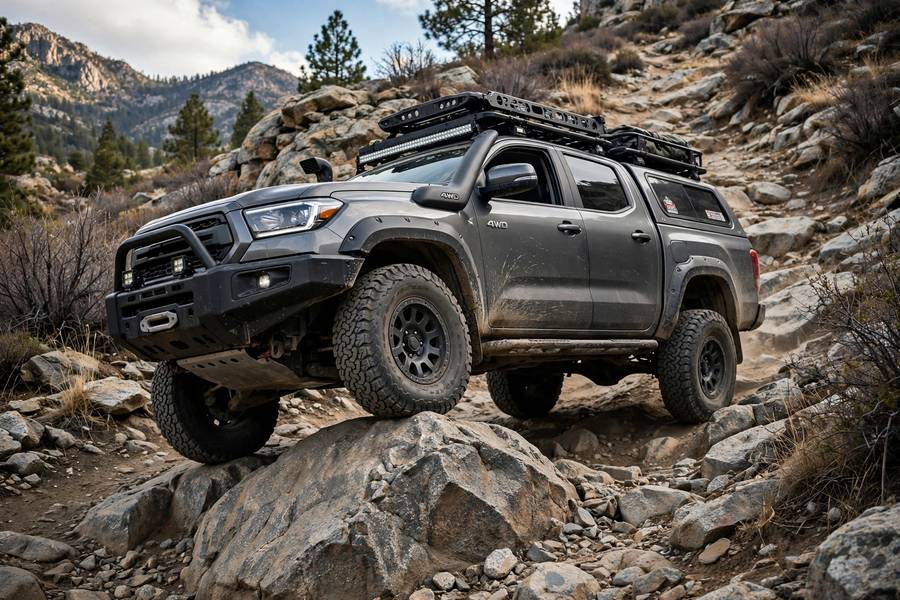
Four-wheel drive is the older, simpler, tougher cousin in the drivetrain family — and I mean that as a compliment. Where AWD is a committee of sensors making millisecond decisions, 4WD is a mechanical promise: when you engage it, the front and rear axles are locked together, turning as one, splitting power 50/50. No guessing, no clutch packs, no software. Here’s exactly how that promise is kept, piece by piece, the way I’d walk you through it with the truck on my lift. For how the two systems compare head-to-head, read my AWD vs 4WD explained guide.
Table of Contents
- The 30-Second Version
- The Transfer Case: The Heart of the System
- How Power Reaches All Four Wheels
- 4WD High: Your Default Off-Road Mode
- 4WD Low: Torque Multiplication Explained
- Locking Differentials: The Next Level
- Part-Time vs Full-Time 4WD
- Why Locked 4WD Can’t Run on Dry Pavement
- Keeping Your 4WD System Healthy
- Frequently Asked Questions
The 30-Second Version
Four-wheel drive works by locking the front and rear driveshafts together through a transfer case, so all four wheels receive engine power at the same rotational speed. You engage it manually (or the truck engages it in auto mode), the transfer case splits torque 50/50 front-to-rear, and each axle’s differential splits it left-to-right. That’s the whole system: engine, transmission, transfer case, two driveshafts, two differentials, four wheels. Simple, mechanical, and brutally effective on loose surfaces.
The defining trait is the lock. Unlike AWD, which lets axles turn at different speeds, traditional 4WD forces them to turn together. That lock is why 4WD is unbeatable in mud, snow, and rock — and why it must be disengaged on dry pavement.
The Transfer Case: The Heart of the System
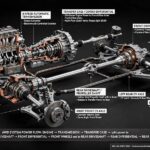
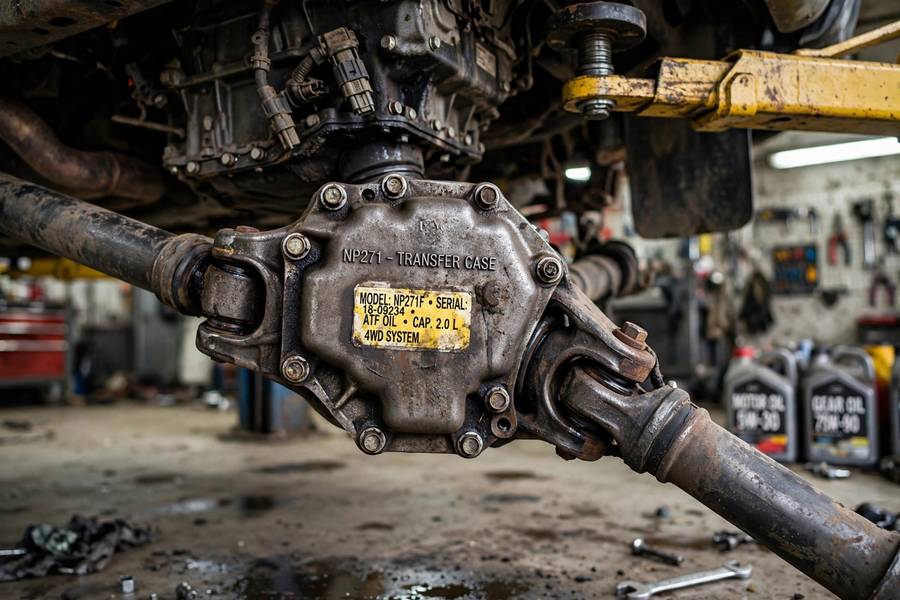
The transfer case is a gearbox bolted to the back of the transmission, and everything about 4WD runs through it. Power enters from the transmission, and the transfer case does two jobs: it splits that power between the front and rear driveshafts, and in most systems it provides a gear reduction for low-range crawling.
Inside, the classic design uses a chain drive (quieter, common in modern trucks) or gear drive (stronger, found in old-school iron like the NP205 that people still worship). A shift fork slides a collar that engages the front output shaft — that’s the mechanical “click” you feel when 4WD engages. In 2WD mode, the front output is disconnected and the front driveshaft just sits there, which is why part-time 4WD trucks get decent highway mileage in 2WD.
Modern trucks often use electronic shift-on-the-fly: a motor on the transfer case does the shifting when you turn a dial, and you can engage 4WD High at speeds up to about 55 mph. The old manual lever trucks needed you to stop (or at least slow way down) and sometimes lock the front hubs by hand. I have a soft spot for the manual levers — fewer things to break, and you always know exactly what mode you’re in.
AWD solves the same traction problem with different hardware — see what all-wheel drive is for the contrast.
How Power Reaches All Four Wheels
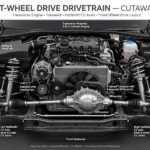
Trace the power and the system makes sense. The engine makes torque. The transmission multiplies it through gears. The transfer case splits it 50/50 to the front and rear driveshafts — long steel tubes running to each axle. Each driveshaft spins its axle’s differential, a ring-and-pinion gear set that turns the power 90 degrees and splits it between the left and right axle shafts, which turn the wheels.
In 4WD, that front driveshaft is doing real work, not just along for the ride. And because the transfer case locks both outputs together, the front and rear driveshafts rotate at identical speeds — which means if the rear wheels are turning, the front wheels are turning at the same rate, regardless of traction. A rear wheel buried in mud gets exactly as much rotational drive as a front wheel on solid ground. That forced equality is the entire point: no wheel gets to slack off.
The weak links in this chain are the U-joints (universal joints) at each end of the driveshafts. They flex as the suspension moves, and they’re the first thing to complain — with a rhythmic clunk on acceleration — when they wear out. Grease them if they’re serviceable; replace them when they clunk. A failed U-joint at speed can pole-vault a driveshaft into the pavement, and that’s a bad day.
4WD High: Your Default Off-Road Mode
4WD High is the 1:1 mode — no gear reduction, just the locked 50/50 split. This is what you use for the vast majority of slippery driving: snowy roads, muddy trails, sandy tracks, gravel. You can drive at normal speeds in 4WD High; the lock is the only difference from 2WD.
The rule for 4WD High is surface, not speed. If the surface is consistently slippery — snow, mud, sand, loose gravel — 4WD High is correct and safe at any reasonable speed. If the surface has good traction — dry pavement, or even patchy plowed roads with dry spots — the locked axles fight each other in turns, and you’re building destructive stress. I’ll cover exactly why in the binding section below.
One thing new 4WD owners get wrong: 4WD High does not make you invincible, it makes you mobile. It helps you go. It does nothing for stopping or turning. I have towed more 4WD trucks out of ditches than I can count, and every driver said the same thing: “But I was in 4WD.” So was the ditch.
4WD Low: Torque Multiplication Explained
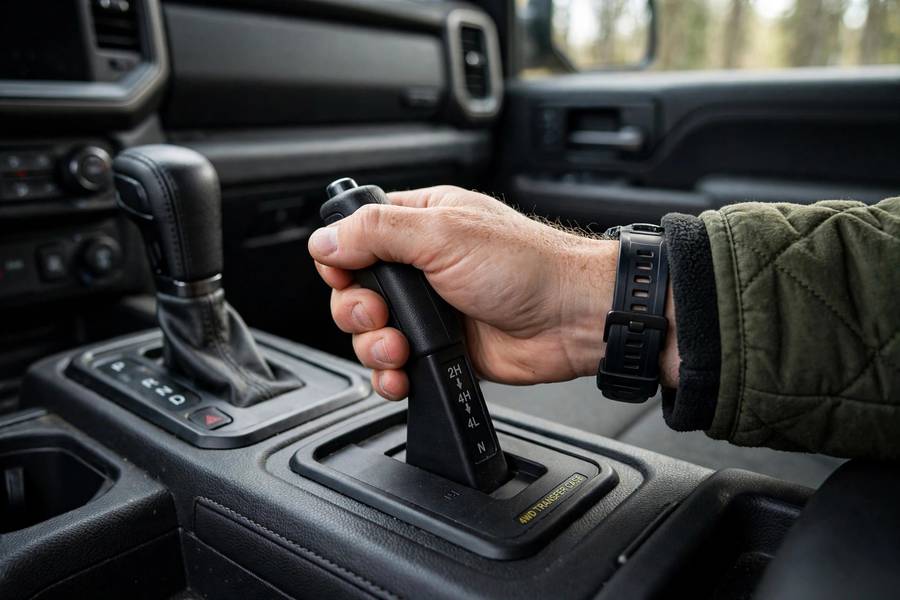
4WD Low is the reason 4WD exists. Engaging it routes power through a reduction gear set in the transfer case — typically a ratio between 2.5:1 and 4:1 — which multiplies torque enormously while cutting speed to a crawl. With a 4:1 low range, first gear, and a typical axle ratio, your engine’s torque can be multiplied 50 to 80 times at the wheels.
What does that feel like? Walking pace at redline, with enough pulling force to climb a wall. 4WD Low is for the extreme end: rock crawling, deep mud, steep grades, pulling a stuck vehicle, descending a nasty hill where you want engine braking to hold you back without touching the brakes.
The rules for 4WD Low are strict: engage it stopped, in neutral, foot on the brake. Never use it on pavement — the torque multiplication plus the locked axles will break things fast. And never use it at speed; low range tops out around 25 to 30 mph, and running it faster is asking the transfer case to do something it was never designed for. Use it for the obstacle, then shift back out. It’s a tool, not a cruising mode.
Locking Differentials: The Next Level
Here’s the dirty secret of basic 4WD: with open differentials front and rear, you really have two-wheel drive — one front wheel and one rear wheel getting power, because each open diff sends power to the wheel with the least resistance. Lift one front wheel and one rear wheel off the ground (diagonal dangle on rocks), and you’re stuck despite having “4WD.”
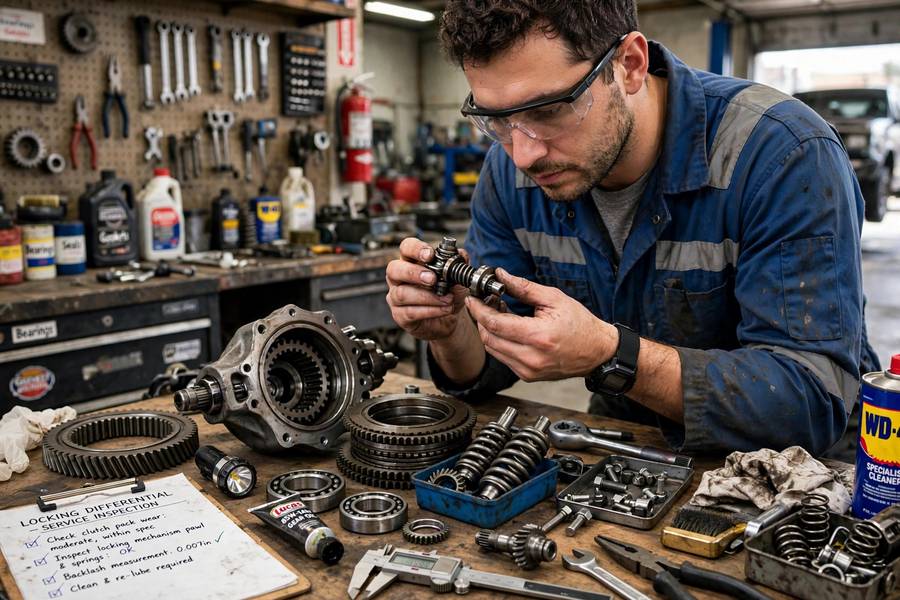
Locking differentials fix this. A locker — selectable (air, electric, or cable actuated) or automatic — forces both wheels on an axle to turn together, so the wheel with grip gets full power. Lock the rear diff and you have true three-wheel drive. Lock front and rear and you have genuine four-wheel drive: every wheel turning at the same speed, no exceptions.
This is why serious off-roaders talk about lockers the way chefs talk about knives. A stock 4WD with open diffs is capable; the same truck with front and rear lockers is a different animal entirely. The trade-off: never engage lockers on pavement, and disengage them before turning on high-traction surfaces — a locked axle resists speed differences in corners just like a locked transfer case does, only worse.
Part-Time vs Full-Time 4WD
Part-time 4WD is the classic system: 2WD for pavement, locked 4WD for slippery surfaces, driver decides. Simple, efficient, and demanding of judgment. Most pickups and body-on-frame SUVs use it. The driver’s job is remembering to disengage on dry pavement — and the number of transfer cases I’ve rebuilt because someone forgot tells me it’s a real burden.
Full-time 4WD keeps all four wheels driven continuously, using a center differential (like AWD) to allow axle speed differences on pavement, plus a locking function for when things get serious. Think of it as the system that splits the difference: the convenience of AWD with the low range and toughness of 4WD. Land Cruisers and some Grand Cherokees run this setup. You get a low-range gear and a lockable center diff, with none of the part-time binding worries.
The maintenance note applies to both: transfer case fluid changes every 30,000 to 60,000 miles, and actually exercise the system. I tell every 4WD owner to engage 4WD for a few miles monthly on a loose surface. Seals dry out, actuators seize, and shift motors freeze from disuse. The 4WD that hasn’t been engaged in two years is the one that won’t engage when you need it.
Why Locked 4WD Can’t Run on Dry Pavement
This deserves its own section because it’s the most expensive lesson in 4WD ownership. When you turn, the front wheels travel a longer path than the rear wheels, and the outside wheels travel farther than the inside ones. On a slippery surface, the tires slip slightly to absorb these speed differences — no harm done. On dry pavement, the tires grip, and the speed differences have nowhere to go.
So the stress builds up in the drivetrain — in the transfer case chain, the U-joints, the axle shafts. This is called driveline bind or wind-up. You’ll feel it as the truck resisting turns, hopping or chirping tires in parking lots, the steering fighting you. Keep driving and something gives: usually a U-joint first ($200 to $400), then the transfer case chain or gears ($1,500 to $2,500), occasionally an axle shaft.
Full-time 4WD and AWD avoid this with a center differential that absorbs the speed difference. Part-time 4WD has no such device — the lock is the whole point. So the rule is absolute: part-time 4WD on slippery surfaces only. If you feel binding, stop, shift back to 2WD, and reverse a few feet in a straight line to let the driveline unwind.
Keeping Your 4WD System Healthy
4WD maintenance is simple but non-negotiable. Change the transfer case fluid on schedule — it’s usually ATF or a specific gear oil, and the owner’s manual is the authority on which. Change front and rear differential fluid every 30,000 to 60,000 miles; if you tow or off-road, do it more often. Inspect U-joints annually for play or rust streaks around the caps.
Exercise the system monthly as I mentioned — engage 4WD High on a gravel road or wet grass for a few miles, cycle through 4WD Low once in a while. Check that the 4WD indicator light actually works; a burned-out bulb has hidden many a failed engagement. And if your truck has locking hubs (older models), lock and unlock them periodically so they don’t seize.
The most common 4WD failure I see isn’t mechanical wear — it’s neglect. The truck that never leaves pavement for three years, then the owner tries 4WD in the first snowstorm and the actuator is frozen solid. Use it or lose it applies to transfer cases too.
Frequently Asked Questions
4WD works through a transfer case that locks the front and rear driveshafts together, splitting engine power 50/50 between the axles. You engage it manually for slippery surfaces. 4WD High is a 1:1 locked mode for snow and mud; 4WD Low adds a gear reduction (typically 2.5:1 to 4:1) that multiplies torque for crawling.
The transfer case is a gearbox behind the transmission that splits power between the front and rear driveshafts. It engages and disengages the front axle, provides the locked 50/50 power split in 4WD High, and contains the reduction gears for 4WD Low’s torque multiplication.
4WD High is a direct 1:1 locked mode for normal slippery driving at regular speeds. 4WD Low routes power through reduction gears (2.5:1 to 4:1), multiplying torque massively while limiting speed to about 25-30 mph — used for rock crawling, deep mud, steep grades, and pulling heavy loads.
No. 4WD locks the front and rear axles together at the same speed and is driver-engaged for slippery surfaces only. AWD uses a center differential or clutch pack that allows axle speed differences, works automatically, and is safe on dry pavement. 4WD is tougher and has low range; AWD is more convenient.
Because the locked transfer case forces front and rear axles to turn at the same speed, but in turns the front wheels travel farther than the rears. On grippy pavement the tires can’t slip to absorb the difference, so stress builds up in the drivetrain — called binding — and can break U-joints, axle shafts, or the transfer case.