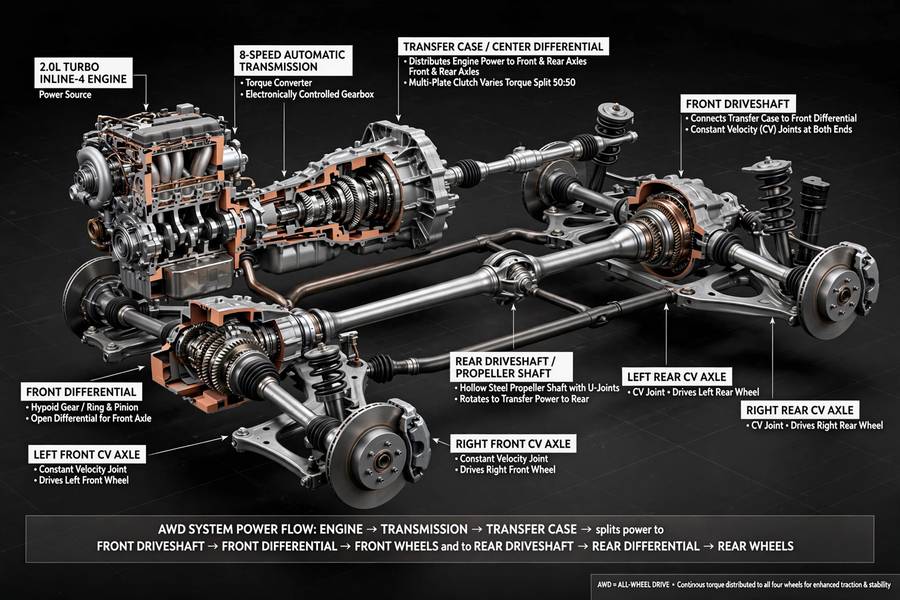
Customers ask me this one while I’m under their car, and I always start the same way: AWD is just the car’s way of asking, “Which wheels have grip right now?” and sending power to the answer. No levers, no driver decisions, no drama. Behind that simplicity there’s a clever stack of hardware — differentials, clutch packs, and electronics — doing quiet math hundreds of times per second. Here’s the whole system explained the way I’d explain it leaning on your fender. If you want to see how it stacks up against the other system, my full AWD vs 4WD guide covers that.
Table of Contents
- The 30-Second Version
- Open Differentials: The Core Problem AWD Solves
- How the Rear Wheels Get Their Power
- Torque Vectoring: The Clever Stuff
- Real-Time vs Full-Time AWD
- The Electronics Watching Everything
- How AWD Differs From 4WD Mechanically
- Common AWD Failure Points I See in the Shop
- Frequently Asked Questions
The 30-Second Version
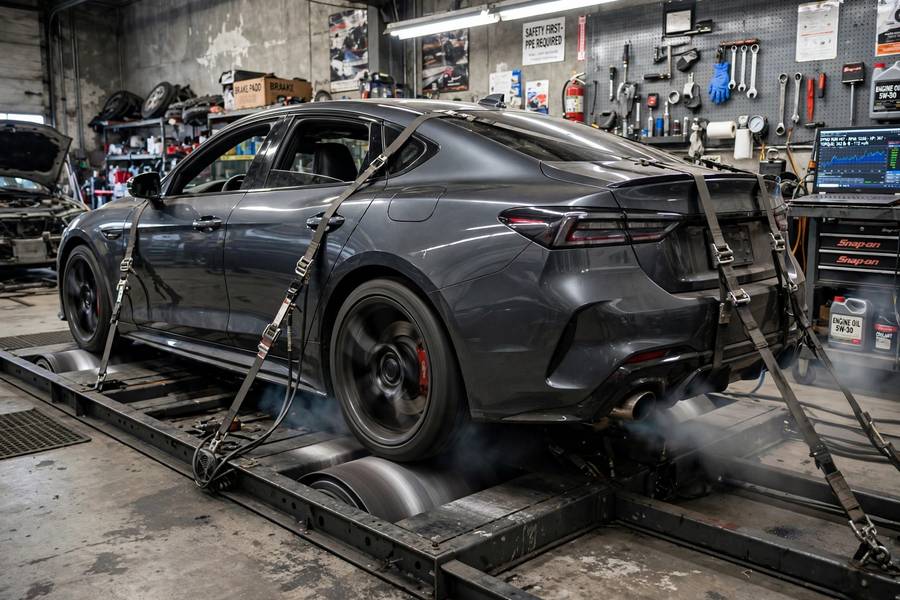
All-wheel drive sends engine power to all four wheels, but unlike 4WD, it does it automatically and lets the wheels turn at different speeds. Power flows from the engine through the transmission, then splits: some goes to the front axle, some travels down a driveshaft to the rear axle. A center differential (or an electronic clutch pack) manages the split, and wheel-speed sensors tell a computer when a wheel is slipping so it can redirect torque in about a tenth of a second.
That’s the whole magic trick. AWD is constantly measuring grip and moving power to where the grip is. You never touch a thing. The car handles it the way your body handles balance — without consulting you.
Open Differentials: The Core Problem AWD Solves
To understand AWD, you first need to understand the open differential, because AWD exists to fix its weakness. A differential is the gearbox at each axle that lets the left and right wheels turn at different speeds — essential for cornering, since the outside wheel travels farther than the inside one.
The problem: an open differential always sends power down the path of least resistance. One wheel on ice, one on pavement? The icy wheel spins uselessly and gets all the power, while the wheel with grip gets almost nothing. That’s why a two-wheel-drive car with one wheel on ice goes nowhere, even though the other wheel could have pulled it out.
AWD solves this by having more driven wheels to choose from, plus devices that override the open differential’s laziness — limited-slip differentials, electronic clutch packs, and brake-based systems that grab a spinning wheel so power goes to the gripping one instead. The whole architecture is built around one idea: never let one slipping wheel waste all your traction.
How the Rear Wheels Get Their Power
In most AWD vehicles, the engine sits up front driving the front wheels through a transaxle (transmission plus front differential in one unit). A power take-off unit — basically a small gearbox bolted to the transaxle — taps some of that power and sends it down a driveshaft running the length of the car to the rear differential, which splits it between the rear wheels.
The interesting part is what sits between the driveshaft and the rear differential in modern systems: an electronically controlled clutch pack. When you’re cruising on dry highway, the clutch pack is mostly disengaged and the car is effectively front-wheel drive — that’s how AWD cars keep fuel economy reasonable. The instant the front wheels slip, the computer engages the clutch pack and up to 50 percent of torque flows rearward. The transition happens in roughly 100 to 200 milliseconds.
Some performance AWD systems flip the default: rear-biased, sending 60 to 70 percent of torque to the rear wheels in normal driving for sportier handling, only shuffling power forward when the rear slips. Same hardware philosophy, different personality.
Torque Vectoring: The Clever Stuff
Basic AWD moves power front-to-rear. Torque vectoring goes further and moves it left-to-right across an axle, and this is where modern AWD starts feeling genuinely smart.
The simplest version is brake-based: when the car senses understeer (front plowing wide in a corner), it lightly brakes the inside rear wheel, which forces torque to the outside wheel and rotates the car into the turn. It works, it’s cheap, and it’s why even affordable crossovers feel planted. The downside is you’re literally burning speed as brake heat — fine for safety, less fine for sport.
The serious version uses an active rear differential with clutch packs on each axle shaft. It can genuinely overdrive the outside rear wheel — spin it slightly faster than the inside one — creating a yaw moment that turns the car. Performance cars use this to feel like they’re being pulled through corners. When I drive a car with a real torque-vectoring rear diff, I can feel the difference in the first roundabout. It’s the single most impressive piece of drivetrain hardware most people will never think about.
The hardware underneath all this cleverness is worth knowing on its own — what all-wheel drive is covers the fundamentals in plain language.
Real-Time vs Full-Time AWD
Not all AWD is on all the time, and the naming confuses everyone. Here’s the clean version.
Full-time AWD (sometimes called permanent AWD) drives all four wheels continuously, with a center differential allowing speed differences between axles. Think Subaru’s core systems or Audi’s Quattro with a Torsen center diff. It’s always working, always ready, and mechanically straightforward. The cost is constant drivetrain drag — you’re always spinning the driveshaft, the rear diff, and all four axle shafts, which costs you a couple of mpg.
Real-time AWD (also called automatic or on-demand AWD) is the clutch-pack system I described above: front-wheel drive until slip is detected, then the rear engages. Honda’s Real Time AWD is the namesake. It’s lighter, cheaper, and more fuel-efficient, since most of the rear drivetrain is disconnected most of the time. The trade-off is a small delay before engagement and the heat limits of clutch packs under sustained slip — which is why these systems can overheat if you try to crawl out of a snowbank for ten minutes.
Neither is “better” in the abstract. Full-time is more robust and predictable; on-demand is more efficient and perfectly adequate for the 95 percent of driving that’s just wet roads and light snow.
The Electronics Watching Everything
Modern AWD is as much software as hardware. Wheel-speed sensors at each corner report rotation hundreds of times per second. A yaw sensor and steering-angle sensor tell the computer what you’re trying to do versus what the car is actually doing. Throttle position, lateral g-forces, even outside temperature feed into the same calculation.
All of this runs through the stability control module, which coordinates the AWD clutch packs with individual wheel braking. When one wheel spins on ice, the system can do two things simultaneously: engage the rear clutch pack to send power back, and brake the spinning wheel so the open differential sends torque to the gripping wheel instead. That coordination — happening in milliseconds, every second you’re driving — is why a modern crossover on decent tires feels almost unflappable in rain and light snow.
The honest mechanic’s footnote: all that electronic cleverness means AWD problems are increasingly electrical. A failed wheel-speed sensor can disable the whole AWD system and light up your dash like a Christmas tree. The hardware is usually fine; it’s the sensors that quit.
How AWD Differs From 4WD Mechanically
The core mechanical difference comes down to one component: AWD uses a center differential (or clutch pack) that allows the front and rear axles to rotate at different speeds, while traditional 4WD uses a transfer case that locks them together at the same speed.
That single difference explains everything. The center differential means AWD works fine on dry pavement — axles can speed-differentiate in corners without stress. The locked transfer case means part-time 4WD binds on pavement and must be disengaged. AWD is automatic and pavement-friendly; 4WD is driver-selected and demands slippery surfaces.
It also explains the torque story. AWD typically splits power variably (anywhere from 100/0 to 50/50 front/rear, or rear-biased in performance cars). Locked 4WD is a fixed 50/50 split. And only 4WD gives you a true low-range gear reduction for crawling — AWD has no equivalent, which is why serious off-road and heavy towing stay in 4WD territory.
Common AWD Failure Points I See in the Shop
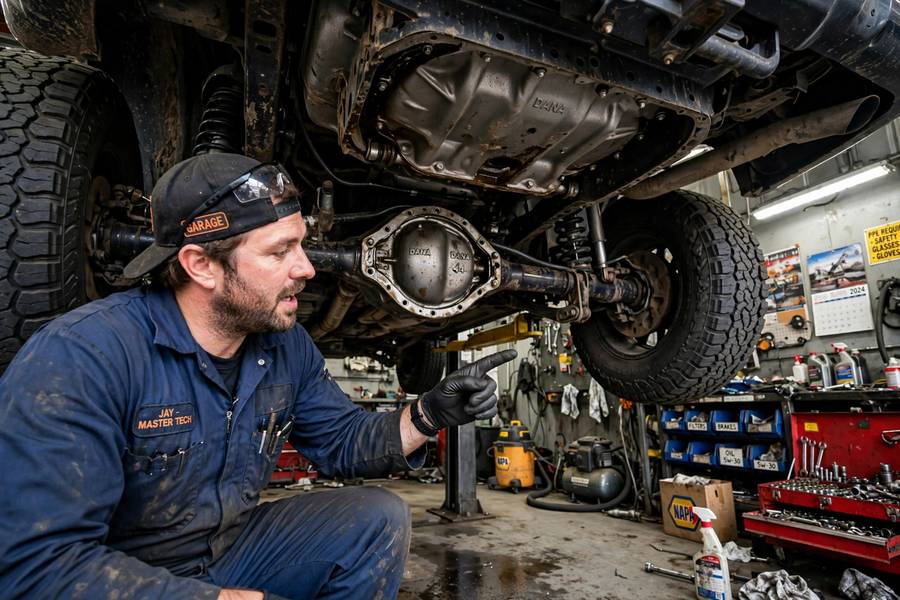
After years of AWD repairs, the pattern is clear. Number one: the rear coupling/clutch pack, especially in on-demand systems. It wears from heat cycling, and when it fails you get AWD warning lights, shuddering on turns, or a car that’s suddenly front-wheel drive. Replacement runs $800 to $1,500 depending on the vehicle.
Number two: differential fluid neglect. Front, rear, and center diffs all need fluid changes — typically every 30,000 to 60,000 miles — and almost nobody does them. I’ve drained diff fluid that looked like metallic paint. Fresh fluid is $150 of prevention against a $2,000 differential. The service schedule is in your owner’s manual; read it.
Number three: mismatched tires. AWD systems are extremely sensitive to tire circumference differences. Run one new tire with three worn ones and the constant speed difference overheats the center diff or clutch pack. Many AWD owner’s manuals specify replacing all four tires together. It’s not a sales trick — it’s physics, and ignoring it cooks the drivetrain.
Frequently Asked Questions
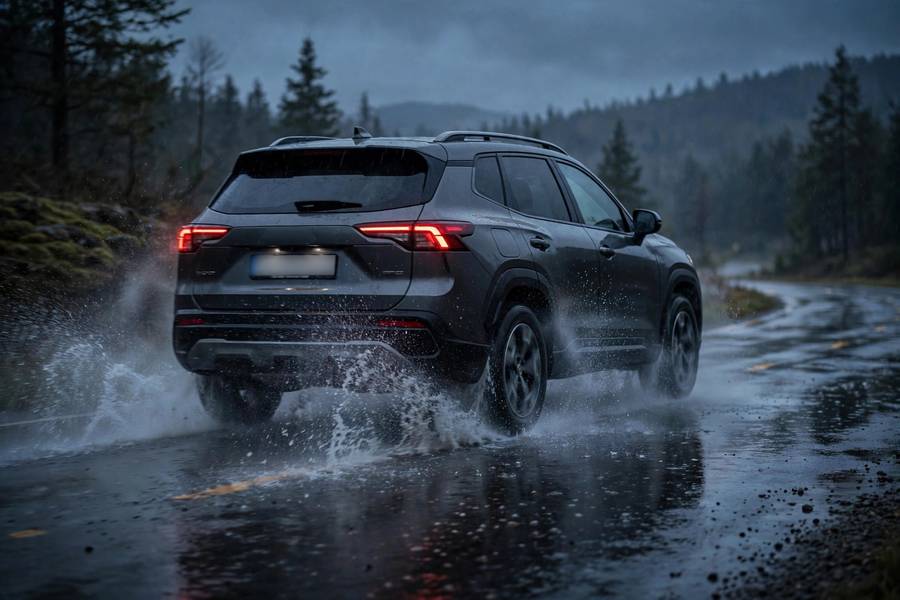
AWD sends engine power to all four wheels automatically. A center differential or electronic clutch pack splits torque between the front and rear axles, while sensors detect wheel slip and redirect power to the wheels with grip — all in about a tenth of a second, with no driver input needed.
It depends on the type. Full-time AWD drives all four wheels continuously. Real-time (on-demand) AWD runs in front-wheel drive most of the time and engages the rear wheels only when slip is detected, which saves fuel but can overheat under sustained slipping.
Torque vectoring distributes power left-to-right across an axle, not just front-to-rear. Brake-based systems slow the inside wheel to push torque outward; active differentials with clutch packs can genuinely overdrive the outside wheel, pulling the car through corners.
Yes — unlike part-time 4WD, AWD is designed for dry pavement. Its center differential or clutch pack allows the front and rear axles to turn at different speeds in corners, so there’s no drivetrain binding on high-traction surfaces.
Yes. AWD systems are sensitive to tire circumference differences — one new tire with three worn ones creates constant speed differences that overheat the center differential or clutch pack. Most manufacturers require replacing all four tires together.