Here’s something most “AI agent” explainers won’t tell you: you’ve been using AI agents for years. You just didn’t call them that. The spam filter that quietly protects your inbox, the fraud alert from your bank, the thermostat that learned your schedule — all of them run the same perceive-reason-act loop that defines an agent. If the concept itself is new to you, read my guide on what an AI agent actually is first. Then come back, because this list will change how you see the software around you.
I’ve grouped these by how visible they are — starting with the invisible ones you’ve never thought about, ending with the flashy ones making headlines.
Table of Contents
- The Invisible Ones (You’ve Used These for Years)
- The Assistants (Working Alongside You)
- The Autonomous Ones (Working While You Sleep)
- The Physical Ones (Agents With Bodies)
- The Ones You’ll Meet Next
- What These Examples Have in Common
- Frequently Asked Questions

The Invisible Ones (You’ve Used These for Years)
1. Spam filters. The original everyday AI agent. It perceives every incoming email, reasons about whether it’s spam based on learned patterns, and acts — filing, flagging, or deleting — without you asking. Modern spam filters adapt to your personal definition of spam, which makes them genuinely learning agents, not just static rules.
2. Fraud detection. When your bank texts you about a suspicious charge three minutes after it happens, that’s an agent at work. It monitors your transaction stream continuously, compares each one against your behavioral profile, and acts autonomously when something doesn’t fit. The best ones balance catch rate against false alarms — block too aggressively and they annoy you; too loosely and they miss real fraud.
3. Smart thermostats. The humble thermostat that learned you like it cooler at night is a textbook agent: it perceives temperature and occupancy, reasons about your schedule, and acts by adjusting the heat. Simple, but it fits the definition perfectly — and it saves real money.
4. Email categorization. Those tabs in your inbox — Primary, Promotions, Social — are maintained by an agent that reads every message and files it. You never trained it explicitly; it learned from millions of users’ behavior plus your corrections.
What strikes me about this group: nobody calls them “AI agents” in marketing, because they’re infrastructure. They just work, quietly, in the background. That’s the sign of a mature agent — invisibility.
The Assistants (Working Alongside You)
5. AI coding assistants. These don’t just autocomplete — the good ones implement whole features: read the requirement, write the code, run the tests, fix the failures. I’ve tested several extensively. They genuinely save hours on boilerplate, and they’re the closest thing most developers have to a junior pair-programmer that never sleeps. They still need human review on anything that matters.
6. Research agents. Give one a question like “compare noise-cancelling headphones under $200” and it searches, reads reviews, synthesizes, and produces a comparison. The output quality has gotten startlingly good — but you must verify the facts, because these agents are confident even when they’re wrong. I treat their output as a first draft, never a final answer.
7. Customer support agents. The better ones don’t just answer FAQs — they actually resolve issues: checking your order status, issuing refunds, rescheduling deliveries. When they work, the experience is better than waiting on hold. When they don’t, you get the special frustration of arguing with software that can’t understand you’re angry. The gap between good and bad implementations here is enormous.
8. Meeting schedulers. The agent that finds a time everyone can meet, sends the invites, and reschedules when conflicts arise. It’s a small thing, but scheduling is pure coordination overhead — exactly the kind of well-defined, verifiable task agents handle well.
This group is where most people’s first conscious “AI agent” experience happens. Notice the pattern: they work best when the task is well-defined and you can check the result.
The Autonomous Ones (Working While You Sleep)
9. Web monitoring agents. Agents that watch pages for changes — price drops, restocks, new listings — and alert you. Shoppers use them for sold-out items; businesses use them for competitor tracking. They browse like a human would, on a schedule, without being asked each time.
10. Social media management agents. The more advanced ones don’t just schedule posts — they monitor engagement, respond to common questions, and flag conversations that need a human. Used carefully, they’re a force multiplier for small teams. Used carelessly, they’re how brands end up auto-replying something tone-deaf at 3 AM.
11. Trading and pricing agents. From high-frequency trading to the algorithms that adjust airline prices minute by minute, autonomous agents make financial decisions continuously. They’re the most economically consequential agents on this list — and the least visible to ordinary people.
The defining trait of this group: they act on your behalf over extended periods without check-ins. That autonomy is powerful and slightly unnerving, which is why the good ones all have clear boundaries and audit trails.

The Physical Ones (Agents With Bodies)
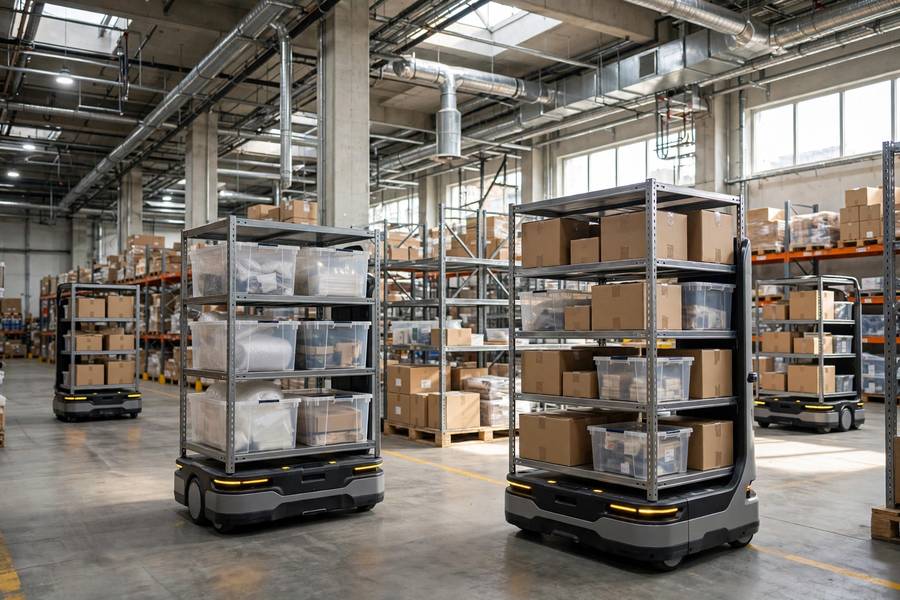
12. Warehouse robots. Fleets of mobile robots that perceive their surroundings, plan routes, pick items, and coordinate with each other — running the agent loop thousands of times per second. If you’ve ordered anything online recently, an embodied agent probably touched your package.
Honorable mentions in this category: delivery drones (limited deployment, heavy regulation), agricultural robots (weeding, harvesting), and driver-assistance systems (lane-keeping, adaptive cruise — agents with narrowly scoped authority over a two-ton machine).
Physical agents advance more slowly than software ones because mistakes have physical consequences. But economically, this category may end up mattering most.
The Ones You’ll Meet Next
The pipeline is full: customer-service agents that resolve tickets end-to-end without human handoff, scientific research agents that run experiments and analyze results overnight, and personal agents that manage your calendar, inbox, and travel as one continuous job rather than separate apps. Most are still rough — impressive in demos, flaky in production. The pattern so far: each new agent generation debuts as a toy, matures into a tool, and quietly becomes infrastructure. Today’s cutting edge is tomorrow’s spam filter — something you use every day without thinking of it as an agent at all.
What These Examples Have in Common
Stepping back, notice what every example shares: a goal, some perception of the world, and the ability to act on it without waiting for a human. That’s the entire definition of an agent, and it’s why the category feels so broad — it covers everything from a thermostat to a warehouse fleet. The differences that matter are scope (how much it can do), authority (how much it’s allowed to do unsupervised), and reversibility (how bad a mistake is). Judge any agent by those three, and you’ll rarely be surprised.
Look across all twelve and three patterns emerge:
They’re defined by the loop, not the technology. A thermostat and a coding agent share almost no technology, but both perceive, reason, and act toward a goal without constant human direction. The loop is the thing — everything else is implementation detail.
The best ones are boring. The agents that deliver the most value — spam filters, fraud detection, warehouse robots — are infrastructure you never think about. Hype concentrates on the flashy new ones; value concentrates on the reliable old ones.
Trust is earned per task, not per agent. I trust a coding agent to draft boilerplate but not to design an architecture. I trust a research agent for a first pass but never for final facts. The right question is never “can I trust AI agents?” — it’s “can I trust this agent with this specific task?” That’s the mental model that will serve you well as these systems spread into everything.
For the technical background on how these systems learn their jobs in the first place, how AI models are trained is worth your time — and if you’re curious about the broader landscape of what’s available, browse the current generation of AI tools to see how many agents you’re already surrounded by.
Frequently Asked Questions
Everyday examples include spam filters, bank fraud detection, smart thermostats, email categorization, AI coding assistants, research agents, customer support agents, meeting schedulers, price-monitoring agents, and warehouse robots. You’ve likely been using several of these for years without calling them agents.
A plain chatbot that only answers messages is not really an agent. It becomes one when it gains tools (web browsing, apps, databases), memory across steps, and the ability to plan multi-step actions. Most modern AI assistants have crossed that line.
Spam filters and fraud detection are the most widespread — they run continuously for billions of people without anyone noticing. Among visible agents, AI coding assistants and research agents are the fastest-growing in everyday use.
It depends on the task and the stakes. Low-stakes, verifiable tasks (filtering spam, drafting code, summarizing research) are fine with light supervision. Never give an agent unsupervised control over irreversible actions like purchases, sent messages, or deleted files — always keep a human in the loop there.
They’re replacing specific tasks rather than whole jobs — and mostly the tedious coordination tasks (scheduling, monitoring, first-draft research). The pattern so far: agents handle well-defined, verifiable work while humans keep judgment, accountability, and anything truly novel.
Warehouse robots are the clearest current example — fleets of mobile robots that navigate, pick items, and coordinate autonomously. Others include delivery drones, agricultural robots, and driver-assistance systems. They run the same perceive-reason-act loop as software agents, but their actions have physical consequences.