
“AI for business” has become a phrase that means everything and nothing. Vendors slap it on dashboards, consultants sell it in slide decks, and somewhere underneath the noise, companies are quietly using AI to make real money.
I’ve spent years in enterprise software, and I’ve seen both sides: the pilots that died in three months and the deployments that transformed operations. Here’s an honest accounting of how AI is actually used in business right now — what’s working, what’s overhyped, and what I’d tell a business owner considering it.
Contents
- What’s Actually Working: The Proven Twelve
- Customer Service: The Killer App
- Forecasting and Planning
- Fraud, Risk, and Security
- Marketing and Sales
- Operations and Supply Chain
- HR and Hiring (Handle With Care)
- What’s Overhyped
- How Businesses Should Actually Start

What’s Actually Working: The Proven Twelve
The applications with real ROI evidence behind them:
- Customer service chatbots — resolving routine inquiries
- Demand forecasting — predicting sales and inventory needs
- Fraud detection — spotting anomalous transactions in real time
- Document processing — extracting data from invoices, contracts, forms
- Predictive maintenance — forecasting equipment failures before they happen
- Personalized marketing — product recommendations and targeted content
- Sales forecasting and lead scoring — prioritizing where reps spend time
- Price optimization — dynamic pricing based on demand signals
- Quality control — computer vision spotting defects on production lines
- Knowledge search — finding answers in company documents conversationally
- Code assistance — developer productivity tools
- Meeting summarization — turning calls into action items automatically
Notice what’s not on the list: fully autonomous decision-making, AI CEOs, and most of what the keynote speeches promise. The real wins are narrower and less glamorous — and they compound.
Customer Service: The Killer App
If there’s one AI business application I’d bet on, it’s this one. Modern AI customer service works in tiers:
Tier 1 — Instant resolution. The AI handles password resets, order tracking, return policies, FAQ-style questions. Well-built systems resolve 40–70% of inquiries without humans. I’ve tested these as a customer, and the good ones are genuinely faster than waiting for an agent.
Tier 2 — Agent assistance. For complex issues, the AI drafts responses, pulls up relevant policies, and summarizes the customer’s history — while a human makes the decisions. This cuts handle time dramatically.
Tier 3 — Human only. Complaints, edge cases, emotional situations. The AI routes these immediately instead of fumbling them.
The failures I’ve seen all share one trait: companies that tried to eliminate humans entirely instead of augmenting them. The winning pattern is AI handling volume and humans handling judgment.
Forecasting and Planning
This is AI’s quiet superpower in business — and the least hyped, because “slightly better forecasts” doesn’t make headlines.
Demand forecasting uses historical sales, seasonality, promotions, weather, and economic signals to predict what you’ll sell. Retailers using modern forecasting cut stockouts and overstock measurably. The math isn’t new, but deep learning handles the complexity of thousands of products across hundreds of locations better than the old statistical methods.
Financial forecasting helps finance teams model scenarios faster. Not replacing judgment — accelerating it.
AI tools can delay the need to hire, but when the workload finally demands a human, here is how to hire your first employee with confidence.
Workforce planning predicts staffing needs from demand patterns. Call centers and retailers live on this.
The honest caveat: forecasting works brilliantly for stable patterns and fails for black swans. No model predicted the pandemic’s demand shocks. Use AI forecasts as the baseline, then apply human judgment for the unprecedented.
Our article on an AI model covers this in more detail.
Fraud, Risk, and Security
Banks and payment companies were doing “AI” before it was cool — they’ve used machine learning for fraud detection for over a decade.
How it works: the system learns your normal transaction patterns (where, when, how much), and flags deviations in milliseconds. That 3 AM purchase from another country gets challenged because it doesn’t match your pattern. False positives are annoying (“was this you?”), but the alternative is unchecked fraud.
Credit risk modeling uses far more signals than the old scorecards — though this is exactly where AI bias concerns bite hardest, and regulators are watching closely.
Cybersecurity uses AI to detect anomalous network behavior — the login at an unusual hour from an unusual location accessing unusual files. Human analysts can’t watch millions of events; AI triages them.
Marketing and Sales
Recommendation engines (“customers also bought”) are the oldest AI business application and still among the most profitable. Amazon attributes a huge share of revenue to recommendations.
Ad targeting uses AI to predict who’s likely to convert — though privacy changes (cookie deprecation, app tracking transparency) have made this harder and less precise than it was five years ago.
Content generation for marketing copy, product descriptions, and email variants. Works well as a first draft; I’ve seen marketing teams double output with AI-assisted drafting plus human editing. Works terribly as unsupervised autopilot — generic AI copy is increasingly recognizable and increasingly ignored.
Lead scoring ranks prospects by likelihood to buy, so salespeople focus where it matters. Simple models, real results.
Operations and Supply Chain
Predictive maintenance might be the highest-ROI AI application nobody talks about. Sensors on equipment feed vibration, temperature, and performance data to models that predict failures days or weeks ahead. One avoided unplanned shutdown in manufacturing can pay for the entire system.
Route optimization for delivery fleets saves fuel and time at scales humans can’t compute manually.
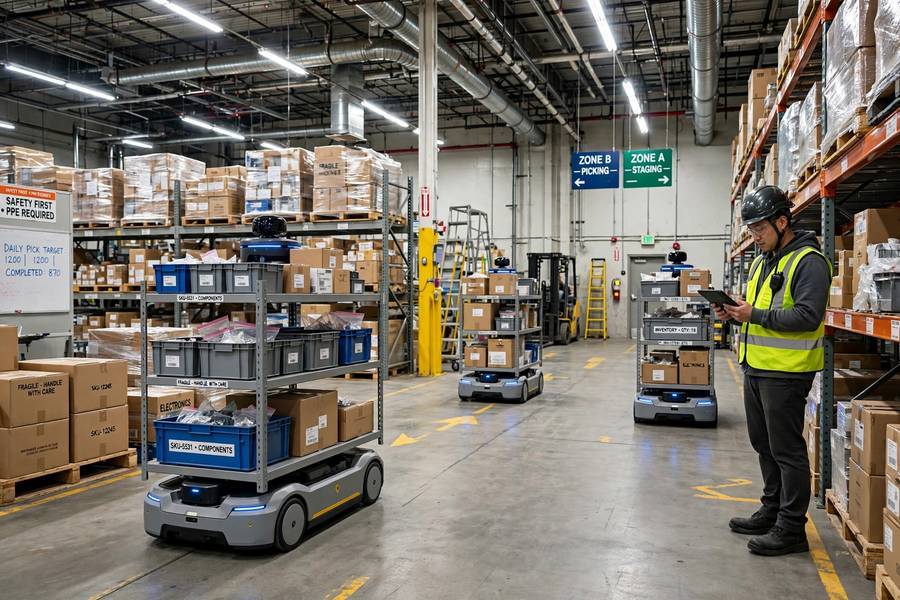
Warehouse automation — robots guided by computer vision — has transformed logistics. Not humanoid robots; boring, effective machines moving shelves and sorting packages.
Quality inspection with computer vision catches defects faster and more consistently than human inspectors for many product types.
HR and Hiring (Handle With Care)
I put this in its own section because it’s where AI in business goes most wrong.
Resume screening, interview analysis, and performance prediction all suffer from the bias problems I detail elsewhere — training on historical decisions reproduces historical discrimination. Multiple high-profile systems have been scrapped after bias was found.
My honest guidance: use AI in HR for administrative tasks (scheduling interviews, answering policy questions, drafting job descriptions) and keep humans firmly in charge of evaluative decisions (who gets hired, promoted, or fired). The legal and ethical exposure of automated employment decisions is enormous and growing.
What’s Overhyped
Being honest about the disappointments:
- “AI strategy” as a product. Most companies don’t need an AI strategy; they need one good use case executed well.
- Fully autonomous anything customer-facing. The technology isn’t there for unsupervised high-stakes interactions, whatever vendors claim.
- AI replacing knowledge workers wholesale. What’s actually happening: AI makes good workers faster. The workers who learn the tools pull ahead; the tools don’t replace the workers.
- Predicting the unpredictable. AI is bad at black swans, novel situations, and anything requiring genuine judgment about unprecedented events.
- ROI timelines in vendor decks. Real deployments take 6–18 months to pay off. Anyone promising 30 days is selling something.
How Businesses Should Actually Start
If I were advising a company (which I used to do), here’s the playbook:
- Start with one painful, repetitive process. Not the most strategic — the most annoying. Volume + repetition = AI’s sweet spot.
- Measure the baseline first. You can’t prove ROI without “before” numbers. Most companies skip this and regret it.
- Pilot small, with an exit plan. 90 days, clear success criteria, permission to kill it.
- Augment, don’t replace. Keep humans in the loop, especially early. You’ll need them for the edge cases anyway.
- Data first. AI on bad data produces bad results faster. Clean up the inputs before buying the model.
- Plan for maintenance. Models degrade as the world changes. Budget for ongoing monitoring, not just launch.
The companies succeeding with AI aren’t the ones with the grandest visions. They’re the ones that picked a real problem, executed carefully, measured honestly, and expanded from there. Boring? Yes. Profitable? Also yes.

Frequently Asked Questions
The main business uses of AI include customer service automation, demand forecasting, fraud detection, document processing, predictive maintenance, personalized marketing, and sales forecasting. The most proven applications augment human workers rather than replacing them.
Customer service automation and demand forecasting show the strongest ROI evidence. Predictive maintenance in manufacturing and fraud detection in finance also deliver major returns. The common thread: high-volume, repetitive processes where AI handles scale and humans handle judgment.
Yes — and they increasingly do. Off-the-shelf tools for customer chat, marketing copy, bookkeeping, and scheduling are affordable and require no technical team. Start with one painful repetitive process, measure the baseline, and pilot for 90 days.
The evidence so far shows AI making good workers faster rather than replacing them wholesale. Roles heavy on routine information processing are most affected; roles requiring judgment, relationships, and novel problem-solving are least affected. Workers who learn the tools pull ahead.
Key risks include biased outcomes (especially in hiring and lending), over-reliance on unreliable outputs, data privacy exposure, and models degrading as conditions change. Mitigate with human oversight on high-stakes decisions, disaggregated testing, and continuous monitoring.