
That three-minute video you watched twelve times? It probably took three weeks — a director, a treatment, a crew of fifty, a location scouted across two states, and an edit bay running until 3 a.m. Music videos are short films with impossible deadlines, and the good ones are miniature masterpieces of planning.
I have always been fascinated by the gap between the effortless final product and the chaos of making it. So here is the full process: how music videos go from a song file to the visual you cannot stop rewatching.
Table of Contents
- It Starts With the Treatment
- Anatomy of a Director’s Treatment
- Budgets: From $500 to $500,000
- A $5,000 Budget, Line by Line
- Pre-Production: Planning the Shoot
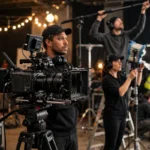
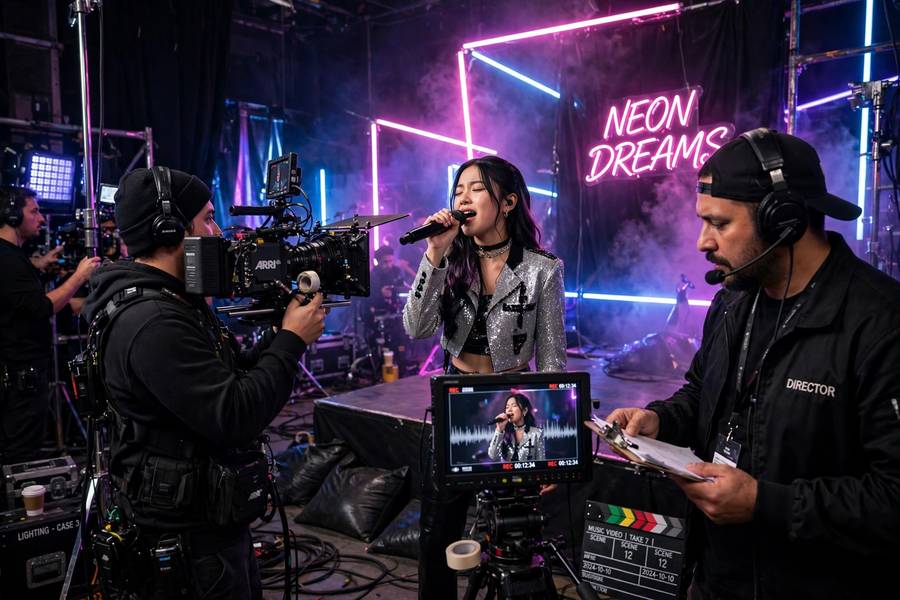
- The Shoot: Controlled Chaos
- The Core Crew: Roles and Day Rates
- Post-Production: Where Videos Are Really Made
- The Premiere and Afterlife
- Release Checklist: YouTube and Vevo
- Frequently Asked Questions
It Starts With the Treatment
Before any camera rolls, directors compete by writing treatments — illustrated pitch documents describing their vision for the video: the concept, visual style, key scenes, color palette, and how it connects to the song. The artist and label pick a winner.
Treatments range from narrative short films to pure performance pieces to abstract visual experiments. The best ones find the emotional core of the song and translate it into images — not literally illustrating lyrics (the rookie mistake), but building a visual world the song lives in.
Legendary treatments became legendary videos: the single-take ambition, the dance routine that launched a thousand imitations, the narrative twist nobody saw coming. It all starts as a PDF with big dreams.
Anatomy of a Director’s Treatment
Here is what a professional treatment actually contains, section by section — the document that wins the job:
- Cover page. Director name, artist, song title, and one striking key image. First impressions are the whole game here.
- The logline. The video in one sentence. If you cannot pitch it in a sentence, the concept is not ready.
- Concept statement. A page on the big idea: what the video is about emotionally, and why this song needs this visual world.
- Narrative / scene breakdown. Verse by verse, sometimes shot by shot: what happens, where, and how it maps to the music.
- Visual references. Mood boards, film stills, color palettes, typography samples. Directors communicate in images, not adjectives — a treatment lives or dies on its references.
- Performance direction. How the artist appears on camera: wardrobe energy, attitude, choreography notes, the “character” they play.
- Styling and wardrobe. Looks per scene, hair and makeup direction, the overall fashion thesis.
- Locations. Specific places or the kind of place, with backup options. Locations quietly determine half the budget.
- Pacing and edit notes. How the cut will feel: frenetic, languid, where the big visual hits land against the song’s structure.
- Why this director. A short reel of past work proving they can actually execute what they just pitched.
Treatments that win are specific. “A moody performance video” loses to “the artist performs in an abandoned aquarium at blue hour, shot on anamorphic lenses, intercut with a flooded ballroom sequence.” Specificity is how the label pictures the finished video — and how you get hired.
Budgets: From $500 to $500,000
The range is staggering:
- DIY/unsigned ($500–$5,000): Friends with cameras, one location, natural light, editing on a laptop. Some iconic videos were made this way — constraints force creativity.
- Mid-level label ($20,000–$100,000): Professional crew, real locations, proper lighting, choreography, a day or two of shooting.
- Superstar ($200,000–$500,000+): Multiple locations, elaborate sets, VFX, big crews, sometimes several shoot days. The blockbusters of the format.
Where does the money go? Crew salaries (the biggest chunk), locations and permits, equipment rental, talent (dancers, actors, extras), costumes and styling, post-production (edit, color, VFX), and catering — never underestimate catering on a 14-hour shoot day.
A $5,000 Budget, Line by Line
Here is what a realistic $5,000 indie budget looks like, line by line. These are approximate ranges — every market differs, and favors shift everything:
| Line item | Approx. cost | Notes |
|---|---|---|
| Director (flat fee) | $800–$1,200 | Concept, shoot day, overseeing the edit |
| DP (1 shoot day) | $500–$800 | Camera and lighting design |
| Camera rental (1 day) | $300–$500 | Mirrorless or cinema body plus lenses |
| Lighting + grip rental (1 day) | $250–$400 | LED panels, stands, modifiers |
| Location / permits | $0–$400 | A friend’s loft costs nothing; a permitted public space does not |
| Production assistant | $150–$250 | The person who does everything nobody else does |
| Hair and makeup | $250–$400 | On-set all day |
| Styling / wardrobe | $100–$300 | Rentals and thrift, mostly |
| Talent (dancers, extras) | $100–$200 each | Or deferred/credit on true micro-budgets |
| Food and craft services | $150–$200 | Non-negotiable on a 12-hour day |
| Editor (flat) | $500–$800 | Assembly through final revisions |
| Color grade | $250–$400 | Often bundled with the edit |
| Contingency (~10%) | ~$400–$500 | Because something always goes wrong |
Add it up and you land right around $5,000 — roughly half on people, a quarter on gear and locations, the rest on post and feeding everyone. The honest secret of micro-budget videos: the numbers only work because half the favors are invisible. Somebody’s cousin owns the camera package; the location is free because the director shot the owner’s wedding. Budget tables describe the money — relationships describe the rest.
Pre-Production: Planning the Shoot
Music video pre-production is brutally compressed — often one to two weeks for what films plan over months:
- Storyboarding and shot lists. Every setup planned: camera angles, lens choices, lighting looks. On a one-day shoot, there is no time to figure it out on set.
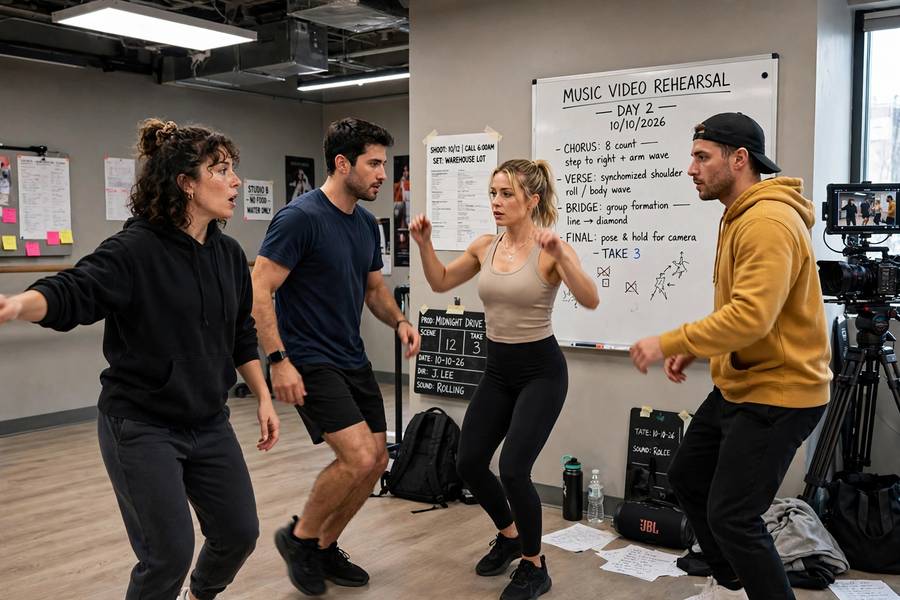
- Casting and choreography. Dancers rehearse for days before the shoot; actors are cast for look and presence.
- Location scouting. The right location does half the production design work. Permits, power access, and backup plans for weather — all sorted in advance.
- Playback planning. The artist lip-syncs to the track on set, so playback systems must be loud enough to hear over everything yet clean enough for the crew to communicate. The song plays hundreds of times during a shoot — crew members report hearing it in their dreams.
The Shoot: Controlled Chaos
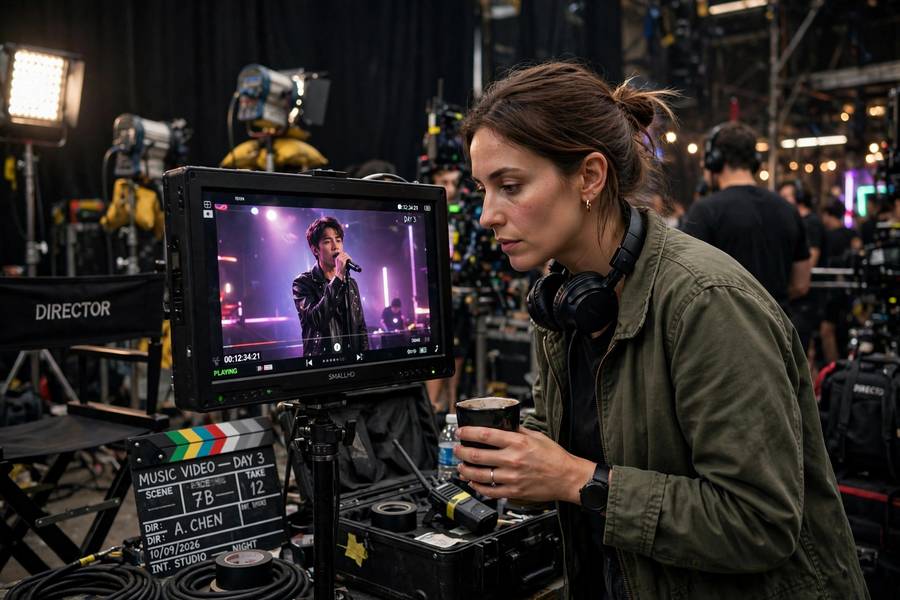
Shoot days are intense: 12–16 hours is normal, sometimes through the night for the right look. What actually happens:
- Performance setups first. The artist performing the song — multiple angles, multiple takes, multiple outfits. Lip-sync precision matters; editors cannot fix a performance that drifts from the track.
- Narrative and B-roll. Story scenes, beauty shots, cutaways — the texture that makes the video more than a concert recording.
- The playback loop. The song plays on repeat, take after take. By hour ten, nobody is hearing it anymore — which is exactly when the best spontaneous moments happen, because everyone has stopped overthinking.
- Problem-solving in real time. Locations fall through, weather turns, equipment fails. Music video crews are famously resourceful — some of the most memorable shots in the format were improvised fixes.
Directors often shoot far more than needed: multiple interpretations of key scenes, alternate endings, wild experimental takes “just in case.” The edit decides later.
The Core Crew: Roles and Day Rates
A lean music video crew is ten to fifteen people. Here is who they are and what they cost at the indie tier — approximate day rates; major markets run higher, favors run lower:
| Role | Approx. day rate | What they do |
|---|---|---|
| Producer | $400–$700 | Budget, schedule, permits, and every problem |
| Director | $500–$1,500 | The creative lead; flat fees are more common than day rates |
| DP / Cinematographer | $500–$1,000 | Camera and lighting design |
| 1st AC (focus puller) | $250–$400 | Keeps the shot sharp |
| Gaffer | $350–$550 | Head of the lighting crew |
| Grip | $250–$400 | Rigging, stands, light shaping |
| Playback / sound | $250–$350 | Runs the track on set |
| Hair and makeup | $300–$500 | On-set all day |
| Stylist | $250–$400 | Wardrobe |
| Production assistant | $150–$250 | Everything else |
| Editor (post) | $400–$700 | Or $500–$1,500 flat for the project |
Notice what is missing: there is no separate art department, no VFX supervisor, no second unit. On indie shoots, the DP is the lighting department, the producer is the locations department, and the director is often holding a reflector between takes. Fewer people means faster decisions — one of the format’s genuine advantages.
Post-Production: Where Videos Are Really Made
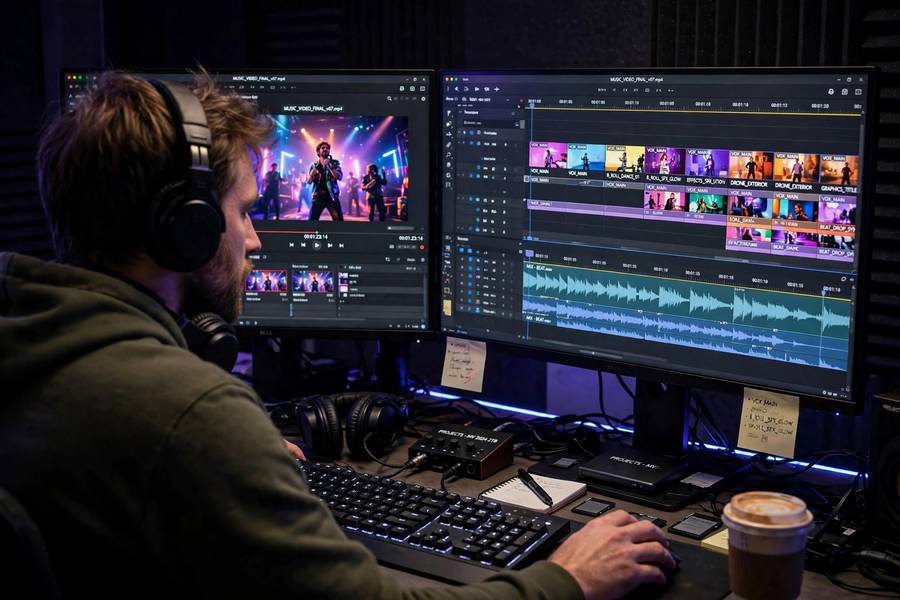
Ask any director: the video is made in the edit. Raw footage is potential; the cut is the product.
- The assembly. Editors sync every take to the track and build a rough structure — usually verse by verse. The first assembly is always too long and slightly boring. That is normal.
- Finding the rhythm. Great music video editing dances with the song: cuts landing on beats, visual energy matching musical dynamics. This is instinct as much as technique.
- Color grading. The “look” — teal-and-orange blockbuster, washed-out indie, hyper-saturated pop — is largely created here. Color tells the audience how to feel before a single plot point lands.
- VFX and finishing. From subtle cleanup (removing a boom mic’s shadow) to full CGI worlds. Even “simple” videos often hide dozens of invisible effects.
- Versions. The main video, plus often: a vertical cut for phones, a lyric video, behind-the-scenes content, and teaser clips. One shoot feeds an entire content ecosystem.
The artist and label give notes through rounds of revisions — “more energy in the chorus,” “lose the clown scene” — until everyone signs off or the release date arrives, whichever comes first.
The Premiere and Afterlife
Release strategy matters: coordinated drops across platforms, premiere events, social teasers. A great video can resurrect a song — the “video bump” on streaming numbers is real and measurable.
Release Checklist: YouTube and Vevo
Uploading is the easy part. Releasing properly is a checklist:
- Deliver the master correctly. Export to the platform’s specs and keep a lossless archive. A bad encode at upload poisons every view forever.
- ISRC code. The video’s unique identifier must be embedded before distribution — without it, plays cannot be tracked or monetized properly.
- YouTube metadata. Title in “Artist — Song Title (Official Video)” format, a description with credits and links, tags, chapters for longer pieces, end screens, and cards pointing to the song and channel.
- Premiere scheduling. Use YouTube’s Premiere feature so fans gather for a live debut — it concentrates the first-hour views the algorithm notices.
- Thumbnail. Design it deliberately; it is the video’s billboard. The strongest frame of the video usually beats a designed graphic.
- Vevo. You cannot upload to Vevo directly — distribution runs through an approved Vevo content provider, usually your label or a digital distributor that partners with Vevo. Independent artists typically get there via their distributor once the video meets Vevo’s technical specs.
- Vertical cuts. Export 9:16 versions for Shorts, Reels, and TikTok — the same shoot should feed every format.
- Closed captions. Caption the lyrics; a large share of viewers watches muted, and captions are an accessibility and SEO win.
- Rollout. Teasers in the days before, the premiere event, social clips, press outreach — the video launches, the campaign sustains.
- Day-after audit. Check comments, analytics, and Content ID claims. Fix metadata errors immediately; the first 48 hours set the trajectory.
And the afterlife: iconic videos become cultural reference points, parodied, homaged, and analyzed for decades. The best ones outlive the chart run of the song itself.
The whole pipeline mirrors film production at sprint pace — how movies are made covers the feature-length version, and the filmmaking tips there apply directly to aspiring video directors.
Videos That Changed the Format
A few milestones worth knowing: Michael Jackson’s Thriller (1983) proved a music video could be a 14-minute cinematic event. Peter Gabriel’s Sledgehammer pioneered stop-motion and claymation techniques. OK Go’s Here It Goes Again (2006) showed a treadmill, one take, and YouTube could outplay million-dollar budgets. Childish Gambino’s This Is America demonstrated the video as cultural commentary. Each one expanded what the format was allowed to be.
Music Videos in the Streaming Era
YouTube and TikTok changed the economics completely. A video no longer needs MTV’s gatekeepers — an artist can shoot on a phone, upload in an hour, and reach millions by morning. This democratized the form but also shortened attention spans: the first three seconds now decide whether anyone keeps watching, so modern videos front-load their strongest imagery. Vertical formats for Shorts and Reels have created a parallel genre of portrait-mode videos. The big-budget spectacle still exists, but the barrier between “official video” and “content” has never been thinner.
Frequently Asked Questions
In stages: a director pitches a treatment, then pre-production (storyboards, casting, locations), an intense 1–3 day shoot with lip-synced performance takes, and extensive post-production (editing to the beat, color grading, VFX) before premiere.
Anywhere from $500 (DIY) to $500,000+ (superstar productions). Mid-level label videos run $20,000–$100,000, with crew salaries the biggest expense, followed by locations, equipment, and post-production.
Typically 2–4 weeks total: 1–2 weeks of pre-production, 1–3 shoot days, and 1–2 weeks of editing and finishing. The final three-minute video represents hundreds of person-hours.
No — they lip-sync to the recorded track during filming. The audio you hear is always the studio recording. Precise lip-sync matters because editors cannot fix a performance that drifts from the track.
An illustrated pitch document where directors describe their vision: concept, visual style, key scenes, and color palette. Artists and labels choose between competing treatments before production begins.
Specialist directors, many of whom graduate to feature films — the format has launched major directing careers. Directors are chosen based on their treatments and visual reels.
On indie shoots, directors typically earn a flat fee of roughly $500–$2,000 for the project. Mid-level label videos pay around $5,000–$25,000, and superstar productions go far higher. Many early-career directors work cheap to build a reel — the treatment that wins the job matters more than the paycheck.
You cannot upload to Vevo directly. Distribution runs through an approved Vevo content provider — usually your label or a digital distributor that partners with Vevo. Independent artists typically get there via their distributor once the video meets Vevo’s technical specs.