

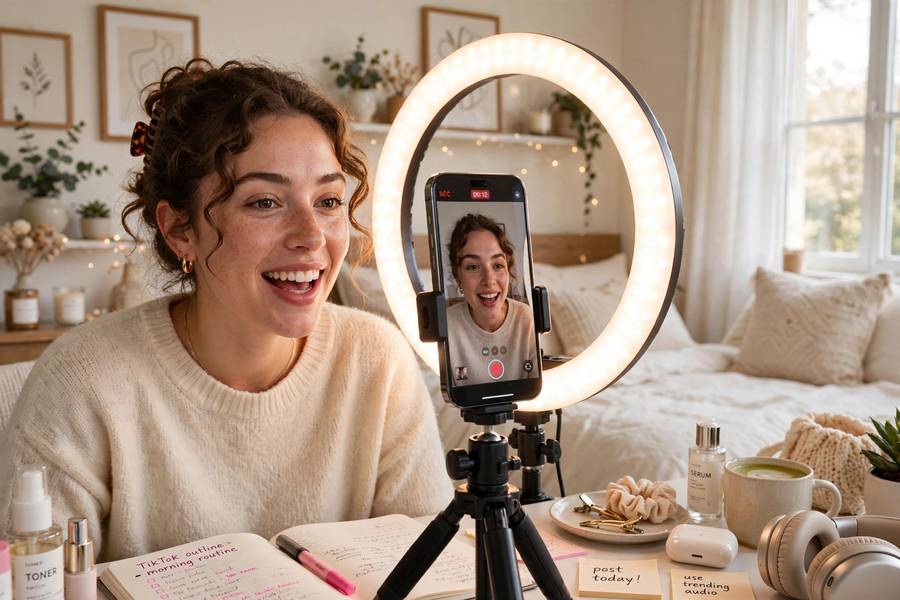
Everyone wants to know how to grow on TikTok, and most advice is outdated, vague (“just be authentic!”), or a funnel for a $997 course. As a film obsessive, I can’t help analyzing the editing, hooks, and pacing — and I’ve watched enough accounts blow up (and flame out) to separate signal from noise.
Honest version: TikTok growth is a skill, not a lottery. The algorithm rewards specific behaviors, audiences respond to specific structures, and consistent creators run systems instead of hoping for virality. Here’s the full playbook.
Table of Contents
- How to Grow on TikTok: Understanding the Algorithm First
- The First Three Seconds: Hooks That Stop the Scroll
- Pick a Lane: Niches, Series, and Repeatable Formats
- The Posting System: Volume, Consistency, and Timing
- Editing and Production: The Film Craft Nobody Talks About
- Engagement Tactics That Actually Move the Needle
- The Mistakes That Kill Growth
- Frequently Asked Questions

How to Grow on TikTok: Understanding the Algorithm First
TikTok’s For You Page is a recommendation engine, not a social graph. That distinction is everything. On older platforms, followers saw your posts. On TikTok, every video is tested on strangers first — shown to a small sample, measured, then boosted or killed on the data.
The metrics that matter, in rough order:
Watch time and completion rate. The king metric. If people watch your 30-second video to the end (or rewatch), the algorithm reads maximum satisfaction. 90%+ completion on a short video beats a million views at 20%. This is why the best TikToks are ruthlessly tight — every second must earn the next.
Rewatches. A rewatch counts double: the video was so good (or dense) one viewing wasn’t enough. Loopable videos — ending where they begin — exploit this brilliantly.
Shares and saves. A share means “someone else must see this.” A save means “I need this later.” Both signal deeper value than a passive like. Tutorials and list content over-index here.
Comments. Not just count — quality and reply threads. 200 comments in active discussion beats 2,000 “lol”s. Genuine questions drive this (not “comment your favorite color”).
Follows from the video. The strongest signal: someone watched and wants more of you. High follow-conversion turns a viral video into actual growth.
What the algorithm ignores: follower count (zero-follower accounts go mega-viral), posting history, effort. It cares about viewer behavior, full stop. Good news: the field is level. Bad news: past success guarantees nothing. Every video starts at zero.
One more: TikTok weighs search behavior. The platform is becoming Gen Z’s search engine — “TikTok SEO” (keywords in captions, on-screen text, spoken audio) increasingly drives discovery. Say the words; write the words; caption the words.
The First Three Seconds: Hooks That Stop the Scroll
Viewers decide in under three seconds. Your hook isn’t the beginning of your video — it’s the entire battle.
Lead with the payoff. “I spent $10,000 testing every viral skincare product so you don’t have to” beats “Hey guys, today I wanted to talk about skincare.” The first sentence should contain the reason to watch. No introductions, no throat-clearing.
Pattern interrupts. The scroll is a trance; break it. An unexpected visual in frame one, a bold claim, a question with real tension, mid-action openings. Film editors call it “in late, out early” — classic filmmaking tips applied to 15-second videos.
Open loops — ethically. Promise information, then delay it: “the third one is why my account got banned.” The payoff must be real and worth the wait. Fake loops train your audience to distrust you, and the algorithm notices the drop-off.
Text on screen. Viewers decide with sound off first. A bold 5–8 word headline restates the hook visually — high contrast, readable at a glance.
Speak to one person. “If you’re a film student” beats “hey everyone.” Specificity attracts the right viewers, and the right viewers watch longer. That’s the whole game.
Pick a Lane: Niches, Series, and Repeatable Formats
The fastest-growing accounts are legible. A new visitor should get what you do within five seconds of landing on your profile.
Niche down, then expand. Start narrow: not “comedy” but “movie plot holes in 30 seconds”; not “fitness” but “hotel-room workouts.” A tight niche focuses the algorithm’s audience model — better targeting, better watch time. Broaden later, once you’ve earned it.
Build series, not just videos. “Rating movie endings until I find a perfect one — Day 47.” Series create appointment viewing: followers return, each episode funnels viewers backward. Nobody starts at episode 47 without context — they binge. Algorithmic gold.
Develop repeatable formats. Same structure, new content each time: a signature catchphrase, visual motif, editing rhythm. Formats cut production burden and train expectations. Your format becomes your brand without you saying the word.
Pillar content vs. experiments. 80/20: proven formats your audience loves, plus experiments testing new angles. Most experiments underperform — that’s R&D. The ones that pop become new pillars. Only experiments: no momentum. No experiments: stale.

The Posting System: Volume, Consistency, and Timing
Volume beats perfection. TikTok rewards reps. Fast growers post 1–3 times daily — not spam, but data. Every post is an experiment; more experiments, faster learning. A “perfect” weekly video teaches twelve lessons a year. Three daily posts teach a thousand.
Consistency beats intensity. Steady output beats burst-and-disappear. Design your system around your actual life, not an aspirational one. A sustainable pace held for a year wins.
Timing is marginal. Post when your audience is awake (check analytics), but TikTok distributes over days, not minutes — a great 3 AM video can still blow up. Don’t obsess over timing; obsess over the video.
Batch production. Film 5–10 videos per session. Separate ideation from filming from editing. Keep a running ideas list — never sit down to film with a blank slate.
The 90-day rule. Most eventual blow-ups posted consistently for 2–3 months before anything happened. The algorithm needs data; your skills need reps. Quitting at day 30 means quitting during calibration. Commit to 90 real days before judging.
Editing and Production: The Film Craft Nobody Talks About
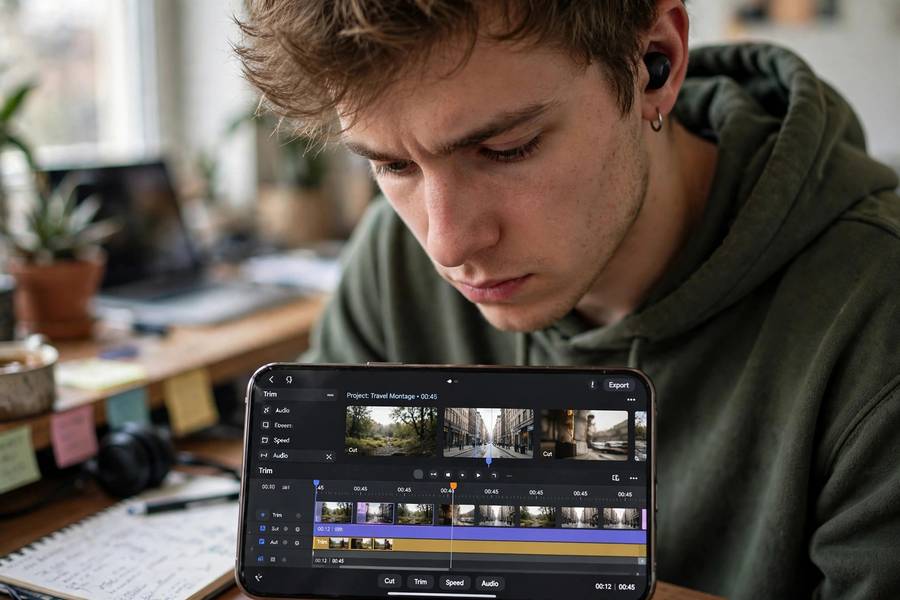
TikTok is filmmaking, compressed. The fastest growers are usually the best editors, whether they know film theory or not.
Cut ruthlessly. Remove every dead frame — silences over half a second, “umms,” repeated points. Information density is the product. Watch at 1.5x speed; if it drags, cut more.
Jump cuts are the grammar. Cutting mid-sentence to the next thought compresses time, maintains energy, signals confidence. Cut on the thought, not the breath.
Captions always. Huge share of viewing is sound-off, plus captions serve TikTok SEO. Use dynamic word-by-word captions — they hold attention better than static blocks. Keep them accurate; mis-captions kill credibility.
Sound selection is strategy. Trending sounds get a discovery boost — users browse by sound. But don’t force-fit: a trending sound on irrelevant content confuses the audience model. Use trends that fit your niche; skip the rest.
Audio first, lighting second, camera last. You don’t need a studio — a window and a $20 mic beat a ring light and phone audio. Viewers forgive vertical video; they don’t forgive straining to hear.
The loop. If your ending flows into your beginning, viewers rewatch without deciding to. Rewatches are rocket fuel. Not every video should loop — but your format videos should.
Engagement Tactics That Actually Move the Needle
Reply with video. Answering comments with new videos is a growth machine: a good question is a free content idea with proven demand. The commenter feels seen, the audience gets value, engagement compounds.
Stitch and Duet strategically. Engage larger creators’ content with genuine value-add — don’t just react, contribute. The best stitches make the original look good while showcasing your perspective.
Pin your converters. Pin the 2–3 videos that best turn profile visitors into followers — your top format videos, your best intro. Your pinned row is your storefront.
Go live (when ready). Lives build parasocial depth shorts can’t — real-time, unscripted. But they need an existing audience; going live to twelve people is practice, not growth.
Cross-post natively. Repost to Reels and Shorts — uploaded natively, never with TikTok watermarks (Instagram deprioritizes them). One session, three distributions. The entrepreneur mindset: build once, distribute everywhere.
Collaborate. Joint series and guest spots with similar-sized accounts in adjacent niches are the fastest legitimate audience trade. Propose specific ideas, not vague “let’s collab.”
The Mistakes That Kill Growth
Deleting underperformers. Deletion erases data and flags erratic behavior — and flopped videos sometimes get picked up weeks later. Leave them up. Your “failures” are your R&D archive.
Buying followers. Fake followers don’t watch, which tanks your engagement rate in the algorithm’s test phase. The single most self-destructive thing a growing account can do.
Inconsistent identity. Fitness Monday, politics Wednesday, cooking Friday confuses the audience model. The algorithm can’t place you. Pick a lane and stay until established.
Ignoring analytics. Retention graphs show exactly where viewers drop off — a brutally honest editor most creators never consult. Study your top 10 videos’ graphs and reverse-engineer what held attention.
Chasing every trend. Trend-hopping without a niche makes you interchangeable with ten thousand accounts doing the same dance. Trends are seasoning, not the meal. Your format is the meal.
Burnout pace. 5x daily for a month then vanishing is worse than 3x weekly for a year. The algorithm remembers consistency. Protect your capacity — this is a marathon.
The through-line: TikTok growth is a craft. Study the algorithm, respect the viewer’s time, build systems over lightning-hopes, give it 90 real days. Most people won’t — which is exactly why it works for those who do.
Frequently Asked Questions
Post 1–3 times daily in a tight niche, hook viewers in the first 3 seconds, maximize watch time and completion rate, use repeatable series formats, and commit to 90 days. The algorithm rewards consistent viewer satisfaction, not follower count.
Every video is tested on a small audience sample first. The algorithm measures watch time, completion rate, rewatches, shares, saves, comments, and follows — then expands distribution for videos that score well. Follower count doesn’t gate virality.
One to three quality posts daily is the sweet spot for growth. Volume matters because each post is a data point, but sustainability matters more — a pace you can hold for a year beats a heroic month followed by burnout.
When your specific audience is active — check your analytics’ follower activity tab. But timing is marginal: TikTok distributes videos over days, not minutes, so a great video posted at an “off” hour can still blow up. Content quality dominates timing.
No. Deleting erases performance data and can flag erratic behavior — and flopped videos sometimes get algorithmic pickup weeks later. Leave them up as your R&D archive and study their retention graphs instead.
Yes, severely. Fake followers don’t watch your videos, which tanks your engagement rate in the algorithm’s initial test phase. Bought engagement is the fastest way to make every future video underperform.