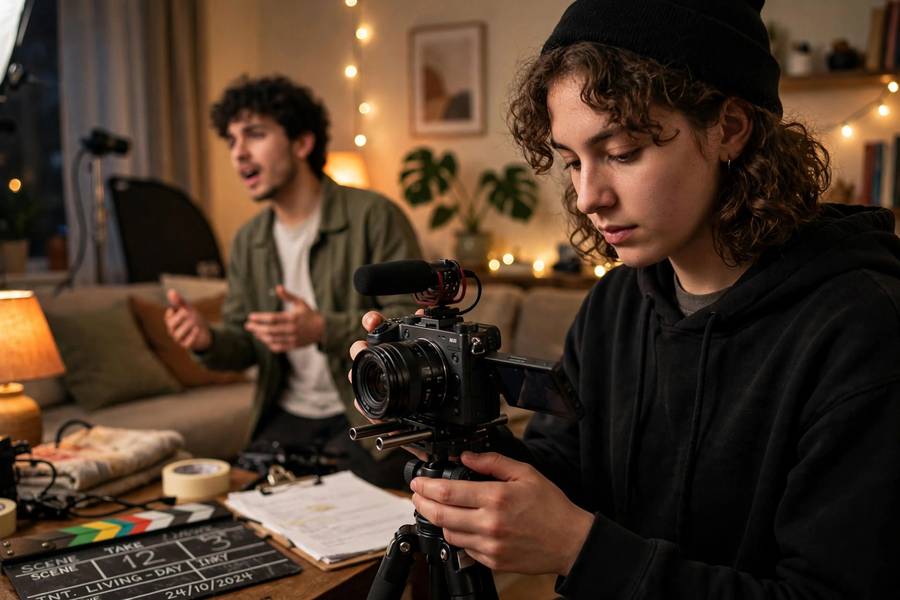
Every great director started with something small, cheap, and probably a little embarrassing. Spielberg was shooting backyard war movies as a teenager. Tarantino worked in a video store. Your first short film won’t be perfect — mine certainly wasn’t — but it’s the single best film school that exists, and it costs almost nothing.
A short film is the perfect format for a beginner. It’s short enough to actually finish (most unfinished films die at the 90-page feature stage), cheap enough to fund yourself, and complete enough to teach you every phase of filmmaking: writing, shooting, and editing. Film festivals, YouTube, and your portfolio all want shorts.
Here’s the full process, from the spark of an idea to a finished film you can actually show people.
Table of Contents
- Start With a Story You Can Actually Shoot
- Write a Short Script (Keep It Tight)
- Plan Like a Producer: Budget, Schedule, Locations
- Assemble Your Crew (and Cast)
- The Gear Question: What You Really Need
- Shooting: Coverage, Lighting, and Sound
- Directing Actors (Even Non-Actors)
- Editing: Where the Film Gets Made
- Sound Design and Music
- Finishing and Sharing Your Film
- Frequently Asked Questions
Start With a Story You Can Actually Shoot
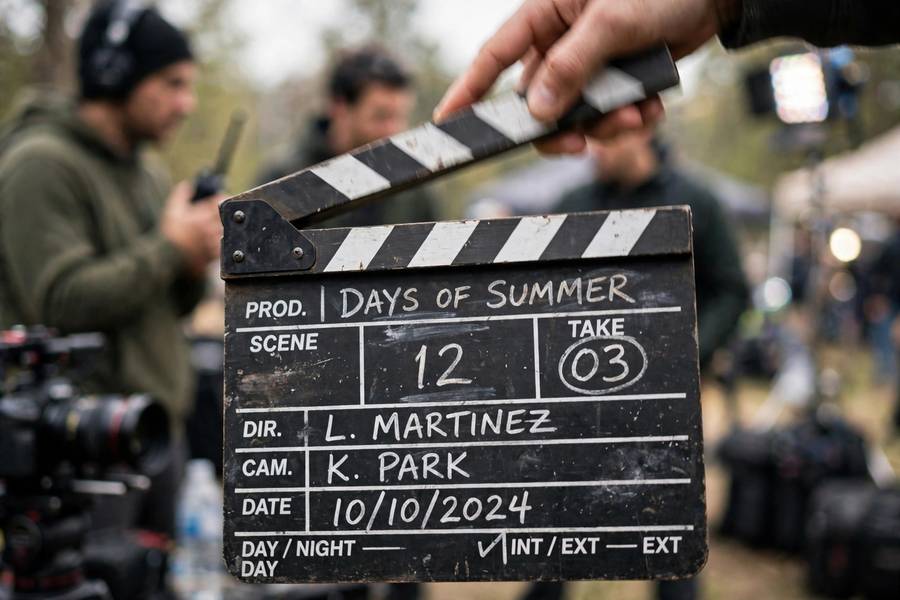
The number one killer of first short films is ambition mismatch — a script that needs a car chase, a crowd scene, and night shoots in three cities, made by someone with a phone and two weekends.
Your first short should have: one or two locations you control, a tiny cast, and a story that fits in 5–10 minutes. Constraints breed creativity. Some of the best shorts ever made are two people in one room. Think character and situation, not spectacle.
Ask yourself: what story can I tell with the people, places, and gear I already have access to? Write toward your resources, not away from them. If your friend has a cool apartment and another friend has a dog, congratulations — you have a movie.
For a deeper look at the craft behind all of this, these filmmaking tips cover the fundamentals every beginner should know.
Write a Short Script (Keep It Tight)
A short film script runs about one page per minute. Aim for 5–12 pages. That sounds small until you try to write twelve good pages — it’s harder than it looks.
Short film structure is different from features. You don’t have time for subplots or slow setup. The best formula for beginners:
- Drop us into a situation already in motion. No ten minutes of backstory.
- One clear want. Your character wants one specific thing.
- One obstacle. Something concrete stands in the way.
- A turn. Something changes — a revelation, a decision, a reversal.
- An ending that lands. Not necessarily happy, but decisive.
Write visually. Film is a visual medium, so if something important only exists in dialogue, find a way to show it. And read your dialogue out loud — if it sounds like writing, rewrite it until it sounds like talking. How to write a screenplay goes deeper on format and structure if you want the full treatment.
Plan Like a Producer: Budget, Schedule, Locations
Nobody likes this part, which is exactly why most first films fall apart here. A little planning saves everything.
Budget: Your first short can cost anywhere from $0 (phone, friends, natural light) to a few hundred dollars (food, props, festival fees). The biggest real expense is feeding people — never skip this. Fed crew = happy crew.
Schedule: Plan to shoot 2–4 pages per day. A 10-page short = 3–4 shoot days max. Schedule more time than you think for setup; everything takes longer than expected.
Locations: Fewer is better. Every location change eats an hour minimum. Get permission in writing — even for a friend’s apartment, a quick text confirmation avoids disasters.
Shot list: Before shooting, list every shot you need. This is your battle plan. Without one, you’ll forget coverage and discover it in the edit, when it’s too late.
Assemble Your Crew (and Cast)
You need fewer people than you think, but you need them committed:
- You (director, and probably producer, editor, and craft services)
- Someone on camera (even if it’s you with a tripod)
- Someone on sound (this matters more than you’d think — see below)
- 1–2 actors who can actually deliver lines naturally
Cast friends, but cast honestly. The charismatic friend who’s “so funny” might freeze on camera. Do a quick read-through before committing. For non-actors, keep dialogue minimal and let behavior carry scenes.
Pay people in food, gratitude, and a copy of the finished film. Be upfront that it’s unpaid and low-budget — honesty now prevents resentment later.
The Gear Question: What You Really Need
Your phone is enough. Seriously. Modern smartphones shoot genuinely good video, and films shot on phones have won festival awards. If you have access to a mirrorless camera, great — but don’t let gear be the excuse that delays you.
What actually matters more than the camera:
- Sound gear. A $30 lavalier mic plugged into a phone beats a $3,000 camera with built-in audio. Bad sound kills more shorts than bad visuals ever will.
- A tripod or gimbal. Shaky footage screams amateur. Stabilize everything.
- Light. A cheap LED panel or even a well-placed window changes everything. Learn the basics of three-point lighting on YouTube in an afternoon.
Understanding how movies are made at the professional level helps you appreciate why these fundamentals matter — the pros obsess over sound and light, not camera brands.
Shooting: Coverage, Lighting, and Sound
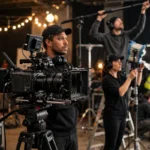
On set, your job is coverage: shoot every scene from enough angles that the editor (future you) can build it.
The minimum coverage for a dialogue scene:
- Wide shot establishing the space
- Over-the-shoulder from each character’s side
- Close-ups for key emotional moments
Shoot each setup multiple times. Actors get better on take three. And always — always — record 30 seconds of room tone (silence) at each location. You’ll need it in the edit.
For lighting, remember: the audience forgives a slightly soft image, but harsh ugly light makes everything look cheap. Bounce light off walls, shoot near windows, and avoid overhead fluorescents like they owe you money.
For sound: get the mic close. Monitor with headphones. If a take has great acting but a truck drove by, do it again — ADR (re-recording dialogue later) is a nightmare you don’t want.
Directing Actors (Even Non-Actors)
Directing is mostly about creating conditions where good performances happen:
- Give playable directions, not results. “Be sadder” is useless. “You just realized he’s lying — try to keep it together” gives the actor something to do.
- Keep takes short and specific. Long rambling direction confuses everyone.
- Protect your actors’ energy. Don’t burn their best emotional take on a rehearsal. Save it for when cameras roll.
- Watch the monitor, not the actor. You need to see what the camera sees.
With non-actors, simplify. Fewer lines, more reaction shots, and scenarios close to their real personality. Some of the most natural performances in indie film came from people who’d never acted before.
Editing: Where the Film Gets Made
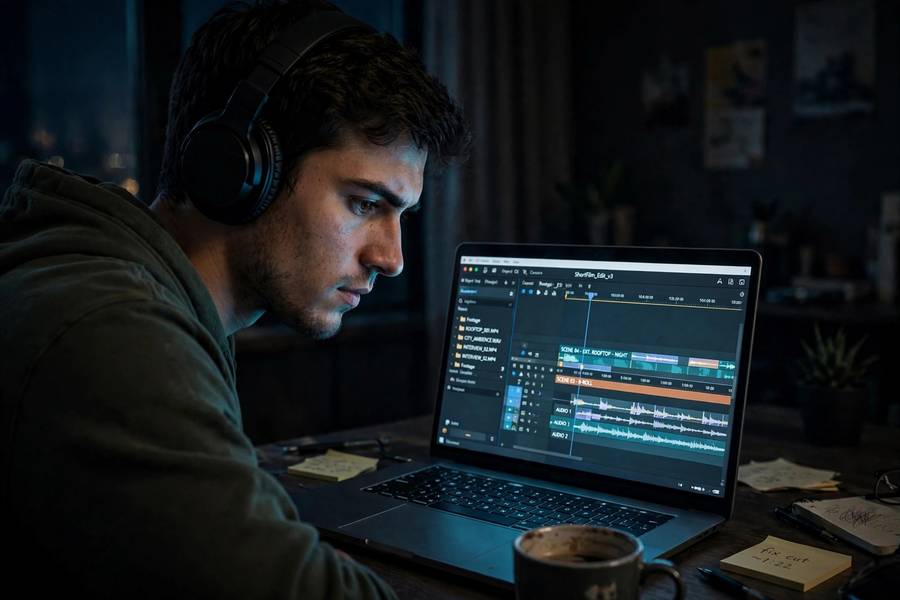
The old saying is true: you write the film three times — in the script, on set, and in the edit. The edit is where your short actually becomes a film.
Assembly first: put everything in story order. Watch it. It’s probably too long and a little boring. That’s normal.
Cut ruthlessly. Your favorite shot might need to go. If a scene doesn’t move the story or reveal character, it’s dead weight. Most first cuts are 30% too long — the film gets better every time you trim.
Pacing: vary your rhythm. Quick cuts for energy, longer holds for emotion. Watch your film with fresh eyes after a day away; you’ll instantly feel where it drags.
Learn the software properly. DaVinci Resolve is free and professional-grade. Spend a weekend learning it before you start cutting — fumbling with tools while making creative decisions is miserable.
Sound Design and Music
Here’s the secret that separates amateur shorts from professional-feeling ones: sound design. Audiences forgive visual imperfections, but thin, empty audio instantly signals “student film.”
Layer your sound: dialogue, room tone, foley (footsteps, doors, clothes rustle), ambience, and music. Each layer is subtle alone; together they create a world. Royalty-free music libraries (Artlist, Epidemic Sound, or YouTube’s audio library) give you legal tracks cheaply.
Mix so dialogue is always clear. Then watch your film on laptop speakers, phone speakers, and headphones — if it works on all three, your mix is solid.
Finishing and Sharing Your Film
Color correction (even basic) unifies your footage. Export in high quality. Make a poster — Canva is fine. Write a logline (one sentence describing your film) because festivals and platforms will ask for one.
Then share it:
- YouTube/Vimeo for general audiences
- Film festivals for credibility (start with local and genre festivals; FilmFreeway lists thousands)
- Your portfolio — this film is now proof you can finish something
Whatever happens, you made a film. Most people who say “I want to make movies” never get this far. Now make the next one — it’s always better.
Frequently Asked Questions
A beginner short can cost $0–$500. Most spend money on food for cast/crew, minor props, and festival submission fees. Your phone and free editing software handle the rest.
5–10 minutes is the sweet spot. Short enough to finish and afford, long enough to tell a real story. Under 5 minutes also works great for festivals and online audiences.
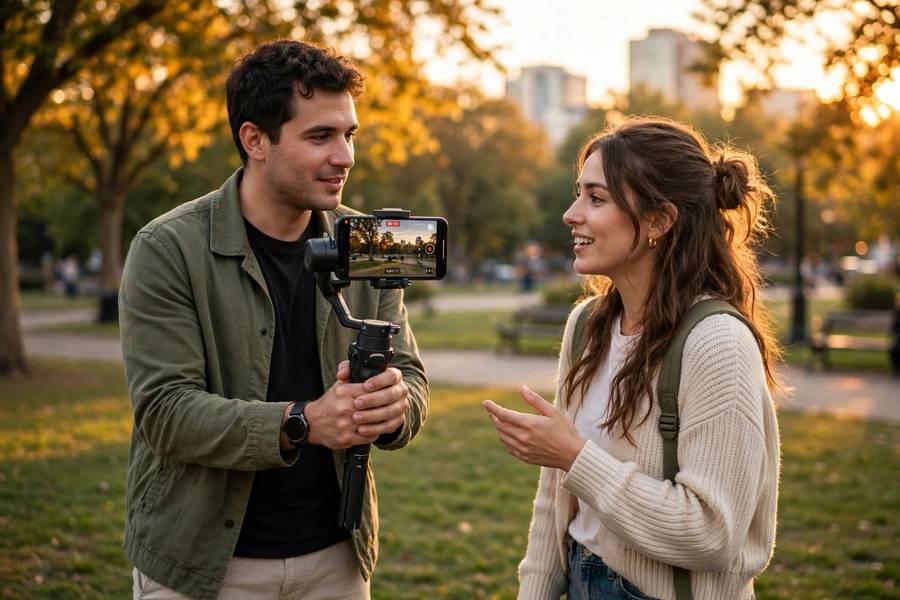
Absolutely. Modern phones shoot excellent video. Invest in sound (a cheap lavalier mic) and stabilization (tripod/gimbal) — those matter more than the camera itself.
On private property with permission, usually no. Public locations vary — many cities require permits for tripods and crews, even small ones. Check your local film office; guerrilla shooting risks fines and shutdowns.
DaVinci Resolve (free) is the best value — professional-grade at zero cost. iMovie or CapCut work for very simple projects. Avoid paid subscriptions until you’ve finished a film and know you’ll keep going.
Submit via FilmFreeway to festivals matching your genre and length. Start with smaller regional festivals where acceptance odds are better, and always follow each festival’s technical specs exactly.