
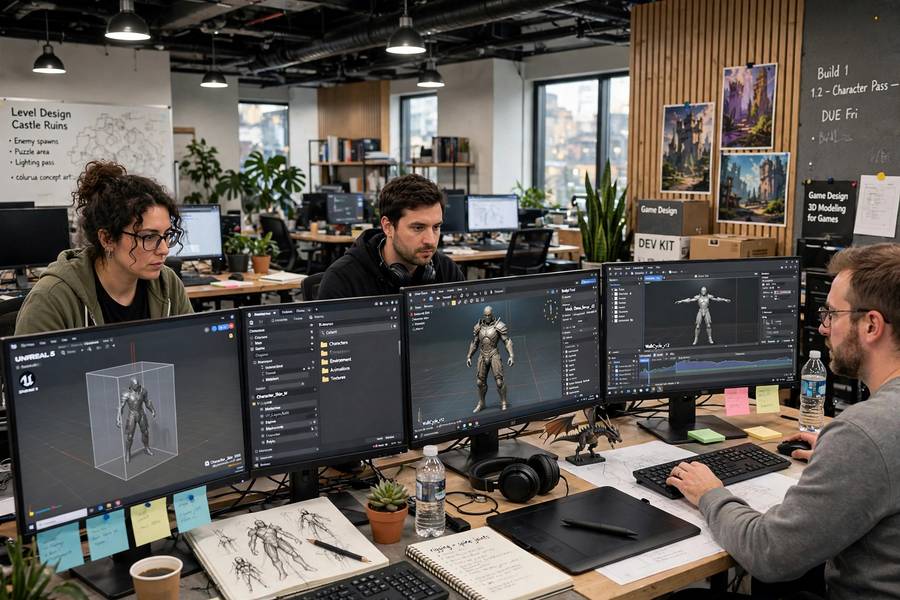
I have spent an embarrassing number of hours in video game worlds. But until I started digging into how they are actually built, I had no idea that the game I finished in a weekend took five years and hundreds of people to make. A modern blockbuster game is one of the most complex creative productions on Earth — part film set, part software project, part orchestra.
So how are video games made? Let me walk you through the full pipeline, from a vague idea to the launch-day patch. Fair warning: you will never look at a loading screen the same way again.
Table of Contents
- The Big Picture: How Long and How Many People
- Stage 1: Concept and Pre-Production
- Stage 2: Production — Building the Game
- Stage 3: Testing and Polish
- Stage 4: Launch and Beyond
- The Roles: Who Does What
- Indie Games vs AAA Blockbusters
- Picking Your Engine: Unity vs Unreal vs Godot
- How Games Get Funded and Published
- Three Real Timelines: How Long Great Games Actually Took
- Frequently Asked Questions
The Big Picture: How Long and How Many People
Numbers first, because they are wild:
- AAA blockbuster: 3–7 years, 200–2,000+ people, budgets of $100–500 million. Yes, some games cost more than Marvel movies.
- Mid-size (“AA”) game: 2–4 years, 50–200 people.
- Indie game: 1–3 years, 1–20 people. Some legendary indie games were made by literally one person.
The credits rolling after a big game are longer than most films’ — because games need everything films need (writing, art, music, acting) plus everything software needs (engineering, systems design, QA).
Stage 1: Concept and Pre-Production
Every game starts as a pitch: a few sentences describing the fantasy. “You are a ghost haunting feudal Japan” (that became a hit). “A farming sim with dungeons.” The best pitches describe a feeling, not just mechanics.
Then comes pre-production, the most important phase nobody sees:
- Prototyping. Developers build tiny, ugly test versions of the core gameplay — gray boxes, no art — to answer one question: is this fun? If the gray-box version is not fun, no amount of graphics will save it. Bad ideas die here, cheaply.
- The design document. The game’s bible: mechanics, story outline, level structure, art direction. It evolves constantly, but it keeps hundreds of people aligned.
- Vertical slice. A small, polished sample of final-quality gameplay — one level that looks and plays like the finished game. Studios use it to prove the vision (and to secure funding).
Pre-production can take a year or more. Rushing it is the classic cause of development disasters.
Stage 2: Production — Building the Game
This is the long haul — years of parallel work across disciplines:
Design
Game designers define the rules: how movement feels, how difficulty ramps, how levels are structured, how the economy balances. Level designers architect individual spaces — every corridor in a shooter, every puzzle room, is deliberately crafted and iterated dozens of times.
Art
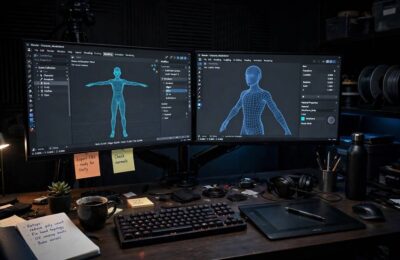
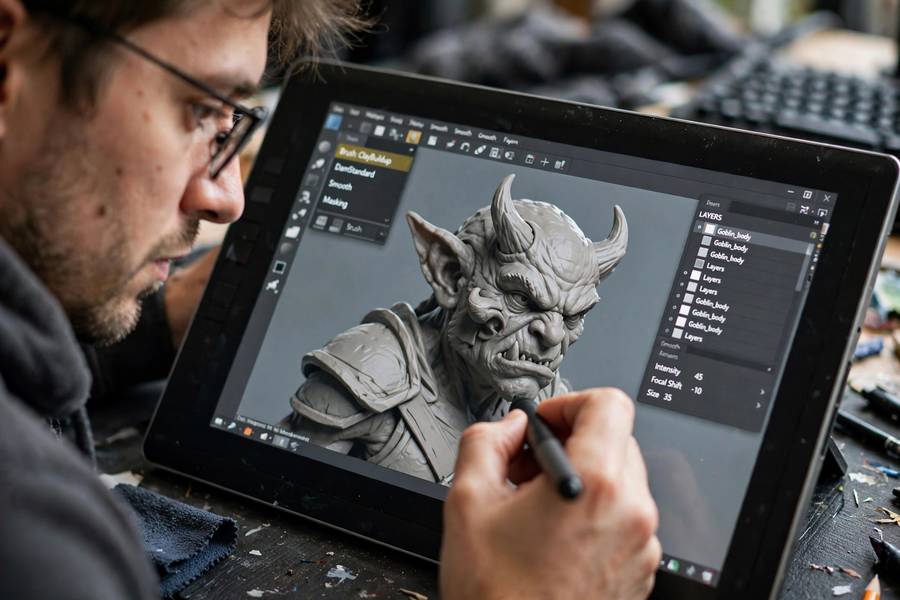
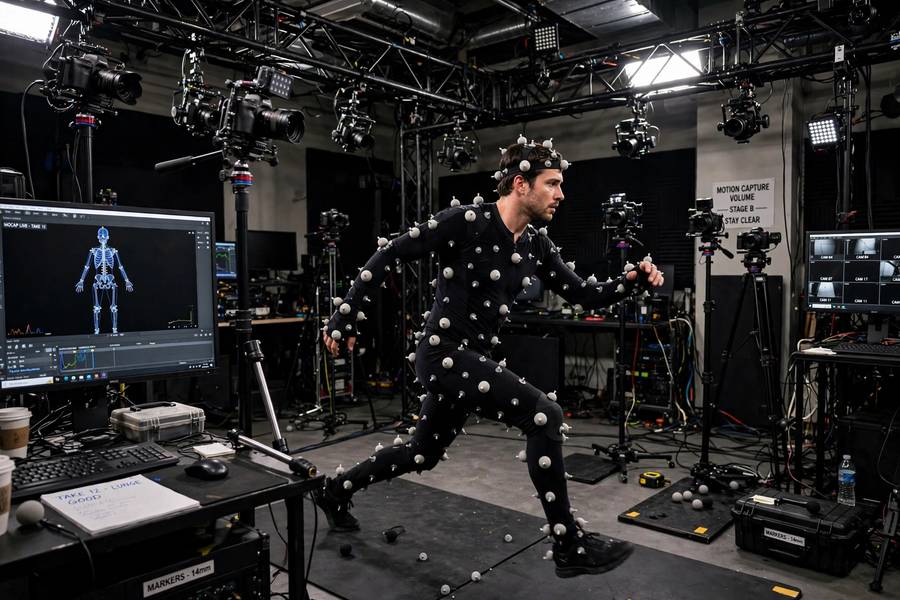
Concept artists paint the visual targets. 3D modelers build characters and environments polygon by polygon. Texture artists paint surfaces. Animators make it all move — increasingly via motion capture, where actors in sensor suits perform movements that get mapped onto digital characters. A single main character can take months.
Engineering
Programmers build the game in an engine (Unity, Unreal Engine, or proprietary tech). Engine programmers handle graphics and physics; gameplay programmers implement mechanics; AI programmers make enemies behave intelligently; network engineers make multiplayer work. Game code is among the most performance-demanding software written — it must render a complex 3D world dozens of times per second without stuttering — targets vary (30, 60, or 120fps) by game and platform.
Audio
Composers score adaptive music that shifts with gameplay. Sound designers create thousands of effects — every footstep surface, every weapon, every ambient hum. Voice actors record dialogue, often performing scenes alone in a booth reacting to nothing. Good audio is half the immersion; players only notice it when it is bad.
Writing
Narrative designers and writers craft story, dialogue, quests, and lore. The best game writing accounts for player agency — the story must work whether you rush the main quest or spend 40 hours fishing.
Stage 3: Testing and Polish
Games are tested more brutally than almost any other product:
- QA testers play the same sections hundreds of times hunting bugs — collision errors, broken quests, crashes. A big game can log 100,000+ bugs before launch.
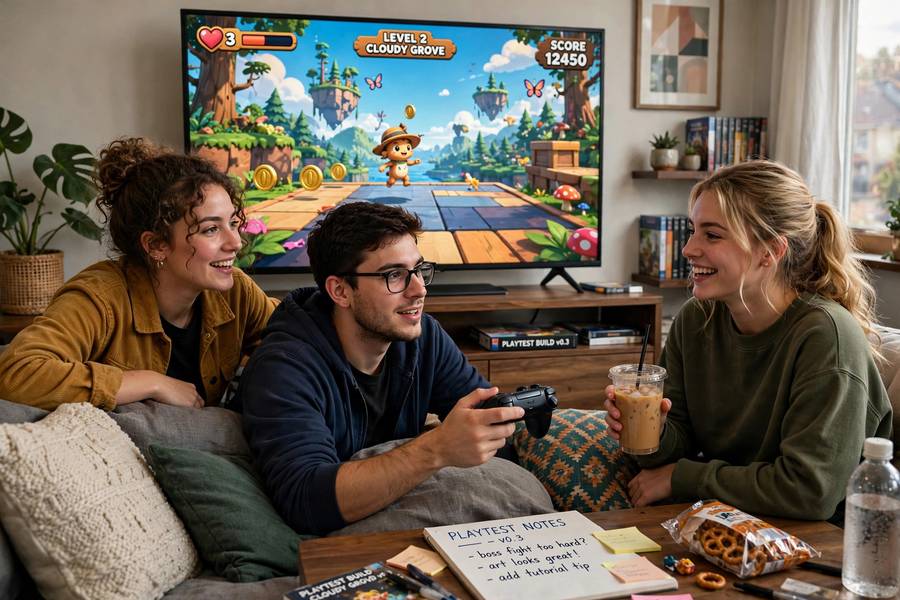
- Playtesting with real players reveals what QA cannot: is this level fun? Confusing? Too hard? Developers watch silently as players struggle with things the team thought were obvious — humbling and essential.
- Optimization. Making it all run smoothly on target hardware, including consoles with fixed specs and the infinite variety of PCs.
- Certification. Console makers (Sony, Microsoft, Nintendo) require games to pass technical certification before release.
The infamous “crunch” — brutal overtime before launch — lives in this phase. The industry is slowly reckoning with it, but it remains common.
Stage 4: Launch and Beyond
Launch day is not the finish line anymore:
- Day-one patches fix the bugs found after the discs were printed (or the download went live).
- Live service games (Fortnite, Genshin Impact) are never “done” — teams ship new content for years.
- Post-launch support includes balance patches, DLC expansions, and community management.
- Then, while players enjoy the game, much of the studio has already moved to pre-production on the next one.
The Roles: Who Does What
A quick cheat sheet for the credits scroll:
| Role | Does what |
|---|---|
| Game Director | The vision-holder; final calls on design |
| Producer | Schedules, budgets, keeps the machine running |
| Game Designer | Rules, systems, levels, balance |
| 3D Artist / Animator | Everything you see moving |
| Engine Programmer | Graphics, physics, performance |
| Gameplay Programmer | Mechanics and interactions |
| Composer / Sound Designer | Everything you hear |
| QA Tester | Breaks the game professionally |
| Community Manager | Talks to players, absorbs feedback |
Indie Games vs AAA Blockbusters
Indie development is the same pipeline, compressed — but compression changes the job completely. On a tiny team, the same person makes the trade-offs a AAA studio debates in meetings: cut this feature or ship late? Constraints breed creativity: some of the most innovative games ever came from tiny teams that could not compete on graphics, so they competed on ideas. But “same pipeline” hides how differently the industry’s tiers actually operate. Here is the honest comparison.
| Tier | Team size | Budget (approx.) | Timeline | How the pipeline differs |
|---|---|---|---|---|
| Indie | 1–20 people | $0–$500k | 1–3 years | Everyone wears five hats; asset stores replace departments; QA is friends and Discord; the vertical slice often is the game |
| AA / mid-size | 50–200 people | ~$10–50M | 2–4 years | Specialized departments return; full mocap and orchestras usually still out of reach; publishers often fund this tier |
| AAA | 200–2,000+ | ~$100–500M+ | 3–7 years | Dedicated cinematics, audio, and localization teams; certification on every platform; marketing can rival the production budget |
| Mobile free-to-play | 10–100 people | Varies wildly | 1–2 years, then years of live ops | Design revolves around retention and monetization; “soft launch” replaces much traditional QA; user-acquisition ad spend is a core budget line |
Indie is where the pipeline compresses hardest. The tools are the great equalizer — free engines, asset stores, and middleware mean a team of five can produce what once took fifty. The weakness is everything around the game: almost no marketing budget, minimal QA, and discoverability left to algorithms and luck.
AA is the sweet spot for creative risk. Specialized artists, programmers, and designers return, but budgets still force discipline — enough money to execute a vision properly, not enough to survive a two-year delay. Publishers love this tier because the downside is survivable.
AAA industrializes the pipeline. Hundreds of specialists, motion-capture stages, orchestras, localization into a dozen languages, certification on every console. The upside is spectacle nobody else can match; the downside is that one bad bet can cost nine figures, which is why AAA plays it safe with sequels and proven formulas.
Mobile free-to-play is almost a different industry wearing the same clothes. The game is a service from day one: soft-launched in smaller markets to tune the economy, then marketed with user-acquisition spending that can dwarf development costs. Success is measured in retention curves, not review scores.
If you have ever dreamed of making one, the barrier is lower than ever: free engines (Unity, Godot), endless tutorials, and asset stores for art and sound. The hard part was never the tools — it is finishing.
Film fans will recognize the parallel crafts — how movies are made covers the cinematic side, and filmmaking tips apply surprisingly well to game cinematics.
Picking Your Engine: Unity vs Unreal vs Godot
Your engine choice shapes everything downstream — what your game can look like, who you can hire, and how much it costs to ship. The good news: the big three are all free to start, so the choice is about fit, not access.
Unity. The indie and mobile workhorse. You code in C#, the asset store sells you art, sound, and systems you cannot afford to build, and exporting to phones, consoles, and PC is mature. It is free to start, with paid tiers once your revenue or funding crosses a threshold — check the current terms before you commit, because they have changed before.
Unreal Engine. The high-fidelity choice — the engine behind many of the best-looking games on PC and console. You get C++ plus Blueprint visual scripting, and Epic’s long-standing deal is generous: free to start, with a 5% royalty that only kicks in after your game’s first $1 million in lifetime gross revenue. For teams chasing cinematic visuals, it is the default.
Godot. Free and open source under the MIT license — no royalties, ever, and you can modify the engine itself. GDScript is friendly to learn, C# is supported too. The ecosystem is smaller than Unity’s or Unreal’s, but for 2D games and solo developers it is a beloved, zero-cost start.
| Engine | Best fit | Language | Cost model (approx.) |
|---|---|---|---|
| Unity | Indie, mobile, 2D/3D | C# | Free to start; paid tiers at higher revenue |
| Unreal Engine | High-fidelity PC/console | C++ / Blueprints | Free; 5% royalty after $1M lifetime revenue |
| Godot | Solo/small teams, 2D | GDScript / C# | Free, open source, no royalties |
Then there are proprietary engines — the in-house tech at big studios. You will only touch these as an employee, which is fine: learning one commercial engine thoroughly transfers to the others. Pick the engine that fits your game’s scope and your team’s skills, not the one with the flashiest demo reel.
How Games Get Funded and Published
A finished game still needs money to reach players. Four routes dominate:
- Self-publishing. You fund it yourself and sell on digital storefronts. You keep creative control and a bigger revenue share — but you also pay for everything, and discoverability is brutal: thousands of games launch every year. Platform holders take roughly a 30% cut of store sales, the long-standing industry split, so budget for that.
- Publisher deals. A publisher funds development (usually in milestone payments) and brings marketing, QA, localization, and platform relationships. In exchange they take a large revenue share and often a say in creative decisions — sometimes the IP itself. Read every contract twice.
- Early Access and crowdfunding. Crowdfunding platforms let players fund the dream upfront. Early Access goes further: you sell the unfinished game, and player revenue plus feedback funds the rest of development. It works brilliantly when the core is already fun; it backfires when it is not.
- Platform holders. Sony, Microsoft, and Nintendo fund or co-fund games in exchange for exclusivity or launch windows, and subscription services pay for day-one catalog placements. One deal here can fund a whole studio — and lock your game to one ecosystem.
Most indies mix and match: savings plus Early Access, or a publisher for console ports only. The funding model is part of the design — a game built for a publisher’s milestone schedule is a different game than one built for Early Access players.
Three Real Timelines: How Long Great Games Actually Took
The marathon: The Last Guardian, roughly nine years. Revealed in 2007 and released in 2016 — the game survived a console generation change, a studio restructuring, and a full engine transition. It is the famous cautionary tale about ambition outrunning planning, and proof that some visions only ship through sheer stubbornness.
The solo sprint: Stardew Valley, about four and a half years. Eric Barone built the entire game alone from around 2012 to its 2016 release — code, art, music, everything — while working a day job early on. It went on to sell tens of millions of copies. The lesson is not “anyone can do it” but “ruthless scope discipline plus one clear vision can beat a hundred-person team.”
The pivot: Fortnite, about six years to its breakthrough. Epic started work around 2011 on a co-op survival game; it entered early access in 2017. The battle-royale mode that made it a phenomenon was reportedly built in a matter of months as an experiment — then the entire company reorganized around it, and it became a live-service game still running nearly a decade later. Sometimes the game you ship is not the game you planned.
The pattern across all three: the timeline was set by scope and surprises, not by headcount. A small team with a tight idea can ship in a few years; a giant team chasing a moving target can take the better part of a decade.
How to Get Into Game Development
Interested in joining the industry? Build a portfolio, not just a resume — one finished small game impresses employers more than a degree alone. Learn an engine (Unity for versatility, Unreal for high-end graphics, Godot for a free open-source start), participate in game jams (48-hour game-making events that force you to finish), and specialize: programming, art, design, audio, or QA. The barrier to entry has never been lower — the tools are mostly free and the community is enormous.
Frequently Asked Questions
In four stages: concept/pre-production (prototyping the fun), production (design, art, code, audio built in parallel over years), testing/polish (QA, playtesting, optimization), and launch plus ongoing support.
AAA blockbusters take 3–7 years with hundreds to thousands of people; mid-size games 2–4 years; indie games 1–3 years with small teams. Timelines depend on scope more than anything else.
Game engines like Unity, Unreal Engine, and Godot handle rendering, physics, and core systems. Artists use tools like Blender, Maya, and Substance; programmers typically work in C++ or C#.
Yes — acclaimed indie games have been made solo. Free engines, tutorials, and asset stores lowered the barrier enormously. The challenge is scope discipline and finishing, not access to tools.
Software framework providing core game systems — 3D rendering, physics, audio, input handling — so developers build the game rather than reinventing fundamentals. Unity and Unreal Engine dominate; Godot is the leading free open-source option.
Modern games combine film-level art, music, and acting with extremely demanding software engineering, all of which must interact flawlessly in real time. Content volume is huge — hundreds of hours of gameplay — and everything must be tested brutally before release.