
Every anime episode — even a mediocre one — represents thousands of hours of skilled labor under schedules that would make a Hollywood producer weep. A standard episode holds 3,000–4,000 drawings, produced by dozens of artists in weeks. The miracle isn’t that some anime looks incredible. It’s that any of it gets finished.
So how is anime made? From planning and scripting through storyboards, key animation, in-betweening, coloring, compositing, and sound — funded by a production committee, not a single studio. Here’s the whole machine, stage by stage, including the parts the industry would rather you didn’t think about.
Table of Contents
- How Is Anime Made? The Pipeline at a Glance
- Stage 1: Planning, Committees, and Money
- Stage 2: Script and Storyboard (Where the Anime Is Really Made)
- Stage 3: Layouts, Key Animation, and Sakuga
- Stage 4: In-Betweening, Coloring, and Backgrounds
- Stage 5: Compositing, the Digital Finish
- Stage 6: Sound, Voice Acting, and Music
- Why the Schedule Is Always Brutal
- Frequently Asked Questions
How Is Anime Made? The Pipeline at a Glance
The big picture first — anime differs from Western animation structurally:
- Limited animation as philosophy. Fewer drawings per second than Disney-style full animation — often 8–12 fps instead of 24, with held poses and speed lines doing narrative work. Not (just) cheapness; an aesthetic. Anime learned to make stillness dramatic.
- The production committee system. A committee (seisaku iinkai) of companies — publisher, network, merchandise maker, music label — splits costs and profits. The studio is usually a hired contractor, not the owner. This shapes budgets and creative control.
- Source material pressure. Most TV anime adapts manga or light novels with existing fanbases: fixed expectations, fixed designs, a calendar tied to the source’s popularity. Original anime is rarer and riskier.
- The weekly grind. Seasons air weekly while later episodes are still in production. No “finished before premiere” safety net. Episodes routinely complete days — sometimes hours — before broadcast.
With that context, here’s each stage.
Stage 1: Planning, Committees, and Money
Every anime starts as a business proposal, not an artistic vision. A producer assembles a production committee: the manga publisher (who owns the IP), a TV network or streamer (the slot), a merchandise company, a music publisher. Each invests; each takes a cut of their domain.
The animation studio — Bones, MAPPA, Ufotable, whoever — is typically contracted for a fixed fee per episode. The part that matters: the studio usually doesn’t own the anime it makes. Profit participation is rare. Legendary studios animate global hits and still struggle financially — the committee captures the upside.
Budgets are smaller than you’d think: roughly $150,000–$300,000 per TV episode, versus $1 million+ for prestige Western animation. The entire model is doing more with less — which makes the highs (a Demon Slayer episode, a Mob Psycho fight) more impressive, and the labor problems more structural.
Planning also locks episode count, broadcast slot, key staff, and the adaptation range. A story needing 24 episodes but getting 12 will feel rushed no matter the talent.
Stage 2: Script and Storyboard (Where the Anime Is Really Made)
Ask veteran directors where an anime is “really” made and most say the same thing: the storyboard.
The script comes first. The series composer (the head writer, not a music role) breaks the story into episodes; scriptwriters draft each one — dialogue, action, structure. If you’ve studied how to write a screenplay, the fundamentals transfer — anime scripts just specify visual information more densely.
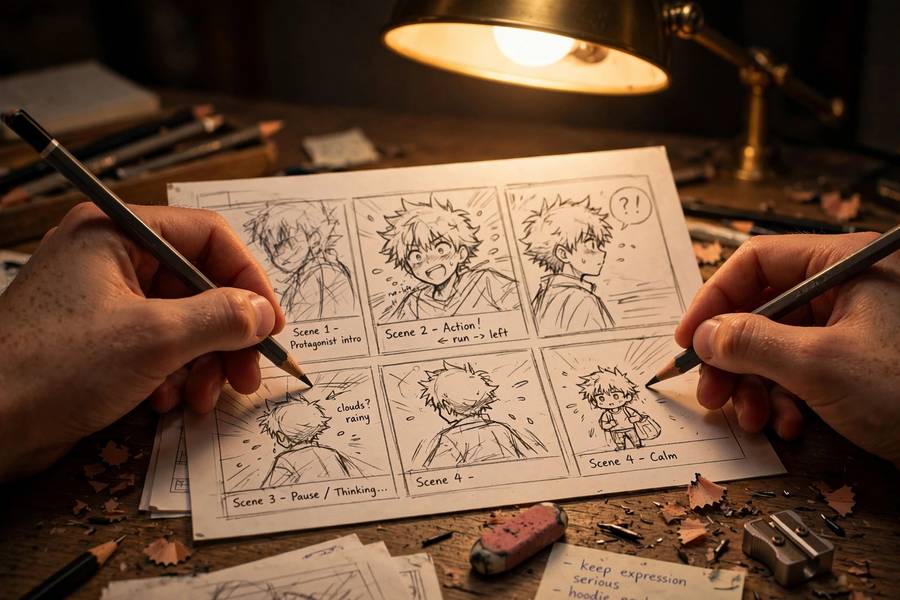
The storyboard (ekonte) is where the episode is truly designed: 300+ panels per episode covering camera angle, poses, timing, dialogue, sound. It determines pacing, composition, emotional emphasis — everything the audience feels. Great anime directors are great storyboard artists first. Mediocre animation of a brilliant storyboard can still be great. The reverse is almost never true.
The storyboard also allocates the animation budget: which cuts get lavish key animation, which survive on limited movement — the “sakuga” moments versus talking heads. Knowing where to spend your drawings is TV anime’s hidden craft.
Layouts follow: detailed compositions fixing exactly where everything sits in frame. Layout artists are the unsung heroes — their drawings set the episode’s quality ceiling.
Stage 3: Layouts, Key Animation, and Sakuga
Here’s where drawings multiply.
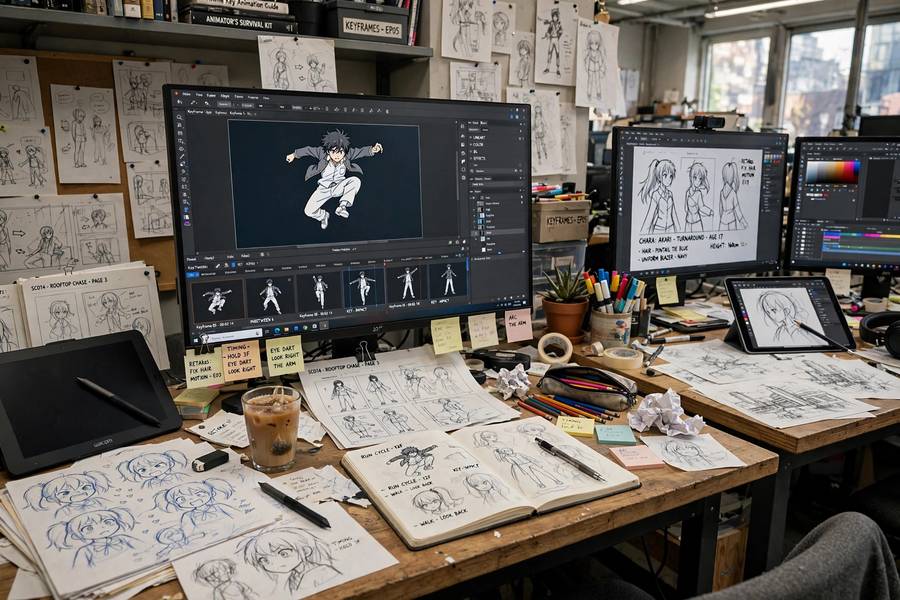
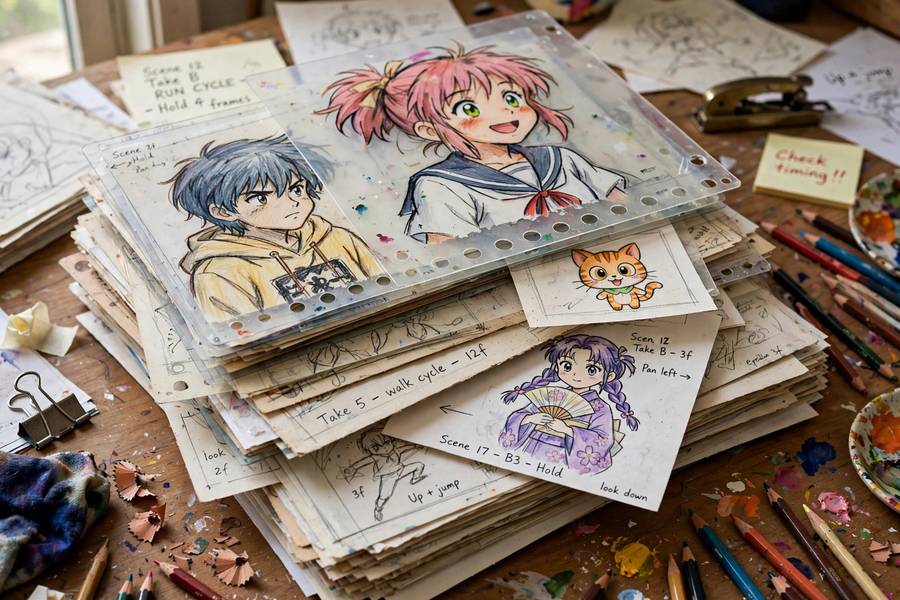
Key animation (genga). Key animators draw each cut’s essential poses — and more importantly, its timing: how many frames a movement takes, which decides whether a punch feels weighty or floaty, a glance tender or cold.
This is where stars are born. Celebrated “sakuga” artists — animators fans track by name, like Yutaka Nakamura of impact-frame fame — carry reputations the way cinematographers do in live action. “Great sakuga” means key animation that was inventive, expressive, beyond baseline.
The sakuga economy. TV anime can’t afford great key animation in every cut, so productions concentrate talent on key moments — fights, emotional climaxes — and economize elsewhere. Smart directors design around this: quiet dialogue scenes needing few drawings, saving budget for the two minutes that matter. A “talking heads” episode followed by an explosive one is resource allocation, not laziness.
Second key animation (daini genga). Senior animators’ rough keys get cleaned and refined by second key animators — division of labor keeping quality consistent when stars are spread thin.
Honesty about conditions: key animators are freelancers paid per cut, at rates barely moved in decades. Celebrated artists often earn less than office workers. The beauty on screen is subsidized by passion and, frankly, exploitation. The labor crisis starts here.
Stage 4: In-Betweening, Coloring, and Backgrounds
In-betweening (douga). In-betweeners draw the intermediate frames between key poses — the connective tissue of movement. The least glamorous, lowest-paid animation work, increasingly outsourced to South Korea, China, and Southeast Asia. Thousands per episode; quality determines smoothness. Bad in-betweens make good keys look jerky.
Clean-up and coloring. Roughs become final line art, then digital color (the hand-painted cel era ended around 2000). Color is storytelling: Your Name’s saturated sunsets, Evangelion’s sickly greens, Mushishi’s watercolor softness. A series’ color script is as deliberate as live-action cinematography.
Backgrounds. Painted separately — traditionally by dedicated artists, now often digital. Great backgrounds do enormous narrative work: Ghibli’s lived-in clutter, dystopian geometry, Shinkai’s dreamlike skies. This is where “every frame a painting” actually comes from.
The digital transition is most complete here. Where how movies are made still involves cameras and sets, anime’s middle pipeline is almost entirely software. The hand-drawn line survives — nearly all anime is still drawn by human hands — but everything around it is digital.
Stage 5: Compositing, the Digital Finish
Compositing (satsuei — “photography,” a cel-era holdover) assembles the layers: character animation over backgrounds, plus digital effects — light blooms, speed lines, camera moves across flat artwork.
This is where modern anime gets its polish — or breaks. Good compositing adds depth: sunset glow, battlefield haze, the subtle drift that makes a still feel alive. Bad compositing is the “CGI looks pasted on” problem. Modern anime uses 3D CG extensively — vehicles, crowds, camera moves — and Ufotable blends it with 2D better than anyone. But cheap CG, stiff and frame-rate-mismatched, remains the medium’s most visible failure mode. Then the color grade, broadcast adjustments, delivery. The episode airing next week may have finished yesterday. Normal.
Stage 6: Sound, Voice Acting, and Music
Anime is visual, but sound is half the experience — produced distinctively.
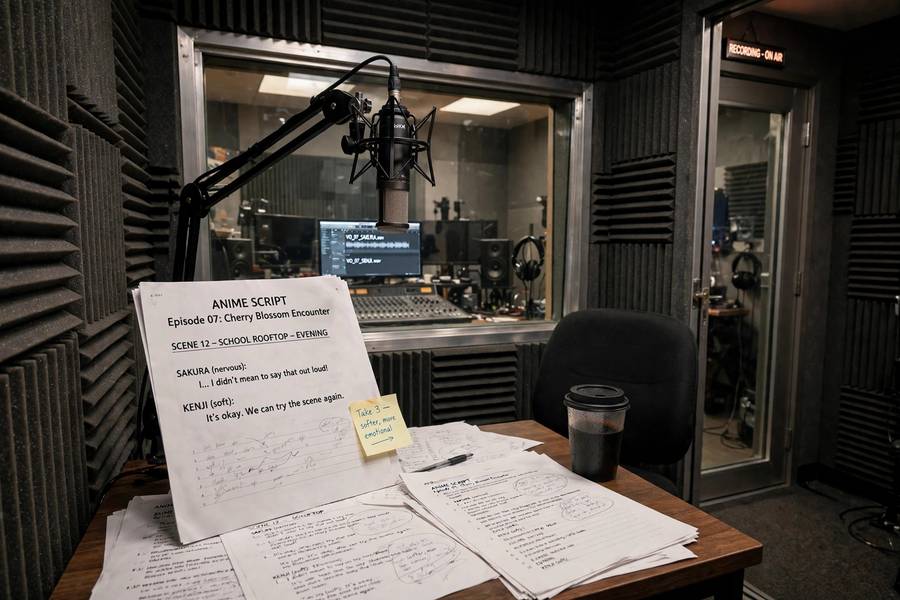
Voice recording (afureko). Unlike Western animation (voices first), anime typically records after animation is complete — actors performing to finished footage, partly schedule necessity, partly tradition. Seiyuu are genuine stars with fanbases and concerts. The craft is specialized: matching lip flaps drawn without the performance, conveying enormous emotion through voice alone. Great seiyuu carry scenes animation alone couldn’t.
Sound design. Heightened by tradition — exaggerated whooshes, crystalline chimes, bass drops on emotional beats. A big part of why anime feels like anime.
Music. From Hisaishi’s orchestral Ghibli scores (the gold standard) to J-pop themes that become hits themselves. The 90-second opening theme is a cultural institution — often more famous than the show. Composers like Kajiura, Sawano, and Ushio have signatures fans recognize instantly.
The mix balances dialogue, effects, music for broadcast. Then the episode ships — and the team starts the next one, already late.
Why the Schedule Is Always Brutal
Blunt version: the anime pipeline is structurally reliant on overwork.
The math doesn’t work. Fixed low budgets, rising quality expectations, immovable broadcast dates. The gap is filled by humans working nights, weekends, 18-hour days — freelancers paid per drawing, directors sleeping at the studio, productions held together by passion and youth.
This isn’t a new crisis; it’s the permanent condition. “Made by passion” is true — and a convenient cover for a model that underpays its most essential workers. Celebrated key animators have reported sub-poverty-line earnings. In-betweeners earn less. Outsourcing pushes the cheapest work to lower-wage countries.
Counterexamples exist: Kyoto Animation (salaried animators, in-house training) proves a better model is possible; Ufotable’s planning shows scheduling can substitute for crunch. Recent years brought more testimonials and unionization efforts.
If you love this medium, know what it costs. Every frame was drawn by a person — usually tired, usually underpaid, doing it because they couldn’t imagine anything else. The pipeline is a technical marvel and a human one. Support the studios, like KyoAni, that treat artists as irreplaceable. Some filmmaking tips cross the camera-animation divide; “don’t burn out your crew” shouldn’t need translation.
Frequently Asked Questions
Anime is made in stages: planning and funding by a production committee, scriptwriting, storyboarding (where the episode is truly designed), key animation, in-betweening, digital coloring, background painting, compositing, then voice recording, sound design, and music.
A single TV anime episode typically takes several weeks of active production across dozens of artists, with around 3,000–4,000 individual drawings. Because episodes air weekly while later ones are still unfinished, production runs on overlapping, extremely tight schedules.
Sakuga refers to exceptionally animated cuts — moments where key animators deliver inventive, expressive work beyond the baseline. Fans track star animators by name. Productions concentrate sakuga on key scenes because budgets can’t sustain it throughout an episode.
Yes — nearly all anime key animation is still drawn by human hands. But everything around the drawings is digital: coloring, backgrounds, compositing, and effects are done in software. The hand-painted cel era ended around 2000.
Fixed low episode budgets, rising quality expectations, and immovable broadcast dates create a gap filled by overwork. Most animators are freelancers paid per drawing at rates that have barely risen in decades. Studios like Kyoto Animation show salaried, sustainable models are possible.
A production committee (seisaku iinkai) of companies — publisher, broadcaster, merchandise maker, music label — splits costs and profits. The animation studio is usually a hired contractor paid a fixed fee, which is why studios rarely share in a hit’s profits.