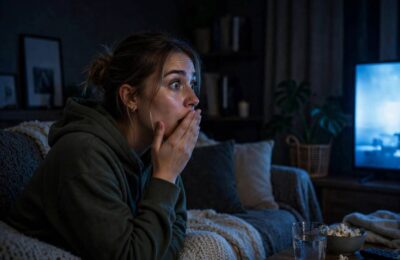

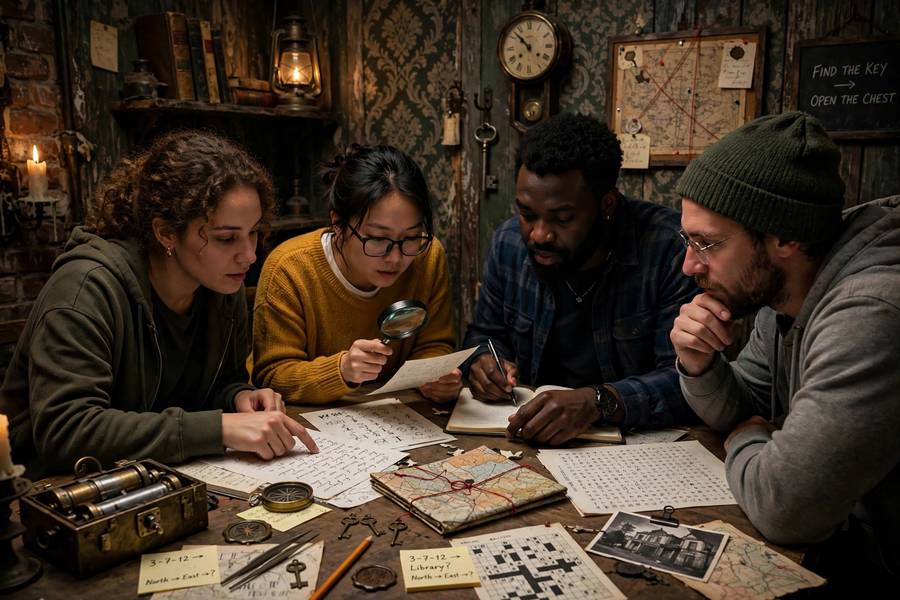
My first escape room experience: six friends, one room, sixty minutes, and me confidently announcing “I am great at puzzles” before spending forty minutes staring at a painting like it owed me money. We escaped with 90 seconds left. I have been hooked ever since.
If you have never been, here is the deal: escape rooms are live-action puzzle games where your team gets “locked” in a themed room and must solve a chain of puzzles to get out before time runs out. Simple concept, wildly fun execution. Here is everything you need to know before booking your first one.
For a deeper dive, see our guide to live streaming work.
Table of Contents
- The Basics: What Actually Happens
- The Types of Puzzles You Will Meet
- The Game Master: Your Invisible Lifeline
- Themes and Difficulty Levels
- How to Choose Your First Room
- Pro Tips for First-Timers
- Escape Room Etiquette
- Frequently Asked Questions
The Basics: What Actually Happens
You arrive with your team (usually 2–8 people) and get a briefing: the story, the rules, how hints work. Then you enter the room, the door closes behind you (do not worry — see the FAQ), and the clock starts: typically 60 minutes.
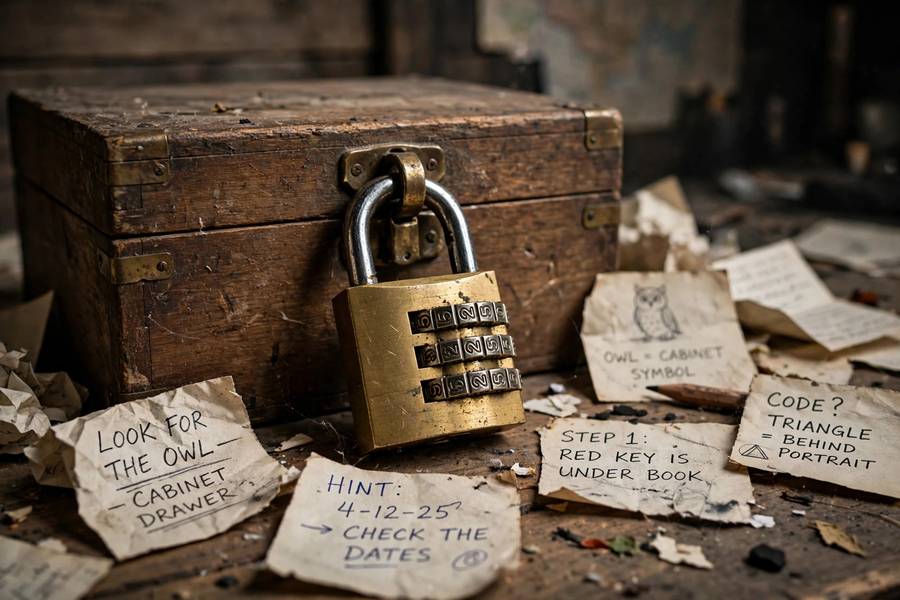
Inside, the room is full of puzzles chained together. Solving one reveals the next — a key opens a box containing a code that unlocks a drawer holding a clue pointing to a hidden compartment. Follow the chain to the final puzzle, “escape,” and win. Most rooms track your time on a leaderboard, because humans are competitive and venues know it.
You are never actually locked in — fire codes require an exit — but the immersion makes you forget that within minutes.
The Types of Puzzles You Will Meet
After a dozen rooms, you start recognizing the species:
- Combination locks. The bread and butter. Four-digit codes, directional locks, word locks. The code is always hidden somewhere in the room — your job is finding where.
- Hidden objects and compartments. False bottoms, magnetic catches, blacklight-revealed messages. Search everything (gently — more on etiquette later).
- Logic and pattern puzzles. Sequences, ciphers, matching games. The room usually teaches you the pattern if you look at the right clue.
- Physical puzzles. Aligning lasers, pouring water to the right level, arranging objects. Satisfying when they click.
- Tech puzzles. RFID sensors, pressure plates, light sequences. Modern rooms blend physical and digital beautifully.
- Meta puzzles. The final boss: combines clues from everything you have solved into one last answer. Teams that kept their solved clues organized crush these; teams that scattered everything suffer.
The golden rule: everything in the room is there for a reason, and red herrings are rare in good rooms. If you are stuck, you have missed something, not encountered something unsolvable.
The Game Master: Your Invisible Lifeline
Every room has a game master watching via cameras. They are not adversaries — they want you to have fun, which usually means escaping (or coming close). They deliver hints through a screen, speaker, or by slipping notes under the door.
Hint philosophy varies: some rooms give unlimited hints, others limit you to three. Use them. There is no prize for suffering in silence, and a well-timed hint at minute 40 beats a miserable slog. New players consistently underuse hints out of pride. Do not be those players.
Themes and Difficulty Levels
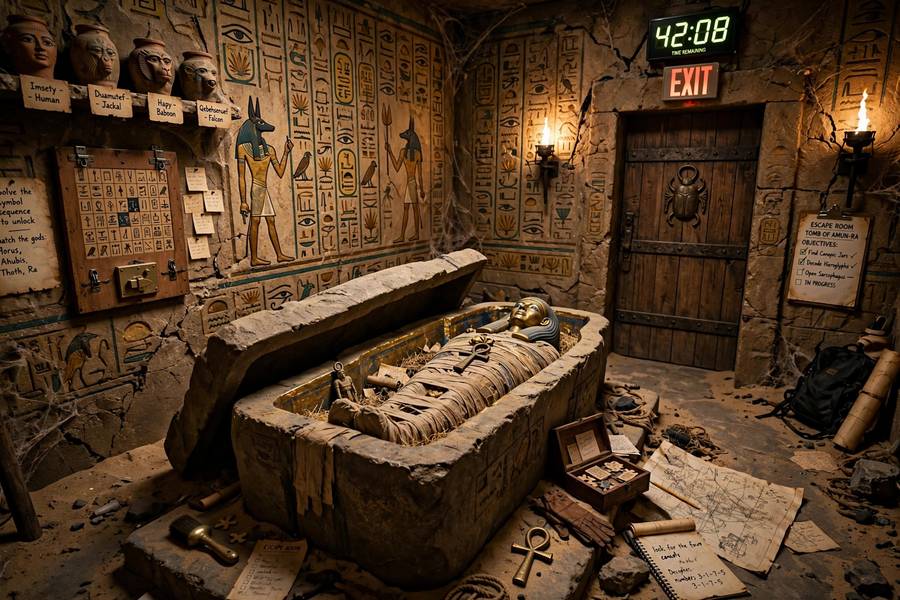
Themes range from the classic (prison break, Egyptian tomb, haunted mansion) to the creative (time machine, art heist, submarine, 1980s video store). The theme is mostly set dressing — the puzzles matter more — but great theming elevates the whole experience.
Difficulty is usually rated 1–5 or as an escape rate (“only 20% escape!”). For your first room:
- Pick beginner-friendly (high escape rate, 40%+).
- Pick a theme your group genuinely likes — engagement beats difficulty.
- Avoid horror themes for first-timers unless everyone is into it. Being scared makes you worse at puzzles (adrenaline narrows thinking).
Group size matters too: 4–6 is the sweet spot. Two people can feel overwhelming; eight people means someone is always standing around.
How to Choose Your First Room
- Read recent reviews, not just star ratings. Look for mentions of puzzle quality, game master helpfulness, and maintenance (broken props ruin rooms).
- Check the escape rate. 30–50% is ideal for beginners — challenging but winnable.
- Consider the venue’s age. Well-established venues with multiple rooms usually have better-designed experiences.
- Ask about private vs public booking. Private (just your group) costs more but is far better — strangers add chaos, not fun, for first-timers.
- Match the theme to the group. A birthday with kids? Pick the adventure theme, not the serial-killer basement.
Pro Tips for First-Timers
These are the lessons from my 90-seconds-left education:
- Announce everything you find. “I found a key!” said loudly beats a key discovered silently in someone’s pocket at minute 55. Communication is the actual game.
- Organize solved vs unsolved. Designate a spot for used clues and solved locks. Re-solving things wastes enormous time.
- Search thoroughly but gently. Look under, behind, inside — but never force anything. If it does not open easily, it is not meant to open that way.
- Do not overthink early puzzles. The first few are designed to be solvable. If your theory requires quantum physics, it is wrong.
- Split up, then regroup. Divide the room initially, then share findings every few minutes.
- Use the whole team. The quiet person staring at the poster might be the one who cracks it. Invite input explicitly.
- Watch the clock, not obsessively. Check every 15 minutes to pace yourselves.
Escape Room Etiquette
- Never force locks, props, or doors. Everything opens with finesse or not at all.
- Do not use phones (photos spoil puzzles for future players; some venues ban them outright).
- Climbing on furniture is usually prohibited — and unnecessary.
- Listen to the briefing. The “do not touch the red thing” rule exists because someone touched the red thing.
- Tip your game master if they were great. Seriously — they made your night.
Virtual and At-Home Escape Rooms
The format has gone digital: virtual escape rooms connect your group to a live game master via video call, who acts as your hands in a real room; print-and-play kits turn your living room into a puzzle space for a fraction of the cost; and fully digital games recreate the logic on screen. They lack the tactile immersion of physical rooms but win on price, accessibility, and remote-friendly play — great for distributed teams and far-flung friends.
We break down how video games are made step by step in a separate guide.
The Business of Escape Rooms
Behind the fun is a real industry: rooms cost tens of thousands to build, rely on game masters paid hourly, and live or die on throughput — most need 4–6 bookings daily to stay profitable. That is why you see upsells (extra hints, photos, merchandise) and corporate team-building packages, which are the most lucrative segment. The best operators reinvest constantly, retiring rooms every 2–3 years before regulars exhaust them. It is entertainment retail with puzzles instead of products.

Frequently Asked Questions
Your team enters a themed room with 60 minutes on the clock. You solve chained puzzles — each solution unlocks the next — to complete the final objective and “escape.” A game master monitors via camera and provides hints when asked.
No — fire codes require accessible exits, and you can leave anytime. The “locked in” feeling is theatrical immersion; the door is never truly sealed.
Four to six is the sweet spot for most rooms. Fewer can feel overwhelming; larger groups often leave people standing around. Book privately (just your group) for the best first experience.
Ask the game master for a hint — that is literally what they are there for. There is no penalty for pride-free hint-taking, and a timely nudge beats twenty minutes of frustration.
Only if you choose a horror theme. Most rooms are adventure, mystery, or heist themed with zero scares. Check the theme description and reviews before booking if anyone in your group is nervous.
Typically $25–40 per person for a 60-minute room, with private bookings costing more. It is one of the better entertainment values per hour — an evening out that is genuinely interactive.