

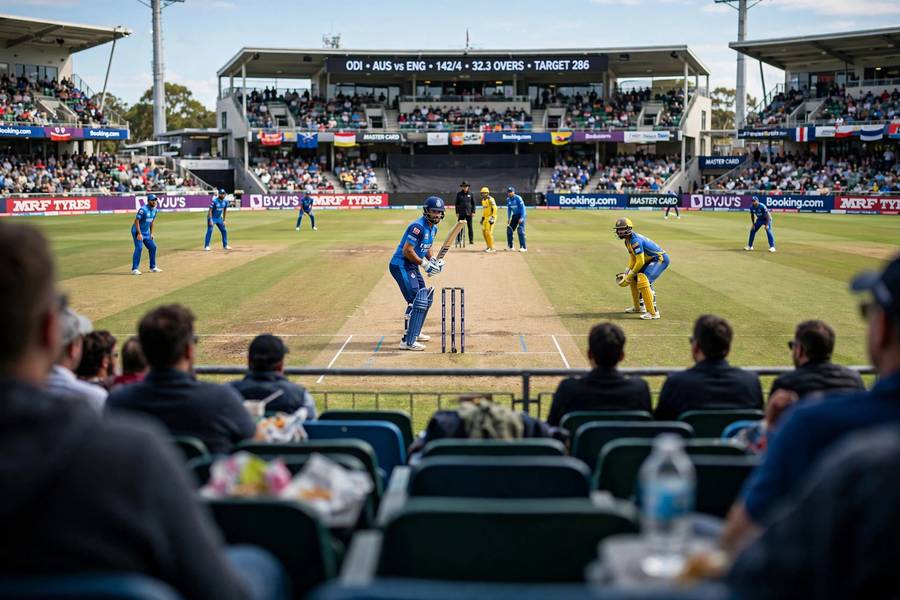
If someone invites you to watch cricket and your first thought is “I have no idea what’s happening,” this guide is for you. You don’t need the full 42 laws of cricket to enjoy a match — you need about ten concepts, and you can learn them in fifteen minutes.
I’m Ryan, and I went from cricket-confused to cricket-obsessed in a single T20 match. Here’s the fast track.
Table of Contents
- The 30-Second Version
- Two Teams, Two Jobs
- How Scoring Works
- How Players Get Out
- Overs: Cricket’s Clock
- The Three Match Lengths
- What to Watch For (The Fun Stuff)
- Your First Match: A Viewing Guide
- Frequently Asked Questions
The 30-Second Version
Two teams of 11. One team bats (tries to score runs), the other bowls and fields (tries to stop them and get them out). Then they swap. Most runs wins. That’s the whole game — everything else is detail.
If you want the full deep-dive afterward, the complete rules of pickleball show how another bat-and-ball-style sport structures its scoring for newcomers.
Two Teams, Two Jobs
At any moment, one team is batting and the other is fielding (which includes bowling — “bowling” is cricket’s word for pitching).
The batting team’s job: Score as many runs as possible. Two batters are on the field at a time, standing at opposite ends of the 22-yard pitch.
The fielding team’s job: Get the batters out and keep the run total low. One player bowls (delivers the ball toward the stumps); the other ten spread out to field.
After the batting team’s turn (their “innings”) ends, the teams switch. In short formats, each team bats once. Simple.
The Field and Equipment
Before the rules fully click, it helps to know what you’re looking at. Here’s the gear and the ground, minus the jargon:
The pitch: A 22-yard (20.12 m) strip in the center of the field. This is where all the action happens — the bowler delivers from one end, the batter stands at the other.
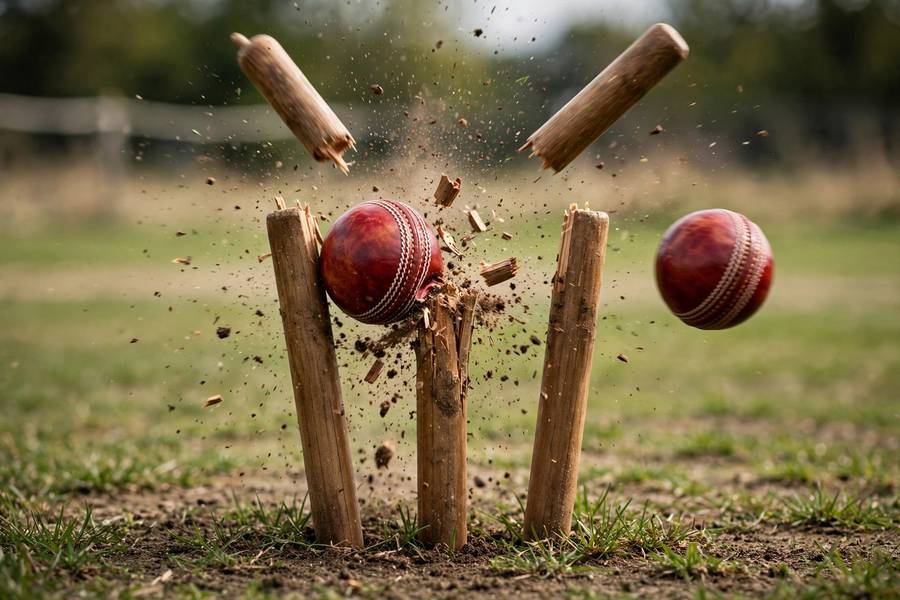
The stumps: Three wooden posts at each end of the pitch, topped by two small bails. Knock the bails off with the ball and the batter is out (bowled). These are the “wickets” in the physical sense.
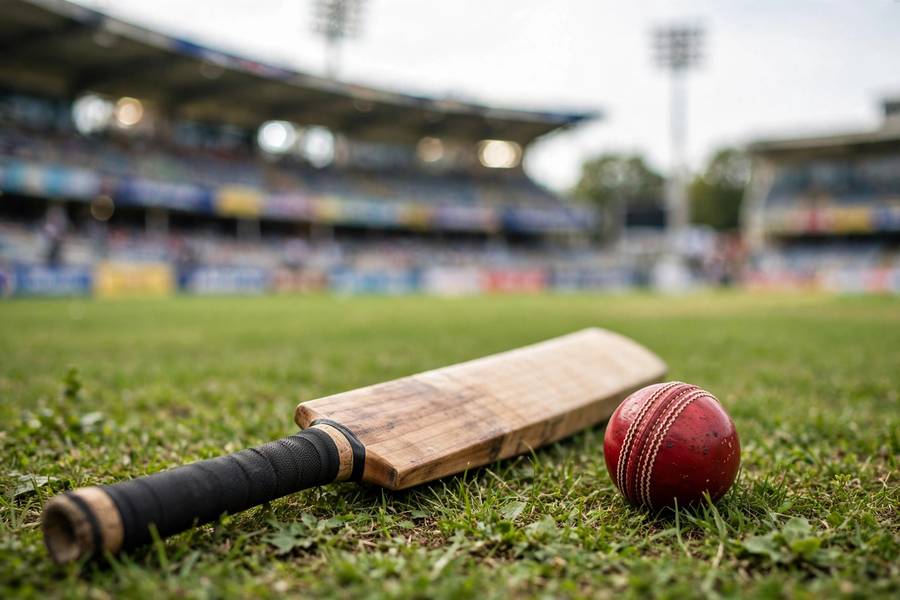
The ball: Hard leather, slightly smaller than a baseball, with a prominent seam. New balls swing through the air; old balls spin and reverse-swing. The ball’s condition is a whole strategic subplot.
The bat: Flat-faced wooden blade with a handle — wider than a baseball bat, designed for both defense and attack.
The field: A large oval (no fixed dimensions — each ground differs), with a boundary rope marking the edge. Hit the ball over the boundary on the bounce: 4 runs. Over it on the full: 6 runs.
Protective gear: Batters wear pads, gloves, and helmets — a 90 mph ball aimed at your head concentrates the mind wonderfully.
How Scoring Works
Runs — cricket’s points — come in three flavors:
Running (1–3 runs): The batter hits the ball and the two batters sprint to swap ends. Each completed swap = 1 run. They can keep going for 2 or 3 if the fielders are slow getting the ball back.
Boundaries:
– Ball reaches the boundary rope on the bounce = 4 runs (automatic, no running needed)
– Ball clears the rope on the full (like a home run) = 6 runs
Extras (free runs): The bowling team can gift runs through illegal deliveries — a wide (ball too far from the batter to hit) or a no-ball (bowler oversteps the line, among other offenses) each add runs to the batting team’s total.
The score is shown as runs/wickets — e.g., “142/3” means 142 runs scored, 3 batters out. The second number is just as important as the first: a team at 142/3 is in great shape; a team at 142/8 is hanging by a thread.
How Players Get Out
A batter is “dismissed” (out) in a few main ways. Learn these four and you’ll follow 95% of dismissals:
- Bowled — the ball hits the stumps (the three wooden posts) and knocks the bails off. The bowler beat the batter clean. Extremely satisfying to watch.
- Caught — a fielder catches the hit ball before it bounces. Like a fly out in baseball.
- LBW (leg before wicket) — the ball hits the batter’s leg when it would otherwise have hit the stumps. The most debated dismissal in cricket; even experts argue about these.
- Run out — a fielder breaks the stumps while the batters are mid-run and short of their ground. Like getting tagged out between bases.
Each team has 10 wickets (11 players, but the last batter has no partner). When the 10th wicket falls, the innings is over.

Overs: Cricket’s Clock
An over = 6 legal balls bowled by one bowler. After each over, a different bowler takes over from the other end.
Overs are how limited-overs cricket is measured: “20 overs per side” (T20) or “50 overs per side” (ODI). Commentators talk about the run rate — runs per over — which tells you the scoring pace. Need 60 runs from 30 balls (5 overs)? That’s a required run rate of 12 per over — very steep.
The last few overs of a close chase are the most exciting passage in all of team sports. The math is simple, the tension is unbearable, and the crowd knows exactly what’s needed off every single ball.
The Three Match Lengths
T20 — 3 hours. 20 overs per side. Maximum action, big sixes, constant drama. Start here. This is the format designed for new fans.
ODI — 8 hours. 50 overs per side. A full day’s story with ebbs and flows — the format of the Cricket World Cup (the tournament structure works like other World Cups).
Test — up to 5 days. No over limit. The traditional form, and an acquired taste — but the final day of a close Test, with a result hanging on every ball after five days of buildup, is genuinely one of sport’s great experiences.
What to Watch For (The Fun Stuff)
Now that you know the basics, here’s what makes cricket actually thrilling to watch:
- The death overs: The last 4–5 overs of a T20 innings, when batters swing at everything and bowlers try to survive. Chaos, sixes, wickets — everything happens at once.
- A bowler “on a hat-trick”: Three wickets in three consecutive balls. The crowd noise for the third ball is unreal.
- Spin bowling: Slow balls that turn sharply off the pitch, deceiving batters who look utterly foolish. It’s pitching as sleight of hand.
- A close chase: When the batting team needs, say, 20 runs off the last 12 balls, every delivery is a mini-drama. This is cricket’s equivalent of a two-minute drill.
- The crowd: Cricket crowds — especially in India, Pakistan, England, and Australia — are among the most passionate in sports. The atmosphere carries you even before you understand the tactics.
Your First Match: A Viewing Guide
Ready to watch? Here’s how to make your first match a good one:
Pick a T20. Three hours, maximum action, party atmosphere. International T20s or leagues like the IPL are perfect — the broadcasters explain basics for casual viewers, and the crowd energy carries you.
Watch with someone who knows the game. One knowledgeable friend transforms the experience. They’ll explain the weird bits in real time and point out what to watch. (Buy them a drink; they’re doing you a favor.)
Follow the score bug. The on-screen graphic shows runs/wickets, overs bowled, and the current run rate vs. required run rate. Once you can read that bug, you understand the match state at all times.
Don’t try to learn everything at once. Your first match: just track who’s winning and why. Second match: notice bowling changes and field placements. Third match: you’ll be explaining LBW to someone else. It compounds fast.
Embrace the rhythm. Cricket has natural ebbs — quiet overs building pressure, then an explosion of boundaries. The slow parts make the fast parts thrilling. Give it the full three hours before judging; the payoff structure rewards patience.
Key Umpire Signals to Know
Umpires communicate decisions with hand signals — learn these and you’ll follow the game without commentary:
- Both arms raised (index fingers up): SIX runs
- One arm waved across the chest: FOUR runs
- One arm raised straight up: OUT
- Arms outstretched horizontally: WIDE ball
- One arm bent, tapping the shoulder: NO-BALL
- Hands on knees, then raised: LEG BYE
- Tapping the wrist: New ball / time related
You don’t need to memorize them all — but recognizing OUT, FOUR, and SIX transforms watching. The crowd reacts to the signal before the replay confirms it, and now you’ll know why everyone’s standing up.
Fielding Positions: A Quick Tour
Cricket has the most colorful position names in sports, and they actually describe where fielders stand:
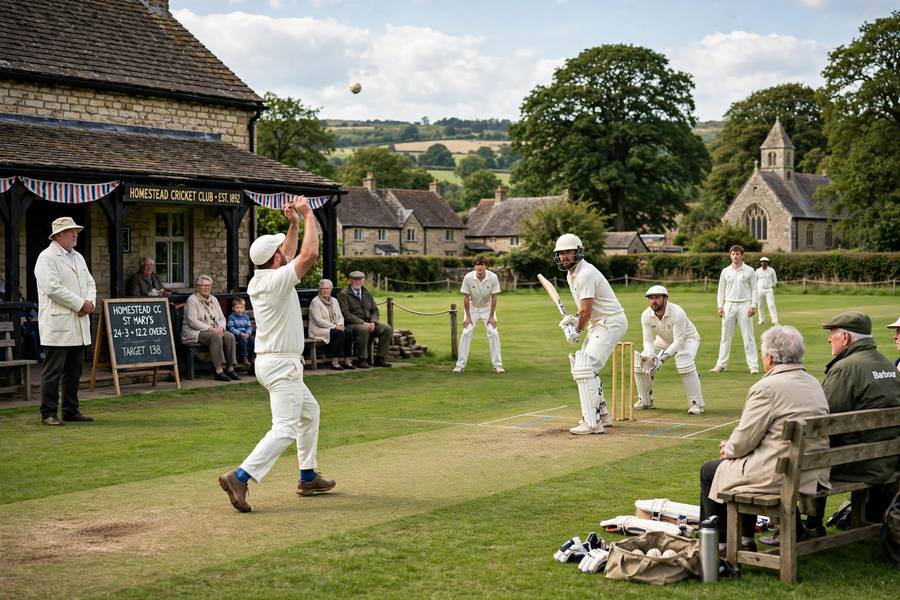
Behind the wicket (on the batter’s blind side): The wicketkeeper (like a catcher, crouched behind the stumps) and the slips — a row of catchers waiting for edges off the bat. First slip, second slip, third slip, then the gully.
In close: Silly mid-off, silly mid-on, short leg — “silly” because standing that close to a hard-hit ball is, frankly, silly. These are attacking positions for spin bowling.
The ring: Point, cover, mid-off, mid-on, midwicket, square leg — the infielders stopping singles and cutting off shots.
The boundary: Third man, fine leg, deep cover, long-on, long-off, deep midwicket — the outfielders patrolling the rope, stopping boundaries.
The captain moves these pieces constantly — sometimes every ball. Watching the field shift tells you what the bowler is planning: fielders crowding the leg side means short-pitched bowling is coming; a packed slip cordon means the bowler is hunting edges. Once you start reading the field, you’re watching cricket at a whole new level.
Common Terms Translated
Commentators will throw these at you from ball one — here’s your decoder ring:
- Wicket — has three meanings: the stumps themselves, a batter’s dismissal (“took 5 wickets”), or the pitch (“a tricky wicket”)
- Duck — dismissed for 0 runs. A “golden duck” is out first ball.
- Century — 100 runs by one batter in an innings. A landmark achievement.
- Maiden over — an over with no runs scored. A small victory for the bowler.
- Silly mid-off — a fielding position dangerously close to the batter. The names are half the fun.
- Yorker — a delivery aimed at the batter’s feet/toes. Nearly unplayable when nailed.
- Googly — a spinner’s deceptive delivery that turns the “wrong” way.
Frequently Asked Questions
Two teams of 11 take turns: one bats and scores runs, the other bowls and fields to get batters out. Most runs after both teams bat wins. Learn runs, wickets, and overs and you can follow any match.
It means the batting team has scored 142 runs and lost 3 wickets (3 batters are out). Since each team has only 10 wickets, the second number shows how much batting resources remain.
T20 matches last about 3 hours, ODIs about 8 hours, and Test matches up to 5 days. Beginners should start with T20 — it’s the fastest, most action-packed format.
An over is 6 legal deliveries bowled consecutively by one bowler. After each over, a different bowler bowls from the opposite end of the pitch.
T20: 20 overs per side, ~3 hours, maximum entertainment. ODI: 50 overs per side, ~8 hours, the World Cup format. Test: unlimited overs up to 5 days, the traditional and most strategic format.
Main ways: bowled (ball hits the stumps), caught (fielder catches before the bounce), LBW (ball hits the leg in front of the stumps), run out (stumps broken mid-run), or stumped (wicketkeeper breaks the stumps with the batter out of position).
Yes — in Test cricket, if five days pass without both teams completing their innings, the match is a draw. Limited-overs matches (T20, ODI) always produce a result, using a Super Over tiebreaker if scores are level.