


AI bias is one of those terms that gets thrown around constantly and explained rarely. I’ve tested enough AI systems to see bias show up in practice — sometimes subtly, sometimes embarrassingly — and I think most coverage either overstates it (“AI is racist!”) or dismisses it (“it’s just math!”). Both miss the point.
Here’s the honest version: what AI bias actually is, where it comes from mechanically, real cases where it caused harm, and what genuinely helps reduce it.
Contents
- The Plain Definition
- Where Bias Comes From: Three Sources
- Real Cases (Not Hypotheticals)
- Why “Just Remove the Sensitive Data” Doesn’t Work
- What Actually Reduces AI Bias
- The Limits of Technical Fixes
The Plain Definition
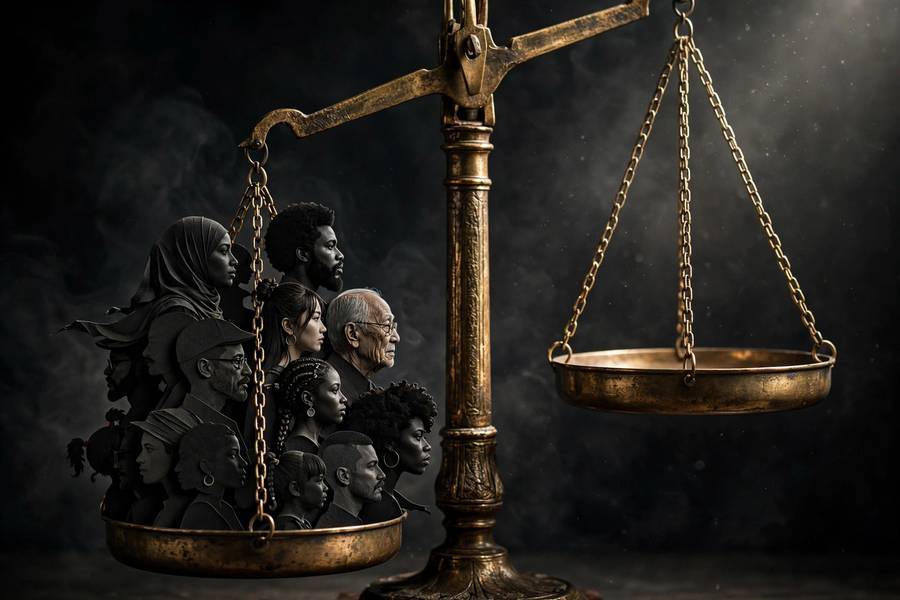
AI bias is when an AI system produces results that are systematically unfair to particular groups of people — consistently favoring some and disadvantaging others.
The key word is systematically. A model that makes random errors isn’t biased; it’s just inaccurate. A hiring tool that consistently ranks men above equally qualified women is biased. The unfairness has to be patterned, not occasional.
And here’s the part people miss: the model isn’t prejudiced. It has no beliefs. It’s a pattern-matching machine, and if the patterns in its training data reflect historical unfairness, the model will faithfully reproduce — and often amplify — that unfairness. The bias is in the data and the design choices, not in some digital bigotry.
Where Bias Comes From: Three Sources
In my experience testing systems, bias almost always traces to one of three places:
1. Biased training data
This is the big one. Models learn from historical data, and history is full of bias. Train a hiring model on a decade of a company’s hiring decisions, and if the company historically favored men, the model learns “male = good candidate.” It’s not making a moral judgment — it’s doing exactly what it was trained to do: find patterns in the data.
Language models absorb bias from text the same way. If training text associates “nurse” with “she” and “CEO” with “he” thousands of times, the model internalizes those associations. I’ve tested this directly with fill-in-the-blank prompts, and the stereotyped completions show up reliably.
2. Biased design choices
What the system is optimized for matters enormously. A classic example: a famous healthcare algorithm was trained to predict who needed extra care — but it used healthcare spending as a proxy for healthcare need. Because Black patients historically received less care (and thus less spending), the algorithm concluded they needed less help. The designers didn’t intend racism; they chose a convenient proxy variable that encoded it.
Other design choices that inject bias: which groups are represented in test sets, what counts as “accuracy” (overall accuracy can hide terrible performance on minorities), and where the decision threshold is set.
3. Deployment context
A model that’s fair in the lab can become unfair in the world. A facial recognition system tested mostly on light-skinned faces degrades on dark-skinned faces — not because anyone intended it, but because the test didn’t represent reality. A resume screener trained on tech-industry data misfires when applied to healthcare hiring.
This is why I always ask, when evaluating an AI product: “Tested on whom, and deployed on whom?” If those two groups differ, bias is likely. To understand the mechanics behind that pipeline, see how AI models are trained — the data stage is where most bias enters.
Real Cases (Not Hypotheticals)
These are documented, not speculative:
- Hiring: A major tech company’s experimental recruiting tool learned to penalize resumes containing the word “women’s” (as in “women’s chess club”) because its training data came from a male-dominated decade of hires. The company scrapped it.
- Criminal justice: The COMPAS recidivism tool, used in US courts, was found to falsely flag Black defendants as high-risk at roughly twice the rate of white defendants. It influenced real sentencing decisions.
- Facial recognition: Multiple studies found commercial systems had error rates under 1% for light-skinned men but over 30% for dark-skinned women. Several cities restricted police use as a result.
- Healthcare: The spending-proxy algorithm mentioned above affected care recommendations for millions of patients before researchers caught it.
- Advertising: Investigations found ad platforms’ optimization skewed job and housing ads by gender and race — the system “learned” who historically clicked and narrowed delivery accordingly.
Notice the pattern: in every case, the system was doing exactly what it was optimized to do. The unfairness was in what it was asked to optimize, or what data it learned from.

Why “Just Remove the Sensitive Data” Doesn’t Work
The naive fix — “don’t tell the model anyone’s race or gender” — fails for a reason that’s worth understanding. Models are excellent at finding proxies: seemingly neutral variables that correlate with the sensitive one.
Remove “race” from the data, and the model finds zip code. Remove zip code, and it finds shopping patterns, name etymology, school attended. In one famous case, researchers showed that even with sensitive attributes removed, models reconstructed them with high accuracy from “neutral” features.
This is sometimes called “fairness through unawareness,” and it’s been demonstrated to fail repeatedly. You can’t blind a pattern-matching machine by hiding one column of the spreadsheet.
What Actually Reduces AI Bias
The approaches with real evidence behind them:
Diverse, representative training data. The single highest-leverage fix. If your training data reflects the population the system will serve, many bias problems shrink dramatically. This is unglamorous data-collection work, not a clever algorithm — which is why it’s underinvested.
Fairness-aware training. Techniques that explicitly penalize the model during training when its errors fall unevenly across groups. This works, with a real tradeoff: you sometimes sacrifice a bit of overall accuracy for fairness. That tradeoff should be a conscious decision, not an accident.
Disaggregated evaluation. Test performance separately for each demographic group, not just overall. A model that’s 95% accurate overall but 60% accurate for one group is a biased model wearing an accurate costume. I consider this non-negotiable for any high-stakes system.
Human oversight on high-stakes decisions. For hiring, lending, criminal justice, and healthcare — AI should advise, humans should decide. And the humans need to understand the system’s limitations, not just rubber-stamp its outputs.
Ongoing monitoring. Bias drifts. A model that’s fair at launch can become unfair as the world changes around it. Deployed systems need continuous auditing, not one-time certification. For a broader sense of what these systems are capable of — and where else they can go wrong — see what AI tools can actually do.
The Limits of Technical Fixes
Here’s where I get honest about what the field can’t do yet:
Technical fixes can reduce bias, but they can’t resolve the underlying question of what “fair” means — because fairness itself has multiple mathematical definitions that contradict each other. You literally cannot satisfy them all simultaneously (this is a proven result, not an opinion). Choosing which definition to use is a values judgment, not an engineering one.
And some problems aren’t really AI problems. If historical hiring data reflects decades of discrimination, no amount of algorithmic cleverness produces a “fair” model from it — the data itself is the record of unfairness. Sometimes the right answer isn’t a better model; it’s fixing the underlying process the model learned from.
AI bias matters because AI systems now make or influence decisions about jobs, loans, healthcare, and freedom. Understanding where bias comes from — data, design, deployment — is the first step toward systems that are genuinely fairer, not just fair-sounding. For more explainers in this vein, browse our Artificial Intelligence guides.
A Closer Look: Hiring Algorithms
Hiring deserves a deeper look because it’s where most people will personally encounter AI bias — and where the dynamics are clearest.
The pitch is appealing: remove human prejudice from hiring by letting data decide. The reality, from every documented case I’ve studied: the algorithm learns from past hiring decisions, which encode decades of human bias. A model trained on a tech company’s historical hires — mostly men — learns that “male” correlates with “good hire.” It then penalizes resumes with women’s colleges, women’s sports, even the word “women’s.” This isn’t hypothetical; it’s exactly what happened with a well-known tech company’s recruiting tool, which was scrapped after the bias was discovered.
What makes hiring bias especially stubborn:
Feedback loops. If the system filters out certain candidates, the company never hires them, so it never learns they would have succeeded. The bias becomes self-confirming — the data “proves” the filtered group performs worse, because the only members of that group who got hired were exceptional enough to pass a biased filter.
Proxy resilience. Remove gender from the application, and the model finds proxies: name patterns, employment gaps (which correlate with maternity), even extracurriculars. Researchers have repeatedly shown that “blinded” hiring algorithms reconstruct the hidden attributes within a few percentage points of accuracy.
The veneer of objectivity. A biased human hiring manager can be challenged. A biased algorithm arrives with a score — a number that looks scientific and shuts down questioning. This false precision is arguably more dangerous than the bias itself, because it launders discrimination through mathematics.
Where this is heading: several jurisdictions now require bias audits for automated hiring tools. That’s progress, but audits only work if they’re rigorous, independent, and ongoing — not checkbox compliance. If you’re a job seeker, know that these systems exist and that a rejection may say nothing about your qualifications. If you’re an employer, the responsible path is using AI for scheduling and logistics while keeping humans — trained, accountable humans — in charge of evaluation.
Frequently Asked Questions
AI bias is when an AI system systematically produces unfair outcomes for certain groups of people — for example, a hiring tool that consistently ranks one gender above another. It comes from biased training data, design choices, or deployment mismatches, not from the machine having prejudices.
Three main sources: training data that reflects historical unfairness, design choices like proxy variables or optimization targets that encode bias, and deployment on populations different from those the system was tested on.
It can be significantly reduced through representative training data, fairness-aware training techniques, disaggregated evaluation across demographic groups, human oversight on high-stakes decisions, and continuous monitoring. But no purely technical fix can fully resolve it, since defining “fairness” itself involves value judgments.
Documented examples include a recruiting tool that penalized women’s resumes, the COMPAS sentencing tool’s racial disparities, facial recognition systems with far higher error rates for dark-skinned women, and a healthcare algorithm that underestimated Black patients’ needs.
Because models find proxy variables — zip codes, names, shopping patterns — that correlate with the removed attributes. This “fairness through unawareness” approach has been repeatedly shown to fail; the model reconstructs the sensitive information from other features.