Best Nintendo Switch Games for Kids: 14 Family Favorites

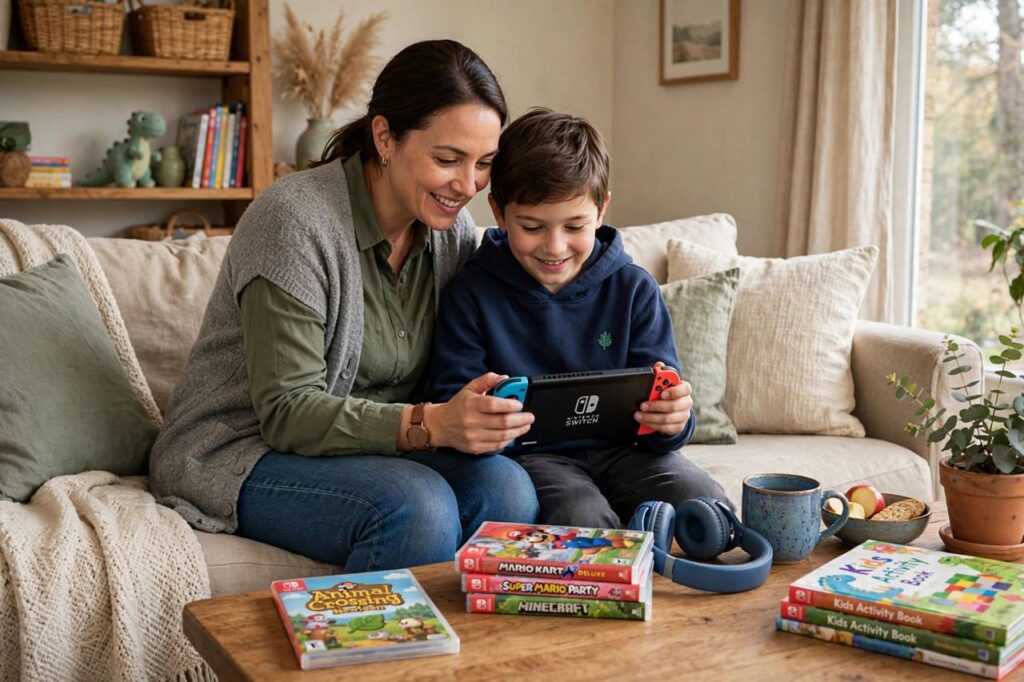
Picking the best Nintendo Switch games for kids is one of those parenting tasks that looks simple until you’re staring at the eShop with a seven-year-old vibrating next to you. The Switch has hundreds of kid-friendly titles, but “kid-friendly” covers a lot of ground — a game that’s perfect for a ten-year-old can frustrate a five-year-old to tears, and “educational” games often bore everyone involved. As a dad who’s bought, borrowed, and regretted plenty of Switch games, here’s my honest, kid-tested shortlist: fourteen games organized by age and play style, with notes on what actually matters — difficulty, reading requirements, multiplayer, and whether you’ll enjoy playing too.
One ground rule first: check the ESRB rating (E for Everyone is your friend; E10+ needs a look), and use the Switch’s built-in parental controls to set play-time limits and restrict the eShop. Nintendo’s parental control app is genuinely good — set it up before handing over the console, not after the first incident.
Best Nintendo Switch Games for Kids Ages 4–6
For the youngest players, the priorities are: no reading required, forgiving gameplay, and bright, friendly worlds. Super Mario Odyssey is the standout — its assist mode practically plays itself in the easy sections, and the simple joy of running and jumping as Mario (or as Cappy, in two-player mode where a parent handles the hard parts) works beautifully. Kirby and the Forgotten Land is another perfect first game: you can’t really lose badly, everything is soft and colorful, and the mouthful-mode transformations get huge laughs.
Animal Crossing: New Horizons deserves a mention even for little ones — there’s no way to fail, the pace is entirely theirs, and naming their island becomes a family event. Just know it runs on a real-time clock, so a kid who wants to play “tomorrow’s” content tonight will learn patience (or learn to time-travel, which every kid figures out eventually).
Best Picks for Ages 7–9
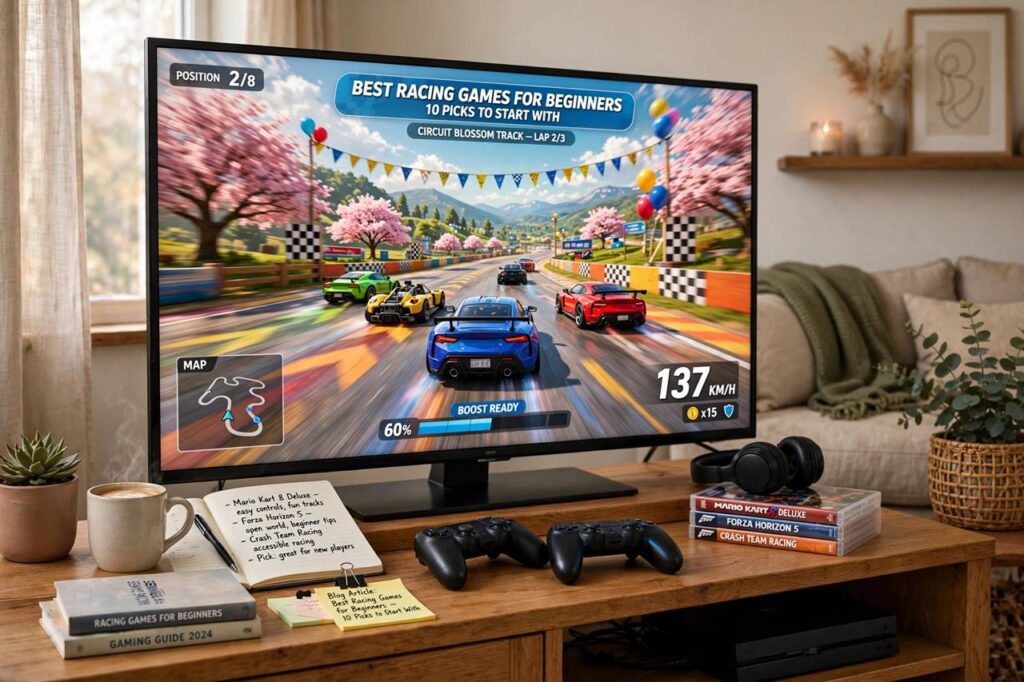
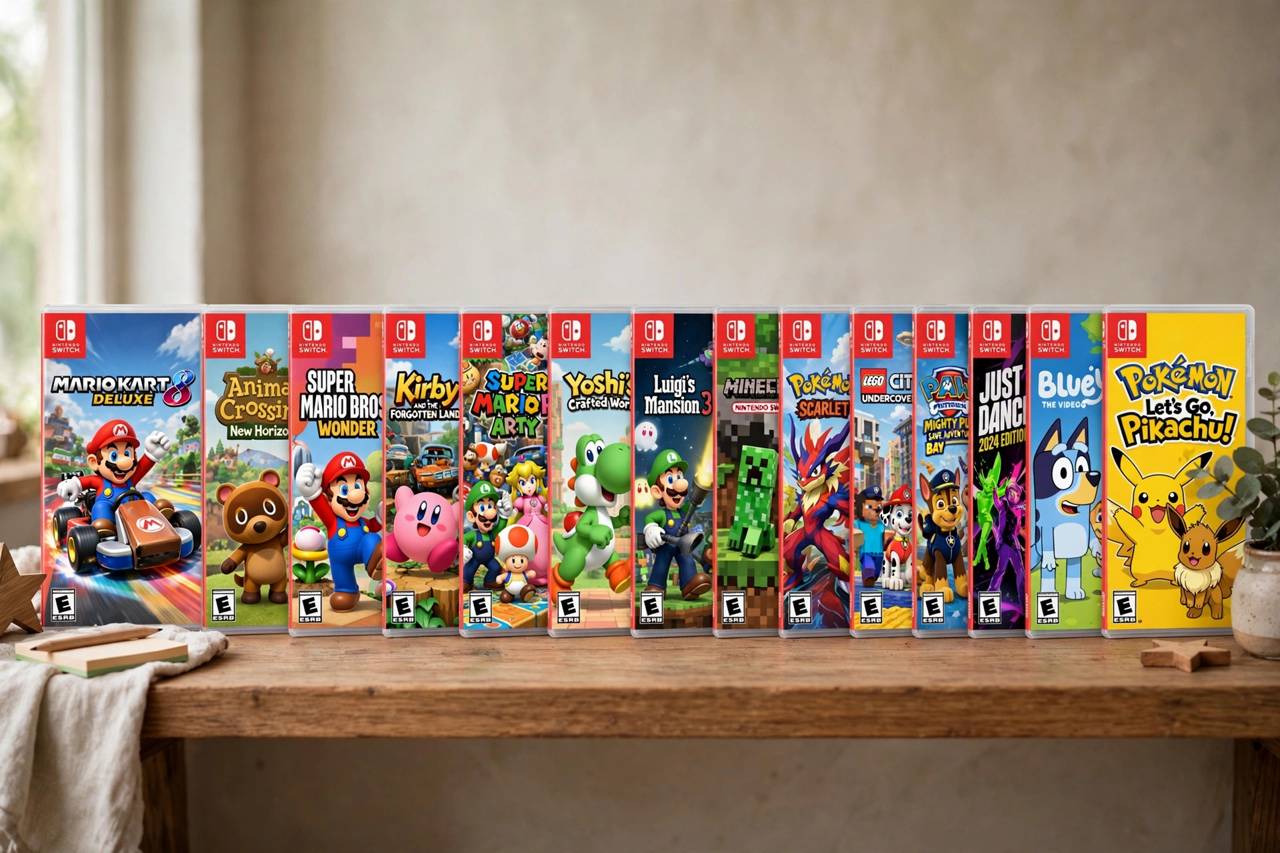
This is the golden age of Switch gaming. Kids can read, handle real objectives, and still find pure delight in silly things. Mario Kart 8 Deluxe is the essential family game — smart steering and auto-accelerate options let younger kids compete with adults, and it’s the rare game where a seven-year-old beating a parent feels fair to everyone. Luigi’s Mansion 3 is my top recommendation for this bracket: funny, gorgeous, genuinely clever puzzles, and a co-op mode where player two is Gooigi (who can’t die — perfect for a younger sibling).
Pokémon Scarlet/Violet or Legends: Arceus scratch the collecting itch that hits hard at this age. The reading load is real, so reluctant readers may need help — but many parents report Pokémon did more for their kid’s reading than any workbook. Minecraft (in Creative or Peaceful mode) is the infinite toy box: no wrong way to play, and the building skills transfer to genuine spatial thinking.
Best Picks for Ages 10–12
Older kids can handle real challenge and richer stories. The Legend of Zelda: Breath of the Wild (and Tears of the Kingdom) are masterpieces that reward curiosity over reflexes — kids who explore rather than rush will thrive, and the open-ended problem-solving is genuinely educational in the best way. Splatoon 3 offers competitive multiplayer that’s colorful rather than violent (you’re painting territory with ink), with a solid single-player campaign for practice.
This is also the age for co-op adventures that feel grown-up: Super Mario 3D World + Bowser’s Fury supports four players of mixed skill, and the chaos of four people platforming together is peak family gaming. Just establish the “no throwing each other off cliffs on purpose” rule early. You know who you are.
Games You’ll Actually Enjoy Too
Let’s be honest: you’ll be playing these as well, so your fun matters. The co-op sweet spot is games where the second player has a real role, not a pity role. Luigi’s Mansion 3 (Gooigi), Super Mario Odyssey (Cappy), Kirby (Bandana Waddle Dee), and Yoshi’s Crafted World all do this well. Turn-based or creative games — Civilization-style strategy is too heavy, but something like the Mario + Rabbids series (tactical combat that’s basically chess with jokes) works for parent-kid teams.
My personal test: if I find myself suggesting “one more level” after the kids are in bed, it’s a keeper. Games that pass this test in our house include the Zelda titles, Mario Kart (eternally), and the occasional indie gem discovered on sale.
Indie Gems Worth the Small Price
Don’t sleep on the eShop’s indie section, especially during sales when great games drop to a few dollars. Stardew Valley teaches planning and patience through farming (and sneaks in reading and arithmetic). Untitled Goose Game is pure mischief — you’re a horrible goose, it’s hilarious, and the puzzles are clever without being hard. Spiritfarer handles big feelings about loss with extraordinary gentleness (preview it first for sensitive kids). These smaller games often become the unexpected favorites, the ones kids talk about years later.
Sale strategy: wishlist everything that looks interesting and buy during the big seasonal sales. Nintendo first-party games rarely discount deeply, but indies routinely hit 50–80% off. A $60 budget at sale time can stock a year’s worth of gaming.
Multiplayer and Family Game Night
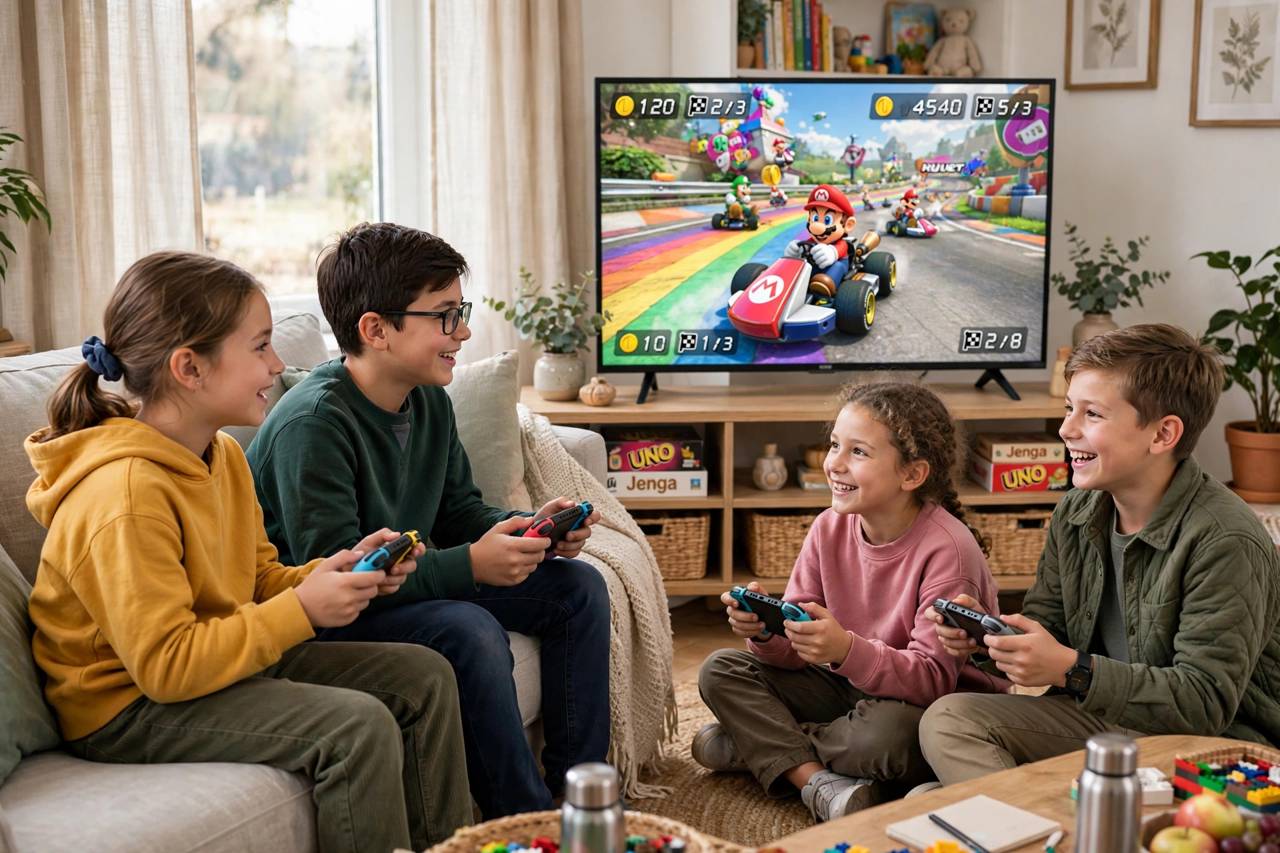
The Switch’s killer feature for families is instant local multiplayer — controllers split, everyone on the couch. Mario Kart 8, Super Smash Bros. Ultimate (cartoon fighting, E10+ — fine for most 8+), Overcooked (cooperative kitchen chaos that tests marriages and sibling bonds alike), and Mario Party Superstars are the core rotation. The trick to a good family game night: rotate who picks the game, keep sessions to an hour, and end on a high note rather than playing until someone cries. Someone always cries eventually; the goal is to stop before that.
What About Screen Time and Online Play?
The reasonable approach: treat gaming like any other activity — fine in moderation, better when it’s social or creative, and not a replacement for sleep, exercise, or homework. The Switch’s parental controls let you set daily limits with a bedtime lockout; use them as the neutral enforcer so you’re not the bad guy every evening. For online play, Nintendo Switch Online is required for most multiplayer — start with friends-only lobbies, keep voice chat off for younger kids (it runs through a phone app anyway, which most kids won’t bother with), and talk to your kids about not sharing personal info with strangers. The same rules as the rest of the internet, applied to ink battles.
Curious what goes into making these games? Our look at how video games are actually made is a great read-along for kids who ask “how did they DO that?” — and if they’re interested in where gaming is headed, how cloud gaming works explains the streaming future in plain terms.
Games That Teach Without Feeling Like School
Some Switch games sneak real learning into the fun, and kids rarely notice. Big Brain Academy: Brain vs. Brain turns quick-fire puzzles into a family competition — memory, math, and analysis disguised as a party game. Nintendo Switch Sports gets everyone moving (the leg strap soccer is genuinely good exercise). For reading practice, any Pokémon game works, and the Ace Attorney-style visual novels suit older kids who love stories.
Minecraft deserves special mention as a learning tool: Creative mode is essentially digital LEGO with infinite pieces, and Redstone contraptions teach basic logic and circuitry concepts that map surprisingly well onto later STEM learning. Several schools now use Minecraft Education officially — the thing your kid does for fun on Saturday is, quietly, curriculum-adjacent. You don’t need to frame it as educational; just notice and appreciate what’s happening.
Making the Switch Travel-Friendly
The Switch earns its name on the road. For car trips and flights: download games before you leave (hotel Wi-Fi is unreliable), invest in a sturdy case with game-card storage, and pack a power bank — the Switch charges over USB-C, and a good power bank doubles play time. Kid-proof the setup with a tempered glass screen protector; it’s a ten-dollar insurance policy against the inevitable drop.
Game selection for travel skews toward pick-up-and-put-down titles: Mario Kart (races are minutes long), Stardew Valley (save anywhere), and puzzle games. Avoid starting a 100-hour Zelda epic the night before a trip — or do, and accept that the back seat will be silent for six hours, which some parents consider a feature. Audio: pack kid-sized volume-limiting headphones. Your fellow passengers will thank you, and so will your child’s ears.
Frequently Asked Questions
What are the best Nintendo Switch games for kids?
Top picks by age: Mario Odyssey and Kirby for ages 4–6; Mario Kart 8, Luigi’s Mansion 3, and Pokémon for 7–9; Zelda: Breath of the Wild/Tears of the Kingdom and Splatoon 3 for 10–12. All are rated E or E10+ with family-friendly content.
What is a good first video game for a 5-year-old?
Kirby and the Forgotten Land or Super Mario Odyssey with assist mode — both are forgiving, require no reading, and let a parent help via co-op (Cappy in Odyssey, Bandana Waddle Dee in Kirby). Animal Crossing: New Horizons also works since there’s no way to fail.
Are Nintendo Switch games appropriate for kids?
Nintendo’s first-party games are famously family-friendly — no graphic violence, no strong language. Check the ESRB rating on every title (E for Everyone is the safest), and note that third-party games on the eShop vary widely, so preview unfamiliar titles.
How do I set parental controls on Nintendo Switch?
Use the free Nintendo Switch Parental Controls app: you can set daily play-time limits, a bedtime lockout, restrict games by age rating, and control eShop spending. Set it up before giving kids the console for the smoothest experience.
Can kids play Nintendo Switch games online safely?
Start with friends-only lobbies, keep voice chat off for younger kids, and teach them never to share personal information with strangers. Nintendo’s online environment is relatively closed compared to other platforms, which helps, but supervision still matters.
What’s the best multiplayer Switch game for family game night?
Mario Kart 8 Deluxe is the safest bet — its assist options (smart steering, auto-accelerate) let young kids genuinely compete with adults. Overcooked and Mario Party Superstars are excellent for cooperative and party play with slightly older kids.