How to Hang Curtains Without Drilling Any Holes


Drilling into walls is not always an option. Maybe you rent and the lease forbids it. Maybe the walls are concrete, tile, or plaster that crumbles if you look at it wrong. Or maybe you just do not own a drill and have no interest in buying one for a single project. Whatever the reason, knowing how to hang curtains without drilling opens up options that are faster, cheaper, and completely reversible.
I have hung curtains in rentals, dorms, and old houses with plaster walls for years, and the no-drill methods have gotten genuinely good. This is not about flimsy compromises. Done right, these approaches hold real curtains, look clean, and come down without a trace. Here are the seven methods that actually work, ranked from simplest to most heavy-duty.

Tension Rods: The Classic No-Drill Solution
Tension rods are the first thing to try because they need nothing but the window frame itself. The rod extends to press against both sides of the frame, and rubber ends grip the surface. Measure the inside width of your window frame, buy a rod that covers that range, twist to extend, and wedge it in place. Ten minutes, no tools.
They work best inside the frame for lightweight to medium curtains: sheers, cotton panels, linen. Heavy blackout curtains with thick linings can overwhelm a basic tension rod, so match the rod’s weight rating to your curtains. Wider windows need thicker rods, and anything over about sixty inches benefits from a rod with a larger diameter for stiffness.
The main limitation is placement. Tension rods sit inside the frame, so the curtains cannot extend past the window edges. If you want the trick of hanging curtains wider than the window to make it look bigger, you will need one of the methods below. But for a clean, simple look inside the frame, nothing beats the speed.
Adhesive Hooks and Bracket Holders
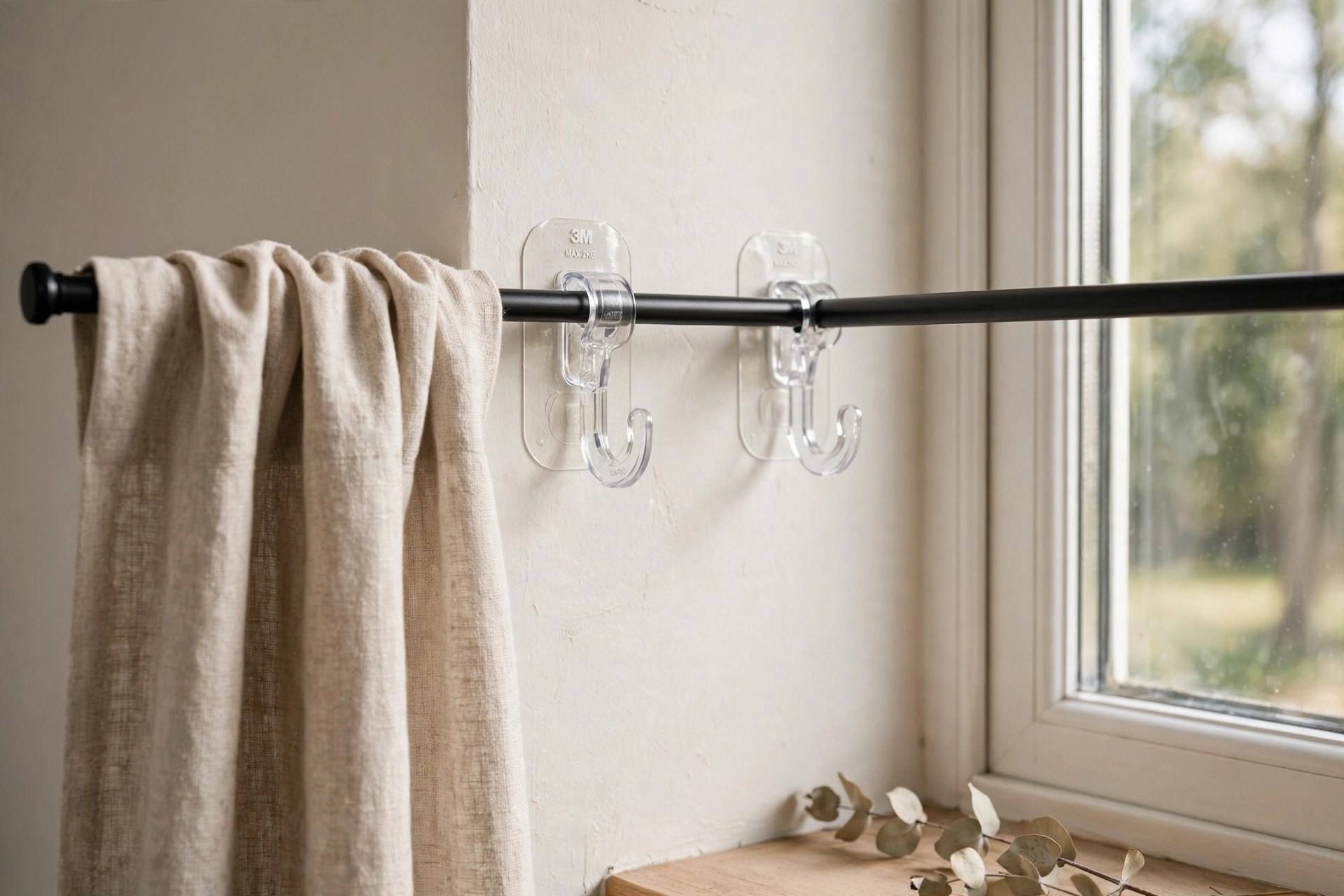
Modern adhesive hooks are far stronger than the ones you remember. Heavy-duty adhesive strips can hold several pounds each, which is enough for curtain brackets when you use multiple hooks. Stick two or three hooks on each side of the window at the same height, rest a curtain rod across them, and hang your curtains normally.
Surface preparation is everything. Clean the wall with rubbing alcohol and let it dry completely before applying. Press the adhesive firmly for a full minute. Then wait. Most adhesives need an hour, some a full day, to reach full strength. Hanging curtains immediately is the number one reason these fail.
Removal is the selling point. The pull-tab design stretches the adhesive off the wall cleanly when you are done. This makes adhesive hooks the best option for renters who need their deposit back. Just check the weight rating, use more hooks than you think you need, and keep the curtains on the lighter side.
Command-Style Brackets and Magnetic Rods
Purpose-built no-drill curtain brackets exist now, designed to hold a standard curtain rod with adhesive or tension mounting. They cost more than basic hooks but look more finished, with the rod sitting at a proper distance from the wall so curtains hang and fold naturally. If appearance matters, these beat improvised hook setups.
Magnetic curtain rods are the specialist tool for metal surfaces. If your window frame is steel, or you are hanging curtains on a metal door, magnetic rods snap on and hold firmly. They are common in kitchens and on apartment balcony doors. Check with a fridge magnet first. If it sticks to the frame, magnetic rods will work.
For a polished look in a rental, these purpose-built options pair well with thoughtful styling. The same care that goes into decorating a small apartment applies here: the hardware should disappear and the curtains should do the talking.
Twist-and-Fit and Pressure-Mount Rods
Twist-and-fit rods are the heavy-duty cousins of tension rods. They mount inside the frame like a tension rod but lock with a twisting mechanism that grips much harder. They handle wider spans and heavier curtains, including many blackout panels that would defeat a basic tension rod.
Installation is the same simple process: measure, twist, wedge. The difference is holding power. These are the rods to choose for bedroom blackout curtains in a rental, where you need real darkness but cannot drill. They also work in tile showers and other slick surfaces where adhesives struggle.
One caution: on very wide windows, even twist-and-fit rods can bow in the middle under heavy fabric. For spans over seventy inches with heavy curtains, consider two narrower rods side by side, or step up to a ceiling-mounted method below.
Ceiling-Mounted Tracks and Wire Systems
If the walls are off-limits but the ceiling is fair game, or even if you want a truly drill-free approach with adhesive ceiling mounts, curtain tracks are the most elegant solution. Flexible track systems can be mounted with strong adhesive pads on smooth ceilings, and they let curtains glide smoothly around corners, which rods cannot do.
Wire systems are the minimalist version. A thin steel cable stretched between two adhesive or tension-mounted anchors, with clip rings holding the curtains. They suit lightweight sheers and give a modern, airy look. They will not hold heavy drapes, but for sheer panels they are beautiful and nearly invisible.
Ceiling mounting also solves the visual trick that makes windows look bigger. Hanging curtains from near the ceiling down to the floor draws the eye upward and makes the whole room feel taller. It is one of the oldest designer tricks, and no-drill tracks make it available to renters.
Over-the-Frame and Furniture-Anchored Tricks
Sometimes the simplest answer is already in the room. Curtains can hang from a bookshelf, a wardrobe, or an armoire positioned beside the window. A rod laid across the tops of two tall bookcases flanking a window holds curtains perfectly and looks intentional. This works especially well in studio apartments where furniture already defines the space.
Another trick: hang the rod from the ceiling with decorative rope or chain anchored to adhesive ceiling hooks. The industrial look suits lofts and modern spaces, and the whole assembly comes down without damage. It takes a bit more creativity, but the result looks custom rather than compromised.
For bedrooms, where the goal is often coziness as much as light control, pairing no-drill curtains with soft textiles multiplies the effect. If you are going for atmosphere, read up on making your bedroom cozy and treat the curtains as one layer of a bigger plan.
Choosing the Right Method for Your Window
Match the method to three things: your curtain weight, your window width, and your wall surface. Light sheers on a standard window? Tension rod, done. Medium panels on drywall in a rental? Adhesive hooks with a proper rod. Heavy blackouts on a wide window? Twist-and-fit rods or ceiling tracks. Metal frame? Magnetic rods.
When in doubt, overbuild slightly. A rod rated for twice your curtain weight will not sag, slip, or surprise you at 2 a.m. And whatever method you choose, live with it for a week before declaring victory. Temperature changes and daily use reveal weak mounting faster than any test you can do on day one.
How to Hang Curtains Without Drilling in a Rental Property
Renters have an extra constraint beyond the walls: the lease and the security deposit. Before choosing a method for how to hang curtains without drilling, check what your lease actually says. Many leases prohibit drilling but say nothing about adhesive hooks or tension rods. When in doubt, ask the landlord in writing. A quick email approval protects your deposit and takes five minutes.
Document the condition of walls and window frames before you mount anything. Phone photos with timestamps are enough. If a landlord later claims damage, your dated photos prove the prior state. This sounds paranoid until the one time you need it, and then it is the smartest five minutes you ever spent.
For renters, the method ranking is simple. Tension and twist-and-fit rods come first: zero wall contact, zero risk. Adhesive hooks and purpose-built no-drill brackets come second: minimal risk if you follow cure times and use the proper removal technique. Magnetic rods come third but only where they apply. Ceiling tracks with adhesive mounts are the premium option for renters who want a polished look without touching the walls.
When you move out, remove everything carefully and clean any residue. Adhesive pull-tabs should come off cleanly if removed correctly. A magic eraser handles most scuffs on frames. Leave the place as you found it, keep your photos, and the deposit conversation stays boring, which is exactly what you want.
Pick your method, measure twice, and you will have curtains up within the hour. No drill, no damage, no landlord phone call. Sometimes the best home improvement is the kind nobody can tell you did.
Frequently Asked Questions
Will tension rods damage the window frame?
Properly installed tension rods rarely cause damage. The rubber ends distribute pressure, and on painted wood or vinyl frames they leave no marks. On delicate or antique frames, put small felt pads under the ends for extra protection.
How much weight can adhesive curtain hooks hold?
Heavy-duty adhesive hooks typically hold three to seven pounds each. Using three hooks per side gives you plenty of capacity for medium-weight curtains. Always follow the cure time on the package before hanging anything.
Can I hang blackout curtains without drilling?
Yes. Twist-and-fit rods inside the frame handle most blackout panels, and ceiling-mounted tracks work for wider windows. Match the rod’s weight rating to your curtains and consider lighter blackout fabrics designed for tension mounting.
Do no-drill curtain methods work on concrete walls?
Adhesive hooks work on smooth concrete if the surface is clean and fully cured, though rough concrete reduces adhesion. For concrete window frames, tension or twist-and-fit rods inside the frame are the most reliable option.
How do I remove adhesive curtain hooks without damage?
Pull the removal tab slowly straight down along the wall, stretching the adhesive until it releases. Never pull outward. Done correctly, quality adhesive strips come off cleanly with no residue or paint damage. If a tab breaks mid-pull, dental floss worked slowly behind the strip usually finishes the job cleanly.