
“Your car needs an alignment” — possibly the most upsold service in the tire industry. Sometimes it’s legitimate and important. Sometimes it’s a $100 suggestion attached to every tire sale whether you need it or not.
Ten years around cars, including running alignments myself, and I can tell you exactly what wheel alignment is, what those angles mean, how to tell if you actually need it, and when to politely decline. No upsell, just the mechanical truth.
Contents
- What Wheel Alignment Actually Is
- The Three Angles: Camber, Caster, Toe
- Alignment vs Balancing (Different Things)
- Symptoms of Bad Alignment
- What Knocks Alignment Out
- When You Actually Need an Alignment
- What a Good Alignment Service Includes
- How Much Should It Cost?
What Wheel Alignment Actually Is
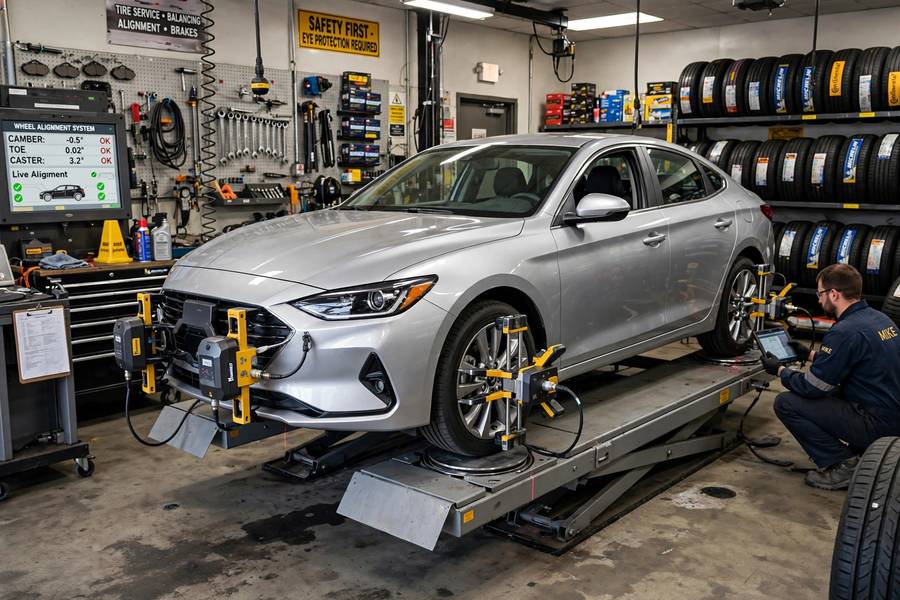
Despite the name, wheel alignment isn’t about the wheels — it’s about the suspension angles. It means adjusting the angles at which your tires contact the road so they’re positioned exactly as the manufacturer intended.
When alignment is correct: tires wear evenly, the car tracks straight, handling is crisp, and fuel economy is optimal. When it’s off: tires wear unevenly (costing you hundreds in premature replacement), the car pulls, handling gets vague, and you’re burning extra fuel dragging misaligned tires down the road.
It’s a precision job — we’re talking fractions of a degree. You can’t eyeball it, and no amount of DIY string-and-tape-measure work matches a modern laser alignment rack. This is one service where the equipment genuinely matters.
The Three Angles: Camber, Caster, Toe
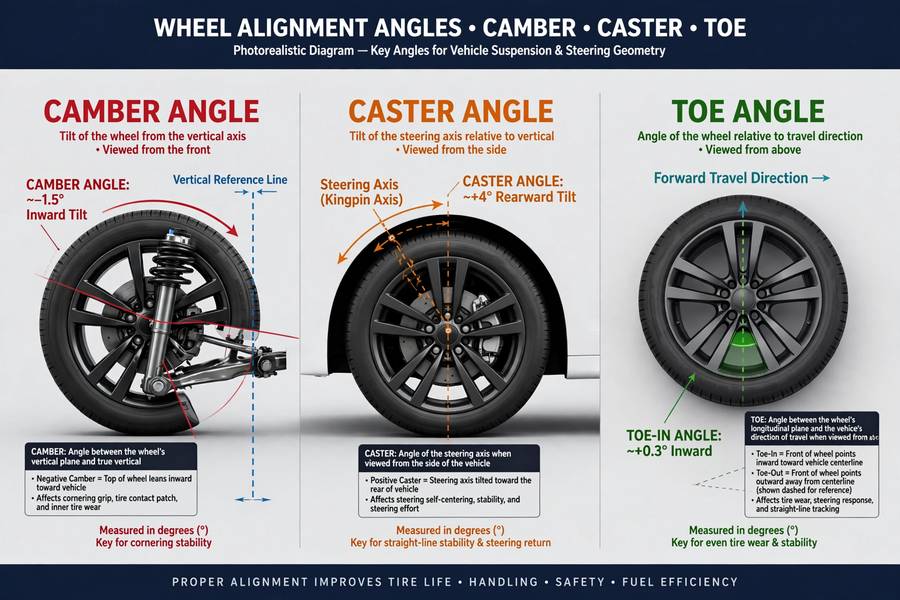
Every alignment adjusts three primary angles. Here’s what they mean in plain language:
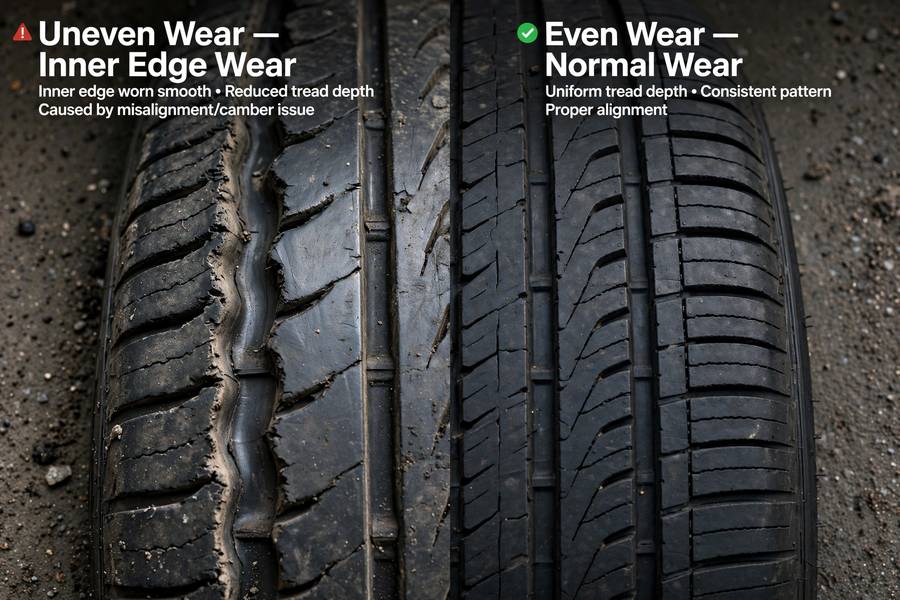
Camber — the tilt in or out. Viewed from the front, does the top of the tire lean inward (negative camber) or outward (positive camber)? A little negative camber is normal and even desirable — it improves cornering grip. Too much either way wears one edge of the tire. If your tires are wearing heavily on the inside or outside edge only, camber is the suspect.
Caster — the steering axis tilt. Viewed from the side, the steering pivot leans backward (positive caster) like the front fork of a bicycle. Caster is what makes your steering wheel return to center after a turn and gives straight-line stability. You can’t see it, but you feel it — wrong caster makes steering feel vague or darty.
Toe — the pigeons’ feet. Viewed from above, do the fronts of the tires point slightly inward (toe-in) or outward (toe-out)? Toe is the most common misalignment and the fastest tire killer — even a small toe error scrubs rubber off with every mile. A car with toe problems can destroy a set of tires in under 10,000 miles while looking perfectly fine to the eye.
There’s also thrust angle (whether the rear axle points straight), which matters on cars with adjustable rear suspension. A good shop checks it.
Alignment vs Balancing (Different Things)
People confuse these constantly, so let’s settle it:
- Alignment = adjusting suspension angles. Fixes pulling, uneven wear, handling.
- Balancing = adding small weights to the wheel so it spins without vibration. Fixes shaking at speed.
They’re unrelated services solving unrelated problems. If your steering wheel shakes at 60 mph, you need balancing, not alignment. If your car pulls left and the tires wear on one edge, you need alignment, not balancing. Shops sometimes sell both together — which is fine when both are actually needed, and wasteful when they’re not.
Symptoms of Bad Alignment
How to tell from the driver’s seat:
- Pulling to one side. On a flat, straight road, the car drifts left or right when you briefly loosen your grip. (Rule out road crown first — most roads slope slightly right for drainage. Test on a truly flat stretch.)
- Uneven tire wear. Run your hand across the tread. Feathering (sharp edges one way, smooth the other) screams toe problems. One-sided wear screams camber. Cupping/scalloping is usually balance or suspension, not alignment.
- Crooked steering wheel. Driving straight but the wheel sits off-center. Classic toe issue.
- Vague or wandering handling. The car feels like it can’t decide where to go, especially at highway speed.
- Squealing tires on normal turns at normal speeds.
One symptom alone can have other causes — pulling can be a dragging brake or mismatched tire pressures (check pressures first; it’s free). But two or more together? Get the alignment checked.
What Knocks Alignment Out
Alignment doesn’t drift on its own — something moves it:
- Potholes and curb strikes. The #1 cause. One good pothole hit can knock toe out significantly. If you clobbered something and now it pulls, that’s your answer.
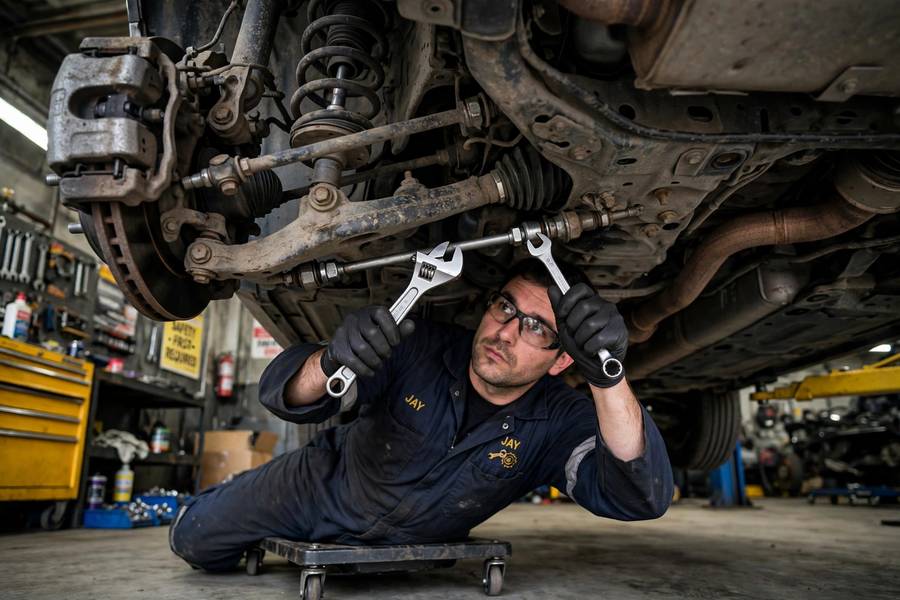
- Worn suspension parts. Ball joints, tie rod ends, control arm bushings — when these wear, alignment goes with them. Aligning a car with worn parts is pointless; the angles won’t hold. A good shop inspects first and tells you.
- Accidents, even minor ones. A 10-mph fender bender can shift things.
- New suspension work. Struts, springs, control arms — any suspension replacement should be followed by an alignment.
- New tires (sometimes). New tires don’t need alignment by themselves, but it’s the smart time to check — you’re protecting a $600+ investment for an extra $100.
When You Actually Need an Alignment
My honest guidance — when it’s worth paying for:
- You have symptoms (pulling, uneven wear, crooked wheel)
- After hitting something hard (pothole, curb)
- After suspension work
- When installing new tires (check, at minimum)
- Once a year as preventive maintenance if you drive rough roads
When to decline the upsell: the shop recommends it “because it’s been a while” but the car drives straight, wears evenly, and nothing’s changed. “Preventive” alignments on a car with no symptoms and no recent impacts are how shops pad tickets. A check is cheap or free at many places — pay for the check, pay for the adjustment only if it’s actually out.
And since you’re already in preventive-maintenance mode: a weak battery is the other classic “fine until it isn’t” item. Make sure you know how to jump start a car before the morning it won’t turn over.
What a Good Alignment Service Includes
Not all alignments are equal. A proper job:
- Test drive (or at least a symptom discussion) before starting
- Suspension inspection — worn parts identified before any adjustment
- Tire pressure set to spec (alignment on wrong pressures is meaningless)
- Computerized measurement of all angles, front and rear
- Adjustment to the middle of spec, not just “within range” — there’s a difference, and good techs know it
- Printout showing before and after numbers — always ask for this; it’s your proof and your baseline
- Test drive after, confirming straight tracking and centered wheel
If a shop won’t show you the before/after printout, that’s a red flag. The numbers are the whole point.
How Much Should It Cost?
- Two-wheel (front only): $50–75. Fine for cars with non-adjustable rear suspension and no rear symptoms.
- Four-wheel: $75–120. The standard for most modern cars. Worth it.
- “Lifetime” alignment packages: $150–200 one-time, free rechecks. Good value if you’ll actually come back — most people don’t, which is why shops love selling them.
Would I spend my own money on it? Annually on my daily driver, yes — I drive rough roads and I’d rather spend $100 than $600 on prematurely worn tires. On a garage-kept weekend car with no symptoms? No. Match the maintenance to the reality.
Cheap maintenance wins are the whole game with car ownership — another one is cleaning cloudy headlights yourself, which costs a few dollars and genuinely improves night visibility.
Alignment and Tire Life: The Money Math
Let me put dollars on this, because “get an alignment” is abstract but tire prices are not.
A set of four decent tires costs $600–1,000 installed. Properly aligned, they last 50,000–70,000 miles. With a moderate toe misalignment — the kind you can’t see and barely feel — that same set can be destroyed in 15,000–20,000 miles. I’ve measured tires with 4/32″ of feathered wear on one edge and 9/32″ everywhere else; that tire is done, and it had 50,000 miles of life left in the other 90% of its tread.
So the math: a $100 alignment that you actually needed saves $400–700 in premature tire replacement. A $100 alignment you didn’t need costs $100. The expected value strongly favors checking — which is why I recommend the check (often free or $20–30) unconditionally, and the adjustment when the numbers say so.
One more money angle: misalignment increases rolling resistance, costing 2–3% in fuel economy. On 12,000 miles a year at $3.50/gallon in a 25-mpg car, that’s $30–45 a year in wasted fuel — not huge, but it means a needed alignment partially pays for itself at the pump too. Maintenance that pays for itself is the easiest maintenance to justify.
Frequently Asked Questions
Wheel alignment is the adjustment of your suspension’s angles — camber, caster, and toe — so tires contact the road exactly as the manufacturer intended. Correct alignment ensures even tire wear, straight tracking, and proper handling.
Key symptoms: pulling to one side on flat roads, uneven tire wear (one edge worn), a crooked steering wheel when driving straight, and vague highway handling. Also get it checked after hard pothole/curb hits, suspension work, or when installing new tires.
Alignment adjusts suspension angles (fixes pulling and uneven wear); balancing adds weights to wheels so they spin smoothly (fixes vibration at speed). They’re unrelated services for unrelated problems.
Typically $75–120 for a four-wheel alignment, $50–75 for front-only. Lifetime packages run $150–200. Always ask for the before/after printout showing the actual angle measurements.
Bad alignment itself rarely causes vibration — that’s usually wheel balance, worn suspension, or tire issues. But severe misalignment can cause uneven wear patterns (like cupping) that eventually do vibrate. Diagnose vibration as a balance/tire issue first.