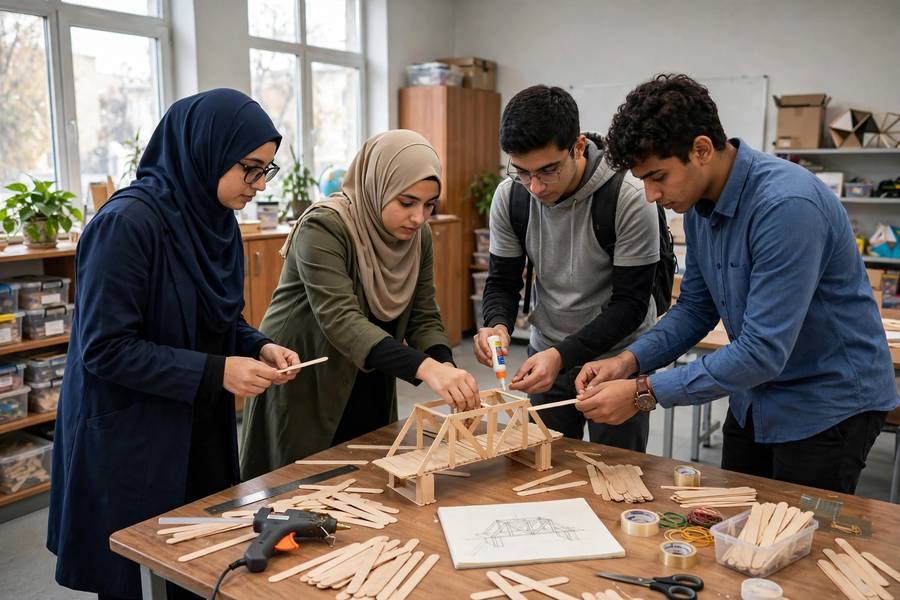
How to Study for a Test Effectively (Science-Backed)


It is 11:47 PM. Your test is tomorrow morning. You have a highlighter in one hand, a textbook in the other, and a growing suspicion that none of this is actually going into your brain. I have been there — and I have sat across from hundreds of students who were there too, back when I tutored one-on-one. Here is what I told every single one of them: how to study for a test effectively has almost nothing to do with how many hours you put in, and everything to do with how you spend those hours. Re-reading your notes for the fifth time feels productive. It mostly is not. Let me show you what actually works, backed by real learning science, not study-blog folklore.
The uncomfortable truth is that most of us study the way we were taught to study in elementary school: re-read, highlight, maybe make a neat set of notes. Researchers have tested these strategies for decades, and the verdict is clear — the popular methods are among the weakest, and the most powerful methods feel harder precisely because they work. Your brain remembers what it struggles with, not what it glides over. So this guide is built around that one principle: make your brain work, in the right ways, and the test takes care of itself.
How to Study for a Test Effectively: The Core Principles
Everything below rests on three ideas from cognitive science. First, retrieval practice: pulling information out of your memory strengthens it far more than putting it back in. Every time you successfully recall something, the memory gets more durable. Second, spacing: spreading study sessions over days beats cramming the same total hours into one night, because your brain consolidates memories between sessions. Third, desirable difficulty: learning that feels a little hard is learning that sticks. If studying feels easy, you are probably not learning.
Hold those three ideas, because they explain every strategy in this guide. Flashcards work because of retrieval. Study plans work because of spacing. Practice tests work because of both, plus a dose of difficulty. Once you see the pattern, you will never waste another evening on passive re-reading again. And if you are facing a big cumulative exam rather than a chapter test, many of these same principles scale up — my guide on how to study for final exams extends this plan to the end-of-term marathon.
Start With the Test, Not the Textbook
Before you open a single note, figure out what you are actually being tested on. This sounds obvious, and almost nobody does it. Find the syllabus or study guide. Look at past tests or quizzes from this teacher — their style repeats more than they would like to admit. Ask directly what format the test will be: multiple choice rewards recognition, essays reward organized recall, problem sets reward practiced procedure. The format should shape your preparation.
Then do a brutally honest inventory. Divide the material into three piles: what you know cold, what is shaky, and what might as well be written in another language. Most students study everything equally, which means they over-study what they already know and under-study what will actually cost them points. Your shaky pile deserves the majority of your time. Your “another language” pile needs the most urgent attention, because those are the questions you will currently get wrong.
Set a realistic schedule. If the test is in five days, you want three to four study sessions, not one heroic all-nighter. If it is tomorrow, accept reality: you are doing a focused triage session tonight, and the goal is maximizing points, not achieving mastery. Both situations are workable. What is not workable is the vague plan of “studying all weekend” with no structure. Your brain needs a plan the way a road trip needs a map.
Active Recall: The Single Most Powerful Study Technique
If you take one technique from this article, make it this one. Active recall means closing the book and forcing yourself to remember. Read a section, close it, and say out loud everything you remember. Do a practice problem without looking at the example. Write down the key terms from memory, then check what you missed. The checking part is essential — retrieval without feedback can cement wrong answers.
This is why flashcards work, but only if you use them correctly. Looking at the front of the card, genuinely trying to recall the back, and then flipping — that is active recall. Flipping through a deck while half-watching videos is just expensive re-reading. Be honest with yourself about which one you are doing. The blank-page method is even simpler and completely free: after each study chunk, take a blank sheet and write everything you can remember. The gaps you discover are your real study list.
Practice tests are active recall at full power, and they have a bonus effect: they train you for the actual conditions of the test. Time pressure, question formats, the feeling of not knowing an answer and having to move on — all of that is a skill, and it improves with practice. If your teacher provides old tests, treat them like gold. If not, turn your chapter headings into questions and answer them from memory. The format matters less than the act of retrieving under slight pressure.

Spaced Repetition: Timing Your Reviews So Nothing Fades
Your memory of new material decays fast — most of it evaporates within a day if you do nothing. But each time you successfully recall something, the decay slows down. Spaced repetition exploits this: you review material at increasing intervals, just as you are about to forget it. Day one, day three, day seven, day fourteen. Each successful recall pushes the forgetting further away.
In practice, this means your study plan should revisit old material, not just march forward through new material. Session two starts with a quick recall of session one’s content. Session three starts with sessions one and two. This feels inefficient — why review what you already studied? — but it is the difference between knowledge that survives until the test and knowledge that evaporates the night before it.
You do not need a fancy app to do this, though spaced-repetition apps exist and work well. A simple system: after each study session, write the date you will review that material again on a sticky note — two days later, then a week later. When the date comes, do a five-minute blank-page recall. If it comes back easily, push the next review further out. If it does not, the interval was too long, and you pull it closer. You are calibrating to your own memory, which is exactly the point.
Interleaving: Mix It Up Instead of Blocking
Most students study in blocks: all of chapter 4, then all of chapter 5, then all of chapter 6. It feels organized. It is also less effective than interleaving — mixing problem types and topics within a single session. Instead of doing twenty identical algebra problems in a row, you do five algebra, five geometry, five algebra, five word problems. It feels harder. That is the desirable difficulty at work.
Why does this help? Because tests interleave. Nobody hands you a test labeled “only chapter 4 problems, in chapter 4 order.” You have to recognize which technique each question needs, and blocked practice never trains that recognition skill. Interleaving forces you to practice the identification step every single time, which is precisely the skill the test measures.
This applies beyond math. For history, mix eras and themes instead of studying one period at a time. For languages, mix vocabulary, grammar, and translation. For science, mix concept questions with calculation problems. The rule of thumb: practice the way you will be tested — mixed up, unpredictable, and requiring you to think about what kind of question you are facing.
Strategies by Test Type
Multiple choice: These test recognition and discrimination. Study by learning the differences between similar concepts, not just the definitions — test-makers love answer choices that are almost right. Practice eliminating wrong answers and explaining why they are wrong. Watch for absolute words like “always” and “never,” which are frequently wrong.
Essays and short answers: These test organized recall. You cannot fake your way through an essay with vague familiarity. Build outline frameworks for the major topics — thesis, three supporting points, evidence for each — and practice reproducing them from memory. The students who do well on essays are the ones who walked in with structures, not just facts.
Math and problem sets: These test procedure under pressure. Watching someone solve a problem teaches you almost nothing; solving it yourself teaches you everything. Work problems from scratch, check your work, and — this is the part everyone skips — redo the ones you got wrong a day later. The redo is where the learning actually happens.
Oral exams and presentations: These test fluent recall under social pressure. Practice out loud, to a real person if possible. Explaining a concept to someone else is the ultimate retrieval test — the gaps in your understanding become embarrassingly obvious the moment you try to say it. That embarrassment is useful. It shows you exactly what to fix.
The Night Before and the Morning Of
The night before a test, your job is consolidation, not acquisition. Do a final round of active recall on your shakiest material, then stop. Cramming new material at midnight produces anxiety, not learning, and it steals the sleep your brain needs to consolidate what you already studied. Sleep is not a break from studying — it is part of studying. The research on this is unambiguous: a rested brain outperforms a crammed one, even with fewer total study hours.
Prepare the logistics the night before so your morning is calm: pack your bag, lay out clothes, set two alarms, know where you are going and how long it takes to get there. Morning-of panic is a performance killer, and it is entirely preventable. Eat something with actual substance — your brain runs on glucose, and “I skipped breakfast” is not the flex some students think it is.
When the test lands on your desk, do a brain dump first if the format allows: write down the formulas, dates, or key terms you memorized on scratch paper before you even read question one. This frees your working memory for the actual thinking. Then read every question before starting, budget your time, and answer the easy ones first to build momentum. If you blank on a question, move on — your subconscious keeps working on it, and later questions often contain clues.
Frequently Asked Questions
Is cramming the night before ever effective?
It can produce short-term familiarity that helps on a test the next morning, but the knowledge evaporates within days, and it is far less effective than the same hours spread over several days. If cramming is your only option, use active recall rather than re-reading — it squeezes the most learning out of limited time.
How long should each study session be?
Most people focus well for 25 to 50 minutes before returns diminish. Work in focused blocks with short breaks between them, and take a longer break every couple of hours. Four focused 40-minute sessions with breaks will beat three blurry hours of half-attention every time.
Are highlighters and re-reading completely useless?
Not completely — they have a place as a first pass through material, to identify what matters. The mistake is stopping there. Highlighting becomes useful when it feeds into active recall: highlight the key terms, then close the book and test yourself on them. The highlighting is preparation; the recall is the studying.
What if I have test anxiety?
Preparation is the best antidote, because anxiety feeds on uncertainty. Beyond that: practice under test-like conditions so the format feels familiar, arrive early so you are not rushed, and use slow breathing to calm the physical symptoms. If anxiety is severe and persistent, talk to a school counselor — it is a solvable problem, not a character flaw.
Should I study with friends or alone?
Both have value at different stages. Study alone first, using active recall to build your own understanding. Then study with others to test it — explaining concepts and quizzing each other is superb retrieval practice. Skip the group session if it devolves into socializing; be honest about whether the group is helping or just comfortable.