How to Play Sudoku: Rules, First Moves & Tips

Sudoku looks intimidating — a wall of empty boxes, numbers everywhere, no instructions. But here’s the secret: the entire game is one rule. Learn it, learn two techniques, and you can solve easy puzzles today. No math required. Seriously — no arithmetic at all. The digits are just symbols.
I’m going to walk you through it like a friend sitting next to you: the rule, reading the grid, your actual first moves on a real board, the mistakes everyone makes (with fixes), and where to go when easy puzzles start feeling simple. Grab a pencil.
What Sudoku Actually Is (30-Second Version)
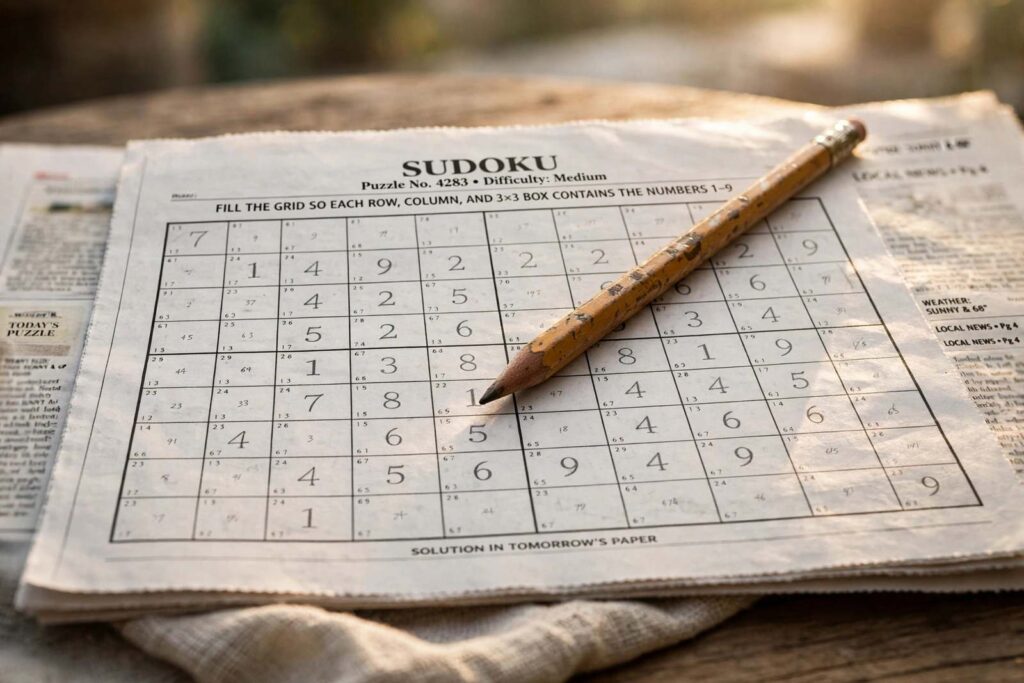
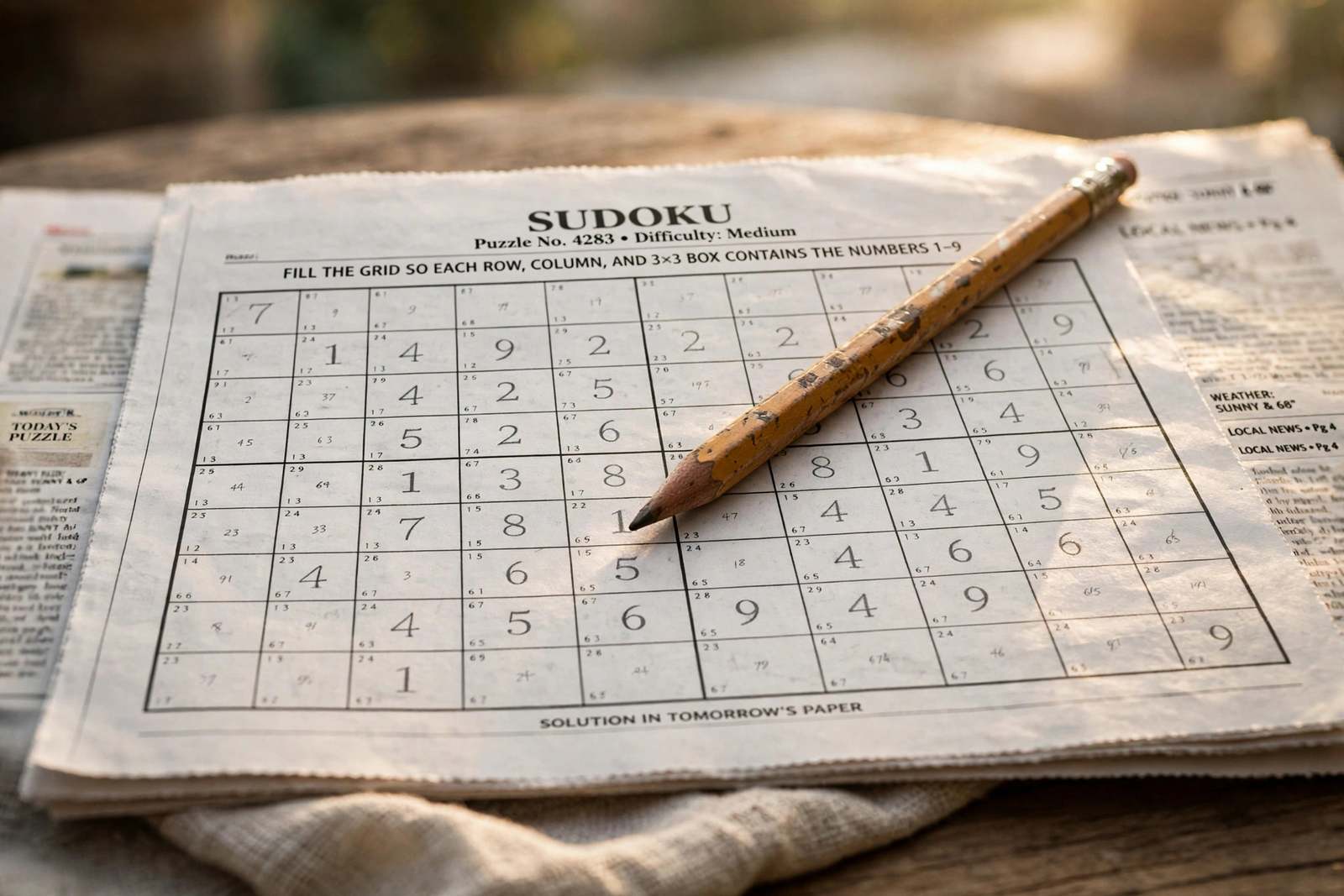
Sudoku is a logic puzzle on a 9×9 grid. Some cells come pre-filled (the “givens”); your job is to fill the empty cells with the digits 1–9 following exactly one rule.
That’s the whole game. No calculations, no equations, no math degree. If you can recognize the digits 1 through 9, you have every skill Sudoku requires. The rest is pure logic — and logic is learnable.
The One Rule
Here it is, the entire rulebook: each row, each column, and each 3×3 box must contain the digits 1–9 exactly once.
Three constraints, one rule:
- Row: no digit repeats in any horizontal row
- Column: no digit repeats in any vertical column
- 3×3 box: no digit repeats in any of the nine 3×3 boxes
And the critical mindset shift: the digits are just symbols. You could replace 1–9 with nine colors or nine letters and the puzzle would be identical. You’re not doing math — you’re doing placement logic. Nobody is adding anything. Ever.
What You Need to Start
- Paper and a pencil (pencil, not pen — you’ll erase), or a free online/app board
- An “easy” puzzle — easy puzzles come with lots of givens (pre-filled numbers), which means more starting points and shorter logic chains
Start easy. Not “I should be able to do medium” easy — actually easy. The techniques below are the same at every level; easy puzzles just let you practice them with training wheels on.
Reading the Grid
The anatomy, precisely:
- The grid is 9×9 = 81 cells total
- It’s divided into nine 3×3 boxes
- Every row, every column, and every box is a “unit” — a set of 9 cells that must hold 1–9
- Every cell belongs to exactly three units simultaneously: its row, its column, and its box
That last point is the engine of the whole game. Every placement has to satisfy three units at once — and every deduction comes from the overlap.
Your First Move — Fill the “Last Digit”
The easiest move in Sudoku: find a row, column, or box with only one empty cell, and place the missing digit.
Example: a row shows 1, 2, 3, 4, 5, 6, 7, 9 — the missing digit is 8. It goes in the empty cell. Done. That’s a legal, complete deduction, and easy puzzles are full of them. Scan the whole grid for these “last digit” placements first — they’re free points. Clear them all before trying anything harder.
Worked Example — Scanning With a Digit
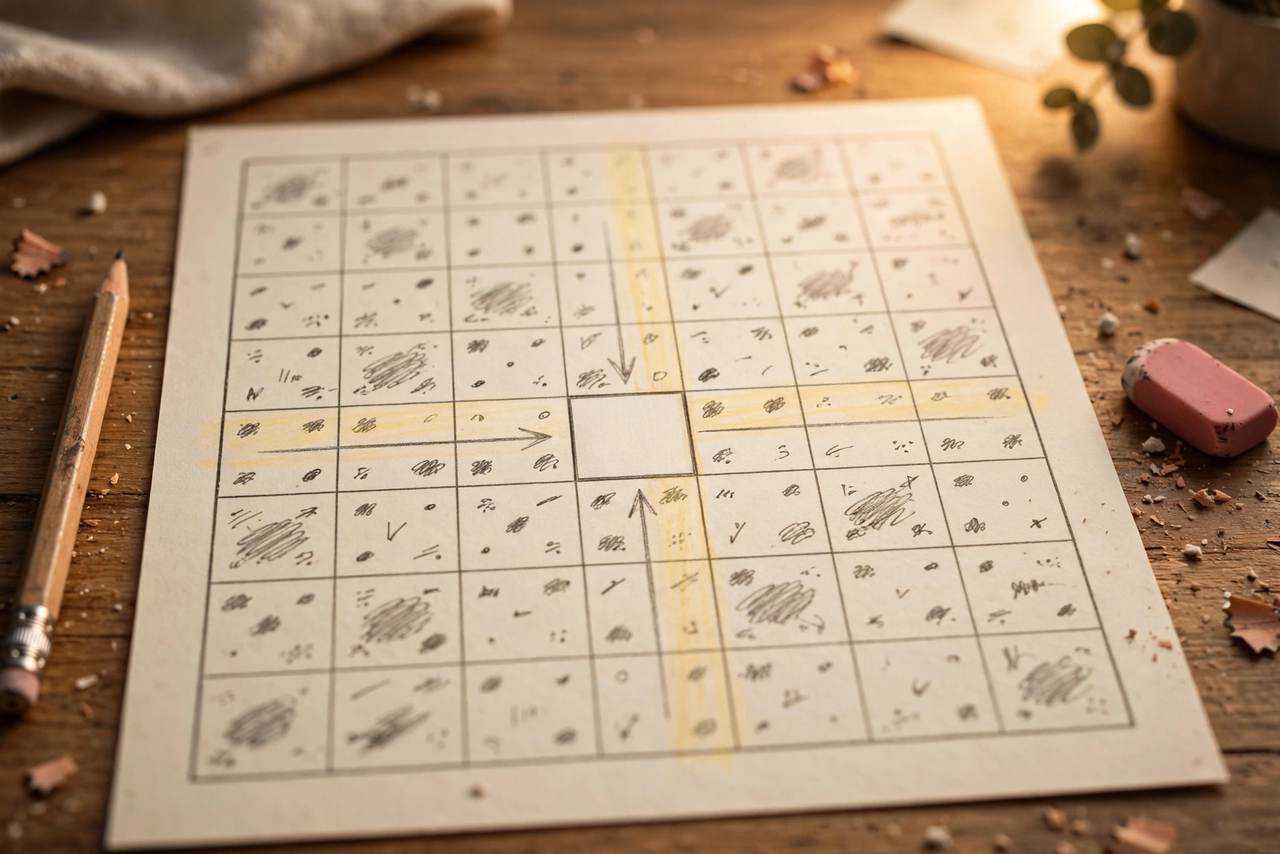
Now the core technique. Pick a digit that appears several times on the grid — say, 5. Now scan:
- Find every 5 already placed.
- For each 5, trace its row and column — the 5 “blocks” those lines in every box they cross.
- Look at a single 3×3 box: with rows and columns blocked by existing 5s, only one cell in that box can hold a 5.
- Place it there.
Concrete picture: imagine the top-left box. There’s a 5 in the same row two boxes to the right, and a 5 in the same column two boxes below. Those two 5s eliminate six of the box’s nine cells; of the remaining three, two are already filled with other digits. One cell survives — the 5 goes there. That’s scanning. Repeat for every digit, and the puzzle starts collapsing.
Naked Singles and Hidden Singles
Two named techniques — the vocabulary of Sudoku:
- Naked single: a cell where only one digit is possible. You’ve eliminated the other eight through row/column/box constraints. The answer is sitting there naked — write it in.
- Hidden single: a digit that fits in only one cell within a unit, even though that cell has other candidates. The 5 must go in this cell of the box because it’s blocked everywhere else — the single is “hidden” among other possibilities.
Naked singles are about the cell; hidden singles are about the unit. Together with scanning, they solve the vast majority of easy and medium puzzles.
Pencil Marks (Notes)
When deductions stall, write small candidate digits in each empty cell — the digits that could go there. These are called pencil marks (or notes).
The discipline: update them after every placement. Place a 7, and every 7 gets erased from its row, column, and box’s pencil marks. Stale pencil marks — candidates you forgot to erase — are the #1 source of confusion in manual solving. Pencil marks turn the puzzle from memory into bookkeeping, and bookkeeping is reliable.
Common Mistakes + Fixes
The five mistakes every beginner makes, with the fix for each:
- Guessing early. Placing a digit because it “feels right” instead of because logic demands it. Fix: if you can’t point to the row, column, or box that forces the placement, it’s a guess. Erase it and scan instead.
- Ignoring the boxes. Beginners scan rows and columns but forget the 3×3 boxes — which is where half the deductions live. Fix: after every row/column scan, do a box scan. Make it a habit loop.
- Stale pencil marks. Candidates you placed three moves ago that are now impossible, silently misleading you. Fix: erase aggressively after every placement. No exceptions.
- Not re-checking units. Placing a digit and moving on without verifying the row/column/box still works. Fix: every placement gets a three-unit check — row, column, box — before you move on.
- Skipping final verification. Finishing the grid and assuming it’s right. Fix: verify — every row 1–9, every column 1–9, every box 1–9. A “solved” puzzle with a duplicate somewhere isn’t solved.
What to Do When Stuck
Stuck is normal. It’s not failure — it’s the puzzle telling you to change tactics:
- Re-scan the units with the fewest blanks. The emptiest unit is closest to yielding.
- Scan one digit at a time across the whole grid (the scanning technique above).
- Add pencil marks to a small area — one box, fully marked, often breaks the logjam.
- Take a break. Fresh eyes see what tired eyes miss. This isn’t quitting; it’s strategy.
- Remember: standard puzzles never require guessing. If you feel forced to guess, you’ve missed a deduction — go back to steps 1–3.
And here’s the mindset that separates people who finish puzzles from people who abandon them: being stuck is information. It tells you exactly where your technique has a gap. Every time you work through being stuck — instead of guessing or quitting — that gap closes a little. The puzzle isn’t testing your intelligence. It’s training your patience.

Difficulty Progression
When easy puzzles feel automatic, climb:
- Easy → medium: longer logic chains, fewer givens, more pencil-mark work
- Harder techniques: pairs (two cells in a unit that must hold the same two digits), pointing/claiming (a digit’s position in one unit constrains another), X-wing (a digit forming a rectangle across rows and columns)
- One warning: difficulty labels vary by publisher — one site’s “medium” is another’s “hard.” Judge by the solving experience, not the label.
The techniques scale. Scanning and singles never stop being useful — harder puzzles just need them plus the advanced patterns.
Quick History + Variants Teaser
Thirty seconds of history: Sudoku was first published as “Number Place” in 1979, popularized in Japan by the publisher Nikoli in 1984, and then spread worldwide in the 2000s to become the most popular pencil puzzle on earth.
Once you’ve got the classic down, the variants are waiting: Killer Sudoku (cages with sums), Diagonal Sudoku (diagonals count too), mini grids (6×6 and 4×4 for quick solves). Same one rule, new twists.
For the puzzle family: how-to-play-sudoku-for-beginners is the companion beginner guide, best-puzzle-games-for-adults has more brain-food, and how-to-play-chess-for-beginners is the other classic to learn.
Frequently Asked Questions
Do you need math to play Sudoku?
No — no arithmetic at all. The digits 1–9 are just symbols; you could replace them with colors or letters. Sudoku is pure placement logic, not math.
Can a number repeat in a row, column, or box?
Never. Each row, column, and 3×3 box must contain the digits 1–9 exactly once — that’s the one rule of the entire game.
Do the diagonals count in Sudoku?
Not in classic Sudoku — only rows, columns, and 3×3 boxes. (Diagonal Sudoku is a separate variant where the two main diagonals also must hold 1–9.)
Should beginners guess when they’re stuck?
No — standard Sudoku never requires guessing. If you feel forced to guess, you’ve missed a deduction: re-scan the emptiest units, scan one digit at a time, or refresh your pencil marks.
How long does a beginner puzzle take?
Typically 10–20 minutes for an easy puzzle once you know the basic techniques. Your first few will take longer — that’s normal and part of learning.