How to Solve a Rubik’s Cube Faster: Speed Tips

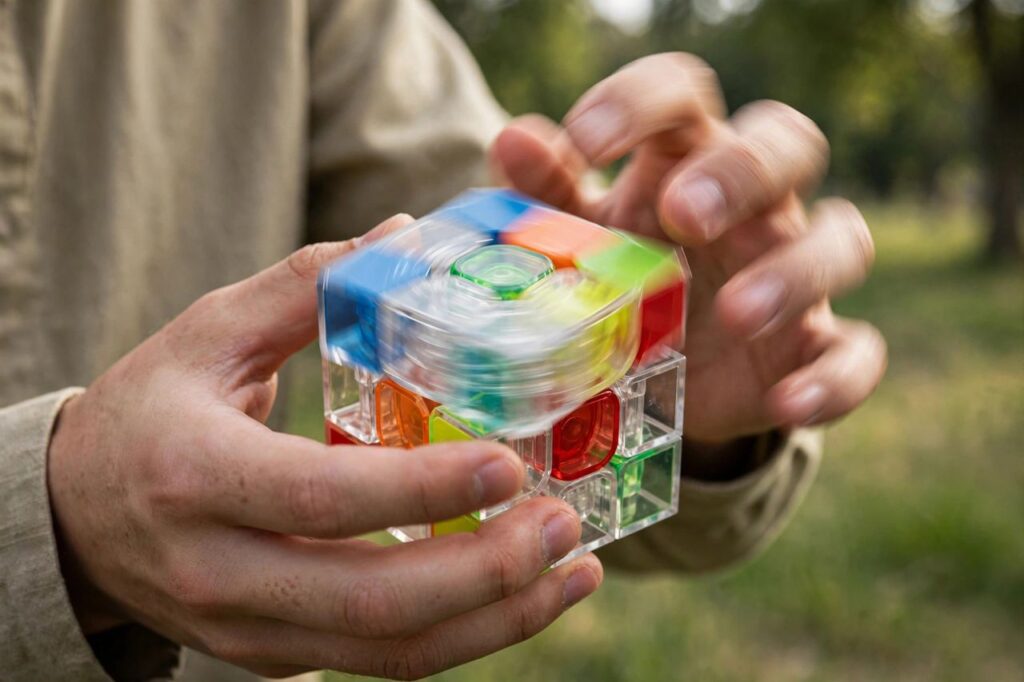
You can already solve the cube. Maybe it takes you two minutes, maybe ninety seconds — and now every solve feels the same, stuck at the same speed no matter how many times you practice. This guide is the way out of that plateau.
Speed doesn’t come from learning more algorithms first. It comes from a sequence: better turning technique, a smarter method, and practice aimed at the right weakness for your current level. Below is a staged roadmap — find your stage, work on exactly what that stage needs, and move on only when it’s solid. If you enjoy the puzzle side of this more than the speed side, the best puzzle games for adults list has plenty to explore.
What Actually Makes You Faster (It’s Not Just More Algorithms)
Beginners assume fast cubers know hundreds of algorithms. The truth is less glamorous: most of your time isn’t spent executing algorithms at all. It’s spent in three places — turning the cube clumsily (re-gripping between moves), pausing to find the next pieces, and solving the cross inefficiently.
That means the biggest speed gains come from technique, not memorization. Smooth turning with no wasted motion, planning ahead while your hands move, and a cross solved in few moves will cut more seconds than any new algorithm. Each roadmap stage below targets exactly one of these, in the order that pays off most.
Find Your Stage: Your Current Average Decides Your Next Step
Time ten solves and average them — that’s your stage, and it decides what you learn next. The roadmap has four stages, and each one takes roughly 2 to 4 weeks of steady practice.
Averaging 60 seconds or more: work on finger tricks and smooth turning. Your method is fine for now; your hands are the bottleneck. Averaging 40 to 60 seconds: learn the 4-look last layer — a small set of algorithms that finishes the top face efficiently. Averaging 30 to 40 seconds: rebuild your middle game with intuitive F2L. Under 30 seconds: learn full PLL (21 algorithms), then full OLL (57 algorithms).
Don’t skip stages. Every stage builds the skill the next one assumes, and jumping ahead just moves the plateau somewhere more frustrating.
Stage 1 — From Beginner Method to Smooth Solves
If you’re still on the beginner method, don’t replace it yet — smooth it out first. Solve slowly and deliberately, watching for the moments you stop moving: those pauses are your real enemy, and they shrink with practice long before new algorithms matter.
Learn to solve the cross on the bottom instead of the top if you haven’t already — it saves the flip at the end and sets up everything that follows. Drill the beginner last layer until you can do it without thinking; when the whole solve feels like one continuous motion instead of a series of remembered steps, you’re ready for Stage 2.
Finger Tricks: The Single Biggest Speed Gain
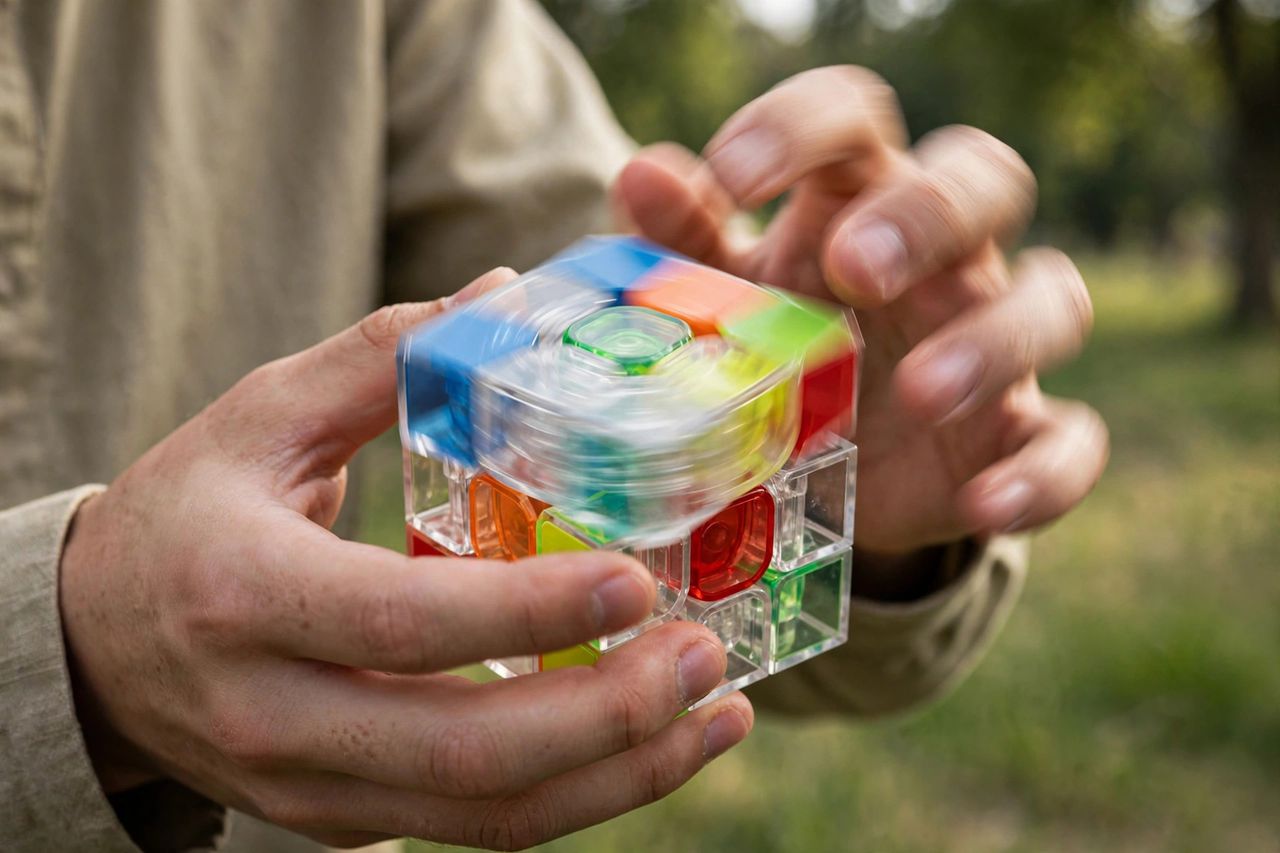
Finger tricks are the technique of turning layers with individual fingers — index-finger pushes, wrist flicks — instead of re-gripping the whole cube for every move. A re-grip costs a fraction of a second; multiply that by dozens of moves per solve and it’s the largest single source of wasted time in a beginner’s solve.
Practice the basics: pushing the upper layer with your index finger, pulling it with the same finger from the other side, and turning the right face with a wrist motion that doesn’t move your left hand at all. Drill these on a solved cube for five minutes a day. Within a couple of weeks, your hands will turn without thinking — and your times will drop without learning a single new algorithm. This is the same culture of deliberate practice you see in speedrunning, applied to a puzzle.
The CFOP Method Explained (Cross, F2L, OLL, PLL)
CFOP is the method nearly all fast cubers use, and it has four steps. Cross: solve the four edge pieces of one face in as few moves as possible. F2L (first two layers): solve the corner-edge pairs of the bottom two layers together, instead of one piece at a time. OLL (orientation of the last layer): orient all the top-face pieces so the top is one color. PLL (permutation of the last layer): move those pieces into their correct positions.
You don’t learn all four at once — that’s the whole point of the staged roadmap. The beginner method you’re using now is essentially a simplified CFOP already; each stage upgrades one step of it.
Learn 4-Look Last Layer First (2-Look OLL + 2-Look PLL)
Before touching the full algorithm sets, learn the 4-look last layer: the top face finished in at most four algorithm applications. It’s built from two halves. Two-look OLL orients the top: first the edges (3 cases, 2 algorithms), then the corners (7 cases, 7 algorithms). Two-look PLL permutes it: first the corners (7 algorithms), then the edges (4 algorithms).
Count it up: 2 + 7 + 7 + 4 = 20 algorithms. That’s the smart shortcut — twenty algorithms gets you a fast, reliable last layer, versus the full set of 78 you’ll learn later. Master these twenty until each one is automatic, and your last layer will consistently come in under 25 seconds.
Then Full PLL (21) and Full OLL (57)
Only after the 4-look layer is solid do you expand. Learn full PLL first — 21 algorithms that each solve the entire last-layer permutation in one look. Then full OLL — 57 algorithms that orient the entire last layer in one look. Together they replace your four looks with two, and each algorithm should run in about 3 seconds of recognition plus execution.
That’s 21 + 57 = 78 algorithms total. It sounds like a lot, and it is — which is why it comes last, and why each stage takes 2 to 4 weeks. Learn a few at a time, drill them into muscle memory, and don’t add new ones until the old ones are automatic. Rushing this stage is the most common way cubers stall.
F2L: Intuitive First, Algorithms Later
F2L — solving the first two layers as pairs — is where mid-level cubers gain the most. Start intuitive: learn to see a corner and its matching edge, pair them up, and insert the pair into its slot. Don’t memorize algorithms for this yet; understanding how pairs move teaches you the cube in a way memorization never will.
Once intuitive F2L is comfortable, the algorithms come as optimizations of cases you already understand. This is the 30-to-40-second stage’s main project, and it’s the one that separates smooth solvers from choppy ones.
Lookahead: Kill the Pauses
Lookahead is the skill of finding your next pieces while your hands are still finishing the current ones. Every pause in your solve — that moment you stop turning to search the cube — is lookahead failing, and killing those pauses is what turns a 25-second solver into a sub-20 solver.
Drill it deliberately: solve at half speed and force yourself to spot the next pair before the current one is inserted. It will feel slower at first — that’s normal, and it’s the point. Slow, pauseless solving trains the eyes; the speed comes back on its own, and it comes back without the pauses.
Cross Practice (12 Moves or Less)
The cross deserves its own practice because it sets up everything. Target: solve the cross in 12 moves or less, and get it under 12 seconds consistently. Plan the entire cross during inspection — before you start turning — and build it on the bottom face so there’s no flip at the end.
Advanced target: a sub-4-second cross, planned fully in inspection, with cross plus F2L together averaging 10 seconds or less. That’s the level where the solve starts before the timer does. Ten minutes of cross-only practice a day, planning each one fully before turning, builds this faster than anything else.
Set Up Your Cube: Lube, Tension, Break-In
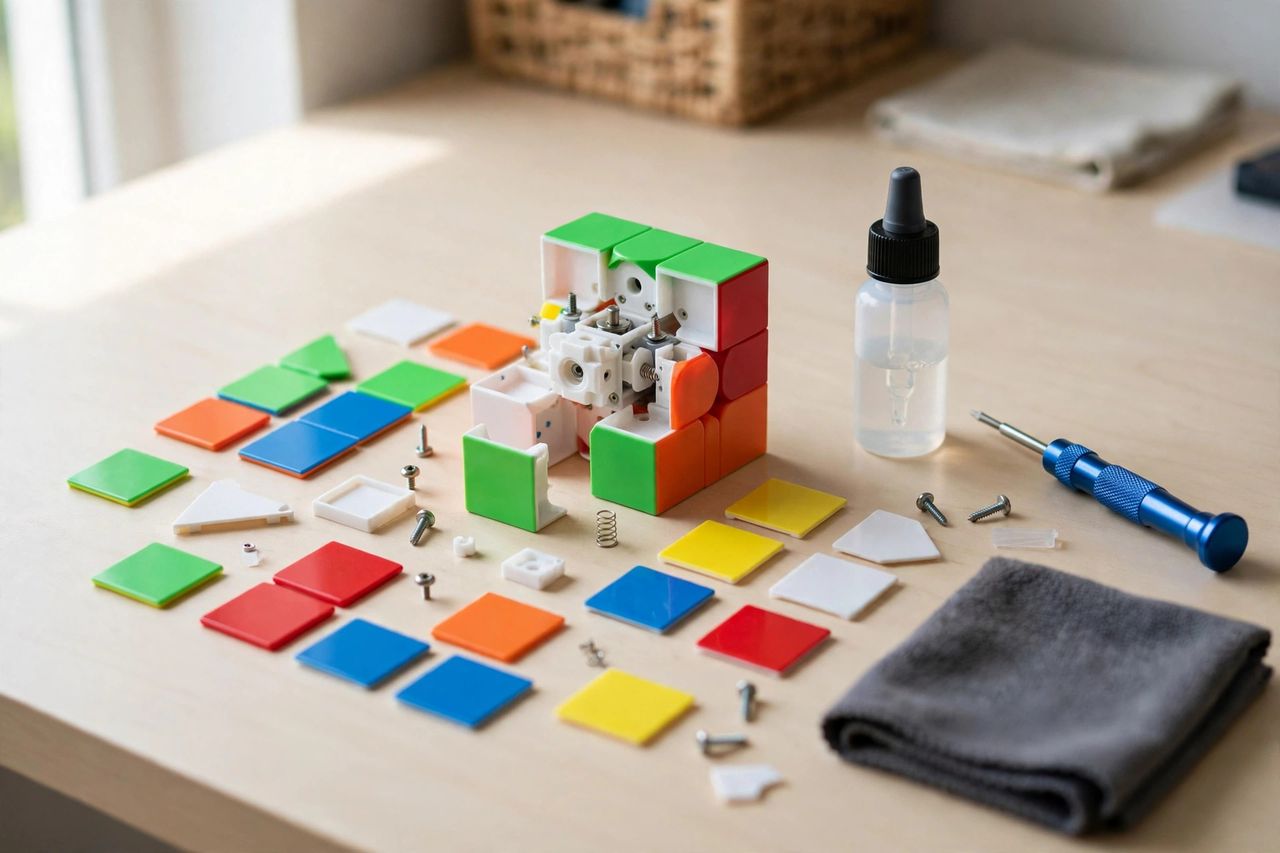
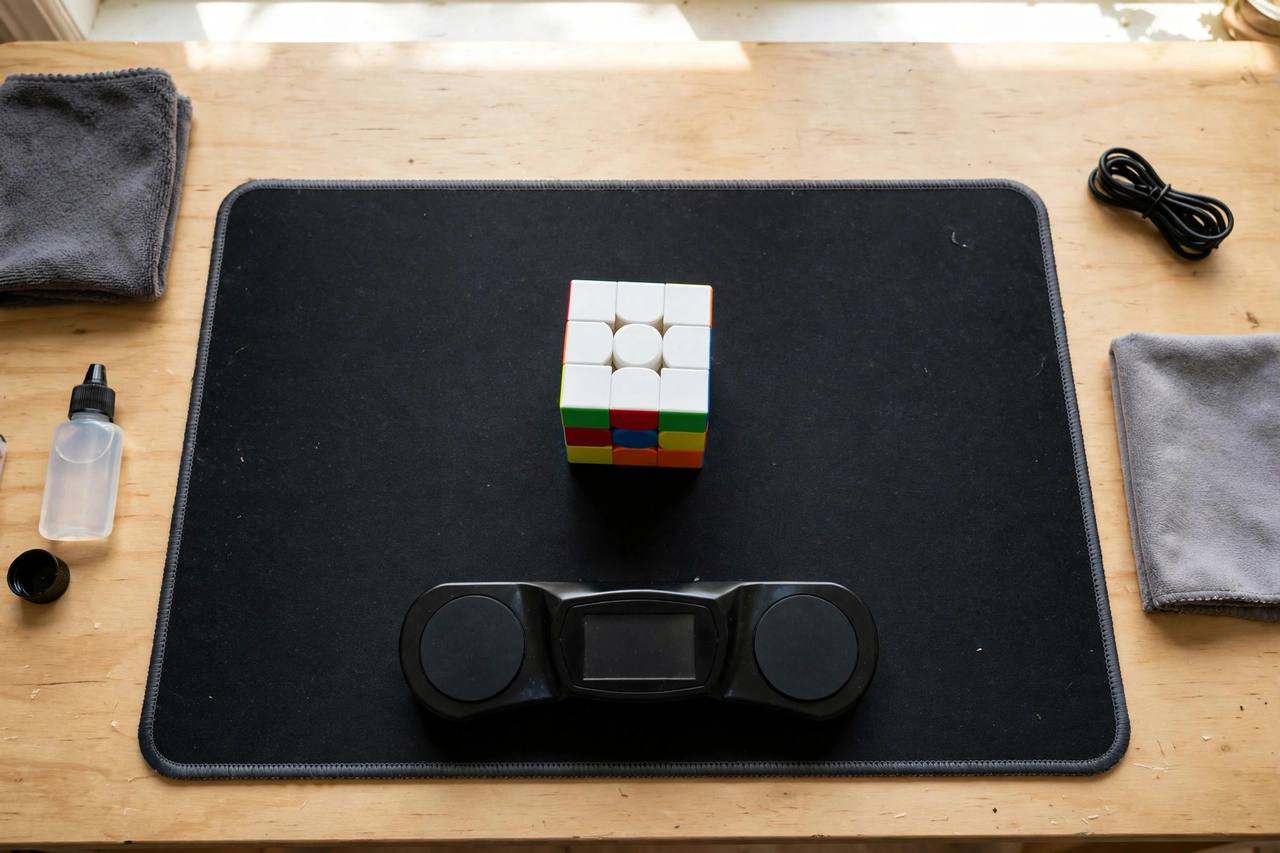
Hardware matters more than beginners expect. A good speedcube, properly set up, turns with a fraction of the effort of a stiff store-bought cube — and every bit of effort saved is speed gained. Three things make a cube fast: lubrication, tension, and break-in.
Lube the core and pieces with cube lubricant (a drop at a time — more is not better). Adjust the tension so the layers turn freely but don’t pop under fast turning; most modern cubes have adjustable screws or magnets for this. Then break it in: a few hundred solves of normal use settles the plastic and the lube into the mechanism. If puzzles are your thing beyond the cube, sudoku for beginners is a fine off-day hobby — and a family game night is where you show off the new speed.
Frequently Asked Questions
What is the fastest method to solve a Rubik’s cube?
CFOP — Cross, F2L, OLL, PLL — is the method nearly all fast cubers use. Learn it in stages: finger tricks first, then the 4-look last layer, then intuitive F2L, then full PLL (21 algorithms) and full OLL (57 algorithms).
How many algorithms do I need to solve a Rubik’s cube fast?
The 4-look last layer needs 20 algorithms total (2 + 7 for two-look OLL, 7 + 4 for two-look PLL). The full sets are 21 PLL algorithms and 57 OLL algorithms — 78 in total — but learn the 20 first and expand only when they’re automatic.
How long does it take to get fast at solving a Rubik’s cube?
Expect roughly 2 to 4 weeks of steady practice per roadmap stage. Finger tricks, the 4-look last layer, F2L, and the full algorithm sets are each their own stage — don’t skip ahead, since every stage builds the skill the next one assumes.
Do I need a special cube to solve faster?
A proper speedcube helps a lot: lubricate it, adjust the tension so layers turn freely without popping, and break it in over a few hundred solves. A stiff store-bought cube fights your hands on every turn.
What are finger tricks in speedcubing?
Finger tricks mean turning layers with individual fingers — index-finger pushes and wrist flicks — instead of re-gripping the whole cube for every move. They’re the single biggest speed gain for beginners, because re-grips waste time on nearly every move.
What is lookahead and how do I practice it?
Lookahead is spotting your next pieces while your hands finish the current ones, so the solve never pauses. Practice it by solving at half speed and forcing yourself to find the next pair before inserting the current one — slow and pauseless first, speed returns on its own.