How to Play Dungeons and Dragons for Beginners (2026 Starter Guide)

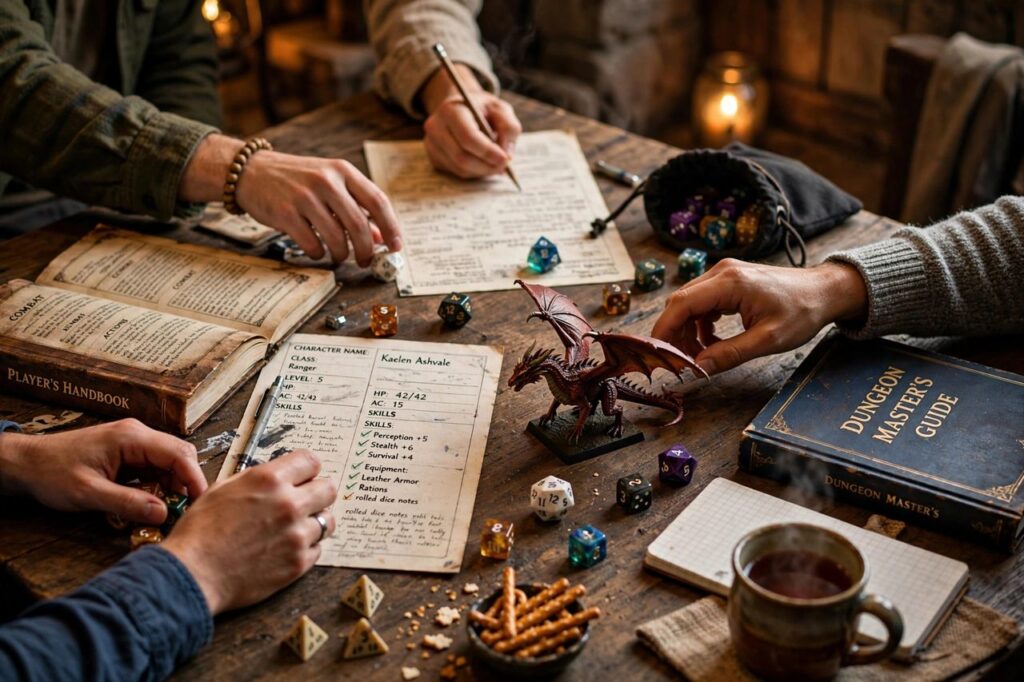
Learning how to play Dungeons and Dragons for beginners is easier than its reputation suggests. Forget the stereotype of rulebooks the size of phone directories: at its heart, D&D is collaborative storytelling where you play a hero, your friends play heroes, and one person (the Dungeon Master) plays the entire world. I’ve run games for total newcomers for years, and every single one of them “got it” within the first hour. Here’s everything you need to start.
What Is Dungeons and Dragons?
D&D is a tabletop roleplaying game first published in 1974 and currently in its 5th edition (with the revised 2024 rules now standard). One player is the Dungeon Master (DM), who narrates the world, controls monsters and non-player characters, and adjudicates the rules. Everyone else plays a single adventurer: a fighter, wizard, rogue, cleric, or one of many other classes.
The game has no board and no winning in the traditional sense. The DM describes a situation (“the goblin charges at you, sword raised”), you say what your character does (“I dive behind the crates and fire my bow”), and dice decide what happens when the outcome is uncertain. That’s the whole game, and it’s wonderful.
What You Need to Start Playing D&D
The starter checklist is shorter than you think:
- A set of polyhedral dice (d4, d6, d8, d10, d12, d20, percentile). One set per player is ideal, or use a free dice app.
- Character sheets, free from the official D&D website or any dice app.
- The basic rules, available free online. The Player’s Handbook is the full version but not required to start.
- A Dungeon Master, one willing friend. The DM does the most prep, so buy them snacks.
- 3 to 5 players total including the DM is the sweet spot for a first game.
The official D&D Starter Set is genuinely the best purchase for beginners: it includes a learn-as-you-play adventure, pre-made characters, and dice for less than the cost of a pizza night.
How to Play Dungeons and Dragons for Beginners: Creating Your First Character
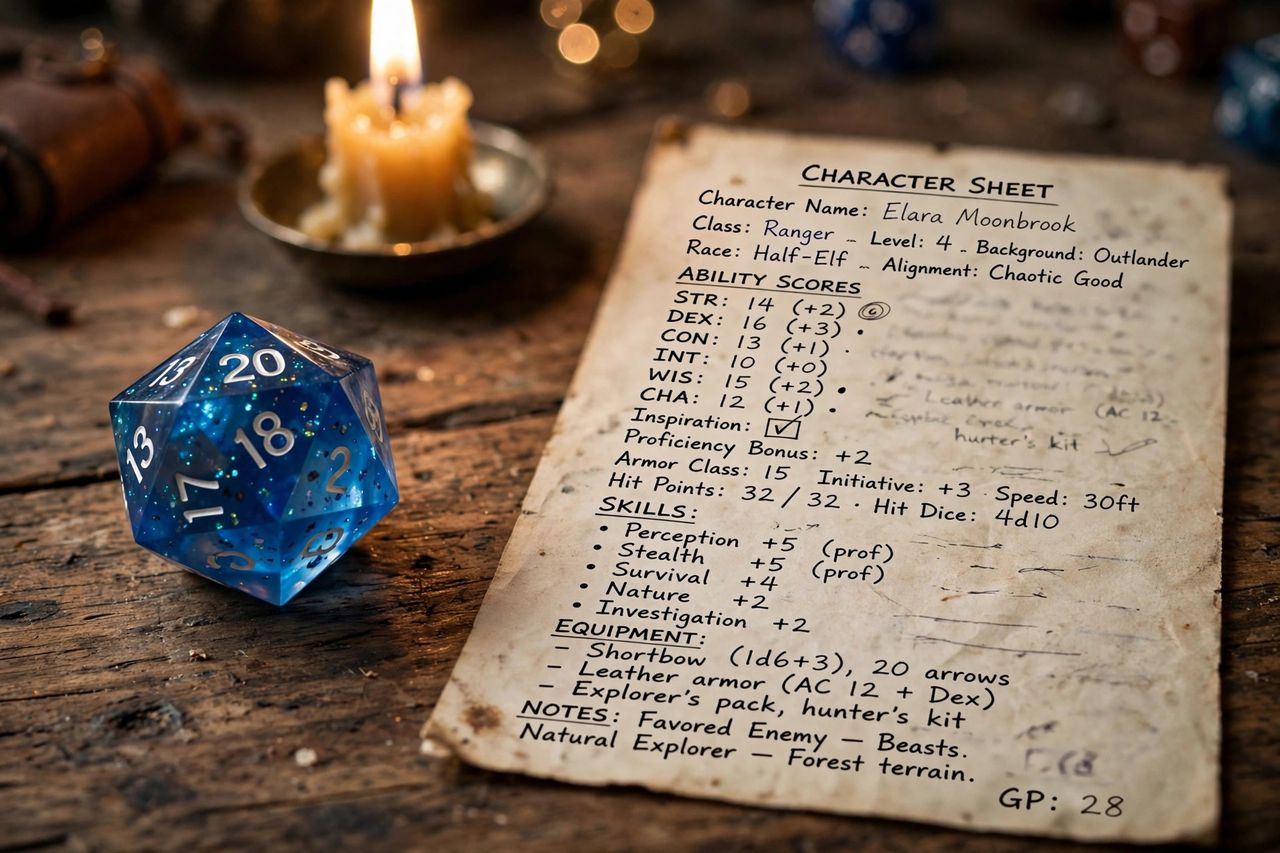
Character creation looks intimidating but follows a simple flow. For your first game, use a pre-made character or the standard array; custom builds can wait.
- Pick a race (species): Human, elf, dwarf, halfling, and more. Each gives small bonuses and flavor.
- Pick a class: Fighter (simple, tough), rogue (sneaky, skilled), wizard (powerful, fragile), cleric (healing, support). Fighters and rogues are the easiest first classes.
- Assign ability scores: Strength, Dexterity, Constitution, Intelligence, Wisdom, Charisma. These six numbers define what your character is good at.
- Choose a background: Where your character comes from. It grants skill proficiencies and roleplaying hooks.
- Pick equipment and spells: Your class starting package covers this; don’t overthink it.
Then write two sentences about who your character is as a person. That’s more important than any stat: D&D rewards characters with personality, not optimized builds.
How Rolls and Combat Work
The core mechanic: when you attempt something uncertain, roll a 20-sided die (d20), add the relevant modifier, and compare to a target number set by the DM. Roll high, succeed. This covers everything from persuading a guard to leaping a chasm.
Combat runs in rounds, with each participant acting in initiative order (a d20 roll at the fight’s start). On your turn you can move, take an action (attack, cast a spell, dash, hide), and possibly a bonus action. Attack rolls target the enemy’s Armor Class; damage is rolled on smaller dice. Don’t worry about memorizing this; your DM will walk you through your first fight, and it clicks fast.
What Actually Happens in a D&D Session
A typical 3-hour session flows like this: the DM sets a scene, players discuss and declare actions, dice resolve the uncertain moments, and the story advances. You’ll spend roughly equal time on three pillars: exploration (traveling, investigating, solving puzzles), social interaction (talking to NPCs, negotiating, deceiving), and combat (fighting monsters).
New players are often surprised how little of D&D is combat. Some of the best sessions I’ve run had zero fights: just players talking their way through a fey court or planning a heist. The game is what your table makes it.
Tips for Your First Session
- It’s okay to say “I don’t know what to do.” Ask the DM what your character would notice or what options seem available. Good DMs love this question.
- Describe intentions, not mechanics. Say “I try to calm the horse” instead of “I roll Animal Handling.” Let the DM call for rolls.
- Engage with other players’ moments. D&D is collaborative; the best players make their friends’ characters look cool too.
- Take notes. Names, places, promises made. Your future self will thank you.
- Embrace failure. Failed rolls create the best stories. Some of my favorite D&D memories are critical failures.
- Talk to your table. Before the campaign, discuss tone (serious? silly?), boundaries, and scheduling. Five minutes of honesty prevents months of friction.
Beyond the First Session: Growing as a Player
After a few sessions, new doors open. Leveling up happens through experience points or DM milestones; each level brings hit points, features, and eventually game-changing abilities. Don’t stress about “optimal” builds; a character you’re excited to play beats a theoretically perfect one every time. Feats and multiclassing (combining classes) add complexity best explored after level 4 or 5. Magic items will start appearing, and attunement rules limit how many powerful ones you can use, which keeps things balanced.
The social game deepens too. Backstory becomes fuel: good DMs weave your character’s history into the plot, so give them hooks to grab. Party roles emerge naturally, the face, the scout, the muscle, the scholar, and the best parties cover all of them without anyone being forced into a job.
Finding a D&D Group
No friends interested? You have options. Local game stores run Adventurers League nights specifically for newcomers; walking in alone is normal and expected. Online, Roll20’s game finder, Discord servers, and Reddit communities list thousands of beginner-friendly games. StartPlaying connects players with professional DMs (paid, but excellent for learning). And ask around anyway: in my experience, every friend group has two secret D&D-curious people waiting for someone else to suggest it first.
Should You Try Being the DM?
Every group needs a DM, and trying it is less scary than it looks. Start with a published one-shot adventure rather than writing your own world; the Starter Set’s adventure is designed for first-time DMs. Prep situations, not plots: create interesting NPCs, locations, and problems, then let players loose. Steal shamelessly from books, movies, and history; your players won’t mind. And remember the golden rule: the DM’s job isn’t to beat the players, it’s to make them feel like heroes who earned it.
D&D Lore in Five Minutes
You don’t need lore to play, but a little context helps. Most D&D games are set in the Forgotten Realms, a fantasy world of kingdoms, ancient magic, and gods who meddle. Key ideas: the Weave is the fabric of magic that spellcasters tap into; the planes are other dimensions (heavens, hells, the feywild) that adventures visit; and classic monsters, beholders, mind flayers, dragons, each have centuries of fictional history. Your DM will introduce what matters. The Player’s Handbook covers the essentials; everything else you absorb by playing, which is the fun way to learn it.
Common D&D Terms, Translated
New players drown in jargon, so here’s a decoder ring. DM: Dungeon Master, the storyteller/referee. PC/NPC: player character vs. non-player character. AC: Armor Class, the number attackers must beat. HP: hit points, your health. DC: Difficulty Class, the target number for a check. Initiative: turn order in combat. Short/long rest: catching your breath vs. sleeping; they restore different resources. Session zero: a pre-game meeting to discuss expectations. Murderhobo: a player who solves everything with violence (don’t be one). Learn these and you’ll follow any table conversation.
Your First Level-Up, Explained
Don’t hoard your new abilities. New players often save their shiny level-up features ‘for the right moment’ and finish the campaign never having used them. The right moment is the next session. D&D rewards bold play, and your DM designed encounters expecting you to use everything you’ve got. Burn the spell slot. Attempt the daring maneuver. That’s what the level was for.
Leveling up is simpler than it looks. When your DM says you’ve leveled, you: roll your hit die (or take the average) and add your Constitution modifier to gain hit points; check your class table for new features, most classes gain something meaningful every level; spellcasters learn new spells and gain spell slots; and at certain levels you choose an Ability Score Improvement or feat. That’s it. The Player’s Handbook lays out each class level by level, so just follow your class’s column. Pro tip: level up between sessions, not during; nothing stalls game night like twenty minutes of decision paralysis.
Frequently Asked Questions
Is D&D hard to learn?
No. The core loop (describe action, roll dice, narrate result) takes minutes to grasp. Character creation is the most complex part, and pre-made characters or digital tools remove that barrier entirely.
How many players do you need for D&D?
The ideal is 4 to 5 players plus one Dungeon Master. You can play with as few as 2 players plus a DM, though the DM will need to adjust encounters. Solo play is possible with dedicated solo rulesets.
How long is a D&D session?
Most groups play 3 to 4 hours per session, meeting weekly or biweekly. A full campaign can run for months or years, but one-shot adventures wrap up in a single session.
Do I need to buy books to play D&D?
No. The basic rules are free online, dice apps are free, and character sheets are free. The Starter Set (around $20) is the best value purchase, and the Player’s Handbook is worth it once you’re hooked.
What dice do I need for D&D?
A standard polyhedral set: d4, d6, d8, d10, d12, d20, and a percentile d10. The d20 is the workhorse; you’ll roll it more than all the others combined.
Can I play D&D online?
Absolutely. Virtual tabletops like Roll20 and Foundry handle maps and dice, D&D Beyond manages character sheets, and Discord works fine for voice. Online play is how most new players start today.