How Accurate Is Voice Recognition, Really? The Numbers

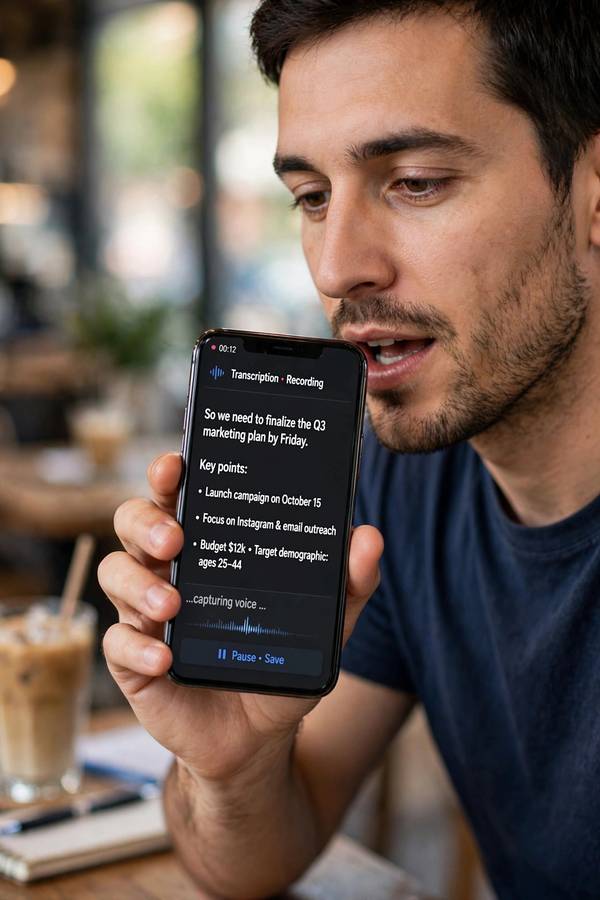
“How accurate is voice recognition?” sounds like it should have a simple answer — a percentage, a clean number. It doesn’t. The honest answer is a range, and the range is wide enough to matter: under ideal conditions, modern systems are remarkably accurate; under real-world conditions, they’re remarkably human. I’ve tested these systems in quiet studios and chaotic kitchens, and the gap between lab benchmarks and lived experience is the whole story.
This guide gives you the actual numbers — word error rates from published benchmarks — then explains why your experience varies so much, what factors move accuracy up or down, and how to interpret every accuracy claim you’ll ever see from a vendor. For the mechanics of how the transcription happens, see my guide on how voice recognition works.
The Headline Number: ~5% Word Error Rate
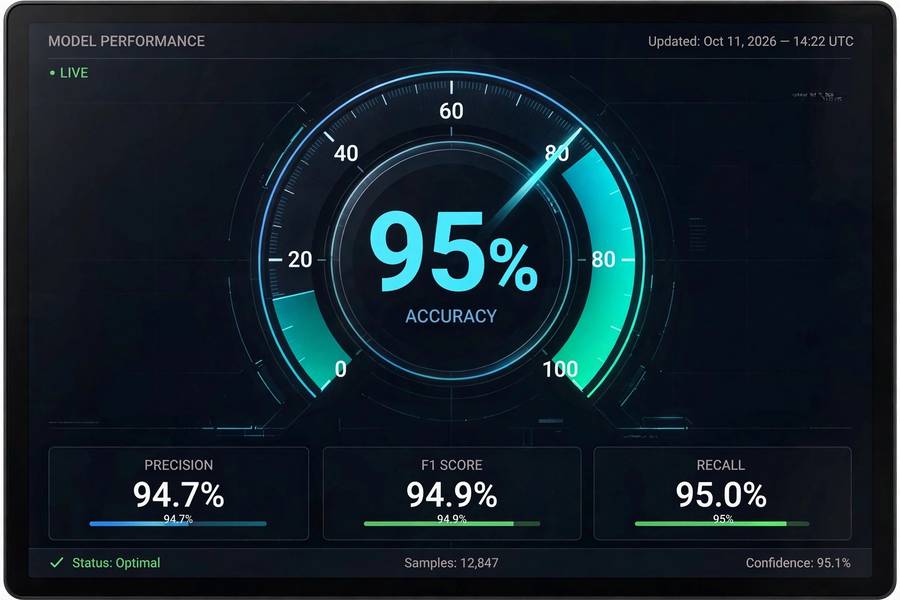
Let’s start with the number you’ll see quoted everywhere: modern speech recognition systems achieve word error rates (WER) around 5% on standard benchmarks — roughly one wrong word in twenty. Some systems on some benchmarks do better; the best published results dip toward 2-3% on clean, well-matched test sets.
For context, this is a staggering improvement. In the early 2000s, 20-30% WER was normal. In 2010, 15% was good. The deep learning revolution compressed two decades of expected progress into about five years. By the late 2010s, the major systems — from Google, Microsoft, Amazon, Apple — were all clustering in the single digits on benchmark tests.
Five percent sounds excellent. One word wrong in twenty — that’s better than most humans transcribing unfamiliar speech, right? Hold that thought, because the benchmark conditions behind that number are doing a lot of heavy lifting, and your kitchen is not a benchmark.
What Word Error Rate Actually Measures
WER is simple arithmetic: take the transcript, count substitutions (wrong word), deletions (missed word), and insertions (extra word), divide by the total words in the reference. A 5% WER means 5 errors per 100 words.
But WER treats all errors equally, and they’re not equal. Transcribing “their” as “there” is a 1-word error that barely matters. Transcribing “don’t” as “do” — also a 1-word error — reverses the meaning entirely. Deleting “not” from “do not resuscitate” is a single deletion with catastrophic consequences. WER is a useful aggregate, but it hides the errors that actually hurt.
There’s also the question of what counts as the reference. Benchmarks use careful human transcripts of clean audio. Real speech is full of disfluencies — “ums,” restarts, trailing off — that humans handle gracefully and machines transcribe literally. Is transcribing your “um” an error? The benchmark says maybe; your experience says the transcript looks wrong.
My rule: WER is good for comparing systems against each other on the same test, and bad for predicting your experience. It’s a lab instrument, not a weather forecast.
Why the Lab Number Lies to You
Benchmarks are designed to be fair, reproducible, and comparable — which means they’re designed to eliminate exactly the variables that dominate real life. Standard test sets feature: clean studio-quality audio, cooperative adult speakers reading prepared text, standard accents, minimal background noise, and complete sentences.
Your actual usage features: a phone mic in a windy parking lot, a child shouting a request over cartoons, a non-native speaker ordering food, overlapping conversation at a dinner table, mumbling at 6 AM. None of this appears in the benchmark, and all of it appears in your life.
The research literature has a name for this: the train-test mismatch, or more bluntly, the benchmark-reality gap. Models are trained and evaluated on clean data because clean data is what’s available at scale. How AI models are trained on massive datasets explains why — you need millions of hours of audio, and millions of hours of clean audio is what exists. The result: systems optimized for conditions you rarely encounter.
Real-world studies — the few that exist — suggest effective WER in everyday use runs 2-4x the benchmark numbers. That 5% becomes 10-20% the moment you leave the lab. Still impressive historically. Still far from the marketing.
The Seven Factors That Move Accuracy
Accuracy isn’t one number — it’s a function of conditions. Here are the seven factors that matter most, roughly in order of impact:
1. Background noise. The single biggest factor. Every 10dB of noise degrades accuracy measurably. A quiet room versus a busy street can be the difference between 5% and 25% WER. This is physics, not AI — the signal is literally buried.
2. Microphone distance and quality. A headset mic inches from your mouth versus a smart speaker across the room: different universes. Far-field recognition (across a room) remains substantially harder than near-field (phone to ear).
3. Accent and dialect. Systems trained predominantly on standard American English perform worse on other accents — sometimes dramatically worse. This isn’t a minor edge case; it’s a systematic gap affecting billions of speakers.
4. Speaking style. Read speech (benchmarks) versus spontaneous speech (life). Spontaneous speech has false starts, filler words, mumbling, variable pace — all accuracy killers. We don’t talk like audiobooks, and the models know it.
5. Vocabulary and domain. Common words in common contexts: excellent. Proper nouns, technical jargon, rare names: much worse. The model is a statistical machine — rare things are, by definition, harder.
6. Speaker characteristics. Age (children’s and elderly voices are underrepresented in training), speech impediments, intoxication, illness — anything that moves the voice away from the training distribution costs accuracy.
7. Overlapping speech. Two people talking at once — the classic dinner-table problem. Separating overlapping voices (the “cocktail party problem”) remains genuinely hard, and accuracy collapses when it occurs.
Notice that most of these are about the input, not the model. The models are excellent; the world is messy.

Accuracy by Use Case: A Reality Map
Different applications live at different points on the accuracy spectrum. Here’s my honest map:
Voice assistants (Siri, Alexa, Google): ~85-90% task success. Not WER — task success, because what matters is whether the command worked. Short, predictable commands in quiet homes: very good. Complex requests in noisy environments: noticeably worse.
Live captioning: Good enough to follow along, not good enough to quote. You’ll catch the meaning; you’ll also catch the errors. Fine for accessibility, risky for record-keeping.
Medical/legal transcription: The high-stakes domain, and the one where accuracy matters most. Specialized systems with domain vocabularies do well, but human review remains standard — because a 2% error rate in a medical note is a malpractice vector.
Call center analytics: Transcribing thousands of calls for sentiment and keyword analysis. Aggregate accuracy is good; individual transcript accuracy is noisy. Works because the analysis is statistical.
Voice control for accessibility: Life-changing for users who need it, and the accuracy bar is “better than the alternative” rather than “perfect.” Here, even 80% accuracy transforms lives.
The pattern: accuracy is always relative to the task’s error tolerance. A 5% WER is miraculous for captioning and unacceptable for contracts.
The Accent and Demographic Gap
This deserves its own section because it’s the accuracy story with the sharpest edges. Multiple studies have found that speech recognition performs significantly worse for Black American speakers, non-native English speakers, and speakers of regional dialects — error rates sometimes double or triple the benchmark average.
This isn’t malice; it’s data. The training corpora overrepresent standard American English from professional voice talent. The models learn what they’re shown. But the effect is a civil-rights-shaped problem: the people least served by the technology are often those who could benefit most, and the gap is invisible in the headline numbers.
The industry knows. There’s active work on diverse training data, accent-robust modeling, and better evaluation across demographics. Progress is real but slow — collecting representative data at scale is expensive, and the benchmark culture still rewards optimizing for the majority. For the broader pattern, see these AI bias examples — speech recognition is a textbook case.
If you have a non-standard accent and voice recognition frustrates you: it’s not you. It’s the training data. And you have every right to be annoyed about it.
How Vendors Inflate Their Numbers
A brief field guide to accuracy marketing, because you’ll encounter it constantly:
Cherry-picked benchmarks. “Our system achieves 3% WER” — on which test set? Vendors report their best number on their most favorable benchmark. Always ask for the test conditions.
The “human parity” claim. Several companies have claimed human-level transcription accuracy. The claim rests on comparing machine WER to human WER on the same benchmark — but human transcribers on benchmarks are often rushed crowdworkers, not careful professionals. Beat a distracted human on clean audio and declare parity: technically true, practically misleading.
Ignoring the error distribution. A 5% average can hide 30% error rates for some users. Averages are not experiences.
The demo effect. Live demos use rehearsed phrases in controlled environments. The product in your pocket meets the world unrehearsed.
My filter for vendor claims: divide the claimed accuracy improvement by two, multiply the claimed timeline by two, and ask what test set they used. You’ll rarely be disappointed by reality afterward.
Is It “Human Parity” Yet?
The honest answer: on narrow benchmarks, machines match or beat average human transcribers. In real-world conditions, humans remain far superior — and it’s not close.
Humans bring things machines don’t: world knowledge that resolves ambiguity (“he said ‘bank’ — river or finance?”), the ability to ask for clarification, lip-reading and visual context, adaptation to a new accent within minutes, and graceful handling of overlapping speech. A human transcriber in a noisy room with an unfamiliar accent will outperform any machine, because humans are general intelligences doing a specific task while machines are specific intelligences hitting their limits.
The parity debate also misses the point. The question isn’t whether machines transcribe like humans — it’s whether they’re good enough for the task. For most consumer tasks, yes, comfortably. For high-stakes professional transcription, as an assistant to humans, yes. As a replacement for humans where errors matter: not yet, and “yet” is doing heavy lifting.
Voice recognition accuracy is a genuine triumph — one wrong word in twenty, in the lab, from a machine, is miraculous by historical standards. Just remember the lab isn’t your life, the average isn’t your experience, and the benchmark isn’t the product. Judge the technology by your use case, under your conditions, with your voice. That’s the only accuracy number that matters.

Frequently Asked Questions
Modern systems achieve around 5% word error rate (one wrong word in twenty) on clean benchmark tests — a huge improvement from 20-30% in the early 2000s. Real-world accuracy is typically 2-4x worse due to noise, accents, and spontaneous speech, putting everyday effective error rates around 10-20%.
Word error rate counts substitutions, deletions, and insertions divided by total words in the reference transcript. It’s the standard metric for comparing speech recognition systems, but it treats all errors equally — so it hides the fact that some errors (like dropping “not”) matter far more than others.
Training data overrepresents standard American English, so models perform worse on underrepresented accents and dialects — sometimes with double or triple the error rate. It’s a data problem, not a user problem, and the industry is working on more diverse training data and better cross-demographic evaluation.
On narrow clean-audio benchmarks, machines match average human transcribers. In real-world conditions — noise, accents, overlapping speech — humans remain far superior thanks to world knowledge, visual context, and rapid adaptation. For most consumer tasks the technology is good enough; for high-stakes transcription, human review remains standard.
Background noise is the biggest factor, followed by microphone distance and quality, accent and dialect match to training data, spontaneous versus read speech, vocabulary rarity, speaker characteristics like age, and overlapping speech. Most accuracy problems come from messy input, not weak models.
Keep reading: