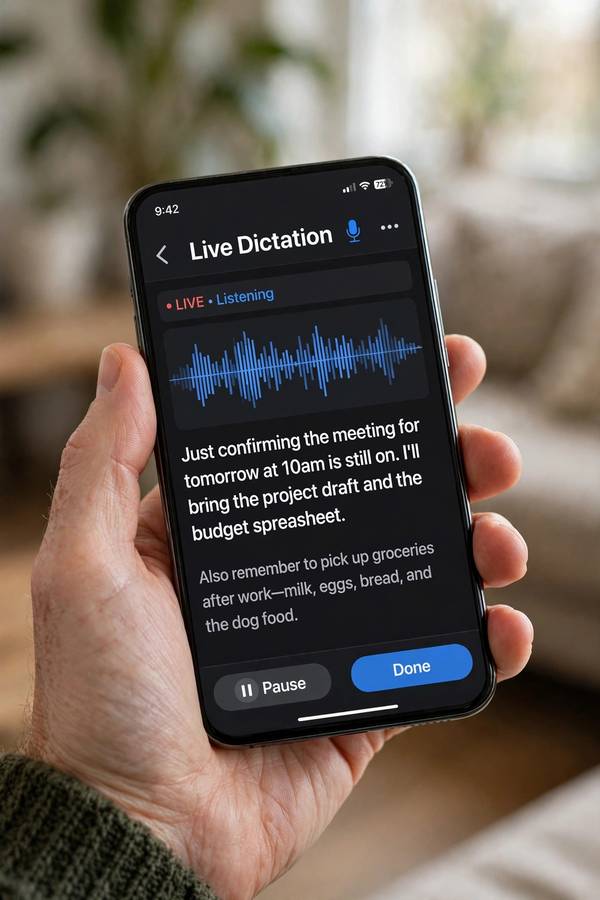
Put your phone in airplane mode, open the keyboard, tap the microphone, and dictate a message. It works — fast, accurate, no internet required. That little miracle is the result of one of the most impressive engineering achievements in consumer AI: squeezing speech recognition that once required a data center onto a chip in your pocket. I think on-device voice recognition is underappreciated precisely because it works so seamlessly — the best engineering is invisible.
This guide explains how phones pull it off: the neural engine hardware, the compressed models, the full pipeline from mic to text, and the tradeoffs versus cloud processing. For the general principles, see my guide on how voice recognition works.
Table of Contents
- The Hardware: Your Phone Is an AI Computer
- Squeezing a Data Center Into Your Pocket
- The On-Device Pipeline, Stage by Stage
- Dictation vs. Assistant: Two Different Jobs
- Personalization: Your Phone Learns Your Voice
- On-Device vs. Cloud: The Tradeoffs
- What Happens in Airplane Mode
- The Battery and Heat Budget
- Where Phone Voice Recognition Is Heading
- Frequently Asked Questions
The Hardware: Your Phone Is an AI Computer
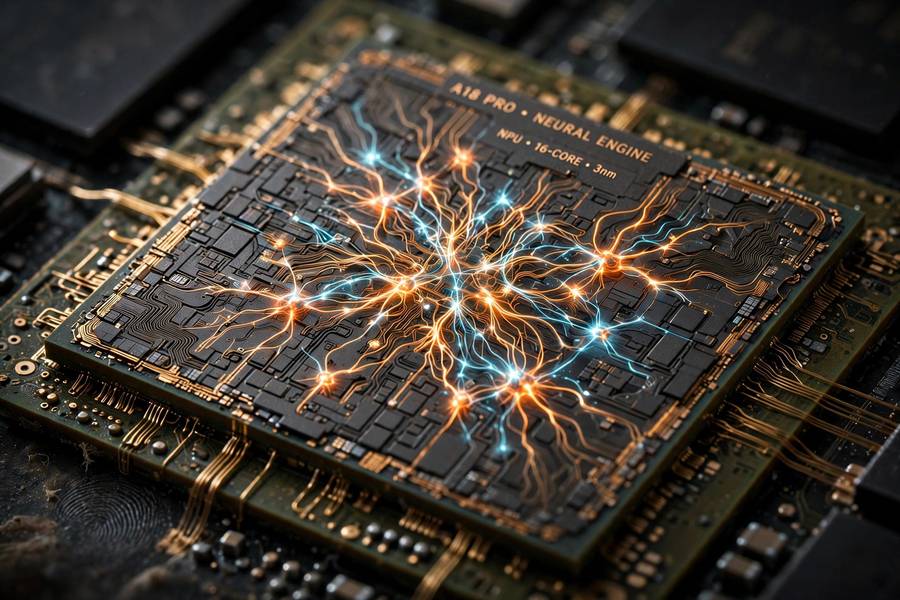
The unsung hero of on-device voice recognition is the neural processing unit — Apple’s Neural Engine, Qualcomm’s Hexagon, Google’s Tensor NPU. These are dedicated chips (or dedicated blocks within the system-on-chip) designed for one thing: running neural networks fast and efficiently.
To appreciate what they do, consider the numbers. A modern phone NPU performs tens of trillions of operations per second (TOPS) — comparable to data-center GPUs from just a few years ago — while consuming a fraction of the power. Speech recognition is computationally intense: the acoustic model alone evaluates millions of parameters against audio frames arriving every 10 milliseconds. Doing that in real time, on battery, without melting the phone, requires hardware designed for exactly this workload.
The NPU doesn’t work alone. The audio pipeline starts with the digital signal processor (DSP) handling microphone input and noise suppression, then hands features to the NPU for the neural network inference, with the CPU orchestrating. It’s a division of labor across specialized silicon — the phone as a tiny heterogeneous supercomputer.
This hardware exists in every flagship phone sold today, and increasingly in mid-range devices. The capability floor keeps rising: what required a server rack in 2015 runs on a $300 phone in 2026.
Squeezing a Data Center Into Your Pocket
The models that transcribe your speech in the cloud are enormous — billions of parameters, gigabytes of memory. Your phone can’t run those. So how does on-device recognition work at all? Through compression techniques that shrink models 10-100x with minimal accuracy loss:
Quantization reduces the precision of the model’s numbers — from 32-bit floats to 8-bit or even 4-bit integers. It’s like rounding every measurement in a blueprint: you lose a little precision, but the building still stands. Modern quantization-aware training produces 8-bit models nearly indistinguishable from their full-precision parents.
Pruning removes the model’s least important connections — the neural equivalent of trimming dead branches. Large networks are surprisingly redundant; you can delete 50-90% of parameters and recover the accuracy with brief retraining.
Knowledge distillation trains a small “student” model to mimic a large “teacher” model. The student learns not just the right answers but the teacher’s reasoning patterns, achieving much of the teacher’s accuracy at a fraction of the size.
Architecture search designs models specifically for mobile constraints — fewer layers, efficient operations, streaming-friendly structures that process audio incrementally rather than waiting for complete utterances.
The result: on-device models with hundreds of millions of parameters (versus billions in the cloud) that achieve remarkably close accuracy for typical use. The gap exists — cloud models still win on hard cases — but for everyday dictation and commands, you’d struggle to tell the difference.
The On-Device Pipeline, Stage by Stage
Here’s what happens between your mouth and the transcribed text, all on your phone:
1. Capture. The phone’s microphones (usually 2-4) pick up your voice. Beamforming focuses on your direction; noise suppression cleans the signal. Phones have an advantage here — the mic is close to your mouth, giving clean near-field audio that smart speakers envy.
2. Feature extraction. The DSP converts raw audio into features — typically mel-frequency cepstral coefficients or log-mel spectrograms, computed every 10ms. These features represent what the audio sounds like in a form neural networks digest efficiently.
3. Acoustic modeling. The NPU runs the acoustic model: given the audio features, what sounds (phonemes) are being spoken, and with what probability? This is the core pattern-recognition step, evaluating the compressed neural network in real time.
4. Language modeling. The language model scores word sequences by likelihood — “recognize speech” beats “wreck a nice beach” because it’s more probable in context. On-device language models are smaller than cloud versions but personalized (more on that below), which compensates.
5. Decoding. The decoder combines acoustic and language model scores to find the most likely word sequence — the actual transcript. Modern systems do this streaming, producing words as you speak rather than waiting for you to finish.
6. Post-processing. Punctuation restoration, capitalization, formatting (“twenty dollars” → “$20”) — the polish that makes transcripts readable rather than raw.
Total latency: often under 300 milliseconds from speech to text appearing. That’s the NPU, the compressed models, and the streaming architecture working together. How AI models are trained at cloud scale produces the teachers; distillation and quantization produce the students that live in your pocket.
Dictation vs. Assistant: Two Different Jobs
Your phone does two distinct voice jobs, and they’re architecturally different:
Dictation (the keyboard microphone) is pure speech-to-text. Audio in, text out, inserted at the cursor. It’s the simpler task — no understanding required, just accurate transcription. Modern phone dictation is excellent because the task is well-bounded and the models are optimized for exactly this.
Voice assistant (“Hey Siri,” “OK Google”) adds understanding and action on top of transcription. The pipeline extends: transcribe, extract intent, execute, respond. The assistant can do more but has more ways to fail — and the on-device versus cloud split matters more, because understanding benefits disproportionately from large models.
The interesting trend: dictation is going fully on-device everywhere (it’s a solved-enough problem), while assistants remain hybrid — on-device for the routine, cloud for the complex. Your phone is quietly becoming two systems: a local transcriber that’s always available and a cloud-connected assistant for heavy lifting.

Personalization: Your Phone Learns Your Voice
The most underrated advantage of on-device processing is personalization. Because your data stays on your phone, the system can learn aggressively about you without privacy concerns:
Voice profile. The phone builds an acoustic profile of your voice — your pitch, accent, speaking rate — and uses it to normalize recognition. It’s why the system gets better at understanding you specifically over weeks of use.
Vocabulary adaptation. Your contacts’ names, your slang, the technical terms you use at work — the on-device language model upweights words from your messages, emails, and documents. When you dictate “Meeting with Priya about the Kubernetes migration,” the system knows those words because they’re your words.
Federated improvement. Some vendors use federated learning: your phone computes model improvements from your usage locally, then shares only the encrypted updates (not your data) to improve the global model. Your voice stays home; the collective model gets smarter.
This personalization is the quiet reason phone dictation often outperforms generic cloud transcription for individual users. The model isn’t just a good transcriber — it’s your transcriber, tuned to your voice and vocabulary over months of use.
On-Device vs. Cloud: The Tradeoffs
The honest comparison:
On-device wins on: latency (no network round-trip — often 2-3x faster), privacy (audio never leaves the phone), offline availability (airplane mode, dead zones, foreign countries), and cost (no server infrastructure per request).
Cloud wins on: model size (billions versus hundreds of millions of parameters), update speed (new models deploy server-side instantly), hard cases (heavy accents, rare vocabulary, noisy audio), and context (access to vast knowledge for understanding).
For dictation and routine commands, on-device is now good enough that the cloud advantage rarely matters. For open-ended conversation and complex understanding, the cloud still leads — which is why assistants stay hybrid.
The trajectory favors on-device: phone NPUs get more powerful every generation, compression techniques improve, and the “good enough” threshold for most tasks was crossed a while ago. The cloud retains the frontier — the hardest 10% of cases — but the frontier keeps shrinking as a fraction of total usage.
What Happens in Airplane Mode
The airplane mode test is the cleanest demonstration of on-device capability. With radios off:
- Dictation: works fully. Transcription is entirely local.
- “Hey Siri” / wake word: works. The detector is on-device.
- Siri commands: device-local actions work (timers, settings, on-device smart home). Anything needing the network fails gracefully.
- Google Assistant: basic functions work on-device; complex queries need connectivity.
- Alexa app: essentially non-functional — it’s a cloud terminal.
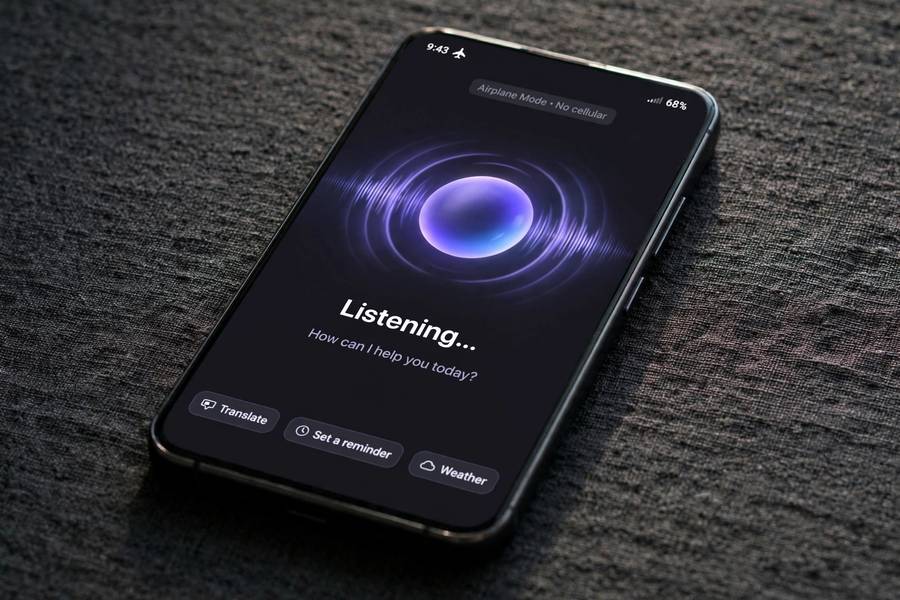
Try it yourself: airplane mode, dictate a paragraph, watch the words appear in real time. That experience — a supercomputer in your pocket, working for you, telling no one — is the culmination of a decade of hardware and software progress. It’s also, not coincidentally, the most private way to use voice recognition: what never leaves the device can’t be breached, subpoenaed, or reviewed.
The Battery and Heat Budget
A word on the physical constraints, because they’re the invisible hand shaping everything. Running neural networks continuously is expensive in power and heat. Phone designers budget carefully:
The wake-word detector runs on an always-on low-power island — microwatts, essentially free. Active transcription uses the NPU at moderate power — noticeable but sustainable for dictation sessions. The phone gets warm during long dictation, not hot; the thermal design accounts for it.
This budget is why the pipeline is staged rather than always-on-full-power. The bouncer (wake word) sips power; the full system only spins up when needed. It’s also why cloud offloading persists for hard tasks — sometimes it’s more efficient to send audio to a data center than to burn battery running a giant model locally. Engineering is the art of the tradeoff, and the battery is the ultimate constraint.
Where Phone Voice Recognition Is Heading
Three directions I’m watching:
Bigger on-device models. As NPUs approach 100+ TOPS in flagship phones, the on-device/cloud accuracy gap narrows further. The “hard cases” that need the cloud shrink to genuine edge cases.
Multimodal on-device. Voice plus camera plus context — the phone understanding not just your words but what you’re looking at, where you are, what you’re doing. The sensors are already there; the models are catching up.
Ambient computing. The phone as an always-available transcription and understanding layer — live captions for every conversation, real-time translation, meeting notes generated silently. The technology exists; the product and privacy design are the frontier. How text-to-speech works on-device completes the loop — full duplex voice interaction without the cloud.
The destination is a phone that hears, understands, and speaks entirely locally — a personal AI that works everywhere, tells no one, and never needs permission from a data center. We’re closer than most people realize. Airplane mode already proves it.
Frequently Asked Questions
Phones use dedicated neural processing units (NPUs) to run compressed speech recognition models entirely on-device. The pipeline — audio capture, feature extraction, acoustic modeling, language modeling, and decoding — runs locally in under 300 milliseconds, which is why dictation works in airplane mode.
Yes. Modern phone dictation runs fully on-device using the neural engine, so it works in airplane mode, dead zones, and foreign countries. Voice assistants are hybrid — local actions work offline, but anything needing web data requires connectivity.
For typical dictation and routine commands, on-device accuracy is now very close to cloud accuracy thanks to model compression techniques like quantization and distillation. Cloud models still lead on hard cases — heavy accents, rare vocabulary, very noisy audio — but the gap keeps narrowing.
On-device personalization builds an acoustic profile of your voice and adapts the language model to your vocabulary — your contacts’ names, slang, and work terminology. Because this happens locally, it improves accuracy without sending your voice data anywhere.
Not significantly. The always-on wake-word detector uses negligible power on a dedicated low-power processor, and active transcription uses the efficient neural engine. The phone may get warm during long dictation sessions, but the power budget is designed for regular use.