

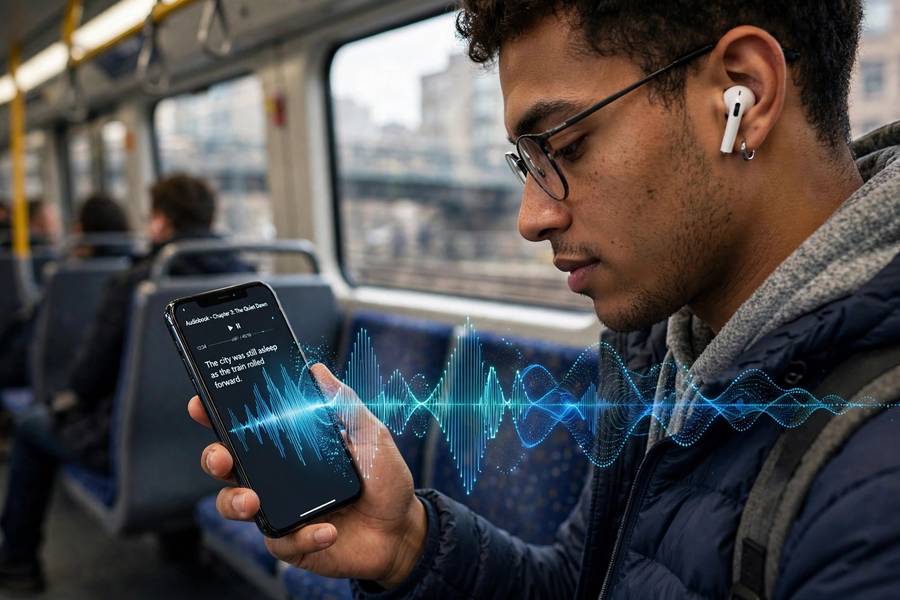
The voice reading your audiobook, announcing your train stop, or narrating that video didn’t come from a recording studio — at least, not exactly. It came from text-to-speech (TTS): AI that converts written text into spoken words. And in the last few years, it went from robotic to remarkably human.
I’ve tested TTS systems across the quality spectrum, from phone accessibility features to studio-grade voice cloning. Here’s how the whole thing works, why modern voices sound so natural, and where the technology is heading.
Table of Contents
- The Short Answer
- The Old Way: Robotic Concatenation
- The Modern Pipeline: Three Stages
- Stage 1: Text Analysis
- Stage 2: The Acoustic Model
- Stage 3: The Vocoder
- Why Modern TTS Sounds Human
- Voice Cloning: How It Works
- Where TTS Shows Up in Your Life
- Limitations and Concerns
- Frequently Asked Questions

The Short Answer
Text-to-speech converts written text into spoken audio in three stages: text analysis (understanding the words, pronunciation, and phrasing), an acoustic model (an AI that predicts what the speech should sound like — pitch, rhythm, tone), and a vocoder (which turns those predictions into actual audio waveforms). Modern AI-based TTS sounds human because neural networks learn the subtle patterns of real speech instead of stitching together recorded fragments.
The Old Way: Robotic Concatenation
To appreciate modern TTS, you need to hear the old stuff in your memory. Early text-to-speech worked by concatenation: recording a human speaking thousands of speech fragments, then gluing them together to form new sentences.
Imagine building sentences from refrigerator magnets — you have all the pieces, but the result sounds… assembled. That’s exactly what concatenative TTS sounded like: every word correct, every transition slightly wrong. The rhythm was off, the emphasis was random, and proper nouns were a disaster.
It worked for accessibility and announcements, but nobody mistook it for a person. The fundamental limit: you can only say what your recorded fragments allow, and the joins always show.
The Modern Pipeline: Three Stages
Today’s neural TTS doesn’t assemble recordings — it generates speech, the way image AI generates pictures. The pipeline has three stages, and understanding them explains both the quality and the quirks.
Stage 1: Text Analysis
Before any sound is made, the system has to understand the text deeply:
Normalization. Raw text is messy. “Dr. Smith paid $1,234.56 on 10/5” needs to become speakable words: “Doctor Smith paid one thousand two hundred thirty-four dollars and fifty-six cents on October fifth” (or May tenth, depending on locale — genuinely ambiguous). Numbers, dates, abbreviations, URLs, and symbols all get expanded.
Phonetic conversion. Words become phonemes — the distinct sounds of speech. “Through” becomes /θ r uː/. This step handles the fact that English spelling and pronunciation are barely related. Most systems use a pronunciation dictionary for common words and a neural model to guess the rest.
Prosody prediction. This is the secret sauce: predicting how something should be said. Which words get emphasis? Where do pauses go? Does the pitch rise at the end (a question) or fall (a statement)? Get this wrong and you get the old robotic feel even with perfect pronunciation.
Modern systems do all three with neural models trained on enormous amounts of text-speech pairs — the same training approach I describe in how AI models are trained, applied to the text-to-audio problem.
Stage 2: The Acoustic Model
The acoustic model is the creative core. Given the analyzed text (phonemes + prosody features), it predicts the acoustic characteristics of the speech: essentially a detailed blueprint of what the sound should be like at each moment — pitch contours, energy, timing, spectral features.
Think of it as a composer writing a score. It doesn’t produce sound yet; it produces precise instructions for sound: “start at this pitch, rise here, hold this vowel for 200 milliseconds, add breathiness there.”
The breakthrough of the last few years: these models learned to capture the micro-variations that make speech sound alive — the tiny hesitations, the breath sounds, the way emphasis shifts meaning. Older systems produced the “average” of all speech, which sounded dead. Modern models reproduce the texture.
This is also where voice identity lives. The acoustic model learns a representation of a specific voice — its timbre, its habits, its personality — which is what makes voice cloning possible.
Stage 3: The Vocoder
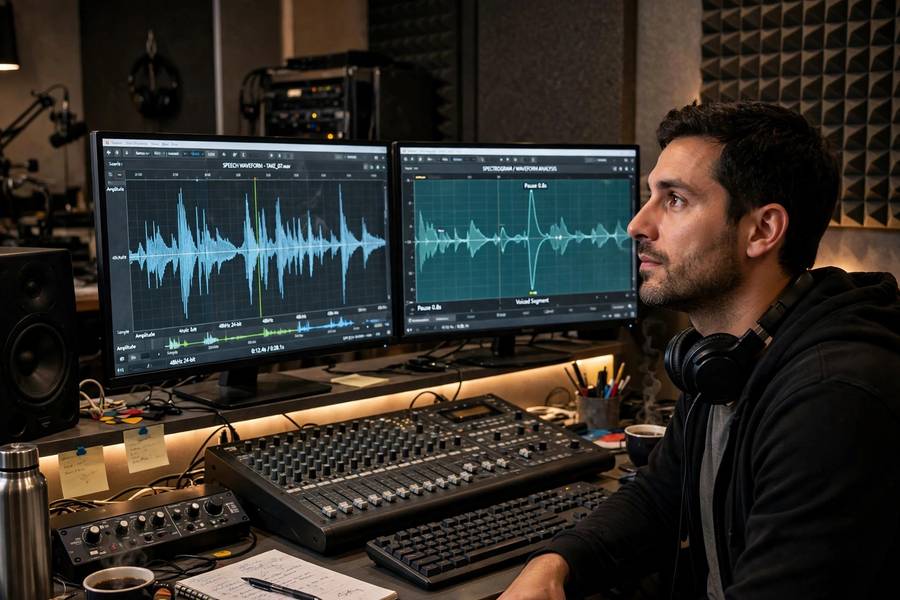
The vocoder takes the acoustic blueprint and renders actual audio — converting abstract features into a waveform your speakers can play. It’s the difference between sheet music and a performance.
Early neural vocoders were slow (generating audio sample by sample, thousands per second). Modern ones generate in parallel and run in real time on a phone. The quality jump here was as important as the acoustic model: a great blueprint with a bad renderer still sounds bad.
The full chain — text analysis → acoustic model → vocoder — now runs end-to-end in many systems, with the stages blending into one large neural network. Fewer seams, more natural output.
Why Modern TTS Sounds Human
Three reasons, honestly:
- Data scale. Models train on tens of thousands of hours of speech — every accent, emotion, and speaking style. They’ve heard more human speech than any human.
- Prosody modeling. The old systems got words right and music wrong. Neural models learned the music — rhythm, emphasis, emotion — which is most of what our brains use to judge “human.”
- End-to-end learning. Fewer hand-built stages means fewer places where human assumptions flatten the output. The model discovers subtleties engineers never coded.
The result: I regularly can’t distinguish good TTS from recordings in casual listening. That’s a genuine milestone — and a genuine concern, which I’ll get to.
Voice Cloning: How It Works
The most startling TTS capability: cloning a voice from a short sample. Here’s the simplified version:
The system analyzes a few seconds to a few minutes of someone’s speech and extracts a speaker embedding — a compact numerical representation of what makes that voice distinctive. Then the acoustic model generates new speech conditioned on that embedding: same words it would speak for anyone, but in that voice.
Quality scales with sample length: 3 seconds gives a rough impression, 3 minutes gives something close, longer samples capture more nuance. The best systems need surprisingly little.
Legitimate uses are wonderful: restoring voices for people who’ve lost theirs, dubbing content into other languages while preserving the actor’s voice, personalizing accessibility tools. The misuse potential — fraud, impersonation, misinformation — is equally real, and it’s why reputable providers now require consent verification for cloning.
Where TTS Shows Up in Your Life
More places than you probably notice:
- Accessibility. Screen readers for visually impaired users — the original and still most important application.
- Audiobooks and podcasts. A growing share of audio content is AI-narrated, especially for back catalogs and articles.
- Voice assistants. Every “smart” speaker is TTS on the output side.
- Navigation and announcements. Maps, transit systems, airport announcements.
- Content creation. Video narration, e-learning, marketing — anywhere voiceover was expensive or slow.
- Customer service. Phone systems that don’t sound like phone systems anymore.
- Language learning. Hearing correct pronunciation on demand, in any language.
Limitations and Concerns
Honest assessment, as always:
Emotional range is still limited. TTS does “neutral professional” brilliantly and genuine emotion unconvincingly. Subtle acting — irony, grief, excitement — remains human territory.
Long-form consistency drifts. Over very long passages, prosody can wander. Chapter 12 might not sound quite like Chapter 1.
Misuse is real. Voice cloning scams (“grandparent scams” using a grandchild’s cloned voice) are already happening. Verify unexpected voice calls through another channel, and consider a family code word.
Consent and rights. Who owns a voice? Can a company clone a voice actor’s voice after their contract ends? Lawsuits are actively defining this. It’s messy.
The uncanny valley of disclosure. AI-narrated content should be labeled. Most reputable platforms now require it. If you’re publishing TTS audio, disclose it — trust matters.
TTS is one of the most practical AI tools most people use daily without noticing — worth exploring the rest of the toolbox while you’re here.

Frequently Asked Questions
Text-to-speech works in three stages: text analysis (converting raw text to phonemes and predicting phrasing and emphasis), an acoustic model (an AI that predicts what the speech should sound like — pitch, rhythm, tone), and a vocoder (which turns those predictions into an actual audio waveform). Modern neural TTS generates speech rather than assembling recordings.
Three reasons: massive training data (tens of thousands of hours of speech), neural prosody modeling (learning rhythm, emphasis, and emotion — the “music” of speech), and end-to-end learning with fewer hand-built stages. The models reproduce the micro-variations that make speech sound alive rather than the “average” of all speech.
Voice cloning analyzes a sample of someone’s speech (seconds to minutes) and extracts a speaker embedding — a numerical representation of what makes that voice distinctive. The TTS acoustic model then generates new speech conditioned on that embedding. Longer samples produce more accurate clones. Reputable providers require consent verification.
A vocoder converts the acoustic model’s abstract predictions (pitch contours, spectral features, timing) into an actual audio waveform your speakers can play. It’s the final rendering stage — like the difference between sheet music and a performance. Modern neural vocoders run in real time, even on phones.
Using TTS itself is legal, but voice cloning raises consent and rights issues — who owns a voice, and can it be cloned without permission? Laws are still developing, with active lawsuits defining the boundaries. Best practice: get consent for cloning real voices and disclose AI narration in published content.
It’s getting hard — good TTS is often indistinguishable in casual listening. Clues include slightly off emotional delivery, prosody that drifts over long passages, and unnatural handling of unusual words. For important matters (like unexpected calls from family), verify through another channel rather than trusting the voice alone.