“Is it listening to me right now?” I’ve been asked this more times than I can count, usually with a glance at the smart speaker on the shelf. The honest answer is more nuanced than the question allows — and more interesting. Voice recognition privacy isn’t a simple yes-or-no story. It’s a layered system of technical architectures, corporate policies, and genuine tradeoffs, with real risks that deserve real attention rather than vague anxiety.
I want to cut through both the paranoia and the complacency. The paranoia says every device is recording everything for advertisers. The complacency says the companies pinky-promised, so it’s fine. The reality: the technology’s privacy properties vary enormously by product and architecture, the documented incidents are instructive, and you have more control than you think — if you know where the levers are. For the technical background, see how voice recognition works.
Table of Contents
- What “Listening” Actually Means
- What’s Recorded, and When
- Where Your Voice Goes
- The Human Reviewers
- The Documented Incidents
- The Architecture Divide: On-Device vs. Cloud
- What Companies Actually Do With Voice Data
- The Risks That Deserve Your Attention
- How to Lock Down Your Devices
- Frequently Asked Questions
What “Listening” Actually Means
The confusion starts with the word “listening.” Your smart speaker is always monitoring audio for its wake word — that’s how “Hey Siri” or “Alexa” works without a button press. But monitoring is not recording, and recording is not transmitting.
Here’s the technical reality: a tiny, low-power processor runs a wake-word detection model against a rolling audio buffer — typically a few seconds, constantly overwritten. Nothing is stored. Nothing leaves the device. The buffer exists only so the system can capture the moments before the wake word, avoiding clipped commands. It’s the difference between a guard dog that barks at a specific sound and a surveillance camera recording everything.
When the wake word is detected, the device transitions to active capture — now it is recording, and (depending on architecture) transmitting. The light ring glows, the screen shows the waveform — every major product signals this transition visibly. That signal is doing real privacy work: it tells everyone in the room that the device’s state has changed.
So “is it listening?” — yes, in the monitoring sense, always. “Is it recording me?” — only after the wake word (or a false trigger), and you can see when that happens. The distinction matters because the mitigations are different: monitoring is constrained by hardware design, while recording is governed by software policy.
What’s Recorded, and When
When your device enters active capture, it records your voice command — the utterance following the wake word, until endpoint detection decides you’ve finished. That recording is the raw material for everything downstream: transcription, understanding, action.
What’s stored afterward varies by vendor and your settings:
Amazon (Alexa): Voice recordings are stored in the cloud by default, associated with your account. You can review, listen to, and delete them in the Alexa app. Amazon also offers auto-delete options (3 months, 18 months) — which I’d recommend enabling.
Google: Audio recordings are stored by default for many users, though Google has moved toward shorter retention and more prominent controls. You can review and delete in My Activity.
Apple (Siri): The outlier — speech recognition happens on-device, so voice audio for most requests never leaves your phone. Apple stores some anonymized data for Siri improvement, with identifiers removed, and you can opt out of contributing.
The retention question is where policy meets architecture. Cloud-processed audio must exist on servers transiently to be processed; whether it’s retained is a product decision. Retention enables features and creates risks — there’s no free lunch, just tradeoffs you should make consciously.
Where Your Voice Goes
Follow a cloud-processed command’s journey: your Echo captures audio, encrypts it, and streams it to Amazon’s servers. There it’s decrypted, transcribed by speech recognition models, analyzed for intent, acted upon, and the response is generated and streamed back. The audio file may then be stored (per your retention settings) in Amazon’s infrastructure.
Each hop is a privacy surface. Transmission could theoretically be intercepted (it’s encrypted, but encryption has limits). Server storage could be breached. Internal access could be abused. Legal process could compel disclosure. None of these are hypothetical in the abstract — every one has occurred in the tech industry generally, if not always with voice data specifically.
The on-device alternative collapses this journey: audio is captured, processed, and discarded on your phone. No transmission, no server storage, no breach surface for the audio itself. This is why architecture matters more than promises — a system designed to not have your data can’t leak, lose, or be compelled to surrender what it doesn’t have. Promises can change; architecture is harder to quietly revise.
The Human Reviewers
In 2019, reporting revealed that Amazon, Google, Apple, and Microsoft all used human contractors to listen to anonymized voice assistant recordings to improve their models. The public reaction was volcanic — people hadn’t realized humans were in the loop.
Let’s be fair about why human review exists: it’s the highest-quality training signal available. Automated metrics can tell you a transcription was probably wrong; a human can tell you exactly how and why. Every major AI system improves through human feedback — it’s how the models get better at accents, rare words, and edge cases.
But the implementation had real problems. Workers reported hearing intimate, embarrassing, sometimes disturbing audio — arguments, sensitive personal discussions, sounds suggesting criminal activity. Anonymization was imperfect; in some cases, recordings included enough context to identify speakers. And crucially, most users had no idea this was happening — the disclosures were buried in privacy policies nobody reads.
The fallout was productive: Apple suspended its program and made participation opt-in; Google and Amazon added clearer disclosures and opt-outs. But the episode revealed the industry’s default posture — collect first, disclose eventually — and it’s worth remembering when evaluating current promises. For the governance angle, see AI accountability.
The Documented Incidents
Beyond human review, the incident record is instructive:
The accidental sharing (2018): An Alexa device recorded a couple’s private conversation — triggered by misheard wake words in a chain of errors — and sent it to a contact. Amazon called it an “extremely rare occurrence,” which was true and beside the point: the architecture made it possible.
The employee access reports: Multiple reports of employees with broader access to voice data than necessary, and contractors describing lax oversight. The pattern: internal controls lagged behind data collection.
The law enforcement requests: Police have sought Alexa recordings as evidence in criminal investigations. Courts have compelled disclosure. Your voice assistant is a potential witness — one you installed voluntarily and that the state can subpoena.
None of these incidents involved a company secretly recording everything 24/7 for advertisers — the most common fear. The real incidents are more mundane and more instructive: false triggers, overbroad access, function creep, and the gap between what users imagine and what systems do.
The Architecture Divide: On-Device vs. Cloud
If you take one thing from this guide, take this: the privacy properties of voice recognition are determined primarily by architecture, not by policy.
Cloud-first (Alexa, Google Assistant historically): Your voice leaves your home for processing. This creates inherent exposure — transmission, storage, human review, legal process — mitigated by encryption, access controls, and retention policies. The mitigations are real but they’re policies, and policies can change with a terms-of-service update.
On-device-first (Siri for core functions): Your voice is processed locally. The exposure surface collapses dramatically. There’s less to breach, less to subpoena, less to misuse. The tradeoff is capability — smaller on-device models versus data-center giants.
I’m not saying on-device is always better — cloud processing enables genuinely better recognition for hard cases, and some users rationally prefer capability over privacy. When you choose a voice assistant, you’re choosing a privacy architecture. Choose like it matters, because it does.
What Companies Actually Do With Voice Data
Stated purposes, roughly in order of defensibility:
1. Fulfilling your request. Your voice must be processed to be understood. Uncontroversial.
2. Improving the models. Your interactions train future versions. This is the human-review pipeline and automated learning. Defensible in principle; the consent and anonymization details are where it gets arguable.
3. Personalization. Learning your voice, vocabulary, and preferences to serve you better. Useful; also the mechanism by which the system builds a detailed profile of you.
4. Advertising and profiling. None of the majors currently claim to use voice recordings directly for ad targeting, and doing so would be a scandal. But voice-derived inferences — your interests, routines, household composition — exist in a grayer zone.
The honest assessment: the documented uses are mostly benign, the potential uses are mostly unregulated, and the distance between the two is a policy decision, not a technical barrier.
The Risks That Deserve Your Attention
Prioritized by likelihood and impact, the risks I’d actually worry about:
False-trigger capture. Your device will occasionally record when you didn’t intend it to. Those recordings go to the cloud (in cloud architectures) and may be human-reviewed. Likelihood: moderate. Mitigation: review and delete recordings periodically.
Data breach. Voice recordings in cloud storage are breachable like any data. Likelihood: low for any individual, nonzero in aggregate. Mitigation: minimize retention — enable auto-delete.
Legal compulsion. Your recordings can be subpoenaed. Likelihood: very low for most people, but the capability exists and has been exercised. Mitigation: on-device architectures; minimal retention.
Household exposure. Other people in your home — guests, children, partners — are recorded when they trigger your devices, often without understanding the implications. Likelihood: high. Mitigation: the mute button exists; use it when it matters.
Function creep. Today’s benign data practices become tomorrow’s product features. The recordings kept for “improvement” could serve future purposes you didn’t consent to. Likelihood: moderate over long time horizons. Mitigation: treat retention as the risk and minimize it.
Notice what’s not on the list: 24/7 secret recording for advertisers. There’s no evidence of it, the battery and bandwidth costs would be detectable, and the companies have easier ways to profile you. Worry about the real risks, not the cinematic ones.
How to Lock Down Your Devices
Concrete steps, highest leverage first:
1. Enable auto-delete. In Alexa and Google settings, set voice recordings to auto-delete after 3 months (the shortest option). This single setting eliminates most long-term exposure.
2. Opt out of human review. All major vendors now offer this. Find it in privacy settings and turn it off.
3. Review your history once. Go through your stored recordings once — in the Alexa app or Google’s My Activity. Seeing what’s there is educational; deleting the backlog is satisfying.
4. Manage voice purchasing. Disable voice purchasing or require a confirmation code. This is security as much as privacy — a TV ad once ordered dollhouses through viewers’ Echos.
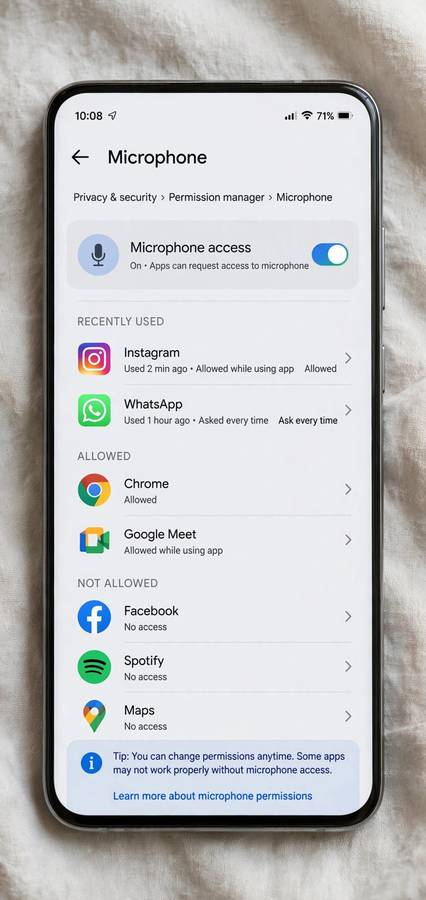
5. Check third-party Skills/Actions permissions. Voice apps can request data beyond the voice command. Audit what you’ve enabled; remove what you don’t use.
6. Consider architecture in your next purchase. If privacy is a priority, the on-device processing story should factor into which assistant you choose. It’s the most structural decision you make.
The goal isn’t paranoia — it’s agency. Voice assistants are genuinely useful, and the privacy risks are manageable with modest effort. The people at risk aren’t the ones using the technology; they’re the ones using it without knowing how it works — and without the protections that evolving AI policy is slowly putting in place. Now you know.
Frequently Asked Questions
They’re always monitoring for the wake word using a local detector with a constantly overwritten audio buffer — but they’re not recording or transmitting until the wake word is detected (or falsely triggered). The light ring or screen indicator shows when the device transitions from monitoring to active capture.
They can. All major vendors have used human reviewers to improve their models, though all now offer opt-outs after the 2019 backlash. Reviewers hear anonymized snippets, but anonymization has been imperfect. Opting out of human review in your privacy settings is recommended.
Yes. Both Amazon and Google let you review, listen to, and delete recordings through their apps and websites, and both offer auto-delete settings (as short as 3 months). Enabling auto-delete is the single highest-leverage privacy step for cloud-based assistants.
Architecturally, yes for core functions. Siri processes wake-word detection, speech recognition, and personalization on-device, so voice audio typically never leaves your phone. Alexa processes in the cloud, creating exposure across transmission, storage, and review. Architecture determines privacy more than policy promises.
Yes, with legal process. Law enforcement has sought and obtained voice assistant recordings as evidence in criminal investigations. Cloud-stored recordings can be subpoenaed; this is one argument for minimizing retention through auto-delete settings and preferring on-device architectures.